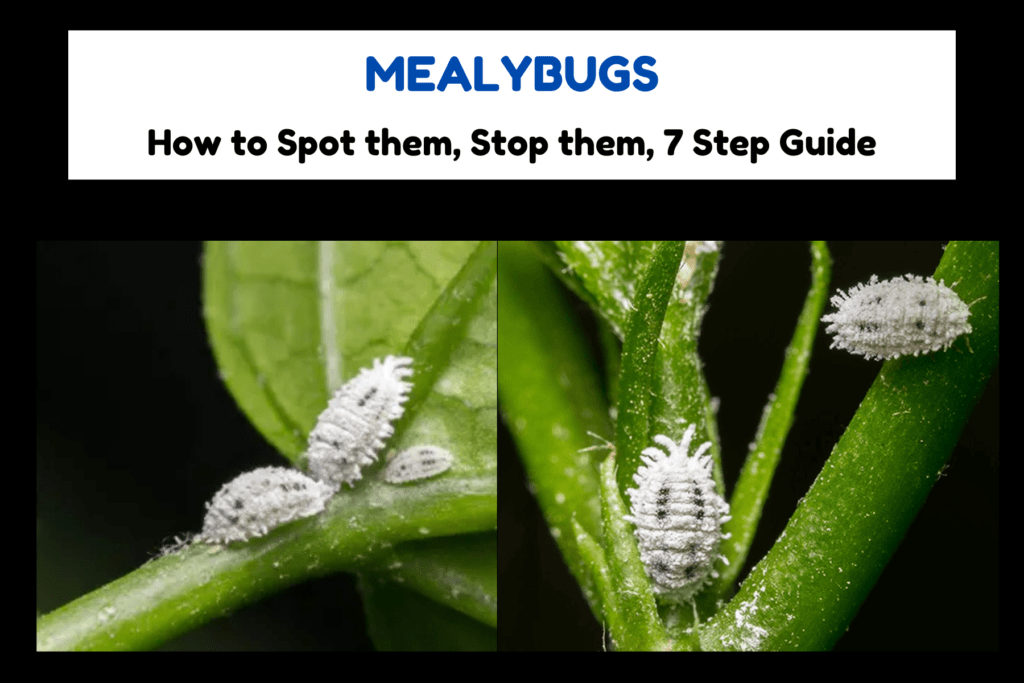
Imagine this: you are watering your favorite plant, and you suddenly see some white, dusty fluff hiding in a corner of a leaf. You look closer and find tiny oval insects covered in white wax. It’s as if someone tear little bits of cotton ball and placed it on your plant.
These are mealybugs. They are small, but they mean big trouble. They suck the sap from your plant, create sticky honeydew, produce black sooty mold and even attract ants that defend them.
The good news is — you can manage them with patience and simple steps. You don’t need strong chemicals.
This easy guide will help you understand what mealybugs are, how to identify them, how to treat them step-by-step, how to stop them from coming back, and answers to common questions.
What are Mealybugs ?
Mealybugs are soft-bodied scale insects that feed on plant sap. They belong to a family of insects, called Pseudococcidae. They resemble small oval bodies, white or powdery/cottony in appearance. Some appear very fuzzy, some like a little cotton ball, and others are hidden under bark or in soil near roots.
They feed by putting a thin needle-like mouth into the plant and drinking its sap. They release a sticky liquid called honeydew, which attracts ants and causes black sooty mold on leaves.
Why mealybugs are a problem:
- They weaken plants (yellow leaves, slow growth, dropping leaves).
- Honeydew makes leaves sticky and dirty.
- They are excellent at hiding, so you don’t notice them until late.
- They multiply quickly in warm locations such as sunny windows, patios and greenhouses.
Garden Pests: Spot, Prevent & Control Naturally
How to identify Mealybug infestation
Look for these signs:
- White, cotton-like or waxy patches on stems, leaf joints, under leaves, or even fruits.
- Very small, soft ovals when you get close.
- Leaves become sticky, or leaves are covered with a shiny coating (honeydew).
- Black sooty mold growing on sticky honeydew.
- Ants crawling on the plant (they protect mealybugs because they love honeydew).
Some mealybugs hide in soil around the roots. If your plant looks weak for no reason, take out the rootball and check the soil.
A simple step-by-step plan to treat mealybugs (houseplants & garden plants)
Dealing with mealybugs takes time. Don’t expect them to disappear overnight. But if you follow these steps regularly, you will win.
Step 1 — Isolate and inspect
As soon as you see mealybugs, move the plant away from other plants. Look at nearby plants because mealybugs spread easily.
Step 2 — Remove as many as you can by hand
For small infestations:
- Dip a cotton swab in 70% rubbing alcohol and touch each bug. Alcohol melts their wax and kills them.
Test first on a small leaf for sensitive plants. - On stronger plants, use a firm spray of water in the shower or outside to wash them off.
- Tweezers or a soft toothbrush can help remove bugs from tight spots.
Step 3 — Use insecticidal soap or diluted alcohol spray
For bigger infestations:
- Insecticidal soap: Use store-bought or mix mild dish soap with water (about 1 teaspoon per gallon). Spray the whole plant, especially under leaves. Repeat every 7–10 days.
- Diluted alcohol spray: Mix 10–25% rubbing alcohol with water. Test first on a small leaf.
Step 4 — Use horticultural oil or neem oil
These oils smother eggs and young mealybugs. Spray in the cooler part of the day. Keep repeating every 7–14 days while you still see bugs.
Step 5 — Biological control (for outdoors or greenhouses)
You can use helpful insects like lacewings, tiny parasitic wasps, or the mealybug destroyer beetle (Cryptolaemus montrouzieri).
They work slowly but give long-term control.
Step 6 — Use traps to monitor (optional)
Sticky traps or pheromone traps catch winged male mealybugs and help you check if the infestation is growing.
Step 7 — Last option: systemic insecticides
If nothing works and the plant is very damaged, you may use systemic insecticides (soil drench or sprays).
Only use as a last option because they can harm helpful insects and are not good for indoor use.
Always follow label instructions.
How often should you treat?
- Light infestation: Hand pick bugs + one spray with soap. And then again and again, watch weekly for 3–4 weeks.
- Medium infestation: Weekly soaping or spraying with neem oil 4 to 8 weeks.
- Heavy infestation: Use hand removal with soap/neem sprays every 7 days and perhaps some biological assistance.
Mealybugs lay eggs and new crawlers keep hatching, so repeated treatment is very important.
Prevention: simple habits that make a big difference
- Isolate new plants for 2–3 weeks.
- Don’t overdo the nitrogen fertilizer — it produces soft new growth that appeal to mealybugs.
- Don’t overwater; increase air circulation around plants.
- Scrub and clean the pots, tools and stakes that you plan to use.
- Manage ants — without ants around mealybugs are easier to control.
Special care for roots, succulents, and tricky plants
Succulents and plants with many crevices often hide mealybugs.
Root mealybugs live in soil.
If you think mealybugs are in the roots:
- Gently remove the plant from its pot and check the roots.
- If you find white cotton around roots, wash the roots, repot in fresh soil, and clean the pot.
Be patient — slow and steady wins
Mealybugs are stubborn, but you can defeat them. It usually takes a few weeks of repeated care.
Stay calm, follow the steps, and you will see your plant getting healthier again.
Frequently Asked Questions (FAQ)
Q: Will mealybugs kill my plant?
A: If you ignore them, yes, they can kill weak plants. But most plants recover well with treatment.
Q: Is rubbing alcohol safe for all plants?
A: No, always test on a small area. Some plants, such as succulents, can get burned.
Q: Can I use neem oil on edible plants?
A: Neem oil is generally safe to use. But ensure to always read the directions and wash food before eating.
Q: How do ants affect mealybugs?
A: Ants protect mealybugs because they want honeydew. Mealybugs are easier to eradicate if you can control ants.
Q: How long until I see results?
A: You should start to notice in a week or two, but true control requires several weeks for the hatched (newly-crawling) insects.
Q: Can I release ladybugs indoors to eat mealybugs?
A: Not a good idea. Indoors, ladybugs fly away. They work better outdoors or in greenhouses.
Q: Should I throw away very infested plants?
A: If you’ve tried multiple treatments and nothing is working, it’s probably best to get rid of the plant for the sake of your other plants.
Final thoughts — small steps make big changes
Mealybugs are annoying — but they teach you patience. Gardening isn’t about perfection — it’s a series of small, repetitive tasks.
If you isolate, remove, treat, and repeat, your plants will will bounce back nicely.