
Last Updated on July 7, 2026 by Sam Wood Worker
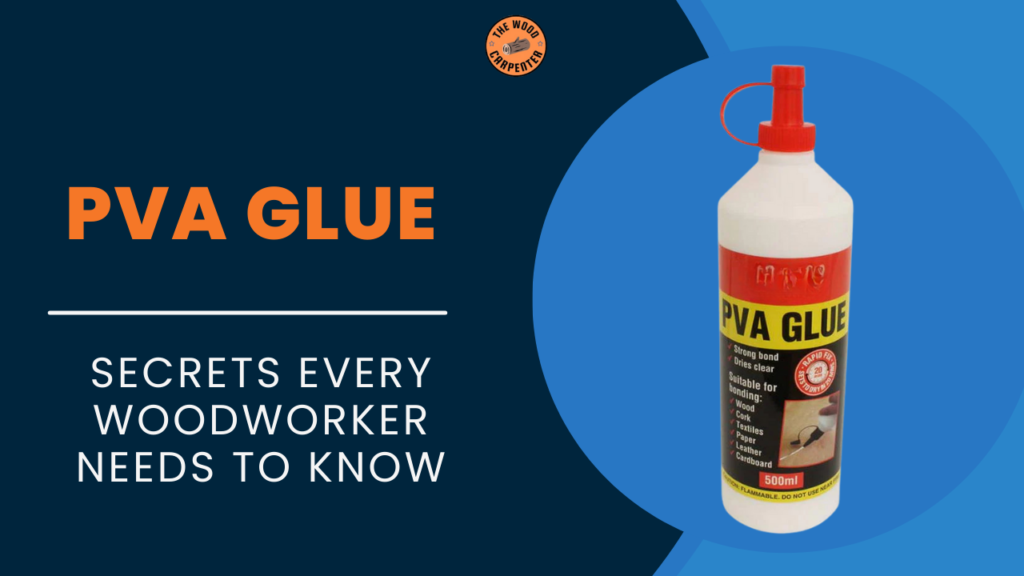
PVA glue is the standard among woodworkers worldwide. It makes incredibly tough joints for furniture, cabinets and crafts but still allows for wood to expand and contract naturally without cracking
PVA stands for polyvinyl acetate. This white, milky glue dries clear, sands smoothly, and cleans up with water. This makes it great for beginners and trusted by professionals working on projects ranging from small craft items to mini-table tops.
What Exactly Is PVA Glue?
PVA glue is made from polyvinyl acetate mixed into water, forming a smooth white liquid. Some versions include fillers like calcium carbonate to help fill tiny gaps. It was introduced in the 1950s and replaced older animal-based glues that were brittle and hard to use.
PVA glue stays workable for about 20–30 minutes, giving enough time to assemble joints. Interior PVA glue can reach about 3,500 PSI shear strength, which is often stronger than the wood itself. Exterior versions include special additives that improve water resistance.
PVA glue holds well even without clamps on flat joints, but clamping improves strength. It has very little movement under load, which is why it works well for chairs and furniture that get daily use.
Is Elmer’s Glue PVA Glue?
Yes. Elmer’s white glue is a classic PVA glue. It is safe for kids, dries clear, and washes off easily. For woodworking, Elmer’s also offers yellow carpenter’s glue, which is stronger and sets faster. Standard Elmer’s white glue is best for paper, crafts, and light projects. It is non-toxic and low odor.
Types of PVA Glue: From Yellow Carpenter’s to Waterproof
Yellow carpenter’s glue is designed for woodworking. It grabs quickly and dries in about 1 hour, with full strength in 24 hours. White glue is weaker and mainly for crafts. Aliphatic resin glue is a stronger yellow version used by professionals.
Waterproof Type III PVA glue works outdoors and passes boiling-water tests. Some hybrid PVA glues expand slightly to fill gaps, but excess foam must be controlled.
| PVA Type | Open Time | Water Resistance | Best For |
| Carpenter’s Yellow | 20–30 min | Interior | Furniture joints |
| White Craft | 10–15 min | Low | Paper, kids’ projects |
| Waterproof (Type III) | 10–20 min | High, boil-proof | Outdoor decks |
| Poly Hybrid | 5–10 min | Expanding foam | Gaps, uneven fits |
What Is PVA Glue Used For?
PVA glue is used for woodworking joints, furniture, cabinets, crafts, paper mache, bookbinding, models, and toys. It bonds shelves, chairs, and trim securely. In schools, it is used for craft projects. When diluted, it can seal walls before painting. Waterproof versions are used for outdoor wood projects.
PVA Glue for Wood
PVA glue works extremely well on wood. Long-grain joints often become stronger than the wood itself. It fills small gaps up to about 1/32 inch and sands smooth. It is ideal for dovetails, miters, edge-glued panels, and chair joints. Light sanding to around 150 grit improves grip.
PVA Glue for Walls
PVA glue can be diluted with water (about 3:1) and used on walls. This seals porous surfaces like plaster or drywall and helps paint stick better. It reduces dust and improves skim coat bonding. It is for indoor use only, as moisture can soften it.
Why PVA Glue Dominates Woodworking Bonds
PVA glue soaks into tiny wood pores and creates a strong plastic-like bond. In strength tests, wood fibers usually break before the glue does. It sands flush without marks, dries clear under stain, and fills small gaps. It has low fumes and is non-toxic when dry.
Compared to epoxy, PVA flexes with wood movement. Super glue sets fast but is brittle. PVA is much cheaper and easier to use, making it ideal for most woodworking tasks.
Disadvantages of PVA Glue
PVA glue is not naturally waterproof. Interior types soften with water. It does not fill large gaps well, and end grain can absorb too much glue, weakening the joint. Freezing can damage the glue, and cold temperatures slow curing.
White PVA may yellow over time. It is less flexible than some polyurethane glues under heavy stress.
Surface Prep: Make PVA Glue Sing
Surfaces should be scraped or sanded to 150–220 grit. Rougher surfaces create stronger bonds. Wood moisture should be around 6–12%. Clamp pressure should be firm but not excessive, around 100–250 PSI.
Dry-fit joints before gluing. Gaps larger than 1/16 inch need fillers. Wipe off wet glue with a damp cloth; dried glue can be scraped off.
Step-by-Step PVA Gluing Technique
Apply a thin, even coat using a brush or bottle. Too little glue weakens joints; too much wastes glue. Assemble parts quickly, tap them into place, and clamp for 30–60 minutes.
Cold weather slows curing, so keep the area warm (around 70°F). High humidity can affect drying.
- Apply a thin coat
- Clamp square and firm
- Clean squeeze-out immediately
Strength Tests and Joint Design Tips
Butt joints reach about 1,000 PSI. Rabbets double that strength. Mortise-and-tenon joints often fail in the wood, not the glue. End-grain joints need reinforcement. Long-grain joints shrink very little.
PVA fills gaps up to 1/32 inch. Mixing in wood dust thickens it. For vibration, add dowels or pegs.
PVA Glue for Furniture: Chairs, Tables, Cabinets
Chairs benefit from waterproof PVA glue to handle movement. Tabletop panels glue edge-to-edge smoothly. Cabinets and face frames bond cleanly. Drawer joints sand flush and slide smoothly.
PVA in Crafts and Model Building
PVA glue is ideal for toys, puzzles, and models. It works well with balsa wood and dries clear. Paper crafts benefit from white PVA because it does not wrinkle easily.
Outdoor and Exterior PVA Applications
Only waterproof PVA (Type III) should be used outdoors. It works for decks, fence rails, and exterior trim when combined with fasteners. Seal wood ends before gluing to prevent moisture issues.
PVA Glue vs. Other Adhesives: Epoxy, CA, Polyurethane
PVA sands and stains easily. Epoxy is very strong but harder to sand. CA glue sets instantly but is brittle. Polyurethane fills gaps but expands and can be messy. PVA handles about 80% of woodworking needs well.
| Adhesive | Clamp Time | Sandable? | Water Resistance |
| PVA Yellow | 30–60 min | Yes | Interior |
| Epoxy | 4–24 hrs | Gummy | Excellent |
| CA Glue | Seconds | Yes | Poor |
| Polyurethane | 1–2 hrs | No | Excellent |
Cleanup, Storage, and Shelf Life Hacks
Clean wet glue with water. Dried glue sands off. Store bottles tightly sealed and protect from freezing. Shelf life is usually 1–2 years. If skin forms, remove it and stir.
Vinegar can soften dried white PVA glue.
Common PVA Mistakes and Fixes
Weak joints usually mean too little glue. Slipping clamps can be fixed with textured pads. Yellowing white glue means upgrading to carpenter’s glue. Frozen glue can sometimes be restored by slow thawing and mixing.
Safety: Handle PVA Like a Pro
Avoid eye contact—wear goggles. Wash skin with soap and water. Dried glue flakes are harmless. Use ventilation with expanding hybrid glues. Non-toxic labels make PVA safe for supervised kids’ projects.
Advanced Tips: Fillers, Accelerators, Thickening
Mix wood dust with PVA to make filler. Borax can speed drying in cold shops. Cornstarch thickens thin glue for vertical surfaces.
FAQ: PVA Glue Questions Answered
What’s the strongest PVA glue for woodworking?
Yellow carpenter’s or Type II PVA—up to 3,500 PSI.
Does PVA glue work outdoors?
Only Type III waterproof versions.
How long should PVA joints be clamped?
30–60 minutes, full cure in 24 hours.
PVA vs. epoxy—which is better for gaps?
PVA for small gaps, epoxy for large voids.
Can PVA glue be sanded?
Yes, it sands smoothly once dry.
Does freezing ruin PVA glue?
Sometimes. Thaw and mix; discard if separated.
White vs. yellow PVA—which is stronger?
Yellow is stronger and grabs faster.
Are Fevicol or Elmer’s PVA safe for kids?
Yes, both are non-toxic when used properly.