
Last Updated on May 11, 2026 by Sam Wood Worker
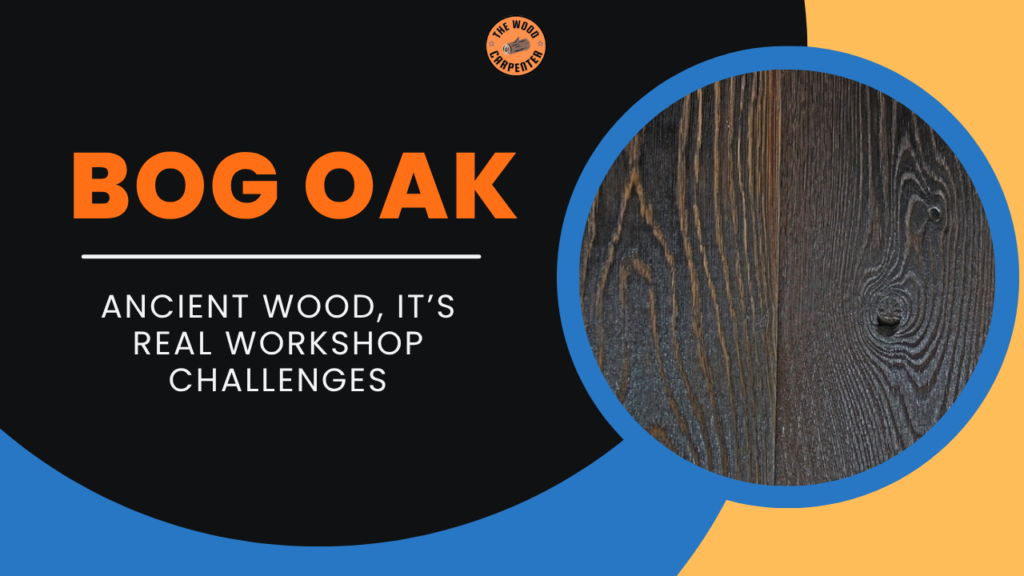
What it is, how it behaves, and what nobody warns you about before your first piece
I remember the first time I held a piece of bog oak. Picked it up expecting something like regular oak — and nearly dropped it. The weight was wrong. The colour was wrong. Everything about it told you this was not ordinary timber.
And that’s the whole point.
Bog oak gets talked about a lot but explained badly. You hear “ancient wood” and “jet black” and think you understand it. You don’t — not until you’ve tried to work with it and hit the problems nobody mentions. This guide covers all of it: what it is, how it behaves, what to watch out for, and whether it’s actually worth the price.
What Is Bog Oak, Exactly?
Bog oak is oak — almost always English or European oak (Quercus robur) — that fell into a peat bog thousands of years ago and never rotted. Instead, something interesting happened: the tannins naturally present in oak reacted with iron-rich water in the bog, slowly turning the wood black right through its full thickness.
It is not stained. Not dyed. Not treated. The colour is a genuine chemical change that goes all the way through. You could plane off half the thickness and it would still be black underneath.
The peat bog acts as a preservative — anaerobic, acidic, and waterlogged. Nothing decays in those conditions properly. So the wood sits, under pressure, for a very long time. Most commercially sold bog oak is 2,000 to 8,000 years old. Some pieces date older. The tree was alive and growing when people were building their first permanent settlements.
The colour ranges from dark charcoal grey to near-pure black, sometimes with a slight olive or brown cast depending on the mineral content of the specific bog. No two pieces look the same — and that variability is part of what makes it so compelling to work with.
Where Does It Come From?
Ireland, the UK, and Eastern Europe — especially Poland, Ukraine, and Russia. Anywhere that has extensive peat bog systems with the remains of old temperate forests buried beneath them.
In Ireland and Britain, pieces turn up when farmers drain waterlogged fields or during peat extraction. Irish bog oak has a long history — craftspeople there have worked with it for centuries. That said, Irish and British material tends to come in smaller dimensions and is rarer on the open market now.
The bulk of what you’ll find for sale comes from Eastern Europe. River dredging operations in Ukraine and Russia regularly pull up massive old logs — dimensions that haven’t come out of any commercial forest in living memory, because these were old-growth trees that predated any managed forestry. The sheer size of some Eastern European bog oak logs is genuinely startling.
Origin matters when you’re buying. Eastern European material tends to be larger and more consistently available. Irish and British material is rarer and often commands a premium — partly for provenance, partly because the dimensions suit smaller work like turning and knife handles better.
Why It Looks the Way It Does
The black colour surprises everyone the first time. You expect a stain or surface treatment. It is neither.
What you’re seeing is the result of oak’s natural tannins reacting with iron minerals dissolved in the bog water — a process that took place slowly over centuries. The iron tannate compound that forms is essentially the same chemistry behind iron gall ink, the black ink used in manuscripts for hundreds of years. The bog, over time, makes its own ink out of the wood.
Because bog oak grew as old-growth timber — sometimes over several hundred years before it died — the grain is typically fine, tight, and even. When you plane the surface and look at it in good light, you can usually see the medullary rays clearly — those subtle, silvery flecks that run across the grain of oak. On regular oak you see them. On bog oak, against that dark background, they catch the light differently. It’s beautiful in a way that photographs genuinely do not capture properly.
The surface density, once planed and finished, feels almost like polished stone. There is nothing soft about it.
Working With Bog Oak — The Honest Version
This is where most guides gloss over the parts that will actually trip you up. Let me cover them properly.
It Is Heavy. Genuinely Heavy.
Pick up a slab and you’ll feel it immediately. The mineralisation over millennia has pushed the density well beyond what fresh oak feels like. It is closer to a dense tropical hardwood in weight. This matters when you’re moving large pieces around the shop, and it matters when you’re planning joinery — this stuff puts real stress on connections.
Your Tools Will Blunt Faster
The density that makes bog oak beautiful is hard on edges. Chisels, plane blades, router bits — they all lose their edge noticeably faster than on regular timber. The answer is simple but non-negotiable: keep everything sharper than you normally would. A dull blade on bog oak does not glide — it tears. And a torn surface on this material is very hard to recover cleanly.
Take lighter passes. Whether you’re planing, routing, or running it through a thicknesser, reduce your depth of cut. There is no shortcut here.
Moisture: The Thing That Catches Everyone Out
This is the biggest issue and the one that causes expensive mistakes.
Freshly extracted bog oak is saturated. The moisture content can be extreme — far above anything you’d encounter with kiln-dried commercial timber. And because the wood is so dense, it releases that moisture slowly and unevenly. If it dries too fast, the outside tightens while the inside is still wet, and it splits. Sometimes straight through a slab.
Even material sold as “dried” can be problematic if the supplier rushed the process. Correct drying for bog oak is slow — ideally years of air drying, with the ends sealed immediately after cutting. Kiln drying, if used at all, should only come after a long air-dry period and at low temperatures.
Watch out for this: Some suppliers sell bog oak that looks stable on the outside but is still wet in the middle. You won’t know until you’ve worked it — and then it moves on you after the piece is finished. Always use a moisture meter before you start. Check multiple spots, including the centre where possible. You want 8–10% moisture content before you touch it with tools.
Machining and Hand Tool Work
Once the moisture is right, bog oak machines well. A well-tuned hand plane with a sharp blade gives you a surface that is almost glassy. Sawing and routing work fine as long as you’re not pushing too hard or too fast.
One practical thing: the dust stains everything. The fine black particles get into your clothes, your hair, your bench, your other wood. Good dust extraction and a proper respirator are both worth it.
Splitting and Checking
Even well-dried bog oak can develop small surface cracks if workshop humidity changes significantly. If you bring material in from cold storage into a warm, dry shop, give it time to acclimatise before you start working it. Don’t rush it onto the bench.
How to Finish Bog Oak Properly
The good news: bog oak takes finishing beautifully. The less good news: you need to test on offcuts first, because the colour can shift in ways you don’t expect when certain finishes hit that very dark, mineralised surface.
Oil finishes are the most popular choice for good reason. Danish oil, hardwax oil, or tung oil all bring out the depth of the grain without deadening the blackness. The surface seems to absorb the oil and deepen in a way that regular oak simply doesn’t do. One coat, left to soak in and then wiped back, can make a piece look extraordinary.
Water-based finishes need care. They raise the grain on dark timbers, and the raised grain on bog oak shows up very obviously. If you’re going water-based, apply one thin coat, let it dry fully, then sand back to 400 grit before subsequent coats. A dewaxed shellac as a first sealer coat before any water-based product helps considerably.
For furniture needing real durability, a catalysed lacquer or hardwax oil with a topcoat gives you depth plus surface protection. French polish on bog oak is extraordinary if you can do it — but be realistic about what it takes to do it properly.
Before you commit to a finish: Always test on a scrap piece first. Oils can go slightly greenish on some pieces. Others come up more brown than black. The raw wood does not always predict the finished colour accurately.
What People Actually Use Bog Oak For
Given the cost, it tends to appear where the wood itself is the whole point.
Furniture is the most obvious application. A bog oak dining table is one of those pieces that stops people mid-conversation. The scale, the depth of colour, and the story behind the material make it a genuine centrepiece. It works particularly well combined with lighter materials — pale stone, brass, white oak — where the contrast does most of the work.
Flooring is a growing market, particularly in high-end residential interiors and hotels. Bog oak flooring is dense, durable, and impossible to convincingly fake with any artificial product. It costs a lot to lay, but there is nothing else like it underfoot.
Turning is one of the best entry points if you want to experience the material without a huge financial commitment. A turning blank for a bowl or vessel costs far less than a large slab, and the density gives you a beautiful surface straight off the tool. Turned pieces in bog oak sell well at craft fairs and galleries.
Knife handles are hugely popular, especially in the custom knife-making world. Bog oak alongside a polished high-carbon blade is a combination that sells itself. The density makes it excellent for handles functionally as well as visually.
Musical instrument components — fingerboards, bridges, small fittings — have embraced bog oak as a practical substitute for ebony, which faces serious supply and legal problems. Several respected luthiers now use it as their first choice. It performs well and looks better than most alternatives.
Jewellery and small decorative work is the most accessible starting point cost-wise. A pendant, an inlay in a ring, a small box lid — even a very small amount of well-finished bog oak makes a strong impression. It carries its story in compact form.
Bog Oak vs. Ebony and Other Dark Woods
This comparison comes up constantly, so here it is straight.
African Ebony is harder, heavier, and has a more uniform colour than bog oak. It is also under serious sustainability pressure — many ebony species are CITES-listed and increasingly difficult to source legally. Bog oak sidesteps this entirely. It is a reclaimed material; no trees are cut to produce it.
Wenge has a much more open, coarse grain and a brown-black striping rather than solid black. It is dramatic in its own way but completely different in character. Wenge also has a reputation for splintering badly and is harder on cutting edges than its hardness rating suggests.
African Blackwood is fine-grained and very dense, but lighter in colour and doesn’t carry the same visual weight as bog oak.
Ebonised oak — regular oak treated with iron vinegar solution or dye to turn it black — is the common affordable alternative. It looks similar at a glance but the black is surface-only. Cut into it and you have pale oak underneath. Bog oak is black all the way through, always.
Bog oak’s combination of fine grain, genuine through-colour, historical provenance, and (relative to ebony) availability makes it unique. Nothing else does exactly what it does.
Price and Where to Buy
Bog oak is not cheap. Large, well-dried slabs for a dining table top can be very expensive. The price reflects genuine rarity, the cost and time of slow extraction and drying, and strong demand from the luxury end of the furniture and interiors market.
For smaller work — turning blanks, handle sets, small slabs for box lids or inlay — the price is much more manageable. If you want to learn how the material behaves before spending serious money, start there.
For sourcing, specialist timber merchants in the UK and Ireland usually carry some stock, though availability varies and stock turns over. Eastern European suppliers who sell online are often the best route for larger pieces or specific dimensions — many will ship internationally.
For a slab destined for a major piece of furniture, deal directly with a supplier who can photograph specific pieces. With a material this variable and this expensive, buying blind from a generic description is a real gamble.
Practical buying advice: Ask for photos of the actual piece, not stock images. Ask for the moisture reading. Ask how it was dried and over what period. A supplier who can’t answer those last two questions clearly has probably not done the drying properly — and that means problems for you later.
Common Questions About Bog Oak
What is bog oak and why is it black? Bog oak is ancient oak preserved in peat bogs for thousands of years. The black colour comes from the oak’s natural tannins reacting with iron minerals in the bog water — a chemical process that works through the full thickness of the wood. It is not stained, dyed, or treated in any way.
How old is bog oak? Most commercially sold bog oak has been radiocarbon dated to between 2,000 and 8,000 years old. Some pieces date older. Age varies by bog and region. Some suppliers of premium pieces provide age certificates.
Why is bog oak so expensive? It cannot be grown or farmed. It has to be found during peat extraction or land drainage, then very slowly dried to prevent cracking — a process that takes months to years done correctly. Rarity plus slow processing plus strong demand equals high price.
Is bog oak sustainable? Yes — genuinely. No trees are felled. The wood is already in the ground, recovered as a by-product of land drainage and peat operations that happen anyway. Compared to newly felled tropical hardwoods, bog oak is about as responsible a choice as luxury timber gets.
Will bog oak fade over time? The colour runs through the full thickness — it will not fade the way a surface stain does. Prolonged direct sunlight can cause some gradual surface lightening over many years. A UV-protective finish is sensible for any piece that sees regular sun.
How hard is bog oak compared to regular oak? Noticeably harder and heavier. Mineralisation over thousands of years significantly increases density beyond fresh-cut oak. It behaves more like a dense tropical hardwood in the workshop — it blunts tools faster and needs sharper, lighter cuts.
Can bog oak be steam-bent? No. The mineralisation makes it brittle compared to fresh timber. It does not have the flexibility for steam bending and will likely fracture rather than bend. Design your project around flat, turned, or carved forms.
Does bog oak smell when worked? Yes — freshly cut or planed bog oak has a distinctive earthy, slightly peaty smell. Not unpleasant, but noticeable. Once finished and sealed, it largely disappears. Some people find it very appealing. It smells exactly like what it is.
Can bog oak be used outdoors? Technically it has good durability given its density, but no — it is not a sensible outdoor choice. Too rare, too expensive, and the appearance deserves to be protected. Keep it indoors.
What is the difference between bog oak and ebonised wood? Ebonised wood is regular timber treated chemically or dyed to produce a black surface. Cut into it and the black disappears — pale wood underneath. Bog oak is black throughout its full thickness, naturally, permanently.
The Bottom Line
Bog oak is a demanding material with a short list of real problems — moisture, tool sharpness, and cost. None of those problems are unsolvable. But they need patience and care that cheaper timber does not demand.
What you get in return is a material that cannot be replicated, approximated, or substituted. The colour is real. The density is real. The age is real. When a finished piece is sitting in front of someone and you tell them the wood was a living tree before the pyramids were built — there is always the same reaction. A pause. Then the questions start.
If you haven’t worked it before, start small. A turning blank. A handle set. Get the feel of it under your tools, understand how it responds to your chosen finish, and learn how it behaves in your shop’s conditions. Then, when you’re ready for something larger, you’ll know exactly what you’re working with.
And what you make from it will last as long as what came before it.