

Eastern White Pine trees are some of the most well-known trees in North America. They are easier to spot due to tall, straight trunks, soft green-blue needles, and lovely shape.
These trees are grown in forests, parks and large areas, where they can offer shading, shelter to wild animals and timber. People have been using white pine to build for hundreds of years, and also this tree has a significant historical role to play as well.
Not only do eastern white pines grow fast, but they also live a long time. Under the right conditions, they can grow to be very tall huge trees that tower even above the rest of the forest.
From how to identify them, where they grow, to how to plant and care for them, and why they really matter to nature and history, this guide explains to you all about the eastern white pine tree!
What Is a White Pine?
In reference to a white pine, people are most often referring to the Eastern White Pine, which is scientifically known as Pinus strobus. This tree is the tallest native pine tree in eastern North America and is one of the most important tree species in eastern North America.
Eastern white pine trees grow naturally across a wide area. The most common range is parts of Canada and all through the northeastern and eastern United States, including the Appalachian Mountains. These trees can grow very tall and live for hundreds of years when growing in the wild.
This tree can range from 50 to 80 feet tall when planted in a yard or landscape situation. But eastern white pine trees in natural forests can exceed 120 to 150 feet easily. Some of the oldest specimens have even exceeded over 170 ft tall.
White pines are fairly easy to recognize. Their needles are soft to the touch, and the tree has a graceful, balanced shape. Young trees usually grow in a neat pyramid shape, similar to a Christmas tree.
As the tree gets older, the top spreads out and the branches form open layers, giving the eastern white pine a more natural and airy look.
White pine trees are also culturally important. They are the state tree of Maine and Michigan in the United States and the provincial tree of Ontario in Canada. Which explains why this tree has a spiritual and respectful significance in the area over the centuries.
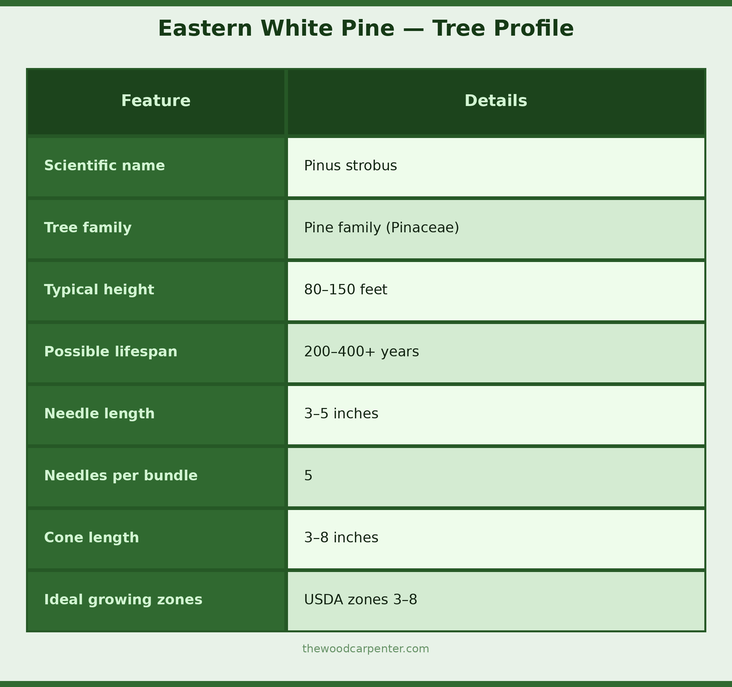
Quick Facts About White Pine
How to Identify an Eastern White Pine Tree
Once you learn a few simple signs, it becomes quite easy to recognize an eastern white pine tree.
The easiest way is to look at the needles. White pine needles grow in small bundles, and each bundle has five needles. A simple trick many people use to remember this is that the word “white” has five letters, just like the five needles in each bundle.
The needles are soft and flexible. They are usually about three to five inches long and have a slightly bluish-green color. Unlike some other pine trees that have stiff or sharp needles, eastern white pine needles feel soft when you touch them.
Another thing to notice is the cones. White pine cones are long and narrow, and they often hang down from the branches. Most cones grow between three and eight inches long. They have thin scales and do not have sharp points.
The bark of the tree also changes as it grows. Young eastern white pine trees have smooth gray or slightly green bark. As the tree gets older, the bark becomes darker and rougher, forming thick plates with deep lines.
If you look at a mature white pine from far away, it has a very unique look. The branches spread out in flat, horizontal layers, and the top of the tree becomes wide and open. Because of this shape, the crown often looks a bit like a natural umbrella.
Where Eastern White Pine Trees Grow
Eastern white pine trees grow naturally across a wide range of eastern North America. Their natural habitat stretches from Newfoundland in Canada all the way south into parts of Georgia, and west into regions like Minnesota.
These trees grow best in cool, humid climates and prefer well-drained soils. Sandy or loamy soil works especially well for them.
However, one of the reasons white pine has survived so long is its adaptability. It can grow in many different environments, including:
- Rocky hillsides
- Sandy soils
- Forest edges
- Old farmland
- Mountain slopes
The trees prefer full sunlight, but young eastern white pines can tolerate partial shade. As they mature, they grow best when they receive plenty of sunlight.
White pine often grows alongside other trees such as oaks, maples, and hemlock in mixed forests.
How Fast Eastern White Pine Trees Grow
White pine trees are considered fast-growing compared to many other forest trees.
Under good conditions, a young eastern white pine can grow one to two feet every year, and sometimes even faster during its most active growth period.
The fastest growth usually happens between about 15 and 45 years of age. During this time, a healthy white pine can quickly reach impressive heights.
The general growth pattern looks something like this:
| Tree Age | Average Height |
| 10 years | 15–25 feet |
| 25 years | 40–60 feet |
| 50 years | 70–100 feet |
| 100+ years | 100–150 feet |
Even after reaching maturity, eastern white pine trees continue growing slowly for many years.
Their long lifespan is another impressive feature. Many white pine trees live 200 to 400 years, and some have survived for over 500 years in protected forests.
Ecological Importance of Eastern White Pine
White pine trees play an important role in forest ecosystems.
Their tall structure and spreading branches provide shelter for wildlife throughout the year. During winter, animals like deer often gather beneath dense eastern white pine branches for protection from wind and snow.
The seeds produced in white pine cones are a food source for many animals, including squirrels, birds, and small mammals.
Many bird species nest in eastern white pine trees, especially in older forests where the trees are tall and widely spaced.
White pine forests also help the environment in other ways. Their roots stabilize soil and reduce erosion, especially on hillsides. The thick layer of fallen needles beneath the eastern white pine supports fungi and small organisms that are part of the forest ecosystem.
Like other trees, white pines also store carbon, helping reduce the amount of carbon dioxide in the atmosphere.
Planting and Growing Eastern White Pine in Your Yard
White pine can be a beautiful landscape tree if planted in the right place. However, because it grows large, it needs plenty of space.
A mature eastern white pine may spread 20 to 40 feet wide, so it should be planted far from houses, power lines, and other structures.
Spring and early fall are usually the best times to plant young white pine trees.
A typical planting process looks like this:
First, choose a sunny location with well-drained soil. Dig a wide hole slightly larger than the tree’s root ball. Place the eastern white pine in the hole so the top of the roots is level with the ground.
After planting, water the tree deeply and add a layer of mulch around the base to help keep moisture in the soil. The mulch should be a few inches thick but should not touch the trunk.
Young white pine trees should be watered regularly during their first year. Once established, eastern white pine trees usually tolerate dry periods fairly well.
Fertilizer is rarely necessary, but if the soil is poor, a balanced slow-release fertilizer can be applied in spring.
Basic White Pine Care Guide
| Care Aspect | Best Practice | Frequency |
| Watering | Deep watering for young trees | Weekly during first year |
| Mulching | 2–4 inches of organic mulch | Renew yearly |
| Pruning | Remove damaged branches | Late winter |
| Fertilizing | Balanced slow-release fertilizer | Every 2–3 years if needed |
Common Problems and Diseases
Similar to other trees, eastern white pine can be affected by pests and diseases.
One of the most common insects is the white pine weevil, which attacks the top leader of young trees. When this happens, the tip of the eastern white pine bends or dies, giving it a curved shape. While this rarely kills the tree, it can affect its form.
Another serious disease is white pine blister rust, a fungal infection that can damage branches and eventually kill the tree. This disease often involves nearby currant or gooseberry plants, which act as alternate hosts.
Other minor problems include scale insects and needle cast diseases that cause eastern white pine needles to turn brown and fall early.
These problems can to some extent be minimised by good spacing, proper air circulation and planting resistant varieties.
Uses of White Pine Trees
Eastern white pine trees have been useful to people for hundreds of years.
People once built ships, houses, and furniture from white pine wood.
The wood is light, has a straight grain, and is easy to cut and shape. Because of this, builders and carpenters liked working with it.
Eastern white pine wood still features in building works, furniture making and various woodworking projects today.
White pine trees are also used occasionally as Christmas trees. Their needles feel soft to the touch and they have a fresh, pleasant smell, making them suitable for the holiday season. But, eastern white pine branches tend to be somewhat flexible, so they may not handle very heavy decorations very well.
In landscaping, white pines are commonly planted for:
- Privacy screens
- Windbreaks
- Shade trees
- Wildlife habitat
Popular Eastern White Pine Varieties
Plant breeders have developed several varieties of eastern white pine for landscaping.
Some varieties stay smaller than the wild species, making them easier to grow in gardens.
Examples include:
- Nana – a dwarf form that grows as a compact shrub
- Pendula – a weeping form with drooping branches
- Fastigiata – a narrow, column-shaped white pine suitable for tight spaces
There are also rust-resistant cultivars developed to better resist blister rust disease.
Interesting Historical Facts
The eastern white pine tree is one of the oldest trees in North America.
In the 1700s, large white pines were extremely valuable for shipbuilding. The British government marked the best trees with a distinctive mark known as the Broad Arrow, setting them aside for the Royal Navy.
Many colonists were angry about losing access to these eastern white pine trees, and disputes over the policy eventually led to protests known as the Pine Tree Riots.
Famous naturalist Henry David Thoreau once described white pine as having a “kingly” presence in the forest.
Some old-growth stands of eastern white pine still exist, primarily in protected areas, in places like the Adirondack Mountains and parts of Canada.
When to Thin or Replace Eastern White Pines
In forests or large plantings, white pine trees sometimes grow too close together. When this happens, thinning the eastern white pines can help the remaining ones grow stronger.
A common spacing rule for mature stands is about 15 feet between trees.
If an eastern white pine becomes severely diseased or damaged, removal may be necessary before planting a replacement tree.
Frequently Asked Questions
How can I easily identify a white pine tree?
Look for bundles of five soft needles that are about three to five inches long. Long slender cones and layered horizontal branches are also strong clues for identifying an eastern white pine.
Are eastern white pine trees deer resistant?
They are fairly resistant although young shoots and buds may be eaten by deer.
Can white pine grow in clay soil?
It will survive non-ideal conditions with improved soil (added organic matter), but the eastern white pine prefers sand or loam soil with good drainage.
How long do eastern white pine trees live?
The majority of these white pine trees live between 200 and 400 years with a few exceptional cases having continued surviving for a longer period.
Final Thoughts
The eastern white pine tree is more than just a mighty giant of the forest. They have been a natural heritage of North America, serving to provide wildlife habitat, building raw material and beauty for many centuries.
Being fast-growing, soft-needled, and wonderfully graceful looking, white pine became one of the most treasured trees in eastern forests and landscapes.
An eastern white pine sown today is nearly a future white pine sown. The tree you plant may outlive you, your children, and grandchildren; with proper care and space provided, it has all the potential to be a landmark for centuries.