
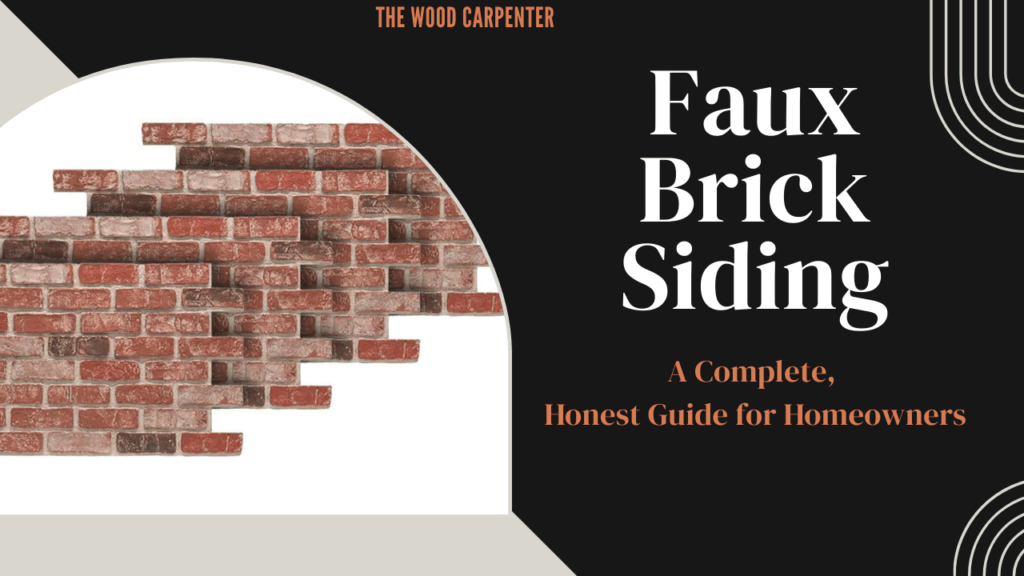
Faux brick siding provides your home with the timeless appearance of a regular brick wall but at a fraction of the cost, and far easier construction.
For many home owners, that product of choice is when they want to transform old plain walls (usually wood or vinyl) into something that looks rich and classic. Good faux brick from the street looks pretty much like the real thing, especially with today’s textures and colors.
Today’s faux brick is not the cheap plastic panels people remember from years ago. Modern products are made using high-density foam, cement blends, stone dust, or fired porcelain.
These products mimic actual brick shapes, course textures and color variations well. Because they’re light and easy to install, many homes can be updated in days, not weeks.
This guide will discuss what faux brick siding actually is, how long it lasts, the average cost of faux brick siding, where it looks best and how its value compares to real brick or other types of home siding.
What Faux Brick Siding Really Means
Faux brick siding is any siding product designed to look like real brick without using full clay bricks and mortar walls.
Some products come as large panels that already show many bricks joined together. Others come as individual thin brick pieces that install like tiles. A few use real brick sliced thin, while most are made from molded materials that copy brick texture and shape.
Unlike real brick, faux brick does not support the house. It is decorative siding only. That makes it lighter, faster to install, and possible on homes that could never handle real brick weight.
Main Faux Brick Materials Explained Simply
Polyurethane (PU) panels are the lightest and most popular. They are made from high-density foam molded from real brick walls. These panels are easy to cut, easy to lift, and install fast. They work well on full house exteriors and interior accent walls.
Cement-based faux brick is heavier and feels more like real masonry. These are often thin bricks installed one by one with adhesive and grout. They look very realistic and handle heat and moisture well.
Stone dust and composite brick mix minerals and binders to create strong, detailed surfaces. Porcelain brick tiles are fired like ceramic tile and work very well in kitchens, fireplaces, and wet areas.
Each material has a different balance of weight, cost, realism, and durability.
Sizes, Shapes, and Visual Style
Most faux brick panels come in 2×4 foot sections that lock together. Individual bricks usually match standard brick size so they look natural.
Textures range from smooth modern brick to rough wire-cut styles and soft tumbled edges that look aged. Colors include classic red, dark brown, whitewashed, gray, black blends, and mixed tones. Better products use layered coloring so bricks do not look flat or fake.
Corner pieces are important. Good systems include molded corners so the brick wraps around edges naturally instead of stopping flat.
Durability and Lifespan
Faux brick is strong, but it does not last as long as real brick.
Most quality faux brick siding lasts between 20 and 50 years depending on material, sun exposure, and weather. Polyurethane handles temperature changes well. Cement and porcelain handle heat and fire better.
Faux brick does not rot, does not attract insects, and does not crack from freeze-thaw the way poor masonry can. However, it can dent from strong impacts and fade slowly over many years if UV protection is weak.
There is no mortar repointing like real brick, which many homeowners see as a big advantage.
Installation: What Makes Faux Brick Popular
One reason faux brick is so popular is how fast it installs.
Most systems attach using construction adhesive, screws, or thinset mortar. Homes can often be finished in a few days instead of weeks. Many DIY homeowners can handle small projects like fireplaces or accent walls.
Faux brick can be installed over flat vinyl, wood, concrete, or sheathing as long as the surface is clean and solid. Moisture barriers and proper sealing are still important.
Because it is lightweight, there is no need for foundation changes or brick ledges.
2026 Faux Brick Cost Breakdown
Faux brick costs much less than real brick but more than basic vinyl.
Material prices usually range from $4 to $11 per square foot. Installed costs are typically $6 to $15 per square foot.
Full house projects usually fall between $12,000 and $30,000, depending on size and product. Accent walls or front-only installs cost much less.
Compared to real brick, faux brick often saves 50–70% upfront.
Faux Brick vs Other Siding Options
| Feature | Faux Brick | Real Brick | Vinyl | Fiber Cement |
| Installed Cost (sq ft) | $6–15 | $8–27 | $3.5–13 | $10–18 |
| Weight (lbs/sq ft) | 2–15 | 30–40 | 1–2 | 3–4 |
| Lifespan (Years) | 20–50 | 70–500 | 20–40 | 50+ |
| Maintenance | Wash & seal | Repoint mortar | Wash | Repaint |
| Fire Resistance | Good (A/B) | Excellent (A) | Moderate (B) | Excellent (A) |
| DIY Friendly | High | Very low | High | Medium |
Faux brick wins on speed, weight, and price. Real brick wins on lifespan and long-term value.
Maintenance Made Easy
Faux brick needs simple care.
A gentle hose wash once a year removes dust and pollen. Mild soap helps with grease or dirt. Avoid strong pressure washers.
Seams and joints should be checked every year or two. Reseal when needed. Cement-based faux brick may need grout sealing every few years.
There is no painting, staining, or heavy repair cycle like wood or real masonry.
Common Problems and Easy Fixes
Most faux brick issues come from poor installation.
If panels peel or gaps appear, the wall surface may not have been cleaned properly. Uneven walls cause visible seams. Cheap products fade faster in strong sun.
Using quality materials, correct adhesive, and proper sealing prevents most problems. Thicker panels handle impacts better than thin sheets.
Environmental Benefits
Faux brick uses less raw material and energy than full clay brick. Lightweight shipping reduces fuel use. Many products include recycled content.
Insulated backing improves wall efficiency and helps reduce heating and cooling costs. Long lifespan means less waste compared to frequent siding replacement.
Is Faux Brick Worth It?
Faux brick is an attractive option for a homeowner who wants the appearance of brick at a reasonable cost, without having to pay big bucks for the real thing.
It works best for renovations, budget-friendly upgrades, accent walls, fireplaces, and homes that cannot support real masonry.
But it doesn’t last as long as actual brick lasts—I mean, nothing does—but it provides visual pop with durability for decades.
Select high-quality products, install with care and faux brick can make even the plainest of homes look classic, strong and solidly built.
Frequently Asked Questions
Can faux brick go over existing siding?
Yes, as long as the surface is flat and secure. Loose or damaged siding should be removed first.
Is faux brick safe for fireplaces?
Cement and porcelain types are best. Polyurethane needs heat clearance or shielding.
Does faux brick fade in sunlight?
Quality products resist fading well. Cheap panels fade faster.
Does faux brick increase home value?
Yes, usually 60–80% return through improved curb appeal.
Can people tell it’s not real brick?
From close inspection, yes. From the street, good faux brick often looks real.