
Key Takeaways:
- Spanish cedar (Cedrela odorata) belongs to the mahogany family — the name comes from its cedar-like smell, not its botanical roots
- Natural oils repel insects and regulate humidity — hence why nearly every humidor in the world is lined with it
- Lightweight, stable, beginner-friendly — one of the easiest hardwoods I’ve worked with in three decades
- Colour starts pinkish-brown and deepens into rich reddish-gold with age
- Used in cigar humidors, furniture, classical guitar necks, wardrobes, and boat interiors
- Sourced from Central and South America — always seek plantation-grown, certified material
Spanish cedar is a tropical hardwood from the mahogany family — native to Central and South America — valued for its warm scent, natural insect-repelling oils, excellent stability in humid conditions, and workability that suits both beginners and seasoned craftsmen.
There’s a smell that hits you the moment you step through the door of a good cigar shop. Warm. Slightly spicy. Woody in a way that feels oddly familiar.
Most people think it’s the cigars. It isn’t — not entirely.
That smell comes from the wood lining the walls, the drawers, every humidor in the room. That’s Spanish cedar. Once you know it, you spot it everywhere — guitar necks, old wardrobes, furniture that still smells good fifty years after it was made.
I’ve been working with it for over many years. It never gets old.
What Spanish Cedar Actually Is
Despite the name, Spanish cedar is not a cedar. Not botanically, not structurally, not in how it behaves in the shop.
It belongs to the mahogany family — Cedrela odorata — a tropical hardwood native to Mexico, Brazil, Peru, and across the Caribbean. Spanish explorers named it for the smell and reddish colour. The name stuck even though the classification was wrong.
The trees grow tall and straight, often past 30 metres. That gives you long, clean boards with straight grain — exactly what woodworkers want.
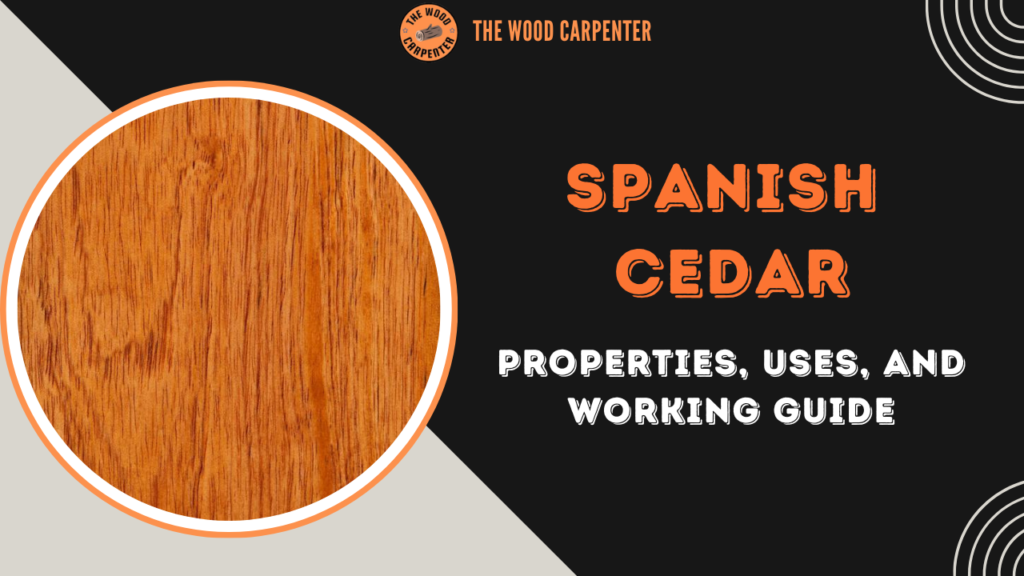
Fresh-cut Spanish cedar is light pinkish-brown. Leave it exposed to light and air and it deepens into a rich reddish-gold. Aged pieces look genuinely valuable, because they are.
Why It Works So Well
Spanish cedar hits a combination of properties most woods simply don’t manage at once.
It’s lightweight for a hardwood — noticeably lighter than mahogany or oak — so large projects stay manageable without losing strength. The straight grain makes cutting, planing, and sanding predictable. It doesn’t fight you the way denser hardwoods can.
The stability is exceptional. In humid climates where temperature and moisture fluctuate constantly, Spanish cedar holds its shape. It doesn’t warp or twist. That’s not luck — it’s exactly why we use it in conditions that would wreck lesser woods.
And then there are the natural oils.
Those oils do two things nothing else replicates. They give the wood its distinctive scent — warm, slightly sweet, slightly spicy. And they make it naturally resistant to insects including moths and termites, with zero chemical treatment required.
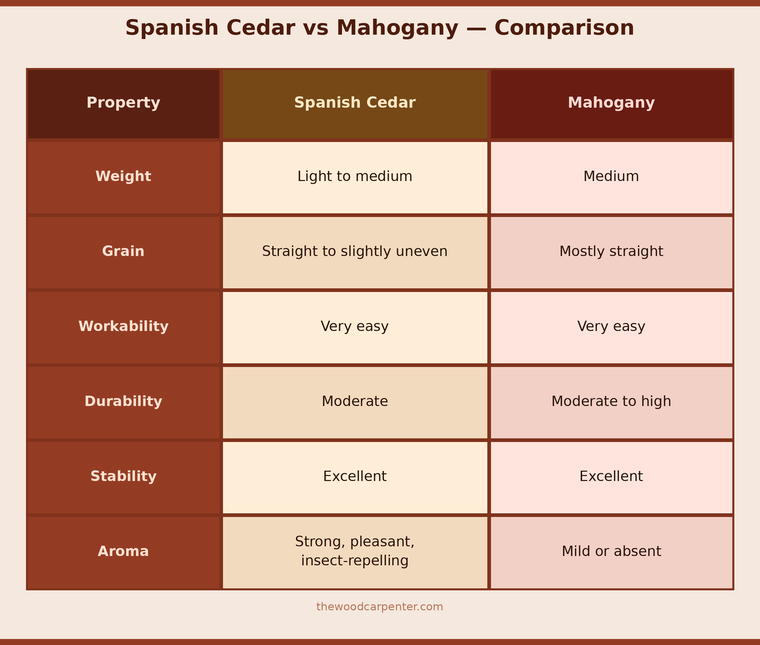
Property Comparison of Spanish Cedar vs Mahogany
The Scent — Why It Matters More Than You’d Think
The smell isn’t just pleasant. It’s functional.
The same compounds that create that warm woody scent also repel insects. This is why Spanish cedar has been the default wood for wardrobes, drawers, and blanket chests for generations. It does the work of mothballs without the chemical smell.
In the cigar world, it goes further. Spanish cedar regulates humidity inside a humidor and likely contributes to how cigars age. Cigar makers worldwide treat Spanish cedar lining.
Where Spanish Cedar Gets Used
Humidors — Lines the interior of almost every quality humidor. Maintains humidity, repels insects, enhances aging. The scent you get when you open a humidor? That’s this wood.
Furniture — Cabinets, tables, display pieces, decorative panels. The rich colour and natural insect resistance make it especially good for bedroom furniture.
Classical guitar necks — Luthiers have used it for decades. Low weight, good stiffness, easy to carve precisely. Balance and resonance both benefit.
Wardrobes and storage — The natural oils protect wool, silk, and natural fibres from moths without chemicals. Centuries of proven performance.
Boat interiors — Stable in variable humidity and resistant to moisture. Not an exterior wood without treatment, but excellent for interior marine joinery.
Working With Spanish Cedar
If you’ve wrestled with difficult hardwoods, Spanish cedar will feel like a relief.
It cuts cleanly with hand tools or power tools. Straight grain means fewer surprises when planing or routing. Sanding is quick and the surface becomes smooth with little effort. Joints hold well, glue bonds reliably, fasteners go in without splitting.
Oil finishes work beautifully — they penetrate rather than sit on top, deepening the reddish tones without masking the grain. For humidor interiors specifically, skip any sealing finish. The wood needs to breathe to do its job.
One important note: the dust irritates skin and airways during machining. Wear a dust mask and work with ventilation. Not optional — just sensible.
Spanish Cedar vs True Cedar
Worth being clear on this.
True cedars — western red cedar, eastern red cedar, cedar of Lebanon — are softwoods. Coniferous trees with completely different properties and structural behaviour.
Spanish cedar is a hardwood, closer to mahogany than to any cedar. The shared name causes real confusion. When a woodworker specifies Spanish cedar, they mean Cedrela odorata. Substituting a true cedar produces a different result entirely.
Sustainability — What to Know Before You Buy
Spanish cedar faced serious pressure from overharvesting. High demand and slow natural growth created real problems in several regions, and some populations remain regulated.
The situation has improved. Plantation-grown Spanish cedar is now widely available and makes up a meaningful share of commercial supply. For most woodworking applications, the quality is comparable to old-growth.
Look for FSC certification or verified chain of custody when sourcing. Plantation-grown from certified suppliers is the right call — cleaner sourcing, more consistent supply.
Frequently Asked Questions
Is Spanish cedar a real cedar? No. It belongs to the mahogany family and gets its name from the cedar-like scent early explorers noticed. It’s a hardwood, structurally far closer to mahogany than to any true cedar.
Why is Spanish cedar used in humidors? Its oils regulate humidity, its scent is compatible with tobacco aging, and it repels insects. No other widely available wood combines all three.
Does Spanish cedar repel insects? Yes — naturally, without chemical treatment. The oils deter moths and other insects, which is why it’s used in wardrobes and storage as well as humidors.
Is Spanish cedar safe indoors? Yes. The dust during machining warrants a mask, but the finished wood in everyday use is completely safe.
Is it sustainable? It can be. Plantation-grown material with FSC certification is the responsible choice. Avoid unverified sources.
How does it compare to mahogany? Very similar in workability and look. Spanish cedar is lighter with stronger scent and natural insect resistance. Mahogany is denser and more durable for high-wear use. For storage and humidity-sensitive applications, Spanish cedar wins.
What finish works best? Oil finishes for furniture — they bring out the natural reddish tones beautifully. For humidor interiors, use no sealing finish at all. The wood needs to breathe.
The Bottom Line
Spanish cedar doesn’t chase attention. It doesn’t hold records for hardness. It won’t come up in the same breath as walnut or ebony when people talk premium exotics.
What it does is work. Reliably, every time. It smells genuinely wonderful, protects what’s stored inside it without chemicals, and ages into a colour that looks better with every passing year.
I’ve been building with it since the early nineties. I still reach for it without hesitation when a project calls for it.
That kind of track record — centuries of consistent performance — doesn’t happen by accident. It happens because the material earns it.