
When it comes to choosing lumber for a project—whether it be for your garden shed or your beautiful indoor furniture, you can’t beat hardwoods over softwoods. Spruce and pine are two of the most popular options, used interchangeably. That can be confusing.
This guide demystifies the actual differences between spruce and pine, explains where one has an edge over the other (and where it doesn’t) and makes direct product recommendations so you can stop guessing and start building.
Quick summary (if you’re in a hurry)
- Spruce: Lighter color, very straight grain, great strength-to-weight ratio, less resin, good dimensional stability when slow-grown. Ideal for structural framing, acoustic uses (like soundboards), and garden buildings when you want neat, uniform appearance.
- Pine: Warmer tones, more visible knots and resin, widely available and often cheaper. Very workable—excellent for rustic furniture, cabinetry, and many interior uses. For outdoor work you’ll want it treated.
What these woods actually are
Both spruce and pine are softwoods, meaning they come from gymnosperm trees (conifers). That doesn’t mean they’re weak—far from it. Many structural timbers are softwood because the grain properties and growth patterns make them reliable and predictable for construction.
However, species differences, growth conditions, and how the lumber was milled make a big difference. A slow-grown spruce from a northern climate behaves differently from fast-grown plantation spruce; similarly, “pine” may refer to several species (Scots pine, white pine, etc.) with different looks and densities.
Appearance & grain — what your finished project will look like
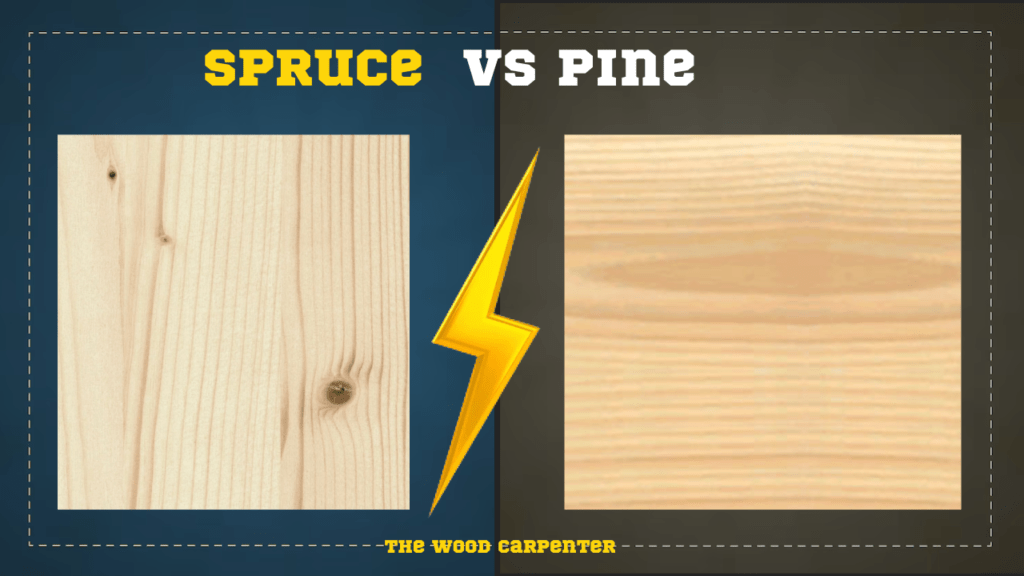
- Pine tends to have warmer, yellow-to-reddish tones and more obvious grain. Knots are common and can be large. That rustic look is desirable for farmhouse furniture, shelving, and decorative panels. If you want character, choose pine.
- Spruce is usually paler (whitewood) with a finer, more uniform grain and fewer large knots—especially when it’s slow-grown. That uniformity helps if you want a clean, modern finish or if you’re staining or painting to a consistent look.
Bottom line: choose pine for character; choose spruce when you want neat, consistent boards.
Strength, weight & structural use
Spruce has a higher strength-to-weight ratio than many pines. That’s why spruce is a go-to for framing, roof trusses, and applications where stiffness and light weight matter. Slow-grown spruce—with tight annual rings—gains density and stability, which translates to better long-term performance.
Pine is still structurally useful, but depending on the species, it can be a touch softer or more flexible. For load-bearing uses, check the specific grade and species; always follow local building codes and engineered lumber specifications.
Moisture, movement & durability
Wood moves—there’s no way around it. But the amount of movement differs:
- Spruce (especially slow-grown spruce) is less porous, so it absorbs moisture more slowly and tends to expand and contract less with humidity swings. That means fewer gaps, less warping, and more predictable behavior in garden buildings and external cladding.
- Pine is generally more porous and resinous, which can make it more susceptible to surface mold (like blue mold) and sap staining in humid or wet conditions.
Important: Neither spruce nor pine is naturally rot-proof. For exterior projects (decks, fences, garden rooms), use pressure-treated timber, apply a quality preservative or oil regularly, and design to shed water. Even the best species will rot if it sits wet.
Resin and finishing
Pine often contains more resin/sap. That has practical implications:
- When milling or planing pine, resin can gum up blades and tools.
- Finishes may show resin bleed-through if the timber isn’t properly sealed or primed.
- On the flip side, resin can give pine a warm, lived-in look.
Spruce is less resinous, so it generally gives a cleaner finish and is easier to get smooth, especially for paint or clear finishes.
Workability: cutting, planing, nailing, gluing
Both are easy to work with hand or power tools, but there are nuances:
- Pine machines well but beware of tearing around large knots. It accepts screws, nails, glue, stain, and paint easily.
- Spruce is typically very consistent to machine: it planes cleanly, sands smoothly, and usually requires less filler for knots. That makes spruce popular in millwork and for components that need precise tolerances.
If you’re making fine cabinetry or instruments, spruce’s stability and straight grain is often favored.
Cost & availability
Pine is an abundant species worldwide and generally cheaper than spruce. Market turbulence matters: supply, milling and regional availability will factor into price. Slow grown spruce that is claimed to be of higher quality and increased stability often has a price premium compared to more generic pine.
Sustainable sourcing
Both species are widely cultivated in plantations and managed forests. If sustainability is a concern, search out third-party certifications such as FSC (Forest Stewardship Council) or PEFC and inquire where lumber comes from (plantation vs old-growth, country of harvest and transport footprint). Slow-grown timber could be obtained from northern forests and might be a greener option, but check good forestry practices.
Best uses (practical suggestions)
- Use Spruce for:
- Framing and roof trusses (where strength-to-weight matters)
- Garden buildings and log cabins when you want neat joints and less seasonal movement
- Musical instruments and soundboards (preferred for acoustic qualities)
- Millwork that requires straight, stable boards
- Use Pine for:
- Rustic furniture, shelving, and decorative panels
- Interior trim and painted cabinetry (if you want character)
- Budget builds where knots and warmth are a feature, not a bug
How to choose for your project — a short checklist
- Is stability critical? → Choose spruce (slow-grown if possible).
- Do you want rustic character? → Choose pine.
- Outdoor use? → Either—only if treated and designed to shed water. Spruce tends to handle movement better; pine may need more maintenance.
- Budget constraint? → Pine often wins on price.
- Need consistent finish or paint? → Spruce usually gives a cleaner result.
Care & maintenance tips
- Keep exterior wood off the ground and allow airflow.
- For outdoor use, apply preservative, stain, or exterior paint and recoat according to the finish manufacturer’s schedule.
- Pre-seal end grains to reduce splitting.
- For resinous pine, clean saw blades and tools often and consider leaving boards to air for a few weeks to let sap stabilize before finishing.
FAQ — Common questions about Spruce vs Pine
Q: Is spruce stronger than pine?
A: Generally, spruce has a better strength-to-weight ratio and greater stiffness for many species—especially slow-grown spruce. But strength varies by species and grade, so always check technical specs for structural applications.
Q: Which lasts longer outside—spruce or pine?
A: Neither is naturally rot-resistant. Slow-grown spruce tends to be more dimensionally stable and less prone to moisture problems, but both must be treated for long outdoor life.
Q: Can I use pine for furniture?
A: A: Absolutely. Pine, on the other hand, is favored for furniture because of its warm color and knots. It’s easy to work, and finishes very well—just don’t forget about the resin and filler in the knots if you want it to be smooth.
Q: What’s “slow-grown spruce” and why does it matter?
A: Slow-grown spruce grows in colder climates and forms tighter annual rings, producing denser, more uniform timber. That density improves stability and reduces warping and shrinkage over time.
Q: Which is better to paint—spruce or pine?
A: Spruce often gives a cleaner base for paint because it’s less knotty and resinous. Pine can be painted beautifully but may require more surface prep and knot-sealing.
Final recommendation
If you’re looking for clean, sound and structurally high-performing wood — go spruce, ideally slow-grown if you can get it. If you want some character and original warmth but also to save pennies? Go pine. And if you’re working outside, treat the wood and include drainage in your design.
Both are easy maintenance woods that have generations of use; the correct choice will depend on your project priorities: looks, stability, cost and maintenance.