
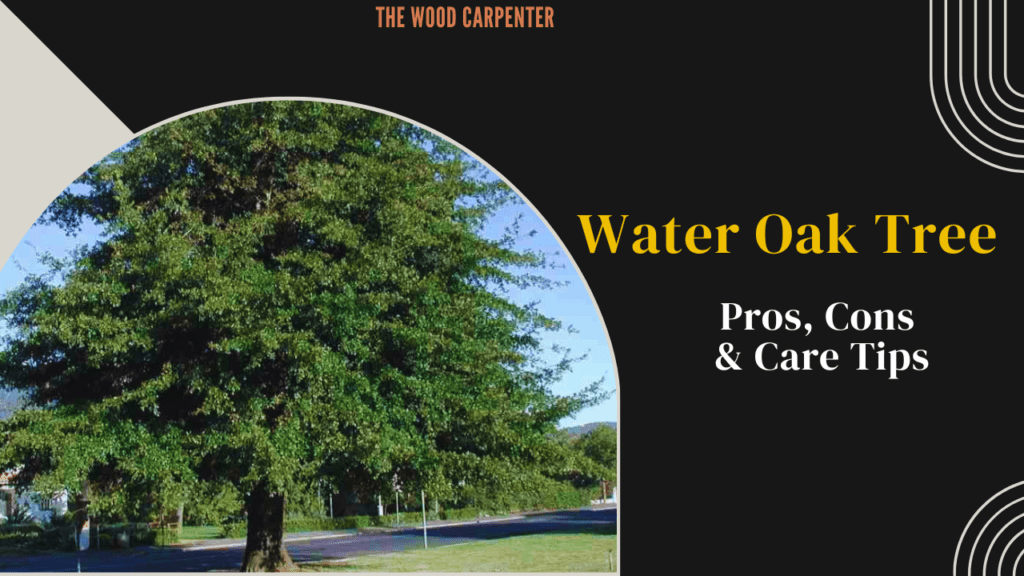
Walk through the neighborhoods of Georgia, Louisiana, or Mississippi, or the Carolinas, for that matter, and you could no doubt encounter a water oak. It blends in. It grows fast. It throws generous shade. It feeds wildlife year after year.
And then, often sooner than people expect, it begins to decline.
Water oak is one of the most common and most debated trees in the southeastern United States. It can be a blessing in the right place and a serious liability in the wrong one. Whether you own land, care to manage it, or considering planting one, knowing what this tree actually does could save you years of regret — or make a wise choice.
What Is a Water Oak ?
Water oak is an oak (Quercus) species within the red oak group. Native in the southeastern and south-central United States from New Jersey down to Florida and west through Texas and parts of Oklahoma and Missouri.
Despite its name, a water oak does not need to grow in standing water. The word “water” comes from where it naturally grows — places like floodplains, along creeks, and in low, wet areas. It can handle wet soil better than most other oak trees. However, once it is established, it can also grow well in normal yard soil and survive short dry periods.
Water oak is a medium to large tree that loses its leaves each year. In warmer southern areas, it may keep its leaves longer, sometimes even into winter, which makes it look almost like an evergreen tree.
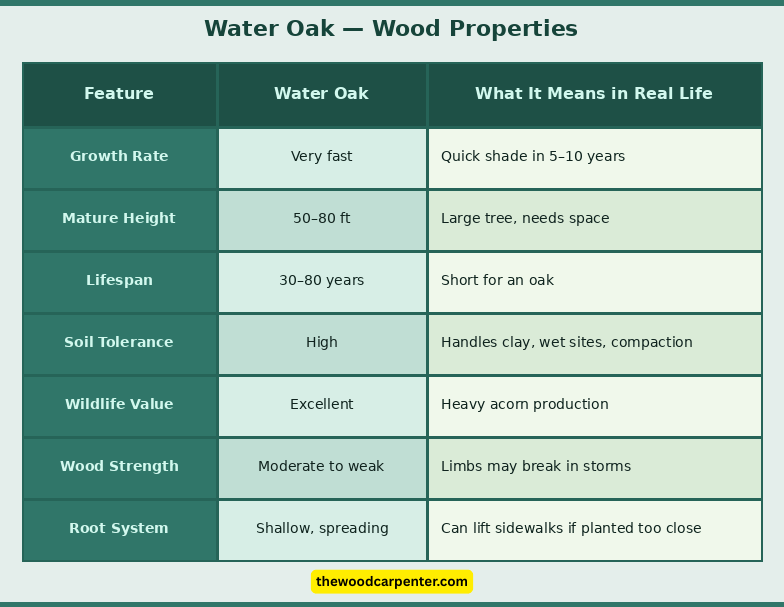
Water oaks typically reaches heights of 50 to 80 feet; they are also broad, often growing about as wide as they are high. The trunk can get 2 to 3 ft. When the tree is young, it often has a cone-like shape. As it matures, the top becomes more rounded or slightly uneven, creating thick, heavy shade underneath.
The lifespan of the water oak can range from 30 to 80 years. That’s a short life when compared with other oaks such as white oak or live oak that can live hundreds of years.
How to Identify a Water Oak
Water oak is famous for one thing: confusing leaves.
The leaves are extremely variable. On the same tree, you may see several different shapes. Some are narrow at the base and wider at the tip, almost like a spatula. Others may have shallow lobes that resemble a duck’s foot. This variation is actually one of the best clues for identification.
Leaves are usually 2 to 6 inches long, bluish-green on top and lighter underneath. In warmer zones, they may hang on through much of winter before finally dropping shortly before new growth appears.
The acorns are small and dark, usually about half an inch long. Like other red oaks, they take two growing seasons to mature. Water oak produces acorns generously and fairly consistently.
Young trees start with smooth, brownish bark. The bark darkens — sometimes nearly black — with age, becoming scaly and having shallow furrows.
But, you can really see how different they are when you compare it to Quercus phellos. Willow oak has long, narrow, willow-like leaves; with no lobes. Whereas water oak leaves are wider and far less consistent.
Quick Property Overview
Where Water Oak Grows Best
Water oak naturally lives alongside stream banks, floodplains, and in wet bottomlands. It grows best in USDA zones 6 through 9 and loves full sunlight.
Honestly it is surprisingly fantastic in the tough conditions of the city. Clay, compacted soil, seasonal flooding and roadsides are nothing to it. It’s one of the reasons it was so popular in suburban neighborhoods during the 1960s through 1980s.
On the other hand, it fails in extended dry spells and does not succeed is cold northern regions with long, severe freezes.
The Growth vs. Lifespan Trade-Off
This is the part many homeowners are never told.
Water oak grows very fast. It has the potential to grow between 1 and 2 feet each year under good conditions. Within 10 to 15 years it can grow into a large tree providing wide, cooling shade. That quick canopy can be very desirable if a new home is built on an empty lot.
However, rapid growth may also lead to softer wood and a shorter life span.
Many water oaks begin declining around 40 to 50 years of age. Dead upper branches, trunk cavities, fungal growth at the base, and structural weakness are common signs. Water oak is relatively short-lived, especially when compared to long-lived oaks such as Quercus alba which can reach ages in the hundreds of years.
So basically, plant a water oak near your home and you should prepare for it to eventually have to be cut down in 20–30 years. Not the kind of tree you plant and expect will be around for generations withoutissues.
Wildlife Value: Where Water Oak Truly Shines
If you want to help wildlife, water oak is a very good tree to have.
Its acorns are small and have thin shells, so many animals can easily eat them. Deer, squirrels, wild turkeys, wood ducks, and many small birds depend on water oak acorns for food. In wet areas and swamps, wood ducks especially benefit from this tree.
On the plus side, water oak consistently produces acorns. It does not yield a bumper harvest one year and nothing the next. This provides animals with reliable food year after year.
So you will often find holes and hollow spots as the tree matures. This can be an issue when the tree is near a house, however in natural areas it is actually beneficial. These cavities are used by owls, woodpeckers and other birds to nest and raise their young.
For people who own rural land and want to support wildlife, water oak is usually seen as a valuable tree to include in a mixed forest.
Common Problems and Health Issues
Water oak’s fast growth often leads to structural weakness.
During storms, ice events, or heavy winds, large limbs can break. Decays in their inner parts occur more frequently as trees get older.
Of these, one of the more serious diseases is oak wilt (Bretziella fagacearum) affecting red oaks, including water oak. Infected trees can decline rapidly.
Avoid pruning during peak growing season in areas where oak wilt is present, as fresh wounds attract insects that spread the disease.
Another frequent problem is hypoxylon canker by Biscogniauxia atropunctata. This disease is common on stressed or older trees. Once visible, decline is usually advanced.
Leaf galls and caterpillar defoliation may look alarming but are often cosmetic in otherwise healthy trees.
Roots are shallow and wide-spreading. When planted too close to sidewalks, driveways, or foundations, they can cause lifting or cracking.
Planting and Care Advice
If you decide to plant water oak, give it room.
A mature tree may spread 50 to 70 feet wide. Ideally, it should be planted at least 20 to 30 feet away from structures — farther if possible.
Full sun produces the strongest structure. Early structural pruning is extremely important. Removing competing leaders and poorly angled branches when the tree is young helps prevent major failures later.
Water young trees deeply during the first two to three years. After establishment, they require minimal care except during severe drought.
In small urban yards, there are often better long-term choices. In large naturalized areas, parks, and wet sites, water oak performs much better.
Wood and Practical Uses
Water oak wood is typical of the red oak group: hard, heavy, and coarse-grained. It is sometimes used for flooring, cabinetry, plywood, and firewood.
As firewood, it burns well once properly seasoned. Like most red oaks, it requires at least a full year of drying after splitting.
It is not generally prized as high-value lumber because it can split and warp during drying.
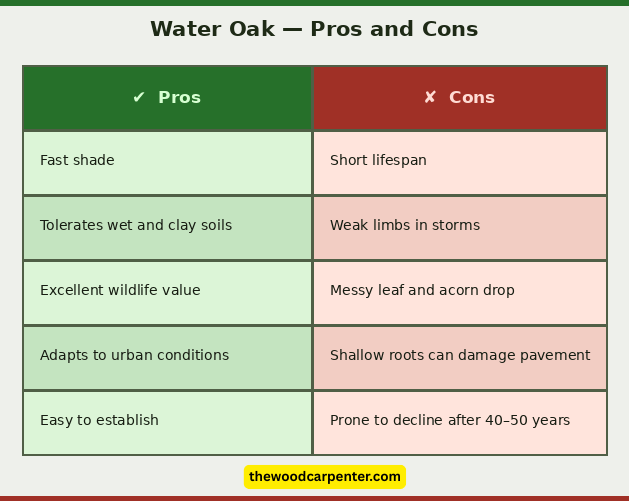
Pros and Cons Summary
Frequently Asked Questions
Is water oak good for a yard?
It can be, especially in large yards with space and moist soil. In small lots or near structures, it may create long-term maintenance issues.
How fast does it grow?
Among the faster native oaks, healthy trees typically grow at least 1–2 feet per year when young
Are the roots invasive?
They are not aggressive in a biological sense, but they are shallow and wide-spreading. Planting too close to sidewalks or foundations causes problems.
Can you eat the acorns?
Acorns are bitter raw (like all oaks) and contain tannins. Leaching in water, a method used by Indigenous peoples historically, is one way to process them. Always raw will cause our stomach problem
Why does it drop leaves in summer?
Summer leaf drop can signal drought stress, insect feeding, or early disease. A healthy, well-watered tree should not shed large amounts of green leaves mid-season.
The Bottom Line
Water oak is not a bad tree. It is simply a tree that demands honesty.
It grows quickly, feeds wildlife generously, tolerates tough soils, and creates shade faster than many other native hardwoods. But it is not built for centuries. It is a medium-term tree with structural weaknesses that show up in middle age.
Plant it where it has space. Monitor it as it matures. You should enjoy it while it is healthy.
Water oak is not a problem tree when it is clearly understood and put in the right place. It is a practical one.