
I tried turning a bowl a few years ago without any accessories other than a faceplate and screws. Halfway through the job, the blank came off, hurtled across the workshop and crashed into the wall. Fortunately, I wasn’t hurt — but I was scared enough to discontinue turning for the day.
When I shared the story with experienced turners, they all said the same thing: “You need a proper chuck.”
Purchasing a quality wood lathe chuck has totally transformed the way I turn. Turning was safer, quicker and much more fun. And if you take woodturning seriously — whether that means bowls, boxes, spindles or hollow forms – understanding chucks is not optional. It’s one of the tools that will be used on your lathe the most.
What Is a Wood Lathe Chuck?
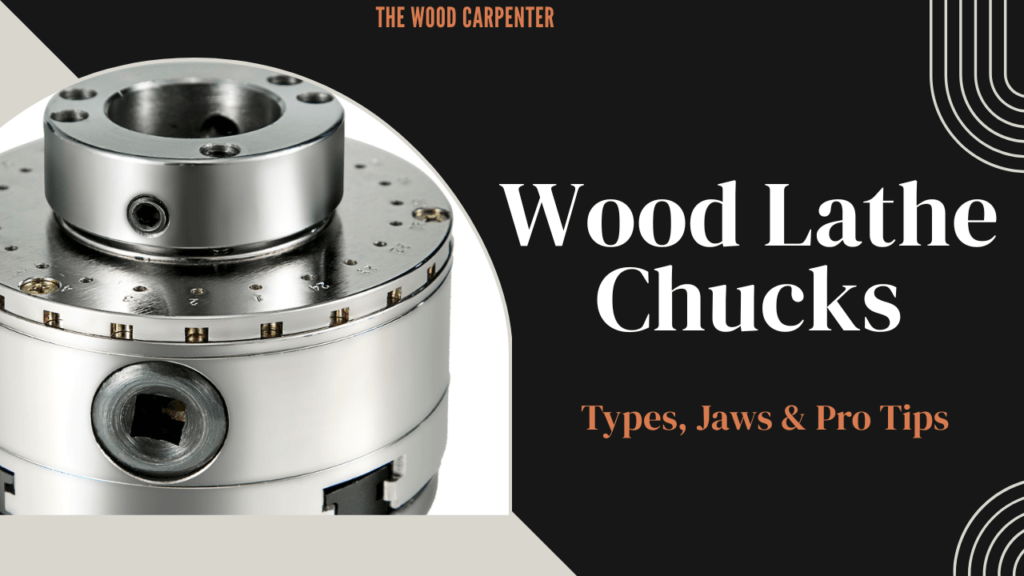
A wood lathe chuck is a mechanical clamp that fixes to your lathe’s headstock and holds your piece of wood firmly in place while it turns. It’s sort of like a sturdy, self centering vise designed for woodturning.
Unlike a drill chuck that squeezes evenly around round bits, a wood lathe chuck uses jaws that move together or apart to hold wood from the outside or the inside. This allows you to grip tenons, expand into recesses, reverse bowls, and remount work accurately every time.
A typical chuck includes a solid metal body, a scroll mechanism that moves the jaws together, interchangeable jaw sets, and a key or handle for tightening. Good chucks are precisely machined so they spin true even under heavy cuts.
The real magic is repeatability. You can remove a piece, work on something else, then remount it later and it will spin exactly where it left off.
Why a Lathe Chuck Is So Important
Traditional mounting methods still have their place, but they come with limits. Faceplates need screws, which leave holes and waste wood. Drive centers work well for spindles but prevent hollowing. Jam chucks are useful but slow and unreliable for repeated work.
A proper chuck solves these problems cleanly. You turn the outside of a bowl, create a tenon or recess, grip it in the chuck, hollow the inside, then reverse it again to finish the base—all without screws or guesswork.
More importantly, chucks improve safety. A correctly mounted piece in a good chuck simply does not come loose. Since switching to chuck-based mounting, I have never had another blank fly off the lathe.
Common Types of Wood Lathe Chucks
| Type | Jaw Movement | Best Used For | Limitations |
| 4-Jaw Scroll (Self-Centering) | All jaws move together | Bowls, cylinders, general turning | Not ideal for square stock |
| 4-Jaw Independent | Each jaw moves separately | Off-center or irregular pieces | Slower to set up |
| 3-Jaw Scroll | Jaws move together | Small round work | Less grip strength |
| Jam / Compression | No jaws | Long spindles | Limited holding power |
For most woodturners, the 4-jaw self-centering scroll chuck is the clear winner. It is fast, accurate, and versatile enough for almost every project.
Understanding Chuck Jaws (This Matters More Than You Think)
Jaws are the heart of any chuck. One chuck body can do many jobs simply by changing jaw sets.
Small jaws are used for pens, finials, and delicate work. Large jaws are needed for bowls, platters, and heavier blanks. Cole jaws allow you to grip finished bowls from the outside so you can clean up the bottom without leaving marks. Soft wooden jaws can be shaped to fit odd or fragile pieces.
Jaw profile is just as important as size. Dovetail jaws grip securely by locking into angled tenons or recesses. Flat jaws rely more on pressure and are less secure for heavy cuts.
Expansion vs. Compression Grip (Simple Explanation)
Compression mode means the jaws close inward and grip the outside of a tenon. This is the strongest and safest method, especially for roughing and heavy cuts.
Expansion mode means the jaws push outward into a recess. This is commonly used when reversing bowls. It works well, but it is slightly weaker because wood can split when pushed outward.
As a rule, use compression for strength and expansion for finishing.
Also read:
Mallets 101: Types, Uses & Materials in 5 Minutes!
Spackle or Wood Filler? Pick the Right One Fast
Choosing the Right Chuck Size
| Chuck Size | Best For | Typical Capacity |
| 2–2.5 inch | Mini lathes | Small boxes, pens |
| 3–3.5 inch | Most lathes | Bowls up to ~14 inches |
| 4 inch and above | Large lathes | Platters, heavy blanks |
For most people, a 3 or 3.5-inch chuck is the perfect balance. It handles small and large projects well and has the widest range of available jaws.
Chuck Threads and Insert Systems
Your chuck must match your lathe’s spindle thread. Common sizes include 1″ x 8 TPI, 3/4″ x 16 TPI, and 1-1/4″ x 8 TPI.
Always choose a chuck with an insert system. Inserts allow one chuck to fit different lathes simply by swapping the adapter. This is extremely useful if you upgrade your lathe later.
Popular Wood Lathe Chuck Brands (Quick Overview)
Nova chucks are widely loved for their reliability, jaw selection, and fair pricing.
Oneway chucks are built for professionals who turn large or heavy work daily.
PSI Barracuda chucks offer excellent value for beginners and hobbyists.
Vicmarc chucks are known for precision and innovative design, especially in Australia.
All of these brands make safe, dependable tools when used correctly.
Basic Maintenance for Long Chuck Life
Wood dust will eventually work its way into the chuck. Every few months, remove the jaws, brush out dust, and apply a light oil to the scroll. Avoid heavy grease—it traps debris.
Store chucks in a dry place and remove them from the lathe when not in use. With simple care, a quality chuck can last decades.
Common Mistakes to Avoid
- Overtightening can crush wood fibers or crack blanks.
- Undertightening can send work flying.
- Using the wrong jaw size reduces grip strength.
- Ignoring soft or rotten wood leads to failure no matter how good the chuck is.
Always test the grip by hand before turning the lathe on.
Frequently Asked Questions
What size chuck should a beginner buy?
A 3-inch or 3.5-inch 4-jaw scroll chuck is ideal for most beginners.
Can I use a metal lathe chuck on wood?
No. Metal lathe chucks are not designed for woodturning forces or safety needs.
Why does my work wobble?
Usually because the tenon or recess is poorly cut, not because the chuck is bad.
Do I need multiple jaw sets?
Yes. One set works, but extra jaws greatly expand what you can turn.
Final Thoughts
A wood lathe chuck is not just an accessory—it’s the key that unlocks real woodturning. Once your workholding is secure, you stop worrying about safety and start focusing on shape, finish, and creativity.
Buy a good chuck, learn to cut proper tenons and recesses, and maintain your tool. The confidence it gives you will completely change how you work at the lathe.
When your chuck is set up right, your turning feels smoother, safer, and far more enjoyable—and that’s when woodturning truly becomes fun.