
Last Updated on August 14, 2026 by Sam Wood Worker
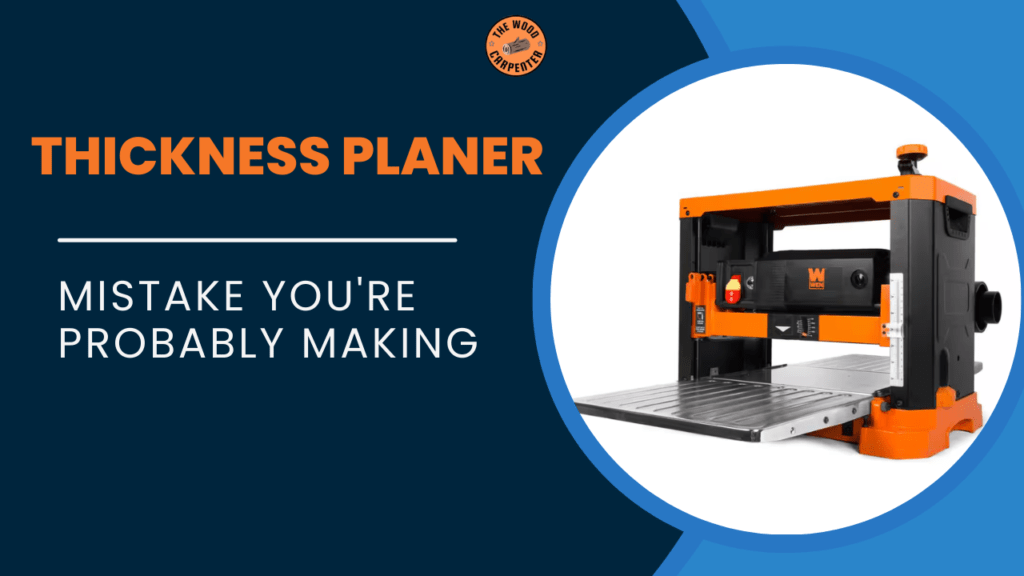
A thickness planer turns rough, uneven wood into smooth boards with the same thickness. It quickly changes twisted or rough lumber into clean, flat boards ready for joinery or finishing. Many woodworkers use a planer at home to save money and avoid buying expensive pre-milled wood.
Thickness Planer Fundamentals: What It Does
Picture pushing a rough oak board into a planer. Rollers pull it in, sharp knives spin at about 5,000 RPM, and the board comes out smooth and evenly thick, such as 3/4 inch.
A planer makes both sides of the board parallel once one flat face is prepared. Unlike a jointer, it does not flatten a warped board by itself.
Benchtop planers like the DeWalt DW735 handle boards up to 13 inches wide and 2–6 inches thick, using strong 15–20 amp motors.
Helical cutter heads with carbide inserts last longer, run quieter, and reduce tear-out, especially on figured woods like maple.
Planer vs. Jointer: Know the Difference
A jointer flattens one face or edge first. A planer then makes the opposite side parallel.
If you skip the jointer, a warped board may come out thinner but still bent, because the rollers press it flat only while cutting.
Helpful tip:
Joint one face first and mark it with an “X”. Always place that side down when planing.
For large slabs, a sled with shims can help flatten boards without a jointer.
Planer vs. Jointer Comparison
| Feature | Thickness Planer | Jointer |
| Main Job | Makes faces parallel | Flattens one face or edge |
| Board Prep Needed | Flat reference face | None at first |
| Width Capacity | 12–20 inches typical | 6–8 inches common |
Picking Your Perfect Thickness Planer
Beginners usually choose portable benchtop planers under $400. The DeWalt DW735X offers a helical cutter head and automatic feed for 96 cuts per inch.
Professional shops often choose larger 15-inch floor models like the Powermatic 209, which use powerful 5 HP motors for hard and exotic woods.
Important features to check include:
- Maximum cut depth per pass (about 1/16 inch for hardwoods)
- Dust collection ports
- Extension tables to reduce snipe
Helical heads are best for glue-ups and figured wood. Straight knives work well for softwood but need frequent sharpening.
Budget option: Wen 6552T (15A, 12.5-inch width)
Mid-range: Cutech 40200H with snipe lock
Professional: Felder or SCM for high precision
Orbital Sander Secrets Pros Don’t Want You to Know
Step-by-Step: Setting Up Your Planer
Mount the planer on a solid stand. Vibration causes poor cuts.
Clean the table and apply wax so boards slide smoothly.
Make sure infeed and outfeed tables are level with the bed.
Joint one face of the board first. Set the cutting depth to about 1/32 inch and test on scrap wood. Adjust until the knives just touch.
Turn on the planer and stand clear of the 3-inch danger zone near the infeed.
Always feed wood in the direction of the grain to reduce tear-out, especially on woods like oak.
Sanding Techniques: Feeding and Passes
Feed wide boards narrow-edge first when possible. Use a helper for long boards.
Let the feed speed, usually 20–50 feet per minute, do the work.
Limit each pass to 1/16 inch or less. Use depth stops to slowly reach the final thickness.
Mark board ends with pencil lines. When the marks disappear, the board is flat.
Flip boards end-to-end during planing to reduce uneven wear.
For resawing, plane the board slightly thick, cut it, then plane again to final size.
To avoid tear-out, plane against the grain carefully or use a helical cutter head.
Do not plane wet wood—moisture causes uneven surfaces.
Depth Per Pass Guide
| Depth per Pass | Softwood Max | Hardwood Max |
| Beginners | 1/16 inch | 1/32 inch |
| Production | 1/8 inch | 1/16 inch |
Crushing Common Planer Pitfalls
Snipe at board ends can be reduced by fully extending tables, lifting the board slightly at exit, or using sleds.
Dull knives cause vibration and rough cuts. Sharpen or rotate blades every 10–20 hours.
Burn marks mean cuts are too deep or resin has built up—clean blades and take lighter passes.
Dust buildup causes clogs and motor strain. Use a dust collector rated at 1,000 CFM.
Warped boards after planing often mean the wood was not acclimated long enough. Let lumber rest 1–2 weeks.
Never plane wood with nails or metal—it destroys blades instantly.
Maintenance: Keep Blades and Beds Sharp
After each use, vacuum chips and clean resin with a mild cleaner.
Weekly, check alignment and lubricate gears as recommended.
For blade changes, unplug the planer first. Align straight knives carefully.
For helical heads, rotate inserts to a fresh edge.
Wax the table regularly to improve feeding.
Store the planer covered to prevent rust and table damage.
Safety Rules Every Woodworker Must Follow
Always wear safety goggles, hearing protection, and a dust mask.
Keep hands at least 3 inches away from the infeed. Avoid loose clothing.
Maintain a clear 3-foot safety zone. Keep children and pets away.
Unplug the machine before adjustments. Always test-run without wood.
If the planer overloads, reduce cutting depth, especially on figured wood.
Real Projects: From Slabs to Shelves
For tabletops, joint one face and plane boards to 1-1/4 inches, then glue panels.
For doors, take 1/16-inch passes to reveal fresh grain.
For shelves, set stops at 3/4 inch to keep all boards the same.
Large slabs can be flattened using a sled and wedges, allowing safe planing of live-edge boards.
FAQ: Thickness Planer Questions Answered
What’s a thickness planer used for?
It makes boards flat and the same thickness after one face is jointed.
Do I need a jointer before planing?
Yes. A jointer creates the flat reference surface a planer needs.
How much wood should I remove per pass?
About 1/32–1/16 inch for hardwoods. Never more than 1/8 inch.
How do I prevent snipe?
Use table extensions, lift boards on exit, or use sleds and locks.
Best benchtop planer for beginners?
The DeWalt DW735X for power, width, and reliability.
Can a planer replace a jointer?
Only partly. Sleds help flatten boards, but jointers work faster for edges.
How often should planer knives be sharpened?
Every 10–20 hours of heavy use, or when tear-out appears.
Is a helical cutter head worth it?
Yes. It runs quieter, lasts longer, and reduces tear-out.
 Thomas Steve