
Last Updated on August 1, 2026 by Sam Wood Worker
Key Takeaways:
- Texas ebony (Ebenopsis ebano) is native to South Texas and northeastern Mexico — one of the toughest trees in North America
- Grows slowly at 6 to 12 inches per year but lives for decades and outlasts most fast-growing alternatives
- Once established, needs virtually no irrigation, no fertiliser, and almost no maintenance
- The wood is nearly black, extremely dense, and prized by woodworkers for small specialty projects
- Over 95% of its native thornscrub habitat has already been cleared — making every remaining and replanted tree ecologically critical
- Best suited to USDA Hardiness Zones 9b through 11
Texas Ebony at a Glance
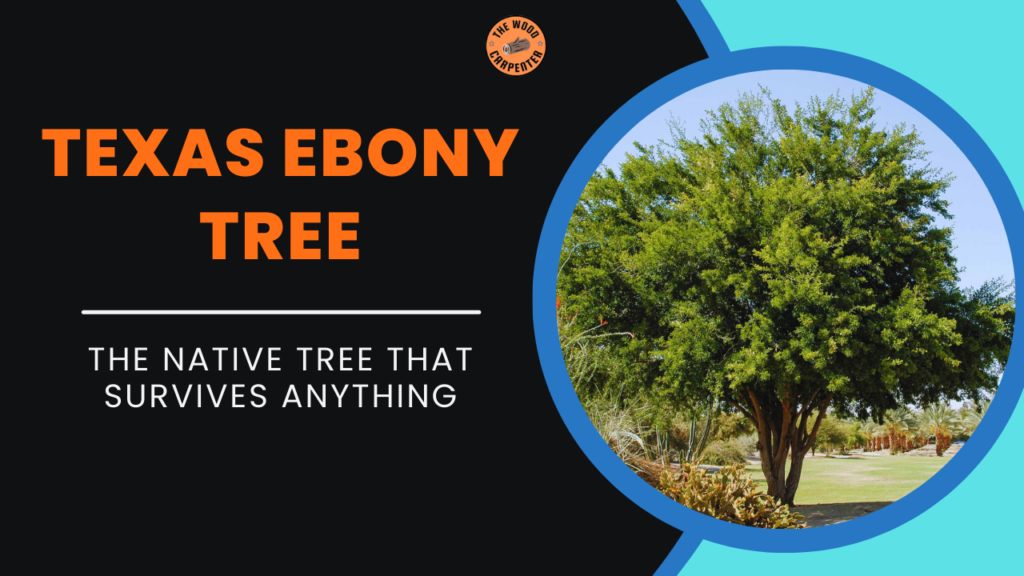
Texas ebony (Ebenopsis ebano) is a slow-growing, evergreen to semi-evergreen native tree from South Texas and northeastern Mexico. It typically reaches 15 to 30 feet tall, handles extreme heat and prolonged drought without flinching, and produces nearly black, incredibly dense hardwood.
It belongs to the legume family, so its roots naturally fix nitrogen into the surrounding soil — quietly improving the ground around it over time. It is considered one of the hardest native trees in North America and one of the most ecologically valuable in the lower Rio Grande Valley.
The Tree That Refuses to Quit
Most trees have a weakness. Too much heat. Not enough water. Wrong soil. Wrong wind.
Texas ebony doesn’t seem to have one.
It grows through brutal South Texas summers where temperatures regularly push past 100°F. It survives droughts that kill everything planted next to it. It thrives in rocky, alkaline, nutrient-poor soils that would stress most landscape trees into slow decline.
And when conditions finally ease up, it doesn’t just recover — it keeps quietly growing, producing shade, feeding wildlife, and building wood so dense and dark it barely looks like it came from a tree at all.
Scientists used to call it Pithecellobium flexicaule. Its current name is Ebenopsis ebano. Whatever you call it, the story is the same — this is one tough, underappreciated native tree that deserves far more attention than it gets.
This guide covers everything worth knowing — how to identify it, where it naturally grows, how to plant and care for it, what the wood gets used for, and why it matters ecologically in one of North America’s most threatened landscapes.
Getting to Know the Tree Up Close
Texas ebony is evergreen to semi-evergreen depending on conditions. In mild winters it holds its leaves all year. During cold snaps or severe drought it may thin out temporarily, then bounce back once conditions ease.
It grows 15 to 30 feet tall and spreads almost as wide. In harsh sites it sometimes stays shrub-sized. Given room and reasonable conditions, older trees develop a genuinely sculptural quality — twisted trunks, deeply furrowed dark bark, a dense rounded canopy that feels almost architectural rather than just vegetative.
It’s a legume, which is more significant than it sounds. The roots associate with specialised nitrogen-fixing bacteria that gradually enrich the surrounding soil. Poor ground slowly becomes more fertile.
Other plants benefit. The whole patch of land quietly improves over time — and the tree did it without any help from you.
The branches carry short paired spines — sharp enough to respect but not aggressive unless you’ve planted the tree right beside a walkway.
Ranchers in South Texas used Texas ebony as natural fencing for generations, and you can see why.
The leaves are bipinnately compound — meaning they divide into smaller sections twice over — which gives the canopy a fine-textured, glossy dark green look from any distance.
In late spring through summer, the tree pushes out creamy white to pale yellow flower spikes with a light sweet fragrance that bees find completely irresistible.
After flowering, thick woody seed pods develop — 4 to 6 inches long, dark brown to nearly black when mature — and they stay on the tree for months, providing a steady food source for wildlife rather than a single burst.
How to Spot Texas Ebony in the Field
Once you know what to look for, Texas ebony is pretty distinctive. The combination of glossy dark foliage, paired stout thorns, heavy dark pods, and nearly black heartwood doesn’t describe many other trees.
The most common mix-up is with mesquite, which grows in similar areas. Here’s how to tell them apart:
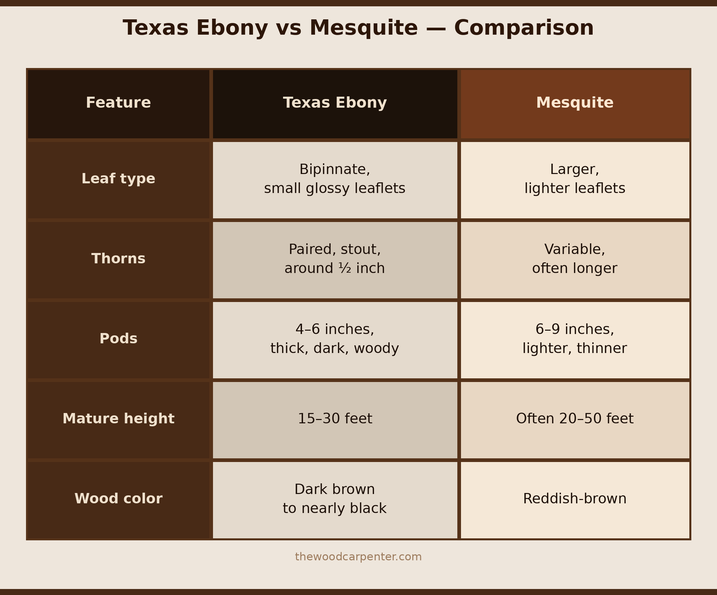
From a distance, the dark dense canopy and heavy nearly black pods are usually the easiest things to spot. Up close, the paired spines and glossy leaf texture confirm what you’re looking at.
Where Texas Ebony Naturally Grows
Texas ebony is native to the Tamaulipan thornscrub — a tough, dry ecosystem stretching across South Texas into northeastern Mexico.
It’s also one of the most ecologically threatened plant communities in North America.
Its range runs through South Texas with the strongest populations in the lower Rio Grande Valley and on protected lands including Santa Ana National Wildlife Refuge and Bentsen-Rio Grande Valley State Park.
The tree thrives in full sun. It handles sandy loam, limestone, caliche, or clay soils. It grows in alkaline ground that many other trees struggle with.
It does fine with just 20 to 25 inches of annual rainfall. And it takes extreme summer heat — well above 100°F — without complaint.
It tolerates occasional flooding but prefers well-drained sites. Once established, it survives long dry spells without any water from you at all.
Here’s the number worth knowing: over 95% of the original thornscrub habitat in the lower Rio Grande Valley has already been cleared for agriculture and development.
Texas ebony and trees like it are no longer common in the landscape they once defined. That makes every existing tree — and every new planting — more ecologically significant than it might otherwise appear.
How Fast It Grows and How Big It Gets
Texas ebony is not a tree for impatient people. It absolutely is a tree for people who think long-term.
After planting, the first year or two looks almost like nothing is happening above ground.
That’s because the tree is putting everything into its root system — building the deep, extensive network that will eventually make it drought-proof and wind-resistant and genuinely self-sufficient.
Once established, expect around 6 to 12 inches of growth per year. At that rate, it takes 20 to 30 years to reach full height.
The payoff is longevity. Texas ebony outlives most fast-growing species planted at the same time.
Trees that shot up quickly in five years may be struggling or already gone by the time a well-established Texas ebony is just hitting its stride.
Why Landscapers and Homeowners Are Starting to Pay Attention
In hot, dry regions, water costs money. Shade saves money. Native plants cut maintenance. Texas ebony delivers on all three.
Once established in its native range, it needs little to no irrigation. Its deep roots find moisture far below the surface during dry periods. Fertiliser is essentially unnecessary — it makes its own nitrogen. It handles heat, wind, and poor soil without you doing a thing.
Planted on the west or south side of a building, a mature Texas ebony provides real summer shade that can genuinely reduce cooling costs inside.
It works well as a specimen shade tree in a yard or open space. As a wildlife garden anchor for people trying to attract birds and pollinators.
As a security hedge — the thorns make it a natural deterrent without any effort. As a windbreak along property lines. As a xeriscape focal point in a low-water landscape.
Practical planting notes:
Space trees about 15 to 20 feet apart. Full sun is essential — this tree does not perform well in shade. For new plantings, water deeply once a week during the first growing season. By year two or three, you can reduce watering significantly or stop altogether in the native range.
Avoid planting directly beside sidewalks, children’s play areas, or tight patio spaces because of the thorns. Give it room to do what it does.
Prune in winter if needed and wear gloves. Some people train it to a single trunk for clearance. Others leave the natural multi-trunk form, which tends to be more sculptural and provides more wildlife habitat value.
The Wood: Dark, Dense, and Genuinely Remarkable
The heartwood of Texas ebony ranges from deep reddish-brown to nearly black. The grain is fine and smooth. It polishes beautifully. By hardness measurements, it ranks among the hardest woods native to North America — denser, heavier, and more striking than most people expect from a tree this modest in size.
Because it grows slowly and doesn’t produce massive trunks, pieces are typically small and irregular. That limits large-scale lumber use but makes it ideal for specialty work.
Knife handles are a natural fit — the density and dark color make it a premium choice. Turned bowls and decorative vessels show the grain beautifully on a lathe. It works for tool handles, small furniture pieces, and decorative inlay where the wood itself is the point.
Historically, fence posts made from Texas ebony lasted decades in the ground without any chemical treatment — a testament to natural durability that most treated commercial timber can’t match.
As firewood it burns hot and long. It needs to be dried carefully to avoid splitting, but once properly seasoned it’s excellent fuel.
What Texas Ebony Does for the Ecosystem Around It
This tree isn’t just tough. It’s genuinely important to the landscape it grows in.
The seed pods feed a wide range of animals — deer, javelinas, wild turkeys, and numerous bird species rely on them.
Because the pods mature gradually and stay on the tree for months, they work as a slow-release food source. Animals can return repeatedly over weeks rather than competing for a one-time windfall.
The dense thorny canopy creates some of the safest nesting habitat in the thornscrub. In the lower Rio Grande Valley — one of the best bird-watching destinations in North America — Texas ebony supports species including the Plain chachalaca, Green jay, and Altamira oriole.
Migratory species use the thornscrub corridor during seasonal movements, and trees like this one are central to that habitat.
During flowering season, the sweet-scented spikes attract bees and butterflies in real numbers. Local beekeepers have noted that heavy Texas ebony flowering years produce honey with a distinctive regional character that lighter years don’t.
Below ground, the nitrogen-fixing roots gradually improve soil quality across the surrounding area.
Grasses and wildflowers grow more vigorously near established Texas ebony trees — a quiet, cascading benefit that extends well beyond the canopy itself.
Pests, Problems, and Cold Limits
Texas ebony has no major pest or disease problems worth worrying about under normal conditions.
The most reliable way to kill it is overwatering. Poor drainage leads to root rot — give it well-drained soil and don’t water it more than it needs once it’s established.
Lace bugs and caterpillars occasionally appear but rarely cause lasting damage.
Cold is the real limitation. Temperatures below about 22°F can damage young trees. Established specimens handle cold better but still prefer warmer climates. USDA Hardiness Zones 9 through 11 are where it performs best.
It has no relationship to true ash trees and is completely unaffected by the emerald ash borer — the pest currently devastating ash populations across much of North America.
How Texas Ebony Compares to Similar Trees
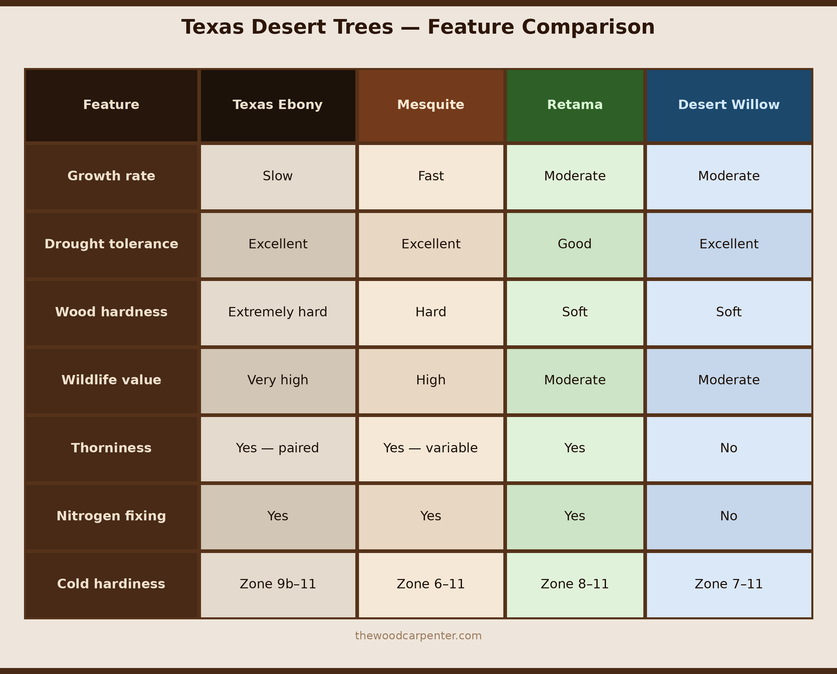
Texas ebony sits in a unique position — slower and smaller than mesquite, but harder, darker, longer-lived, and with higher habitat value per individual tree.
Frequently Asked Questions About Texas Ebony
How fast does Texas ebony grow? About 6 to 12 inches per year once established. The first one to two years focus heavily on root development, so above-ground growth initially looks almost nonexistent.
Is Texas ebony evergreen? Mostly yes. In warm winters it holds leaves year-round. During cold snaps or severe drought it may thin temporarily before recovering.
Is it really that drought tolerant? Genuinely, yes. Once established it can go through prolonged dry spells without any supplemental watering — one of the most drought-resilient native trees in the region.
What is the wood actually used for? Because pieces are typically small, it’s best suited to knife handles, turned bowls, tool handles, decorative inlay, and small specialty woodworking. It’s one of the darkest and hardest native North American hardwoods available.
Are the thorns actually dangerous? Sharp enough to be uncomfortable and to warrant careful placement in a landscape. Gloves are non-negotiable when pruning. Don’t plant it directly beside walkways or play areas.
Can it grow outside South Texas? Yes, in warm climates. It does well in parts of Arizona, Southern California, and coastal Gulf regions within USDA Zones 9b through 11.
How do you grow it from seed? Seeds need scarification — nicking or lightly sanding the hard seed coat — followed by soaking in water for 24 hours before planting. Germination typically takes 2 to 4 weeks in warm conditions.
Does it attract wildlife? Significantly. Pods feed deer, javelinas, wild turkeys, and many bird species. The canopy provides nesting habitat. Flowers attract bees and butterflies. Roots improve surrounding soil for other plants.
Does it need fertiliser? No. As a legume it fixes its own nitrogen through root bacteria. Adding fertiliser is unnecessary and can sometimes do more harm than good.
How tall does it get? Typically 15 to 30 feet tall with a similar spread. In harsh conditions it may stay shrub-sized.
The Bottom Line
Texas ebony is not a tree that tries to impress you quickly. It doesn’t shoot up in a season, bloom dramatically, or make a statement the first year you plant it.
What it does is outlast things. Bad soil. Extended drought. Brutal heat. Decades of time passing.
In a region where over 95% of the native thornscrub has already been lost, a tree that stabilises soil, feeds wildlife, fixes nitrogen, provides genuine shade, and produces some of the most beautiful dense dark wood in North America is worth considerably more than most people give it credit for.
Plant it in the right place. Give it the patience it deserves.
In twenty years, when everything planted next to it has come and gone, Texas ebony will still be standing — darker, denser, and more valuable than the day you put it in the ground.