
Last Updated on May 11, 2026 by Sam Wood Worker
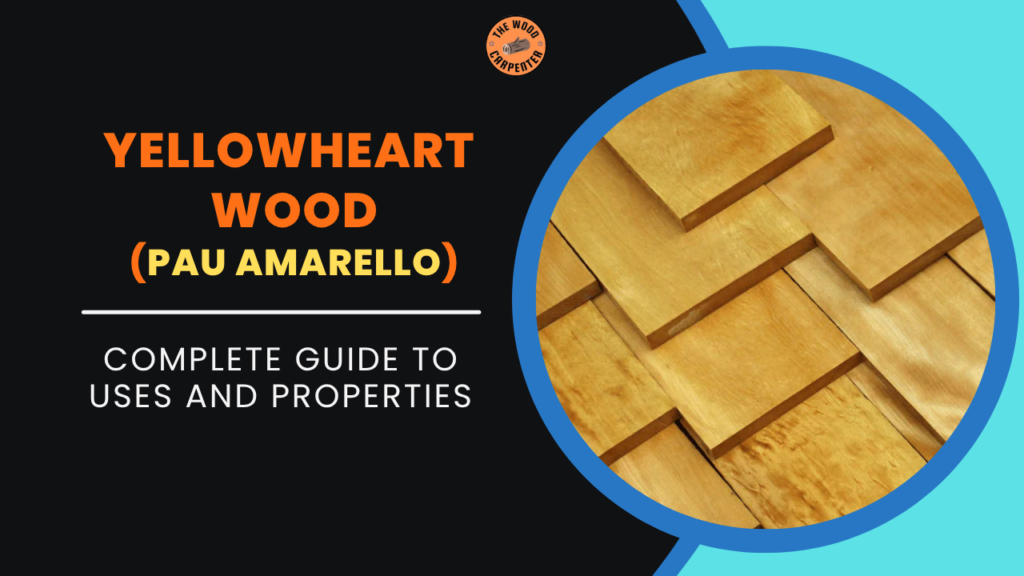
Most woods are brown. Some are reddish. A few lean towards blonde. And then there’s Yellowheart — a wood that comes out of the Brazilian rainforest looking like it was stained with a highlighter marker, and somehow that’s completely natural.
The first time you see a freshly cut board of Yellowheart, you do a double-take. That can’t be real. That colour can’t just… come from a tree. But it does. And once you’ve worked with it, finished it, and watched someone stop mid-conversation to stare at the piece you just built — you understand why woodworkers keep coming back to it.
This is the full, honest guide to Yellowheart wood. What it is, what it’s like to actually work with, where it belongs, where it doesn’t, and whether it’s worth the price tag — just what you actually need to know.
What Is Yellowheart Wood?
Yellowheart — scientifically Euxylophora paraensis, commercially known as Pau Amarello, which literally translates to “yellow wood” in Portuguese — grows primarily in Brazil, mostly in the Pará region. These aren’t scrubby little trees either. They push well past 100 feet tall, producing long, clean boards with good width and excellent figure.
The trees grow in tropical conditions, which gives the wood its density and fine texture. It’s been used in Brazil for centuries — locally for construction, furniture, and everything in between — but the international market really started paying attention when exotic hardwood demand picked up and people realized there was a genuinely yellow hardwood that actually performed as well as it looked.
Commercially, you’ll see it sold as Yellowheart, Pau Amarello, or occasionally just “Brazilian Yellow Wood.” If you’re sourcing it, those names all refer to the same species.
The Colour — Let’s Talk About It Properly
Because this is really the whole conversation with Yellowheart, isn’t it.
Freshly cut heartwood is bright, almost aggressive yellow — the kind of colour you’d normally only see in stained or painted wood. It’s not subtle. It doesn’t whisper. It announces itself immediately and unapologetically.
Here’s what most people don’t realize though: that fresh-cut yellow mellows over time. Light exposure and oxidation gradually shift it toward a warmer, deeper golden amber tone.
Think fresh lemon versus aged honey. Both are beautiful — just different. Most experienced woodworkers actually prefer the aged colour. It’s richer, warmer, and more sophisticated while still being unmistakably Yellowheart.
The sapwood runs cream to pale yellow, blending naturally into the heartwood without a jarring contrast. The grain is mostly straight with occasional gentle waves or interlocking sections that add movement without complicating the work.
Under a good oil finish? The warmth deepens, the grain comes forward, and the colour intensifies in exactly the way you’d hope. It’s one of those finishing moments that reminds you why you got into woodworking in the first place.
Physical Properties — The Numbers Behind the Beauty
Here’s where Yellowheart earns its keep beyond just looking extraordinary.
| Property | Yellowheart | Red Oak | Hard Maple |
| Janka Hardness | 1,790 lbf | 1,290 lbf | 1,450 lbf |
| Density | ~52 lbs/ft³ | ~45 lbs/ft³ | ~44 lbs/ft³ |
| Volumetric Shrinkage | 10.6–12% | Higher | Higher |
| Grain | Straight to wavy | Mostly straight | Straight |
| Natural Durability | Moderate | Moderate | Low |
| Colour | Yellow → warm gold | Reddish-brown | Pale blonde |
That Janka hardness number is significant. At 1,790 lbf, Yellowheart outperforms red oak by 500 lbf — a difference you’ll actually feel in everyday use. It resists denting, surface damage, and wear in a way that softer hardwoods simply don’t. When clients ask whether something will hold up, that number is part of the answer.
Dimensional stability is another strong point. Low shrinkage after drying means it doesn’t move dramatically with seasonal humidity changes. In coastal environments, humid climates, or anywhere wood movement is a real concern — that stability matters enormously for joinery, flooring, and panel work.
Working With Yellowheart — What It’s Actually Like
Manageable. Predictable. Rewarding. But the hardness demands respect.
Cutting and machining: Yellowheart cuts cleanly with both hand tools and machines. Table saw, bandsaw, router — all perform well. The catch is that the density is real, and it will dull your blades faster than softer species. Keep your tooling sharp. A blade that cruises through pine or poplar will start to complain on Yellowheart if you let it go too long between sharpenings.
When you hit sections of interlocking grain — and you will occasionally — slow your feed rate. Rushing through wavy grain with a dull blade is how you get tearout on a surface you were planning to keep visible. Take your time on those sections.
Hand tool work: Planes work beautifully on straight-grained sections, producing ribbon-thin shavings and glass-smooth surfaces. Chisels and carving tools perform well with sharp edges. Again — sharpness is the theme. Don’t fight the density with dull tools.
Drilling and screwing: Pre-drill. Always. The hardness makes splitting a genuine risk near edges and ends, especially in thinner stock. A properly sized pilot hole takes fifteen seconds and saves a board you’ve been planning a project around. Skip it and you’ll regret it.
Gluing: Good news here. Yellowheart takes wood glue reliably and glue joints hold solidly. Standard PVA and most woodworking adhesives work well. Clean glue surfaces, proper clamping pressure, adequate open time — nothing unusual required.
Sanding: Genuinely satisfying. The fine, even texture moves through grits predictably and the final surface polishes up smooth with minimal effort. Work through 80, 120, 180, 220 and you’ll have a surface that’s ready for almost anything. It doesn’t load sandpaper excessively and doesn’t develop problem spots that sand at different rates. Nice, consistent, cooperative wood to sand.
Finishing:
This is where the work pays off.
- Oil finishes are the natural choice for furniture. Hardwax oil, tung oil, Danish oil — they soak in, deepen the warmth, and bring the golden tones fully to life without building a plasticky surface film. The wood looks alive rather than coated.
- Polyurethane is the right call for floors and high-wear surfaces. Provides the protection that penetrating oils can’t match for heavy daily use.
- Lacquer and varnish work well for smaller decorative pieces and turnings.
- Staining — this is where to be careful. The yellow base colour shifts stain colours in ways that aren’t always intuitive. A grey stain can go greenish. A brown stain reads differently than it would on oak. Always, always test on an offcut from the same board before committing to your piece.
One health note: Yellowheart dust is a mild irritant to skin and respiratory systems. A quality dust mask and proper ventilation aren’t optional when you’re machining this wood. Keep the shop aired out and don’t work in a sealed space without protection.
Drying and Storage — Don’t Skip This Part
Freshly milled tropical hardwood can have significant moisture content, and Yellowheart is no exception. For interior projects, kiln-dry to 6–8% moisture content before you start working.
Why does this matter? Wood that’s too wet when you build with it will continue drying after the project is complete — and as it loses moisture, it moves. Joints open up. Panels cup. Boards twist. Fixing movement after the fact is frustrating work. Getting the moisture content right beforehand costs nothing extra and prevents all of it.
Once dried, store your boards flat on a level surface, stickered for airflow, away from direct sunlight and heat sources. Rapid environmental changes — moving wood from a cold garage into a heated shop, or from a dry space into a humid one — stress even well-dried timber. Let it acclimatize to your workspace for a week before dimensioning. Two weeks if you can manage it.
Buy from suppliers who can tell you the moisture content of their stock. If they can’t or won’t, that’s information about the quality of their operation.
Where Yellowheart Belongs — Best Uses
Flooring: One of the best applications. The hardness handles real foot traffic without the denting issues you’d get from softer species, and the colour makes a statement that no stained floor can replicate. Acclimate planks for at least five days before installation, use urethane adhesive for solid bonding, and the result will outlast most other exotic hardwood floors.
Furniture accents: Here’s something experienced woodworkers figure out quickly — you don’t need to build an entire piece from Yellowheart to maximize its impact. A Yellowheart border around a dark walnut tabletop. Chair backs against a darker frame. Drawer fronts in an otherwise traditional piece. The contrast work is where this wood earns its price tag most efficiently.
Marquetry and inlay: That colour contrast makes Yellowheart practically purpose-built for decorative inlay. Even thin strips create designs that command attention. Pen blanks, small accent pieces, geometric patterns — the colour does the heavy lifting.
Turnings: Bowls, pens, boxes, handles — Yellowheart turns beautifully, holds crisp detail, and finishes to a near-glassy surface with straightforward technique. Turned pieces in Yellowheart look premium from across the room.
Musical instruments: The density and resonance properties make it suitable for guitar bodies, back and sides on acoustics, drum shells, and various instrument components. Not just visually interesting — acoustically useful.
Marine interiors: Thwarts, trim, rub rails, interior joinery on boats and small vessels. The moisture resistance is real, and with UV-resistant varnish, it holds up in dock environments. Not an outdoor wood without proper sealing — but with it, genuinely capable.
Knife and tool handles: Stable, hard, smooth-finishing, and comfortable. Shapes well, holds detail, and looks extraordinary once oiled and buffed.
Yellowheart vs. Other Woods — Honest Comparisons
Yellowheart vs. Red Oak
Red oak is the benchmark hardwood for most North American woodworkers. Yellowheart is harder by 500 lbf, more visually distinctive by any measure, and more expensive. For projects where durability and uniqueness matter more than cost — Yellowheart. For everyday builds where you want reliable performance at a familiar price — oak. They’re not really competing for the same projects.
Yellowheart vs. Hard Maple
Comparable hardness range. But maple is blonde-neutral — almost deliberately understated — while Yellowheart makes its presence known. Maple costs less and disappears nicely into designs that don’t want the wood to be the focal point. Yellowheart costs more and becomes the focal point whether you plan for it or not. Different tools for different jobs.
Yellowheart vs. Walnut
Less a competition than a conversation about pairing. These two are frequently used together precisely because the contrast — deep espresso brown walnut against bright Yellowheart — is visually dramatic in a way that’s hard to achieve any other way. If you’ve seen a walnut piece with bright yellow accent strips and couldn’t figure out what the contrast wood was, it was probably Yellowheart.
Yellowheart vs. Osage Orange
Both are naturally yellow hardwoods — one of the more unusual comparisons to make, but worth noting. Osage Orange is domestically available in North America, harder (around 2,040 lbf), and starts green-yellow before mellowing to brown with age. Yellowheart holds its golden colour longer and is more readily available in consistent grades. For colour longevity and board quality, Yellowheart has the edge.
Yellowheart vs. Purpleheart
Another bold tropical hardwood comparison. Both are visually striking, both are Brazilian-region exotics, both polarize opinion. Purpleheart is slightly harder, more structurally dramatic in colour. They work brilliantly together — purple and yellow is a high-contrast pairing that either works beautifully in a design or overwhelms it. Use with intention.
Yellowheart vs Other Woods – Comparison Table
| Feature | Yellowheart | Red Oak | Hard Maple | Walnut | Osage Orange | Purpleheart |
|---|---|---|---|---|---|---|
| Janka Hardness | 1,790 lbf | 1,290 lbf | 1,450 lbf | 1,010 lbf | ~2,040 lbf | ~1,860 lbf |
| Color | Bright yellow → golden amber | Reddish-brown | Pale blonde | Dark brown (espresso tone) | Yellow → brown over time | Purple → dark brown-purple |
| Visual Impact | Very high (stands out) | Medium (classic look) | Low (subtle, neutral) | High (rich, elegant) | Medium (natural yellow) | Very high (bold color) |
| Price | High | Moderate | Moderate | High | Moderate | High |
| Workability | Good, but hard on tools | Easy | Moderate | Easy | Difficult (very hard) | Moderate (can be tricky) |
| Best Use Case | Accents, flooring, inlays | General furniture, flooring | Cabinets, clean designs | Furniture, contrast pieces | Outdoor, specialty items | Decorative, accent pieces |
| Durability | High | Moderate | High | Moderate | Very high | Very high |
| Uniqueness | Rare, eye-catching | Common | Common | Premium but familiar | Uncommon | Exotic and bold |
| Pairing Use | Great for contrast | Usually standalone | Blends into design | Excellent with Yellowheart | Rarely paired | Strong contrast pairing |
Pricing and Where to Buy
Expect to pay $15–$25 per board foot depending on grade, width, supplier, and market conditions. That places it firmly in exotic hardwood territory — more expensive than domestic species, less than the premium end of the tropical hardwood market.
The smartest approach most experienced woodworkers take: use Yellowheart strategically rather than building entire pieces from it. A well-placed accent, an inlay border, a contrasting component — these uses maximize visual impact while managing cost sensibly. A small amount of Yellowheart in the right place often does more for a design than building the whole piece from it.
When buying, look for:
- FAS grade for furniture-quality boards with minimal defects
- 1 & 2 Common for flooring, smaller parts, and cost-sensitive projects
- Board lengths typically 8–12 feet at 4/4 thickness
- Wider boards at premium pricing — plan your project dimensions before ordering
- FSC certification or verifiable chain of custody documentation
Specialist exotic hardwood dealers are your best source — not the big box stores, which rarely stock anything beyond domestic species. Online exotic wood suppliers ship Yellowheart reliably if you don’t have a local dealer.
Pros and Cons — The Straight Version
What makes Yellowheart worth it:
- Unmatched natural color — nothing else looks quite like it
- Exceptional hardness at 1,790 lbf — genuinely durable for demanding use
- Low shrinkage and excellent dimensional stability
- Smooth, fine texture that sands and finishes beautifully
- Takes oil finishes extraordinarily well
- Versatile across flooring, furniture, instruments, and craft work
- Color deepens and warms attractively with age
- Strong glue adhesion for panel and laminated construction
What to know before you buy:
- Price — $15–$25 per board foot is real money, especially for large projects
- Dulls tooling faster than softer species — maintenance discipline required
- Staining requires testing — the yellow base shifts colors unpredictably
- Dust is a mild irritant — PPE is essential, not optional
- Not suitable for fully exposed outdoor use without significant treatment
- Sourcing requires care — FSC certification matters
- Color will shift over time — not a defect, but worth understanding
Sustainability and Sourcing — The Responsible Side
Yellowheart comes from Brazilian tropical forests, and like most tropical hardwoods, irresponsible harvesting is a real issue in the region. That doesn’t mean you can’t source it responsibly — it means you need to be deliberate about where you buy.
FSC-certified material is the baseline. The Forest Stewardship Council certification means the wood was harvested under verified management practices that protect forest health. Ask your supplier directly. If they can’t tell you the certification status of their stock, find a supplier who can.
Plantation-grown Yellowheart is increasingly available and represents the cleanest sourcing option — consistent quality, verified origin, no contribution to old-growth deforestation.
Using Yellowheart strategically as accent material rather than solid-wood construction also reduces your consumption without sacrificing visual impact. That’s both an economic and environmental win.
Common Questions People Ask About Yellowheart
Does the colour fade or change over time?
Yes — and most people consider the change an improvement. The bright fresh-cut yellow mellows to a warmer, deeper golden amber with light exposure and oxidation. If you want to slow the shift, UV-protective finishes help. If you want to embrace it, let it age naturally. Either way, it stays distinctly Yellowheart.
Can I use Yellowheart outdoors?
With proper sealing, it can handle some outdoor exposure — covered porches, sheltered exterior applications. For fully exposed outdoor use, regular maintenance is non-negotiable and even then it’s not the first choice. It’s fundamentally an interior wood that can tolerate sheltered exterior conditions with care.
Is it beginner-friendly?
Reasonably, yes. The hardness means sharp tools and pre-drilling are non-negotiable, but the straight grain and fine texture make it predictable to work. It won’t throw unexpected surprises at you the way highly figured or interlocked grain species can. Go in with sharp tools and patience and you’ll be fine.
How do I stop it from turning orange as it ages?
You can’t completely prevent color shift — it’s a natural process in the wood. UV-blocking finishes slow it significantly. Keeping finished pieces out of direct sunlight helps. But some color evolution is part of owning Yellowheart, and the amber-gold it settles into is genuinely beautiful.
Can I mix Yellowheart with other woods?
Absolutely — and this is where it gets exciting. Walnut, wenge, ebony, and dark-stained woods create high-contrast pairings that are visually dramatic. Maple and light-toned woods create a subtler, tonal harmony. It pairs well with almost anything because the color is so distinct — you control the drama level by choosing your contrast partner.
Final Thoughts — Is Yellowheart Worth It?
Here’s the honest answer: it depends entirely on what you’re building and what you want it to do.
If you need a wood that disappears into the background, supports the design without demanding attention, and does its structural job quietly — there are better, cheaper choices. Yellowheart is not a wallflower.
But if you want a wood that makes people stop and ask questions, that brings genuine visual drama without staining or painting, that holds up to real-world use, and that gets more beautiful as it ages — Yellowheart is one of a very small group of species that can deliver all of that at once.
Use it strategically. A small amount in exactly the right place does more than a full piece built from it. The colour carries the room. The hardness handles the use. The finish brings it all together.
Most woods fade into the furniture. Yellowheart becomes the reason people notice the furniture in the first place.
That’s a rare quality. And for the right project, it’s absolutely worth every penny.