
Last Updated on August 14, 2026 by Sam Wood Worker
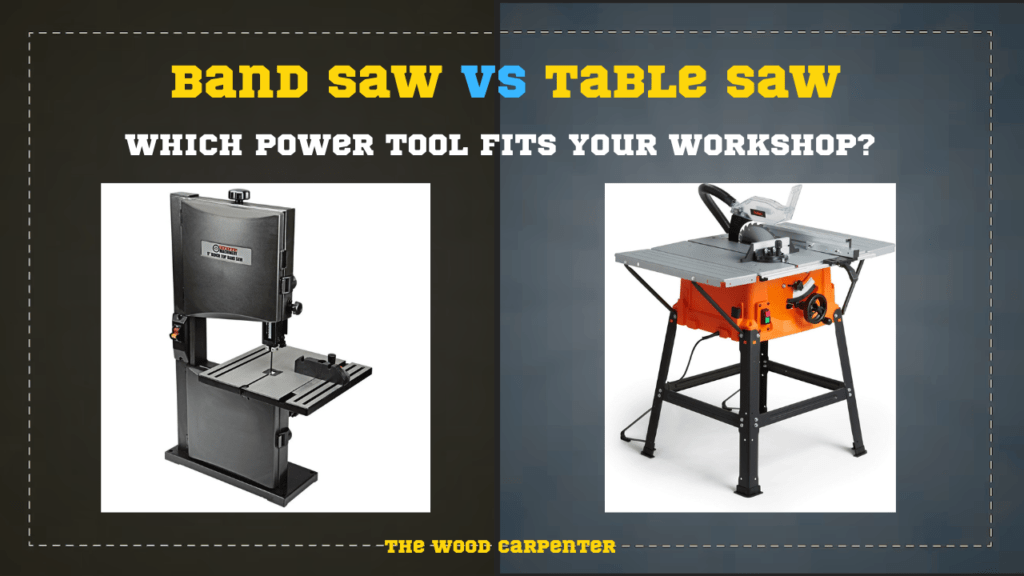
Step into a woodworking shop, and typically two machines dominate the space from their location in opposite corners: the band saw and the table saw. Both are robust, both are reliable and both can revolutionize the way you work with wood. But they are crafted for very different jobs. The choice between the two is not which one is “better” but which one better suits the kind of work you actually do.
Whether you’re trimming cabinet doors, cutting baseboards, or turning rough lumber into a smooth top, knowing how the different types of woodworking tools work will speed things up, make them easier and save you a ton of frustration!
How Each Tool Works
A band saw uses a long, narrow blade formed into a continuous loop. This blade runs around two wheels and cuts in a downward motion through the table. Because the blade is thin and flexible, it moves smoothly through curves, thick stock, and uneven shapes.
A table saw, on the other hand, uses a flat circular blade that spins upward through the center of a large table. You push the wood across the blade using a fence or miter gauge, which locks the cut into a straight, repeatable path.
This basic difference explains everything that follows. Band saws provide freedom and flexibility. Table saws give you speed, power and straight-line precision.
What Each Saw Does Best
Table saws are the foundation of most wood shops. They’re great for breaking down long boards, cutting plywood into panels and reproducing identical parts over and over.
If you are making cabinets, shelves, a set of frames or furniture parts that need to match precisely, it feels almost like you can’t do the work well without a table saw.
Band saws shine where table saws struggle. Curves, circles, arches, and irregular shapes are where the band saw feels completely at home. It also dominates at resawing, which means slicing thick boards into thinner pieces or creating your own veneers from beautiful wood.
Trying to cut tight curves on a table saw is unsafe and impractical. Trying to break down full plywood sheets on a band saw is slow and inaccurate. Each tool has a clear comfort zone.
Band Saw vs Table Saw: Key Differences at a Glance
| Feature | Band Saw | Table Saw |
| Blade Type | Continuous loop, narrow (1/8″–1″) | Circular blade (7″–10″) |
| Best Cuts | Curves, resawing, irregular shapes | Straight rips, crosscuts, bevels |
| Cutting Depth | Up to 12–14″ on tall stock | Around 3–4″ at 90° |
| Speed | Slower, controlled feed | Fast, high RPM cutting |
| Accuracy | Excellent for curves, fair for straights | Outstanding straight-line precision |
| Space Needed | Compact footprint | Larger working area required |
Band saws are gentler on figured or delicate wood, reducing tear-out. Table saws power through hardwoods quickly without slowing down.
Accuracy and Cut Quality
If straight cuts are your priority, the table saw wins without debate. A good fence allows you to repeat cuts within fractions of a millimeter, which matters greatly for joinery and fitted parts.
Band saws can cut straight, but they require more setup and skill. Blade drift, tension, and guide adjustment all affect accuracy. That said, for curves and resawing, no table saw can match a properly tuned band saw.
The surface finish also differs. Table saw cuts are usually smoother and need less sanding. Band saw cuts often show light blade marks, which is normal and easy to clean up with sanding or planing.
Safety: A Serious Comparison
Band saws are generally considered safer. The blade moves downward into the table, pulling the wood in rather than throwing it back. Kickback is extremely rare, and injuries are usually less severe.
Table saws demand more respect. The exposed blade spins upward, and kickback can happen in an instant if the wood twists or binds. Modern safety features like riving knives, blade guards, and flesh-detection systems such as SawStop greatly reduce risk, but proper technique is still essential.
Simple habits matter on both machines. Keep guards in place, use push sticks, stand out of the kickback line, and never rush a cut. Unplug machines before adjustments, and keep your work area clean.
Power, Dust, and Performance
Table saws rely on raw strength. Motors between 1.5 and 5 horsepower chew through thick hardwoods with ease. Their fences lock boards into position for long, straight cuts that stay true from start to finish.
Band saws focus on finesse. They resaw thick lumber smoothly without burning and handle odd shapes that would stall other machines. Dust collection is often better on band saws, since the blade is enclosed and the kerf is narrow.
Maintenance also differs. Band saw blades last longer but need regular tension and tracking checks. Table saws require fence alignment, arbor checks, and more frequent blade changes.
Also read:
Wet or Dry Sanding: Which Gives Better Results?
Space and Budget Considerations
Space can be a deal-breaker. Table saws often need large infeed and outfeed areas, especially for sheet goods. Band saws take up less room and fit more easily into small shops.
Price ranges overlap. Entry-level band saws can start around $200, while jobsite table saws begin near $400. Professional-grade versions of either can reach several thousand dollars. Blades cost less for band saws, but you’ll need several widths for different jobs.
Buying quality matters more than buying cheap. A poorly built fence or weak motor will frustrate you every time you turn the machine on.
Which One Should You Choose First?
If most of your projects involve straight boards, panels, and precise joinery, start with a table saw. It forms the foundation of many woodworking workflows.
If your work leans toward curves, resawing, artistic pieces, or working with rough lumber, a band saw may serve you better at the start.
Many woodworkers eventually own both because they complement each other so well. The table saw breaks down stock efficiently. The band saw adds creativity and flexibility. Together, they cover nearly every cutting task in a workshop.
Maintenance Basics That Matter
Band saws benefit from regular tuning. Keeping the blade centered, guides close, and wheels clean makes a huge difference in performance. Releasing blade tension after use extends blade life.
Table saws require clean blades, straight fences and flat tops. Waxed surface is faster for better play and speed control. Zero-clearance inserts help prevent tear-out.
You should also clean sawdust in the dust collector on a daily basis and keep blades out of harm’s way so they don’t rust and fire hazards.
Frequently Asked Questions
Is a band saw safer than a table saw?
Yes, in general. Band saws have less kickback risk and enclosed blades, making injuries less severe. Table saw safety has improved greatly, but caution is still critical.
Can a band saw replace a table saw?
No. While band saws are versatile, they cannot match a table saw’s accuracy and efficiency for long straight cuts and sheet goods.
Which tool is better for beginners?
Band saws feel more forgiving, but beginners benefit from learning both. Safety training and patience matter more than the machine itself.
Which saw is best for plywood?
A table saw handles full sheets cleanly and accurately. Band saws are not ideal for breaking down large panels.
What’s best for resawing lumber?
The band saw, without question. Its deep cutting capacity and blade design make thin, even slices possible.
Final Thoughts
It’s not the band saw vs table saw debate—which one is better—there isn’t no winner. The table saw provides structure, speed and precision. Freedom, creativity, versatility; all unlocked by the band saw.
The choice is whatever suits your space, your workflow and how you like to work. If woodworking sticks with you, the odds are good that you will find a way for both — and wonder how you ever worked without them.