
Last Updated on August 1, 2026 by Sam Wood Worker
Key Takeaways
Apple wood is not grown for timber; it becomes available only when fruit trees are replaced in orchards after their productive life ends.
The trees are relatively small, usually 30 to 40 feet tall, which means the wood comes in short, irregular pieces instead of large boards.
It is a hardwood, stronger than softwoods like pine but easier to work with than very hard woods like hickory.
The wood has a fine texture and attractive color, starting pale and developing warm reddish tones over time.
Because of its size and properties, apple wood is best suited for carving, turning, small woodworking projects, and smoking rather than large furniture.
Where Does Apple Wood Come From?
Here’s the thing about apple wood that makes it different from most other materials — nobody plants apple trees to harvest the wood. That’s not the point of the tree.
Apple trees are grown for fruit. They produce for years, sometimes decades. Eventually they slow down, stop being productive, and the orchard takes them out to make room for younger trees. That’s when the wood becomes available.
Most apple trees only grow 30 to 40 feet tall, and the trunks stay relatively slim. So you’re never going to get long wide boards out of an apple tree the way you would from an oak or a walnut.
What you get instead are shorter, irregular pieces — perfect for smaller projects, for turning on a lathe, for carving, or for splitting into chunks for the smoker or the fireplace.
The wood itself is a hardwood, despite coming from a fruit tree. It’s denser and tougher than pine or cedar. Nowhere near as brutal to work with as hickory. Somewhere in that comfortable middle range where it’s strong enough to be useful but still manageable with hand tools.
Fresh apple wood is pale — creamy white on the outside, often with a soft pink or reddish tone in the heartwood. As it ages and gets finished, those warm tones deepen. A well-oiled piece of apple wood genuinely glows.
Quick Facts About Apple Wood
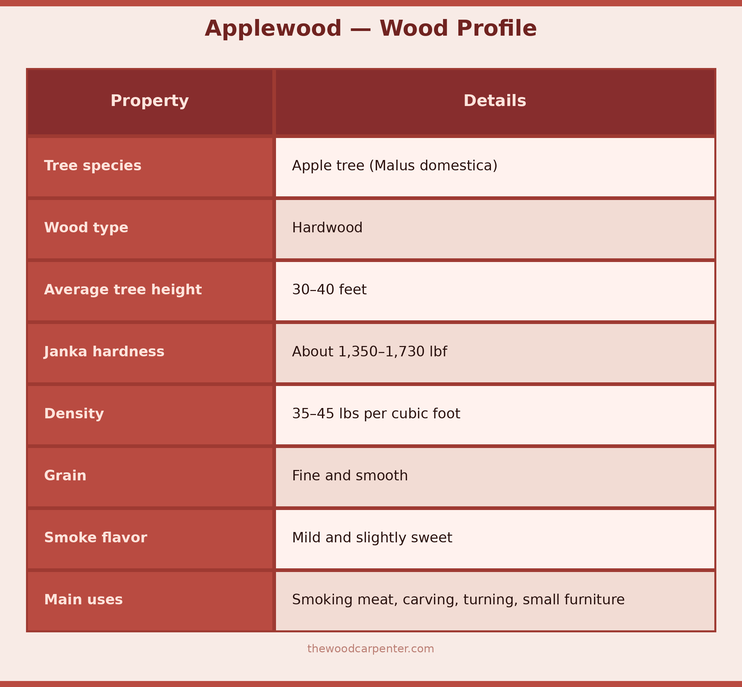
Hardness sits between roughly 1,350 and 1,730 lbf on the Janka scale — harder than cherry, softer than hickory. Density is around 35 to 45 pounds per cubic foot. The grain is fine and straight. Heat output as firewood is around 26.5 million BTU per cord, which puts it right alongside oak. Good numbers all around. But the numbers don’t really capture why people love this wood. That comes down to how it actually performs.
Apple Wood for Smoking — Why BBQ People Swear By It
If you’ve ever eaten pulled pork or smoked chicken that tasted subtly sweet without being heavy or bitter, there’s a decent chance apple wood was involved.
When apple wood burns slowly — in a smoker, on a charcoal grill with wood chips, or in an offset firebox — it produces a mild smoke with a gentle fruity sweetness. Not syrupy. Not perfumed. Just clean and slightly sweet, the way good smoke should be.
The reason serious pitmasters love fruitwoods like apple is exactly that mildness. Stronger woods like hickory or mesquite can overwhelm delicate proteins. Apple wood doesn’t do that. It enhances without dominating.
Pork is the classic pairing. Ribs, pork shoulder, pork belly — the sweetness of the smoke and the richness of the pork just work together naturally.
Chicken and turkey take apple smoke beautifully. The result is golden skin, moist meat, and a flavor that’s interesting without being heavy.
Fish — especially salmon — does really well with apple wood. The smoke is gentle enough that it doesn’t overpower the delicate flavor.
Vegetables and cheese are worth trying if you want to experiment. Apple wood smoke on cold-smoked cheddar is a genuinely impressive thing.
A simple example many backyard cooks try is smoking chicken using apple wood chips in a charcoal grill. The result is usually a light golden color and a gentle smoky aroma.
Smoking Strength Compared to Other Woods
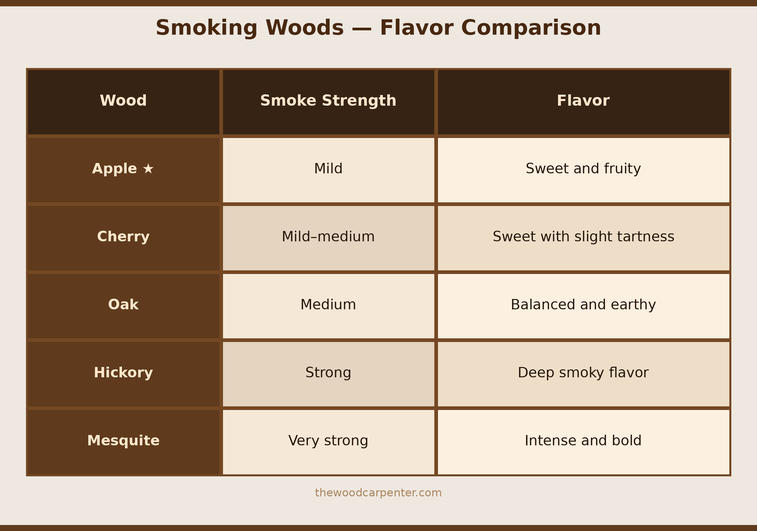
If you’re new to smoking meat, apple wood is actually a great starting point because it’s forgiving. Hard to overdo it.
Apple Wood as Firewood
People who burn apple wood in their fireplace or wood stove tend to notice two things right away.
First — it burns well. Because it’s dense, it produces a solid amount of heat and good coals. Around 26.5 million BTU per cord, which is similar to oak and significantly more than softer woods like cherry or pine. It burns steadily rather than flaring up and burning out fast.
Second — it smells good. That faint sweet scent that apple wood has when you cut it carries through to the smoke when it burns. Nothing dramatic. Just a warmth to the smell of the room that you notice and appreciate. It doesn’t throw excessive sparks either, which matters if you have an open fireplace.
The one rule with apple wood firewood: it needs to be properly dried before you burn it. Fresh-cut apple wood has a lot of moisture in it. Burn it green and you get excessive smoke, poor heat output, and creosote buildup. Give it 12 to 18 months of proper drying and it’s completely different.
Firewood Comparison
| Wood | Heat Output (BTU per cord) | Burning Quality |
| Apple ★ | ~26.5 million | Steady, pleasant smell |
| Oak | ~26.4 million | Long burn time |
| Hickory | ~27.7 million | Very hot burn |
| Cherry | ~20.4 million | Light pleasant smoke |
| Pine | ~14.3 million | Fast burning |
Apple Wood in the Workshop
This is where apple wood quietly shines in a way most people outside the woodworking world don’t know about.
The fine, straight grain means it cuts cleanly. Hand tools glide through it without fighting. It holds detail well — better than many more famous woods — which is why carvers have used it for generations.
Cutting boards and kitchen items — apple wood is food safe, naturally smooth, and takes a beautiful finish.
Carving — spoons, spatulas, small figures. The tight grain means you can carve fine detail without the wood splitting or tearing.
Turning — woodturners particularly love apple wood. Turned bowls, pens, and small vessels often show off those warm pink and amber tones beautifully.
Small furniture and joinery — apple wood glues well and holds screws securely.
With a good oil finish, apple wood develops this warm reddish glow that looks almost lit from within. It’s quieter than burled walnut — but genuinely beautiful.
Apple Wood vs Other Popular Woods
Different woods perform better for different tasks. Apple wood sits somewhere in the middle — not the strongest, but very versatile.
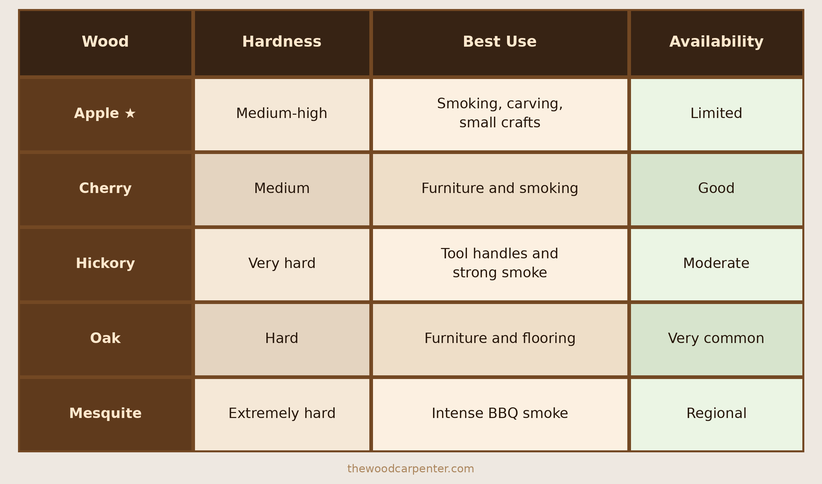
vs Cherry — both are fruitwoods with mild smoke and beautiful warm tones. Cherry is slightly softer and more widely available as lumber. Apple is harder and arguably more interesting to carve.
vs Oak — oak is harder, more available, and better for large furniture and flooring. For smoking, oak gives balanced earthy smoke; apple gives sweetness.
vs Hickory — hickory is significantly harder, excellent for tool handles, and produces a strong deep smoke that’s polarising. Apple is gentler in every way.
vs Walnut — walnut is a premium furniture wood with a rich dark color apple can’t match for large-scale work. But for smaller projects and carving, apple competes well.
How to Dry Apple Wood Properly
Apple wood needs to be dried slowly. If it dries too fast — sitting in direct sun, or near a heat source — it cracks. The moisture leaves the outside faster than it can leave the inside, and the wood splits along the grain trying to relieve the tension.
Split the wood into smaller pieces first. More surface area means more even drying. Stack it off the ground — on a pallet or simple rack — where air can circulate around the sides. Cover the top to keep rain off, but leave the sides open.
For firewood, give it 12 to 18 months minimum. For woodworking, you really want two years or more to get down to the moisture level where the wood is stable and won’t move around on you after you’ve made something.
Properly dried apple wood is a completely different material from green apple wood. The patience is worth it every time.
Where Apple Wood Falls Short
Hard to find in quantity. Because it comes from orchards rather than managed timber forests, supply is inconsistent.
Not suited for outdoors. Apple wood isn’t naturally rot-resistant. For outdoor use, you need something like teak or cedar instead.
Small irregular sizes. If you want wide boards for a tabletop or long lengths for floor planks, apple wood will frustrate you. It’s a small-project wood.
Common Questions
Where do you actually buy apple wood? BBQ supply stores often carry it as chips or chunks for smoking. For woodworking, specialty lumber dealers and local sawyers are your best bet. Orchards clearing out old trees are sometimes willing to give or sell the wood directly — worth asking.
Is it safe for cutting boards and kitchen utensils? Yes. Fully food safe. Finish with mineral oil or beeswax and maintain it the same way you would any wooden kitchen item.
Can I use it outdoors? Short answer — not really, not without very heavy sealing and regular maintenance. It’ll deteriorate in wet conditions. Stick to indoor use.
How long does apple wood last if you take care of it? Indoor pieces that are properly finished and occasionally maintained can last 50 to 100 years without much trouble. Plenty of old apple wood kitchen items are still in daily use after generations.
What’s the best beginner project with apple wood? A simple carved spoon or a small cutting board. Both show off the material well, both are forgiving for less experienced woodworkers, and both actually get used — which is the point.
The Bottom Line
Apple wood won’t show up on lists of the most famous or prestigious woods. It doesn’t come in wide boards. It’s not easy to find in bulk. It won’t make a grand dining table or a hardwood floor.
But for what it does do — smoke food gently, carve beautifully, burn warmly, finish with a glow — it’s genuinely hard to beat.
Most apple wood comes from trees that lived a full life — grew for decades, produced fruit, and then got cleared out when they stopped being productive. Using the wood is genuinely sustainable.
No clear-cutting. No old-growth forest being touched. Just an orchard tree that finished its fruit-producing life and is now getting a second one — as a bowl, a spoon, a smoked rack of ribs, a warm fire on a cold night.
It’s the kind of material that rewards people who pay attention to the quieter things. And that, honestly, puts it in pretty good company.