
Key Takeaways:
- Trees appear hundreds of times across Scripture — they’re one of the most consistent symbols in the entire Bible
- The biblical story begins with trees in Genesis and ends with a tree in Revelation — it’s one complete narrative arc
- Specific trees — olive, fig, cedar, mustard, and others — each carry distinct theological meaning
- Jesus used trees constantly in His teaching because His audience lived and worked alongside them every day
- Understanding tree imagery opens up layers of meaning in Scripture that casual reading often misses
- More than 30 different tree species are referenced across the Old and New Testaments
You’d Be Surprised How Often Trees Show Up in the Bible
Open your Bible anywhere and there’s a good chance a tree is nearby.
In the opening pages of Genesis, humanity stands beside two of the most consequential trees ever described. A few chapters later, Abraham sits under a tree when God visits him in the heat of the day.
Moses meets God in a burning bush on a mountainside. Elijah — exhausted, broken, and asking God to take his life — collapses under a broom tree and is fed by an angel.
And then in the New Testament, a short tax collector named Zacchaeus climbs a sycamore tree just to catch a glimpse of Jesus walking through the crowd below. Jesus stops. Looks up. And changes that man’s life entirely.
Trees frame some of the most significant moments in all of Scripture. But here’s what’s easy to miss — they’re never just scenery. In the Bible, trees are active participants in the story. They carry meaning.
They mark moments. They teach things that sentences alone can’t quite capture.
This article walks through the most important trees in Scripture, what they mean, and why understanding them changes how you read the whole Bible.
Where It All Starts: The Two Trees in the Garden
The first trees the Bible mentions are also the most important in human history.
In Genesis 2, God plants a garden in Eden and places two specific trees at its centre. Not on the edges. Not tucked away somewhere. At the centre — where everything in the garden pointed toward them.
The Tree of Life. And the Tree of the Knowledge of Good and Evil.
The Tree of Life represented something that’s hard to fully put into words — uninterrupted, unbroken communion with God. Access to it meant life without death, without decay, without the separation that now sits at the heart of the human experience. It wasn’t a magical fruit. It was a symbol of what human beings were created for.
The Tree of the Knowledge of Good and Evil is the one that gets misunderstood most often. It wasn’t evil in itself. God planted it. The issue was the boundary God set around it — not to withhold something good, but because eating from it meant humanity choosing to define right and wrong on their own terms rather than trusting God’s.
It was a test of relationship. Of trust. Would the creature submit to the Creator, or would it decide it knew better?
The answer changed everything.
What happens immediately after is a detail worth noticing. Adam and Eve cover themselves with fig leaves. It’s the first human attempt at self-sufficiency — managing shame and brokenness without returning to God.
That instinct — to cover up rather than turn back — runs through the entire human story.
After the fall, God blocks access to the Tree of Life with cherubim and a flaming sword. This gets read as punishment, but there’s another layer here that many theologians across church history have pointed to.
Letting broken, fallen humanity eat from the Tree of Life and live forever in that condition would have been the real tragedy. The exile from Eden wasn’t the end of the story. It was the beginning of the rescue.
And here’s the full circle that makes the Bible one of the most structurally remarkable books ever written — the Tree of Life appears again in the very last chapter of Revelation. Standing beside the river of life in the New Jerusalem, bearing fruit every month, its leaves bringing healing to the nations.
The story that begins with a tree ends with a tree. That’s not accident. That’s architecture.
The Olive Tree: Where Peace, Anointing, and Covenant Meet
If you had to pick one tree that carries the most sustained weight across both testaments, the olive tree makes a strong case.
Its first appearance after the flood is simple and beautiful. After weeks on the water, Noah sends out a dove. It comes back carrying an olive branch. The waters are receding. Something new is beginning.
That image — an olive branch as a sign of peace and restoration — has lasted thousands of years and is still recognised by people who’ve never read a Bible.
But the olive tree goes deeper than that moment.
Olive oil was used throughout the Old Testament for anointing — setting apart priests, kings, and prophets for their God-given roles. The act of anointing with oil wasn’t ceremonial decoration.
It was a declaration that someone had been chosen. Set apart. Given a specific purpose by God.
The word Messiah in Hebrew and Christ in Greek both mean exactly the same thing — the anointed one. Every drop of olive oil used in every anointing ceremony across the Old Testament was pointing toward someone.
Jesus is the ultimate fulfillment of every anointing that ever happened.
In Romans 11, Paul builds one of his most complex theological arguments entirely around an olive tree — the cultivated tree, the natural branches, the wild branches grafted in. He’s explaining the relationship between Israel and the Gentile church, and he does it through the image of one tree with room for more.
And then there’s Gethsemane. The garden where Jesus prayed the night before the crucifixion. The word Gethsemane means oil press — the place where olives are crushed to release what’s inside them. In that garden, in that place of crushing pressure, the anointed one surrendered His will to the Father completely.
The olive tree holds all of that.
The Fig Tree: Fruitfulness, Hypocrisy, and National Identity
The fig tree is one of the most layered symbols in Scripture and it’s easy to miss how consistently it runs through the biblical story.
It starts in the garden — fig leaves are what Adam and Eve reach for after the fall. Not to return to God. Not to confess. But to cover themselves. To manage the situation on their own terms. The fig leaf has been humanity’s go-to response to shame ever since.
Moving into the Old Testament, the fig tree becomes strongly associated with Israel as a nation. Sitting under your own vine and fig tree was the biblical image of peace, security, and blessing in the promised land.
When Israel was faithful, the fig trees flourished. When the prophets described coming judgment, withering figs were part of the picture.
The most dramatic fig tree moment in the New Testament is the one that confuses people most — Jesus cursing the fig tree in Matthew 21. It’s the only destructive miracle in the Gospels, and it needs its context to make sense.
This happens immediately after the triumphal entry into Jerusalem and immediately before Jesus cleanses the temple. The sequence is deliberate. The fig tree was covered in leaves — it looked alive, productive, impressive from a distance. But it bore no fruit.
Jesus wasn’t having a bad morning. He was acting out a parable in real time. The religious establishment of Israel had all the outward appearance of spiritual life and produced nothing of real value.
The cursing of the fig tree was a judgment on that — visible, immediate, impossible to miss.
The lesson travels forward in time without losing any of its edge. Religious performance without genuine fruit isn’t impressive to God. It never has been.
The Cedar of Lebanon: Between Glory and the Warning About Pride
The cedars of Lebanon were the most impressive trees in the ancient Near East. Enormous, ancient, fragrant, virtually indestructible — they were the building material of choice for Solomon’s temple and palace. When you wanted to build something that would last, you used cedar from Lebanon.
Because of this, cedars became biblical symbols of majesty and lasting strength. Psalm 92:12 says the righteous will grow like a cedar of Lebanon — tall, deeply rooted, thriving, unmoved by seasons or storms.
But the cedar carries a second edge.
Ezekiel 31 uses a towering cedar as a metaphor for the pride of Assyria and Egypt — nations that became great and forgot where their greatness came from. God brings them low. The tallest trees in the forest fall hardest when pride is the root system holding them up.
The cedar threads a needle that runs through the whole Bible — what God’s people are meant to grow into, and the warning that comes when growth becomes self-congratulation.
Real strength, the Bible insists, is always rooted in dependence on God. The moment you forget that, the height you’ve reached becomes the distance you have to fall.
The Mustard Tree: The Kingdom That Starts Invisible
Jesus tells a parable in Matthew 13 about a mustard seed — the smallest of seeds, He says, that grows into the largest of garden plants, a tree large enough for birds to come and nest in its branches.
He’s describing the Kingdom of God.
It started with a handful of fishermen, a tax collector, and a crucified carpenter from a small town in Galilee. By any reasonable measure of the first century, it was invisible.
Nothing about it suggested it would grow into something that would eventually touch every nation on earth.
But Jesus knew what a seed does when it’s planted in the right ground.
There’s also a deliberate Old Testament echo here that His audience would have caught. Ezekiel uses the image of birds nesting in a great tree to describe nations finding shelter under God’s kingdom. Jesus is reaching back to that image and saying — this is what I’m building. Small now. Unmissable later.
The Cross: The Tree That Pivots the Whole Story
The New Testament writers were deliberate and careful about calling the cross a tree.
Peter in Acts 5:30 says God raised Jesus “whom you killed by hanging him on a tree.” Paul in Galatians 3:13 quotes directly from Deuteronomy — “cursed is everyone who is hung on a tree” — and declares that Christ became a curse for us.
This language connects to Old Testament law in a specific way. Hanging on a tree was associated with being under divine curse.
Paul is making a staggering theological claim — Jesus, who knew no sin, took on the curse that hung over broken, sinful humanity. He was cursed on a tree so that the curse over us could be broken.
The full arc becomes visible when you step back and look at it:
A tree in a garden — humanity chooses independence from God. Death enters.
A tree on a hill — God in human flesh absorbs the consequence. Life is offered back.
A tree beside a river — the Tree of Life in the New Jerusalem, its leaves healing the nations.
Three trees. One story. The most coherent narrative in human history.
Other Trees Worth Knowing
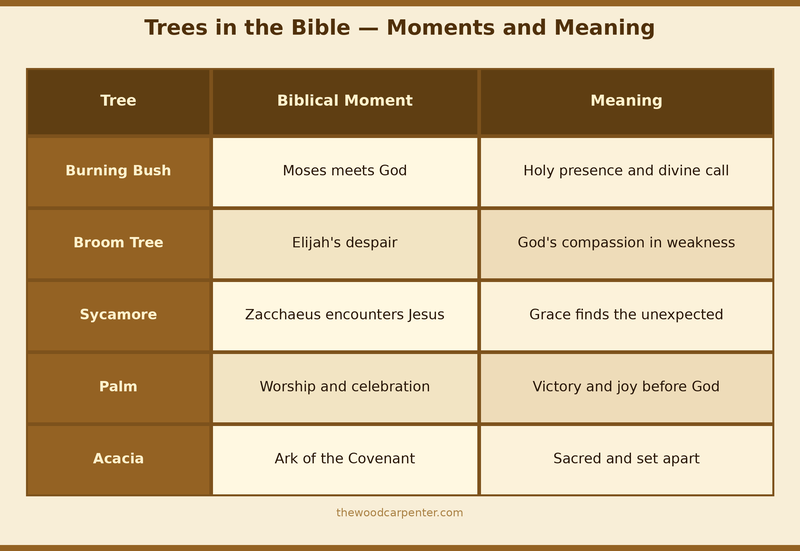
The Burning Bush — Moses encounters God on Horeb in a bush that burns without being consumed. It represents Israel in Egypt — afflicted, burning, but not destroyed. And it introduces the God who sees suffering and decides to do something about it.
The Broom Tree — Elijah, after one of the greatest spiritual victories in the Old Testament, collapses in exhaustion and depression and asks God to end his life. God’s response is not rebuke. It’s food, water, and rest. One of the most tender moments in all of Scripture, framed by a small desert tree.
The Sycamore Tree — Zacchaeus climbs one to see Jesus above the crowd. Jesus stops, looks up, and invites Himself to dinner. By the end of that meal, a man nobody expected God to care about has encountered grace that changed everything.
The Palm Tree — used in worship and celebration, palm branches are spread before Jesus on His entry into Jerusalem and appear again in Revelation as the worship of the redeemed before the throne of God.
What Tree Imagery Teaches About the Spiritual Life
The Bible returns again and again to one central image — the person whose life is rooted in God described as a tree planted by water.
Psalm 1 opens with it. The person who meditates on God’s word is like a tree planted beside streams — its roots go deep enough that drought doesn’t devastate it. It produces fruit in season. Its leaves don’t wither.
Jeremiah 17 uses the exact same image and contrasts it directly with the person who trusts in human strength — like a shrub in the desert, in parched land, unable to see when good comes.
The contrast is clear and consistent. Shallow roots mean instability. Deep roots — grown slowly, over time, through regular return to God — mean the kind of resilience that storms can’t permanently destroy.
Trees don’t grow overnight. Neither does genuine faith. Both need the right conditions, consistent nourishment, and enough time for roots to go deeper than the surface.
Frequently Asked Questions About Trees in the Bible
What is the most mentioned tree in the Bible? The olive tree appears most frequently and carries the most sustained symbolic significance — connected to peace, anointing, covenant, and the identity of both Israel and the Gentile church.
What does the Tree of Life represent in the Bible? Unending communion with God — life as it was designed to be, without death or separation from the source of all existence. It appears in Genesis 2-3 and again in Revelation 22, forming the narrative frame of the entire Bible.
Why did Jesus curse the fig tree? Most biblical scholars read it as a symbolic act of judgment on the religious establishment of Israel — which had the outward appearance of spiritual health but was producing no genuine fruit. The context surrounding the event makes the meaning clear.
How many trees are mentioned in the Bible? Scholars estimate more than 30 different tree species are referenced across the Old and New Testaments.
Is the cross called a tree in the Bible? Yes — deliberately. Both Peter in Acts 5:30 and Paul in Galatians 3:13 refer to the cross as a tree, connecting Jesus’s death to Old Testament language about bearing a curse. The theological point is that He took on humanity’s curse in our place.
What does being like a tree planted by water mean? Psalm 1:3 and Jeremiah 17:8 both use this image to describe someone whose life is anchored in God — deeply rooted, fruitful, and resilient even through difficult seasons. It’s one of the most enduring pictures of spiritual health in Scripture.
Why did God block the Tree of Life after the fall? Many theologians read it as mercy rather than punishment — allowing fallen humanity to live forever in a broken, sinful state would have been the real tragedy. The block was the beginning of a rescue plan, not the end of the story.
What tree did Zacchaeus climb? A sycamore tree in Jericho — Luke 19:1-10. It marks one of the most vivid and unexpected salvation encounters in the Gospels.
The Bottom Line
Trees in the Bible are not background decoration. They are theologically loaded, narratively significant, carefully chosen markers that run from the first pages of Genesis to the final vision of Revelation.
Understanding them doesn’t just add historical context. It opens up the Scripture in ways that reward the reader who pays attention — revealing how deliberate, coherent, and beautifully constructed the biblical story actually is.
The same God who planted a garden and placed two trees at its centre is working toward a city where the Tree of Life stands beside the river and its leaves bring healing to every nation.
That story is still unfolding.
And the invitation it extends — to become like a tree planted by water, deeply rooted, genuinely fruitful — is as alive today as it was when the words were first written down.