
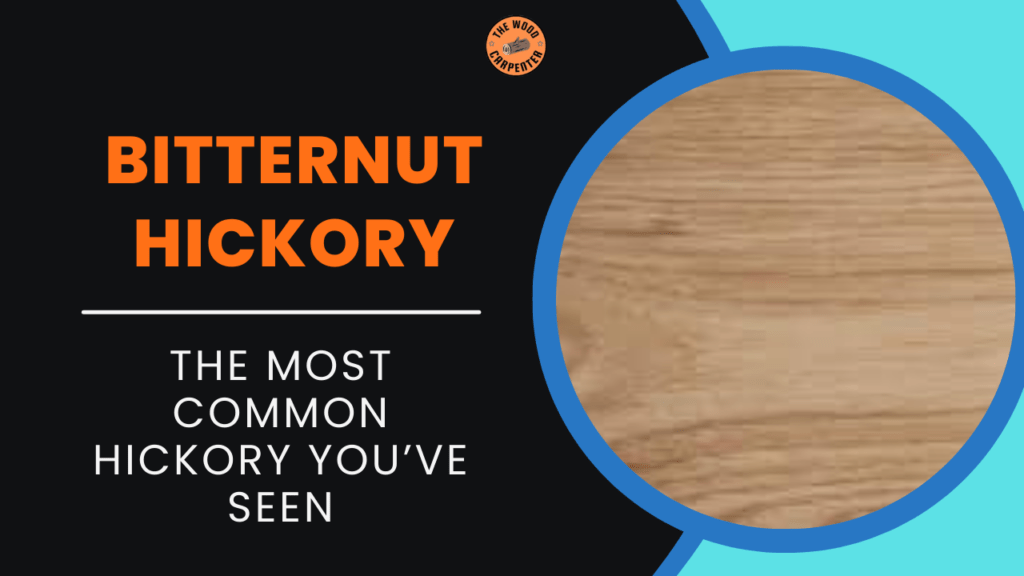
Bitternut hickory is one of the most common hickory trees in North America. Every day, countless people walk past it without realizing what it is. This guide explains about bitternut hickory.
By the time you finish this article, you will know what it looks like, where it grows and why the wood matters — whether or not its nuts are useful.
What Is Bitternut Hickory?
Bitternut hickory is a hardwood tree with the scientific name Carya cordiformis. It belongs to the same plant family as walnuts and pecans.
Depending on the region, people may also call it:
- Swamp hickory
- Yellowbud hickory
- Pig hickory
These names come from its growing areas and its bright yellow buds.
Pecan trees are pretty close to bitternut hickory. The leaves are one easy way to tell them apart. The number of leaflets is usually 7 to 9 on bitternut hickory, and clearly 11 or more on pecan.
Quick Facts About Bitternut Hickory
- Height: 60 to 130 feet
- Average lifespan: Up to 200 years
- Wood hardness: Around 1,500 on the Janka scale
- Dry wood weight: About 46 lbs per cubic foot
Where Does Bitternut Hickory Grow?
Bitternut hickory grows across a very large area in North America. It is found from:
- Southern Canada
- The northeastern United States
- The Midwest
- Down to Texas and Florida
This wide range is why it is considered the most widespread hickory species in the country.
It grows well in many environments. You will often find it near rivers, wetlands, and forest edges. However, it can also survive in dry and poor soil. Its deep taproot helps it stay strong during droughts and storms.
Important note: Bitternut hickory is the most cold-tolerant tree in the pecan-hickory group. It grows farther north than most of its relatives.
How to Identify Bitternut Hickory
The easiest way to identify this tree is by its bright yellow buds. No other native North American tree has buds like this. Even in winter, these yellow buds stand out clearly.
Other identifying features include:
- Smooth bark on young trees
- Thin, scaly bark on older trees
- Leaves with 5 to 9 leaflets
- Yellow fall color
- An open canopy that lets light pass through
Because of this open canopy, grass and plants often grow well underneath the tree.
Growth Pattern and Tree Shape
Bitternut hickory is the fastest-growing hickory species. In forests, it grows tall and straight as it reaches for sunlight. In open areas, it grows wider with a broader crown.
The tree has a deep taproot. This makes it very stable but also hard to transplant. Once planted, it should stay in the same place permanently.
It can live almost 200 years, but is in fact the shortest lived of the hickory species. Still, it’s a very long time compared to most trees anyway.
Are Bitternut Hickory Nuts Edible?
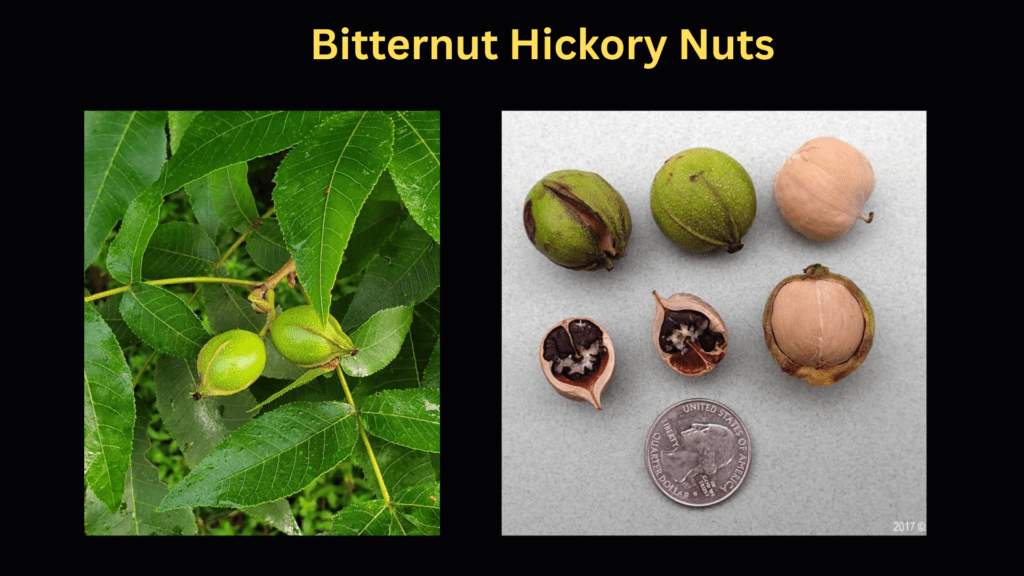
The nuts are very bitter. For the most part, people do not eat these raw because they taste unpleasant. This bitterness is from natural tannins.
Curiously, squirrels tend to bypass these nuts as well, enabling more seeds to develop into new trees.
Though the nuts don’t go to waste. If you really squeeze them, they make a nice mild oil. Some people compare it to pecan oil.
Bitternut hickory trees usually start producing nuts after about 30 years, and heavy nut crops only appear every few years.
Why Bitternut Hickory Wood Is Valuable
Bitternut hickory wood is strong, hard, and durable. Even though it is slightly softer than some other hickories, it is still tougher than many popular hardwoods.
The wood has:
- Light to medium brown heartwood
- Pale yellow sapwood
- A straight grain with medium texture
When both colors appear together, it is sometimes sold as calico hickory.
Common uses include:
- Tool handles
- Ladder rungs
- Sporting goods
- Furniture
- Bent wood projects
- Firewood
- Meat smoking wood
It burns hot and produces excellent smoke flavor, making it popular for smoking meat.
In lumber stores, bitternut hickory is usually sold simply as “hickory”, mixed with other species.
Wildlife and Environmental Benefits
Bitternut hickory plays an important role in forest ecosystems.
It supports wildlife by:
- Feeding birds and small animals
- Hosting moth species like the Luna moth
- Allowing plants to grow underneath due to its open canopy
The tree also regrows easily after being cut or damaged. It can sprout from stumps and roots, which helps it survive logging and fires.
Planting and Care Tips
Bitternut hickory is easy to care for once established.
Best conditions include:
- Full sun or partial shade
- Deep soil (but it adapts well to poor soil)
- Acidic to neutral pH
And it’s not bothered by the presence of black walnut trees nearby, which many other plants can’t abide.
Space should be at the forefront of your mind. This is a tree that needs space both above and below ground. Its ideal use is in parks, spacious lawns and even wild areas.
If you plant one, do so in spring and pick the spot carefully. Transplanting later is very difficult.
Frequently Asked Questions
Can you eat bitternut hickory nuts?
Not raw. They are very bitter. But they can be pressed for oil, which is quite mild.
How can I tell it apart from other hickories?
Look at the bright yellow buds. They are the most reliable feature.
Is it good for smoking meat?
Yes. It also creates a lot of strong, flavorful smoke and burns hot.
How fast does it grow?
Fastest of the hickories, but still takes decades to attain full stature.
Is the wood good for furniture?
Yes, but it is hard to work with. Sharp tools are required.
Does it attract wildlife?
Yes. It offers food for insects, birds and small mammals.
When does it start producing nuts?
Typically after 30 years, with crops every 3 to 5 years.