
Key Takeaways:
- Briar wood comes from the root burl of Erica arborea, a Mediterranean shrub — not a tree
- The burl takes 30 to 80 years to grow before it’s usable
- Briar handles temperatures over 400°C — higher than almost any other natural pipe material
- Grade affects appearance only — a lower-grade pipe smokes just as well as an expensive one
- A well-maintained briar pipe can last 50 to 100 years
Briar wood is a dense, heat-resistant hardwood that comes from the underground root burl of Erica arborea, a shrub native to the Mediterranean region. The burl takes 30 to 80 years to mature and is harvested, boiled, and slowly dried before being carved into tobacco pipe bowls.
Briar is considered the best pipe-making material in the world because of its exceptional heat resistance, moisture absorption, and durability.
Introduction: Why One Shrub Root Changed Pipe Making Forever
In the mid-1800s, pipe makers were working with clay, cherry wood, porcelain, even bone. Then someone discovered briar. Within a few decades, almost everything else got pushed aside.
That was over 150 years ago. Briar is still the dominant pipe-making material today — not out of habit or nostalgia, but because nothing has come close to matching what it does naturally.
This guide covers everything: what briar wood is, where it comes from, why it works so well, how it’s graded, what else it’s used for, and why serious pipe smokers, woodturners, and knife makers still consider it genuinely extraordinary.
What Is Briar Wood ?
Most people hear “briar wood” and picture some kind of tree. It isn’t.
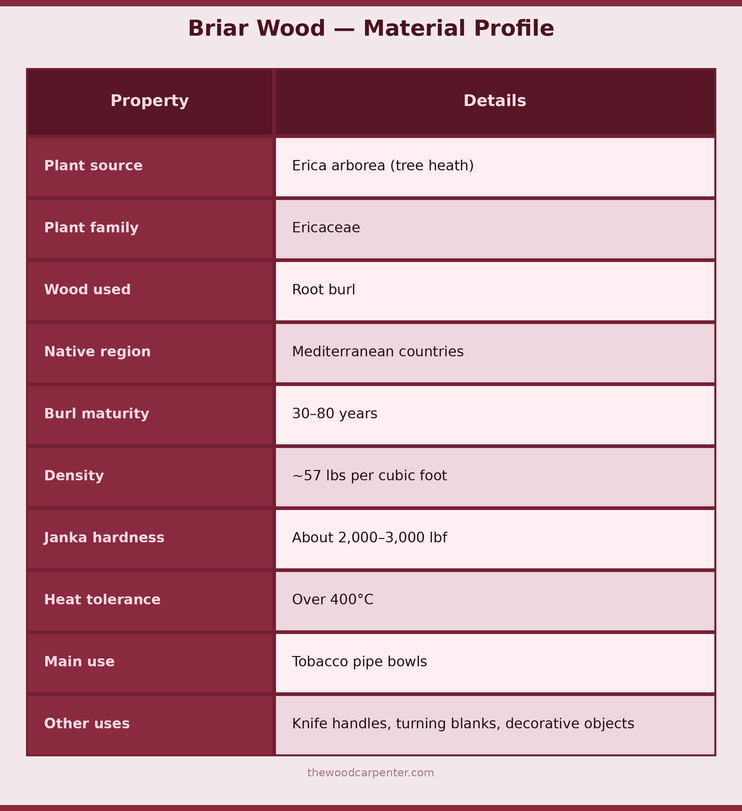
Briar comes from a plant called Erica arborea — commonly known as tree heath. It grows wild across the Mediterranean — France, Italy, Greece, Spain, Turkey, Morocco, Algeria. Above ground the plant is fairly unremarkable. Tough, scrubby, usually only a few meters tall.
The interesting part is underground.
Where the roots meet the base of the plant, a dense rounded growth forms over many decades. This is called a burl. It takes 30 to 50 years in most cases — sometimes 80 years or more — before it reaches a size worth harvesting. When it finally gets cut, dried, and worked, that burl becomes briar wood.
Fresh briar is usually a light tan or creamy color. Age it, finish it, smoke a few hundred bowls through it, and it slowly deepens into warm golden browns and reddish tones. A well-used pipe develops a character that a brand new one simply doesn’t have yet.
Briar Wood Quick Facts
Why the Burl Is the Whole Point
The Mediterranean isn’t an easy place to grow. Dry summers, rocky soil, wildfires moving through every few years. Erica arborea survives by storing energy in the burl. If the plant burns to the ground — which happens regularly — new shoots grow back from the burl. It’s the plant’s emergency backup system.
That survival mechanism is what makes briar wood extraordinary for pipes.
The burl develops tightly twisted, interlocking grain to hold itself together through constant stress. It becomes extremely dense. Hard. Heat resistant in a way most other woods simply aren’t. The same structure that lets the plant survive a wildfire is what lets a briar pipe bowl survive decades of burning tobacco.
You couldn’t design a better pipe material if you tried. Nature did it without trying at all.
Where the Best Briar Wood Comes From
Not all briar is equal. Where it comes from matters — especially to serious pipe collectors and makers.
France — The town of Saint-Claude in eastern France is where the modern briar pipe industry was born. Techniques developed there in the 1800s still influence pipe making today. Corsican briar, from the island of Corsica, has a strong reputation for tight grain and clean material with few defects.
Italy — Home to some of the most respected pipe makers in the world. The Calabria region produces large quantities of briar known for bold grain and warm color tones.
Greece — Greek briar is respected for its density and heat resistance. Many pipe makers worldwide source blocks from Greek suppliers specifically for these qualities.
North Africa and Turkey — Algeria, Morocco, and Turkey have supplied European pipe makers for well over a century. Good consistent material, often at more accessible prices.
The differences between regional sources are real but subtle — the kind of thing that matters deeply to serious collectors and rather less to everyone else.
How Briar Wood Is Harvested and Processed
Getting briar wood from the ground to a finished pipe takes considerably longer than most people realise.
Harvesters first cut the plant above ground, then dig the burl out of the soil — physical work, often on rocky hillsides. A single burl typically weighs between 5 and 30 kilograms.
The burl is cut into rough blocks, then boiled in water for several hours. This draws out the natural saps and resins that would otherwise affect the flavor of the smoke. It also begins the drying process.
Then comes the slow part. Standard commercial briar dries for one to two years. High-end pipe makers who prioritise quality often prefer briar dried for five years or more. Slow drying prevents cracking and produces wood that stays stable once shaped.
By the time a block reaches a pipe maker’s bench, it has already been years in the making — and the burl itself took decades before that.
Briar Wood Grades Explained
When pipe makers buy briar, they grade it mainly on appearance — grain quality, number of natural pits, and surface defects.
| Grade | Description | Typical Use |
| Plateau | Top part of the burl with natural surface | Premium artisan pipes |
| Ebauchon | Standard rough block | Most commercial pipes |
| Extra / Grade A | Very few defects, beautiful grain | High-end pipes |
| Rustique / Grade B–C | More pits or irregular grain | Sandblasted or textured pipes |
One thing every experienced pipe smoker knows: grade affects how a pipe looks, not how it smokes. A lower-grade pipe with a sandblasted finish — where the texture hides the pits — can smoke every bit as well as a flawless straight-grain pipe costing ten times more. Many experienced smokers actively prefer them.
Why Briar Wood Is the Best Material for Pipes
It’s worth being specific here because the answer isn’t simply “it’s a hard wood.”
Heat resistance — Tobacco burns hot. Briar handles temperatures over 400°C without cracking, charring through, or breaking down. Most other woods fail well below this threshold.
Moisture absorption — Burning tobacco produces moisture. Briar’s porous structure absorbs some of that moisture as smoke passes through, producing a cooler, drier, more comfortable smoke. This is a physical property built into the wood — not something that can be replicated easily with other materials.
Flavor neutrality — Properly cured briar doesn’t add any taste to the smoke. It stays out of the way and lets the tobacco do what it’s supposed to do.
Durability with workability — Briar is hard enough to last decades of daily use but workable enough that skilled craftspeople can carve detailed shapes from it. That balance is rarer than it sounds — most very hard materials are difficult to work precisely.
Briar Wood Grain Patterns
Because briar comes from a burl, the grain doesn’t run in neat straight lines the way it does in regular timber. It twists, curves, and forms patterns that vary from block to block. This is a big part of why collectors are so passionate about the material.
| Grain Type | Appearance | Rarity |
| Straight Grain | Parallel lines running along the bowl | Rare |
| Bird’s Eye | Small circular dot patterns | Uncommon |
| Cross Grain | Lines running across the pipe | Uncommon |
| Flame Grain | Flowing wave-like lines | Moderate |
| Mixed Grain | Irregular patterns | Common |
Straight grain is the most prized and most expensive. Getting clean parallel lines requires cutting the block at exactly the right angle, which produces more waste and demands more skill. A well-executed straight-grain pipe is genuinely beautiful.
Bird’s eye grain — small circular patterns that look like eyes across the surface — comes from cutting across the tips of the burl’s grain. Striking in a completely different way.
Briar Wood vs Other Pipe Materials
Pipe makers have experimented with many materials over the centuries. Briar remains the most balanced option available.
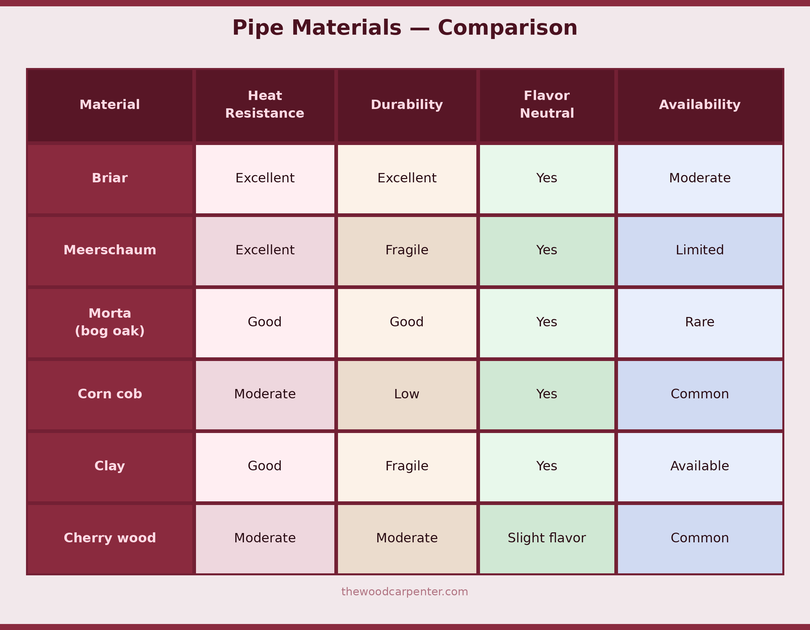
Meerschaum is briar’s most serious competitor. It smokes beautifully and looks extraordinary when carved. But drop a meerschaum pipe and it may be finished. Drop a briar pipe and it’ll likely be fine. That durability gap is why briar dominates.
Corn cob pipes have their fans — but they’re disposable in a way briar isn’t. You smoke a corn cob for a season. You smoke a briar pipe for a lifetime.
Mechanical Properties of Briar Wood
| Property | Measurement | Why It Matters |
| Janka Hardness | ~2,090 lbf | Resists dents and daily wear |
| Modulus of Rupture | 7,120 lbf/in² | Stays strong under stress |
| Crushing Strength | 8,540 lbf/in² | Durable bowl structure |
| Volumetric Shrinkage | 15.6% | Stable once properly dried |
| Heat Tolerance | 400°C+ | Handles burning tobacco reliably |
These numbers back up what people who work with briar already know from experience. It’s genuinely tough material — tougher than its relatively modest origins suggest.
Other Uses of Briar Wood
Pipes are the main event, but briar shows up in other crafts too.
Knife handles — Dense, hard, and attractive after polishing. Knife makers use briar when they want handles that look interesting and hold up to regular hard use.
Woodturning — Pens, bottle stoppers, small bowls, jewelry. Briar on a lathe produces clean cuts and beautiful grain. Results can look almost exotic compared to common timber.
Decorative inlay — Thin pieces of briar get used as inlay in boxes, frames, and decorative objects where the unusual grain catches light in ways plain wood doesn’t.
What you won’t find is briar in furniture or flooring. The burls are simply too small and irregular to produce consistent large pieces. It’s a small-project material by nature — but within that world, it’s exceptional.
How to Care for a Briar Pipe
A good briar pipe, looked after properly, can outlast the person who bought it. Pipes made 80 to 100 years ago are still being smoked today.
Break it in slowly. With a new pipe, smoke shorter sessions at first. This allows a thin carbon layer — called the cake — to build up inside the bowl. That cake protects the wood and actually improves how the pipe smokes over time. Rushing this is one of the most common mistakes new pipe smokers make.
Let it rest. The wood needs time to dry fully between smokes. Serious pipe smokers rotate five or six pipes so each one gets a day or two off between sessions.
Clean it regularly. Run a pipe cleaner through the stem after each smoke to clear out moisture and residue. Thirty seconds of work that makes a real difference over years of use.
That’s essentially it. Not complicated — just consistent.
Is Briar Wood Sustainable ?
This question tends to come up more often now, and I did feel it needs a straight answer too.
Since a burl is formed on the root system, when a burl is harvested, the rest of the root system can live on, and the plant is often able to sprout again. It takes between 30 and 50 years for a new burl to grow to be able to use some of the burl. If an area gets over-harvested, it takes a long time to recover.
Responsible suppliers rotate their harvesting areas and give regions decades to recover. Many now track origin and source transparently.
Whether this is happening consistently across the whole industry is harder to verify — but awareness is genuinely higher than it was a generation ago, and consumer pressure is pushing the right direction.
Apple Wood: The Hidden Gem for BBQ and Crafts
Texas Ebony Tree Secrets: Why This Native Tree Is So Tough
Frequently Asked Questions About Briar Wood
What is briar wood made from?
Briar wood comes from the underground root burl of Erica arborea, a shrub that grows around the Mediterranean. The burl forms slowly over 30–80 years. After it is harvested, it is boiled and dried before craftsmen turn it into pipes.
Why is briar used for pipes?
Briar handles heat extremely well, even above 400°C. It also absorbs some moisture from the smoke, which helps keep the pipe cooler and smoother to smoke. On top of that, it does not affect the flavor and is strong enough to last many years.
How long can a briar pipe last?
If it is used and cleaned properly, a briar pipe can last for decades. Some pipes made in the early 1900s are still being used today.
What do briar pipe grades mean?
Grades mainly describe how the wood looks. Pipes with perfect grain and fewer marks are graded higher. But the grade usually affects appearance, not how the pipe smokes.
Is expensive briar always better?
Not necessarily. Higher prices often mean nicer grain or more detailed craftsmanship. Many mid-range briar pipes smoke just as well as very expensive ones.
Where does the best briar come from?
Some of the most respected briar comes from France (especially Corsica), Italy, and Greece. Each region produces wood with slightly different grain and density.
Is briar used for anything besides pipes?
Yes. Craftspeople also use briar for knife handles, pens, and small decorative wood items because of its strength and beautiful grain.
Is briar wood sustainable?
It can be when harvested responsibly. The plant grows back after harvesting, but it takes many years to form another usable burl, so careful harvesting is important.
What is “cake” in a briar pipe?
Cake is the thin carbon layer that forms inside the bowl after repeated use. This layer protects the wood and helps the pipe smoke better over time.
How can you tell if a briar pipe is good quality?
Good pipes usually have even grain, smooth finishing, and a stem that fits properly. Most importantly, the pipe should allow air to flow easily when you draw from it.
The Bottom Line
Over a century and a half, many materials have been attempted for pipes, but briar still tops them all. With its natural resistance to heat and durability as well as moisture-management, it is nearly perfect for the task.
What makes it special is that all these qualities come from nature. The plant developed a dense root burl to survive harsh Mediterranean soil and fires. That same toughness is what makes briar such a great material for pipes.
Put another way, briar didn’t just pop up one day and achieve stardom — it took generations to get its status.