
Centrolobium spp. — what it is, how it works, and why it deserves more attention than it gets
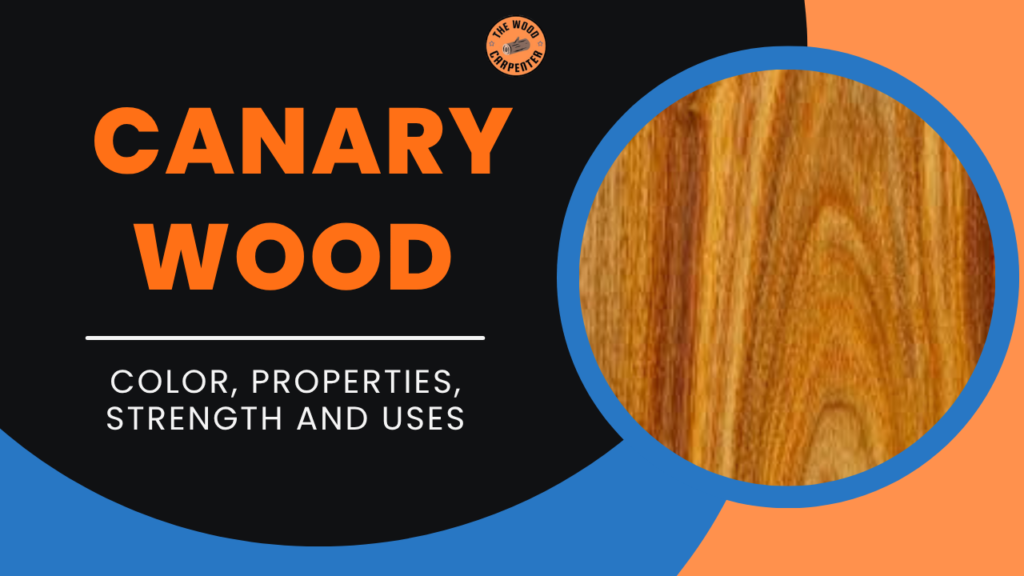
Open a freshly planed board of canarywood and you’ll understand immediately why people stop and stare. The colour isn’t one thing — it’s half a dozen things at once. Bright yellow, orange, reddish-brown, and dark purple-black streaks all running through the same piece, competing for attention and somehow all winning. It looks almost painted. It isn’t. This is what the tree actually grew.
Canarywood gets overlooked in exotic hardwood conversations, overshadowed by the famous names — rosewood, ebony, purpleheart. That’s a mistake. Unique colour range, genuinely accommodating to work with, excellent durability, and a price that won’t make you wince. Let’s give it the attention it deserves.
What Is Canarywood?
Canarywood covers Centrolobium spp. — a genus of over 40 tropical hardwood species, most grouped together commercially because their appearance and properties are broadly similar. The most common include Centrolobium microchaete (Tarara amarilla), C. orinocense, and C. tomentosum.
Other names you’ll see: Canary, Yellow Tarara, Tarara amarilla, and occasionally Brazilian Satinwood in some markets — though that last one causes confusion since it’s applied to other species too.
It belongs to the Fabaceae family — the legumes — making it a distant botanical relative of pau ferro and rosewood, though it shares little of their working character.
As with most exotic hardwoods, a small number of unrelated species get sold under the same trade name in various markets. Buy from a supplier who knows their stock by genus. If they can’t tell you the species, be cautious.
Where It Comes From
Canarywood grows across a wide range — from Panama through Venezuela, Colombia, and into Brazil. It favours open forest and drier terrain rather than deep rainforest, which is part of why it’s more consistently available than many tropical species tied to specific habitats.
Typical trees reach 65 to 100 feet tall with trunk diameters of 2 to 3 feet. Large specimens can hit 4 feet across — enough to produce boards of useful width for furniture and cabinetry, though truly wide clear slabs take some hunting.
The sapwood is pale yellow, sharply and cleanly separated from the heartwood — almost a hard line rather than a gradual fade. The heartwood is where everything interesting happens.
The Colour — What Nobody Fully Prepares You For
The base heartwood runs from pale yellow-orange through warm orange-brown to reddish-brown. Overlaid on that are contrasting streaks of dark purple, near-black, and deep brown winding through the grain in irregular patterns.
On the most striking pieces, you get bright gold, burnt orange, deep red, and dramatic black all on one board. The “rainbow wood” label is genuinely earned.
The grain is typically fine to medium, straight, with good natural lustre. Irregular or interlocked grain occurs on some pieces — worth watching for when you’re selecting stock.
Here’s the thing nobody tells you clearly enough: the colour will change. Not subtly. The bright yellows mellow toward tans and warm browns. The vivid, almost neon freshness of a newly worked board deepens over months and years into a richer, more uniform reddish-brown. The dark streaks stay visible but the palette homogenises.
Some people find the aged colour more handsome — quieter, deeper, more sophisticated. Others specifically want the vivid freshness and find the ageing disappointing. Neither reaction is wrong, but go into any project knowing it will happen. Your finish choice significantly affects the rate of change.
Key Properties
Janka hardness: 1,520 lbf. Harder than black walnut (1,010 lbf) and cherry (950 lbf). Solidly substantial without being punishing on tools.
Density: ~52 lbs/ft³. Good heft in the hand. Not as dense as ipe or pau ferro, but meaningfully heavy.
Rot resistance: very durable. Resistant to decay, termites, and marine borers. An impressive durability profile that puts it well beyond most decorative exotics. This is why it has a legitimate history in boatbuilding, not just furniture.
Dimensional stability: good. Once properly dried, it behaves well and doesn’t move dramatically with humidity changes.
One weakness worth noting: susceptible to the common furniture beetle. Less relevant for finished furniture in normal conditions, but worth knowing for pieces likely to be stored long-term.
Working With It — The Honest Version
Machining and hand tools: For an imported tropical hardwood with genuine structural strength, canarywood is remarkably accommodating. Sawing is clean, routing is well-behaved, and straight-grained material responds nicely to a sharp hand plane. Considerably less demanding than species of comparable hardness like wenge or padauk.
Where you need to pay attention: irregular grain causes tearout during planing. The fix is standard — sharp tools, fine cuts, read the grain direction before committing to a pass. A drum sander is the safe option for thicknessing boards that show wild figure.
One canarywood-specific quirk: sharp edges chip and crumble unexpectedly during turning when working square stock on the lathe. The corners catch air before the piece rounds over, and the wood can break away. Take conservative cuts on square blanks initially. Once it’s rounded, it turns very well.
Pre-bore for screws and nails. The hardness means driving fasteners without pilot holes risks splitting, particularly near edges. Takes ten seconds and completely solves the problem.
Gluing: No issues. Unlike oily rosewoods, canarywood bonds well with standard adhesives — PVA, hide glue, epoxy all work. No acetone wipe-down, no special prep needed. Just normal practice.
Finishing: This is where you need to think carefully because of the colour change question.
Oil finishes (Danish oil, tung oil, hardwax oil) produce a beautiful immediate result and enrich the colour well — but offer little UV protection, meaning the colour change proceeds at its natural pace. If you’re happy with the ageing, oil finishes are lovely. If you want to preserve the vivid freshness as long as possible, they’re not the right choice.
Film finishes with UV inhibitors — quality lacquers, catalysed finishes, marine-grade spar varnish — substantially slow the colour change. They won’t prevent it entirely, but they buy you considerably more time. For pieces where the bright yellow-orange palette is the whole point, UV-protective lacquer is the right call.
Water-based finishes work but can read cool or flat on a wood with this much warmth. Test on an offcut first.
Always test any finish on a scrap piece from the same board — canarywood’s colour variation means different sections can respond quite differently to the same product.
Dust warning: Canarywood dust is notably irritating to the nose and eyes, even at low exposure levels. Multiple woodworkers describe it as feeling physically sharp in the nasal passages almost immediately. Proper dust mask for all machining and sanding — not just heavy cuts. Apply it consistently.
The Acoustic Side — Something Most Guides Skip
This deserves more attention than it usually gets.
Canarywood has genuinely useful acoustic properties. It’s used for high-end speaker enclosures and home audio cabinets, where its resonance characteristics actively contribute to sound quality — unusual in hardwoods, most of which are chosen for speaker cabinets precisely because they dampen resonance.
Among guitar builders, it’s appearing as back and side material on acoustic instruments, with players and luthiers reporting tonal character similar to padauk — warm, resonant, with pleasing clarity. Guitar amp cabinet builders have explored it specifically for what one noted builder called its “singing” qualities.
For anyone interested in instrument making or audio work, canarywood is worth serious consideration. The combination of acoustic properties, workability, and appearance makes it genuinely interesting at a price point more accessible than most alternatives.
What People Use It For
Furniture is where it shines most obviously. Dining tables, cabinet doors, sideboards — the colour range turns a single piece of canarywood furniture into a room’s focal point without trying. Pairs beautifully with quieter timbers used for structural elements, where the contrast does all the work.
Flooring earns its place here on merit, not just looks. The hardness exceeds walnut, the rot and termite resistance is genuine, and dimensional stability after drying is solid. High-end interior flooring that performs as well as it looks.
Turning is where most hobby woodworkers first encounter it — and a great entry point before committing to larger stock. The colour in a turned bowl can be extraordinary. Pen blanks and small turning blanks are accessible and low-risk.
Musical instruments — acoustic guitar backs and sides, xylophone bars — are an emerging use as luthiers explore alternatives to restricted tropical hardwoods. The acoustic properties support this direction properly.
Speaker enclosures and audio cabinets for those who know about the acoustic properties.
Veneer captures the colour for cabinetry and architectural panels without the cost of solid stock. Canarywood veneer on a cabinet door achieves an effect that’s genuinely impossible to replicate with any other species.
Canarywood vs. Similar Woods
Padauk is the closest comparison in terms of vivid warm colour and dramatic initial impact. Padauk skews orange-red rather than yellow-orange, and its colour change is actually more dramatic — it fades from vivid orange to dark chocolate brown, losing much of its early character.
Canarywood’s change is significant but more moderate, and the dark streaking remains visible throughout. Padauk is slightly harder and tougher on cutting edges.
Purpleheart occupies similar territory as a distinctive, dramatic exotic. Purpleheart’s purple-to-brown shift is well known. Canarywood’s multi-colour palette is more complex, but purpleheart is more consistent across boards — a real consideration for matching work.
Yellowheart (Pau amarelo) shares some of the yellow tones but is more uniformly yellow and lacks the multi-colour drama of canarywood’s dark streaking. A quieter option if consistent warm yellow is specifically what you need.
Tulipwood (Brazilian tulipwood) offers a similar multi-colour palette — pink, yellow, and red in striped patterns. More expensive, harder to source in large sizes. For small decorative work and turning, a close comparison. For furniture, canarywood is the more practical choice.
Canarywood’s specific position: wide colour range within a single board, good workability, strong durability, and a price that doesn’t need a special occasion to justify. No other exotic hardwood offers quite that combination.
Price and Where to Buy
Moderate for an imported exotic — noticeably more affordable than rosewoods, ebonies, or premium figured exotics, and honestly priced relative to its visual impact. You’re not paying a scarcity premium for ordinary-looking wood. The colour is real, the price is fair.
Available through specialist exotic timber merchants and online suppliers in North America and Europe — pen blanks, turning blanks, dimensional lumber, and occasionally slabs. Finding very wide clear boards in large sizes takes some searching given the trunk dimensions.
The colour variation between boards can be significant — even from the same supplier, same batch. Some boards lean heavily yellow-orange with minimal streaking; others are predominantly dark red-brown; others are the full spectrum. For a single statement piece, go for maximum drama. For matching cabinet doors or a set of panels, sort carefully and accept that some variation is part of the material’s character rather than a flaw.
Always ask for photos of specific boards before buying for any appearance-critical project.
Common Questions
Will my canarywood keep its bright colour?
No — not indefinitely. The vivid yellows mellow toward tans and reddish-browns with time and light exposure. UV-protective film finishes significantly slow the process but won’t stop it entirely. The aged colour is warm and attractive in its own right, but know what you’re working with going in.
Is canarywood sustainable?
Yes, currently. Not listed on CITES Appendices, not on the IUCN Red List. Wide natural distribution and relatively fast growth give it better supply resilience than many tropical species. It doesn’t carry the ethical complications of Brazilian rosewood or ebony.
Can it be used outdoors?
The durability profile is legitimately impressive — very durable against decay, resistant to termites and marine borers. In principle it can handle exterior conditions. In practice, the UV exposure and weathering will rapidly strip the colour, which seems wasteful for a wood you’re buying primarily for its appearance. Keep it inside.
How does it compare to cherry?
Both are warm, reddish-toned timbers that darken with age. Cherry is softer (950 lbf vs 1,520 lbf), more consistent in colour, easier to source in large clear sizes. Canarywood is harder, more durable, more dramatically coloured. If you want elegant and understated, cherry. If you want striking and distinctive, canarywood has no close domestic equivalent.
Is it good for turning?
Very good — with the one caveat about chipping on square blanks before rounding. Take conservative initial cuts, let it round over properly, and then it turns cleanly and holds detail well. Many turners call it one of their most reliable go-to exotics because the results are consistently impressive.
What does it smell like when worked?
Distinct and noticeable — slightly sharp or resinous. Not unpleasant. Disappears once the piece is finished and sealed.
The Bottom Line
Canarywood is the exotic hardwood that consistently surprises people. They come for the colour — which is legitimately extraordinary, unlike anything else at its price point — and they stay for everything else: workability that doesn’t punish you, durability that earns its place in serious projects, acoustic properties that open up applications most decorative exotics can’t reach, and a price that doesn’t make the decision feel like a risk.
The colour change is real — know about it. The dust is irritating — protect against it. Wild grain needs attention — read the board before you plane it. These are minor considerations for a wood that delivers this much.
Start with a pen blank or a small turning. The colour that comes up off the tool will almost certainly surprise you. Then take on something bigger — a tabletop, a set of drawer fronts, a guitar back. Somewhere the full range of colour can play out across a surface large enough to make an impression.
Canarywood has been quietly doing remarkable things in workshops for decades. It’s past time it got the reputation it’s earned.