
Last Updated on August 1, 2026 by Sam Wood Worker
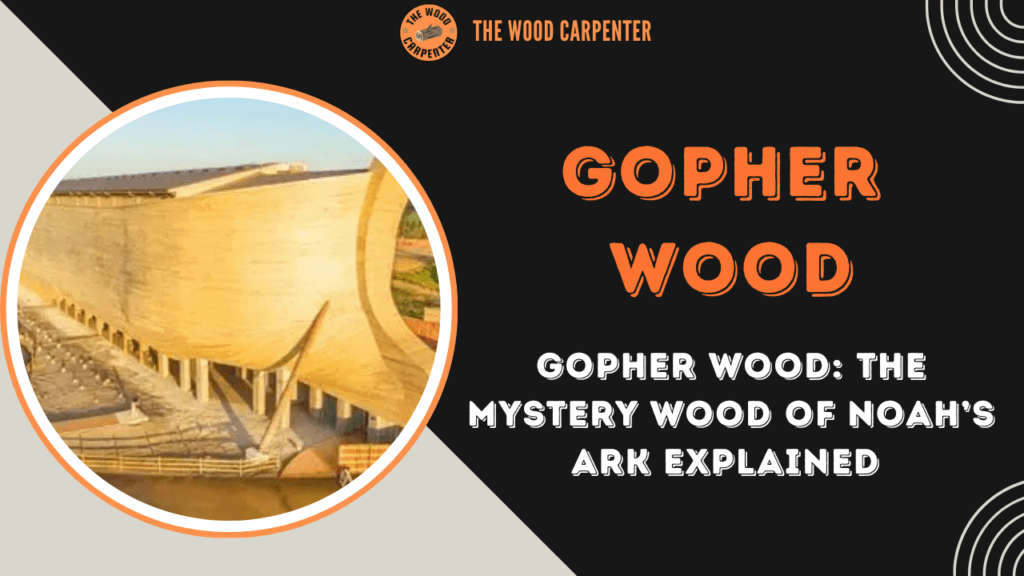
One of the most mysterious materials mentioned in the Bible is Gopher wood. It appears only once; in the story of Noah’s Ark in Genesis 6: 14. Gopher wood is one of the most mysterious materials mentioned in the Bible.
It appears only once, in the story of Noah’s Ark in Genesis 6:14. In that verse, God tells Noah to build the Ark using “gopher wood” and to coat it inside and outside with pitch so it would not leak.
The type of wood is unknown to us possibly since this word is only used once in all of the bible. Millions of people have wondered what in the world “gopher wood” means, and for hundreds of years scholars, historians, and language experts have tried to solve the mystery. Some think that it was one particular tree. Some say it described as a type of treated wood or a building method.
The simple, honest truth is: we are not completely certain. However, if we look at history and usage, there are certainly stronger ideas of what it might have been.
What Is Gopher Wood According to the Bible?
Gopher wood appears exactly once in the Bible, in Genesis 6:14, where God instructs Noah: “Make yourself an ark of gopher-wood.” The Hebrew word used is “gofer” and it has no parallel anywhere else in ancient Hebrew literature, which is precisely why it has stumped translators for thousands of years.
Gopher-wood is defined as an unidentified timber species or wood type referenced in Genesis, used for the construction of Noah’s Ark. Because the word appears nowhere else in the Hebrew Bible and has no cognate in other ancient Semitic languages, its precise identity remains genuinely unknown.
What we can reasonably conclude from context:
- The wood was available in the ancient Near East during the period the Genesis account describes
- It was structurally capable of building a vessel of enormous scale
- It had sufficient natural durability or could be treated to resist water
- Ancient carpenters could work it with pre-metal or early metal tools
- It was likely available in large enough timber sizes for major structural members
Understanding what gopher-wood is not helps narrow the field. It was almost certainly not a softwood too weak for large vessel construction, not a purely decorative species, and not a wood so rare that Noah could not have sourced enough to complete the project.
Gopher Wood Translation Theories: What Do Scholars Actually Think?
Because the Hebrew “gofer” has no direct parallel, translators across different Bible versions have handled it differently. Most simply transliterate it as “gopher-wood” rather than guess. But serious scholarship has produced several competing theories worth examining.

The Cypress Wood Theory
The most widely cited candidate is cypress. In Hebrew, “gofer” and “kopher” are phonetically close, and kopher refers to pitch or resin in Hebrew, which cypress trees produce abundantly. Multiple Bible translations, including some versions of the Septuagint (the ancient Greek translation), render gopher-wood as cypress.
Is gopher-wood cypress? The argument is credible for several reasons:
- Cypress (Cupressus sempervirens) was widely available across the ancient Near East and Mediterranean
- It is naturally rot resistant due to high resin content
- Ancient Phoenician and Egyptian shipbuilders used cypress for major vessel construction
- Cypress wood in the Bible appears in other contexts connected to significant construction
- The resin content would help with waterproofing, which aligns with the pitch-sealing instruction in the same Genesis passage
For scenario: If you are building an outdoor structure today and want the closest modern equivalent to what cypress offered Noah’s world, look for tight-grained, old-growth cypress or its practical modern substitute, western red cedar, both of which share high natural rot resistance from resinous wood content.
The Cedar Theory
Could gopher-wood be cedar? Cedar of Lebanon (Cedrus libani) was the prestige timber of the ancient Near East. It was used to build Solomon’s Temple and was widely traded across the region. It is durable, resistant to insects, and naturally aromatic.
The case for cedar is reasonable but less linguistically convincing than cypress. The Hebrew word for cedar is “erez,” which appears dozens of times in the Bible, making it harder to explain why a completely different and unrelated word would be used if cedar was simply what was meant.
The Laminated Wood Panel Theory
One less traditional but technically interesting theory holds that “gopher-wood” does not describe a species at all but a construction method. Some scholars suggest it refers to laminated or layered wood panels, essentially an ancient form of plywood where planks are layered with grain directions alternating to improve structural strength.
How laminated wood panels improve structural strength is well understood today: cross-laminated timber resists warping, splitting, and directional weakness in a way single-plank construction cannot. For a vessel of the scale described in Genesis, laminated construction would have been not just useful but arguably necessary.
This theory is speculative but architecturally sound. Ancient woodworkers in Egypt and Mesopotamia did use layered wood construction for boat hulls, and the technique predates the biblical period.
What Were the Properties of Gopher Wood?
Even without knowing the exact species, the Genesis account gives us engineering clues about what gopher-wood needed to perform. Based on the scale of the structure and the conditions it needed to withstand, we can reason about the required wood properties.
Structural Requirements
The ark described in Genesis 6 measured approximately 300 cubits long, 50 cubits wide, and 30 cubits high. Using the most common cubit conversion of 18 inches, that translates to roughly 450 feet long, 75 feet wide, and 45 feet tall, making it a structure comparable in length to a modern cargo ship.
How big was Noah’s Ark in feet? At 300 cubits using the standard 18-inch cubit, the ark would have been approximately 450 feet long and 75 feet wide, one of the largest wooden structures theorized in the ancient world.
For wood to serve in this capacity it needed:
- High compressive and tensile strength to handle structural loads without crushing or pulling apart
- Resistance to splitting and checking over long lengths of timber
- Workability sufficient for ancient carpenters using early hand tools
- Availability in large enough stem diameters to produce long structural timbers
How ancient woodworkers joined large timber without metal fasteners relied on mortise-and-tenon joints, wooden pegs, rope lashing, and precisely fitted interlocking components. Ancient shipbuilding wood from this era shows all of these techniques in archaeological finds from Egypt and Mesopotamia.
Durability and Water Resistance
Was gopher-wood waterproof? The Genesis text itself addresses this question. God instructs Noah to coat the ark with pitch (kopher in Hebrew) inside and out, which was the standard ancient waterproofing method. This suggests the wood itself was not inherently waterproof but was made so by treatment.
Was gopher-wood termite resistant? We cannot know for certain, but naturally resinous woods like cypress and cedar do provide moderate insect resistance, which is one reason both species remain popular for outdoor construction today.
How resinous woods resist rot naturally comes down to their chemical composition: the aromatic oils and resins in species like cypress, cedar, and pine act as natural preservatives that inhibit fungal growth and insect activity, making them the logical candidates for a long-duration water vessel.
Our guide on how to choose naturally rot resistant wood for outdoor projects covers the modern equivalents in detail, including which domestic and exotic species offer the best natural durability without chemical treatment.
Is Gopher-Wood Extinct or Does It Still Exist?
If gopher-wood referred to a specific species that no longer exists, that would explain why the word appears nowhere else in ancient literature and has no surviving linguistic relatives. Species extinction in the ancient Near East is well documented. Deforestation across the Levant, Lebanon, and Mesopotamia over thousands of years eliminated many large-scale timber resources that were abundant in biblical times.
Is gopher-wood a real type of wood? It appears in a historically significant text, but whether it describes a specific botanical species, a regional variety, or a construction method is still genuinely unresolved by scholars, linguists, and botanists alike.
Where does gopher-wood come from? If it was a real species, it was almost certainly native to the ancient Near East, the region of the Genesis account. The geography suggests the Fertile Crescent, the Caucasus region, or the eastern Mediterranean as the likely origin area.
For scenario: For woodworkers interested in using the closest modern equivalent to what ancient Near Eastern shipbuilders relied on, eastern Mediterranean cypress or Lebanese cedar are the strongest candidates based on the available historical and linguistic evidence. Both remain available from specialty suppliers.
If you are researching ancient wood types for a historical construction or replica project, our post on ancient and historical wood species used in traditional carpentry provides a broader reference for pre-modern timber traditions.
Gopher Wood Cost: What Would It Take to Source It Today?
Since gopher-wood has no confirmed identity, you cannot buy it by name. Based on the strongest candidates, here is what sourcing the closest modern equivalents will cost you.
Eastern Mediterranean Cypress
- Rarely available in North American lumber yards
- Specialty importers charge $12 to $25 per board foot
- Direct sourcing from Europe or the Middle East reduces cost but adds shipping complexity
Bald Cypress
- Most accessible option with comparable rot resistance
- Standard grades run $5 to $12 per board foot
- Old-growth tight-grain stock reaches $15 to $30 per board foot
Lebanese Cedar
- Protected species, not commercially harvested at scale
- Requires certified specialty importers to source legally
- Expect $20 to $50 per board foot for verified stock
Western Red Cedar
- Widely available at most building supply stores
- Standard lumber runs $3 to $8 per board foot
- Clear vertical-grain stock reaches $10 to $18 per board foot from specialty dealers
Gopher-wood has no market price since its identity remains unresolved. What you are buying today is its functional property set, natural rot resistance, structural strength, and workability, all of which modern cypress and cedar deliver at accessible prices.
What Is the Best Modern Equivalent of Gopher-Wood?
For contractors, woodworkers, and DIY owners asking the practical question, here is what modern wood science suggests as the closest functional equivalents to what gopher-wood likely was.
The best modern equivalents based on the cypress and cedar theories:
- Western red cedar: Naturally rot resistant, lightweight, workable, widely available in North America, shares the resinous properties of Mediterranean cypress
- Bald cypress: A North American species with exceptional natural durability in wet conditions, historically used for boat building and water-exposed structures
- Teak: The gold standard for boat building durability today, with natural oils that make it extremely resistant to moisture and insects
- Douglas fir: Used in large-scale timber framing where structural strength and availability in long lengths are priorities
- White oak: Historically used in traditional wooden boat building across Europe and North America for its closed-grain density and natural tannins that resist rot
What tools would ancient carpenters have used on gopher-wood? Bronze adzes, copper chisels, stone abraders, and wooden mallets were the primary tools available in the early Bronze Age period. The wood would need to have been workable with these tools, which rules out extremely hard tropical species but is consistent with cypress, cedar, and pine.
How to choose naturally rot resistant wood for outdoor projects today follows the same basic logic that likely guided the choice of gopher-wood: look for resinous species, tight grain, and proven track records in wet or ground-contact applications. Our detailed breakdown at choosing wood for outdoor and water-exposed structures applies directly to modern builders facing similar durability requirements.
Conclusion
Gopher wood remains one of the most genuinely unresolved questions in biblical scholarship, and that unresolved status is actually what makes it so interesting. The most credible modern consensus leans toward cypress, based on linguistic proximity, regional availability, natural durability, and ancient shipbuilding traditions. But no scholar, linguist, or botanist has been able to close the case definitively.
What the question does for woodworkers and craftsmen is more practical: it opens a window into how ancient builders thought about material selection. They prioritized rot resistance, workability, availability, and structural strength, exactly the same criteria we apply today when choosing wood for any serious outdoor or structural project.
If the mystery of gopher-wood sparked your interest in how different wood species perform for outdoor and structural applications, explore our guides on rot resistant wood species for outdoor use, traditional timber joinery techniques, and biblical wood types and their modern equivalents for hands-on, research-backed guidance.
Frequently Asked Questions
1. What is gopher wood in the Bible?
Gopher-wood is an unidentified wood type mentioned only once in the Bible, in Genesis 6:14, where God instructs Noah to build the ark from it. The Hebrew word “gofer” has no other biblical occurrences and no confirmed equivalent in other ancient Semitic languages, making its exact identity genuinely unknown.
2. Is gopher-wood the same as cypress?
Cypress is the most widely accepted candidate for gopher-wood based on linguistic and historical evidence. The Hebrew words “gofer” and “kopher” are phonetically close, and cypress was a durable, resinous timber widely used for ancient shipbuilding across the Near East and Mediterranean. However, no definitive proof confirms the identification.
3. Is gopher-wood extinct?
Gopher-wood may refer to an extinct species, which would explain why the word appears nowhere else in ancient Hebrew literature. Significant deforestation across the ancient Near East over thousands of years eliminated many timber species that were abundant in biblical times. Without identification, extinction cannot be confirmed or ruled out.
4. What type of wood did Noah use to build the ark?
Noah used gopher-wood according to Genesis 6:14, but the exact species remains unidentified. The leading theories suggest cypress, cedar, or pine based on regional availability, natural durability, and ancient shipbuilding traditions. The ark was also coated with pitch inside and out as a waterproofing treatment.
5. Why was gopher-wood chosen for Noah’s Ark?
The text does not explain the selection, but the structural requirements of the ark point to a wood that was durable, resistant to water and decay, available in large sizes, and workable with ancient tools. Naturally resinous species like cypress and cedar fit all of these criteria based on what we know of ancient Near Eastern timber resources.
6. What is the best modern equivalent of gopher-wood?
The best modern equivalents based on the cypress and cedar theories are western red cedar, bald cypress, and teak. All three offer natural rot resistance, proven performance in wet or water-exposed conditions, and a long history in traditional boat building and outdoor structural construction.
7. How big was Noah’s Ark and what does that tell us about the wood used?
At 300 cubits long using the standard 18-inch cubit, Noah’s Ark would have been approximately 450 feet long and 75 feet wide. A structure of this scale required timber with high structural strength, long clear lengths, and the ability to be joined with ancient techniques, properties consistent with old-growth cypress or cedar.