
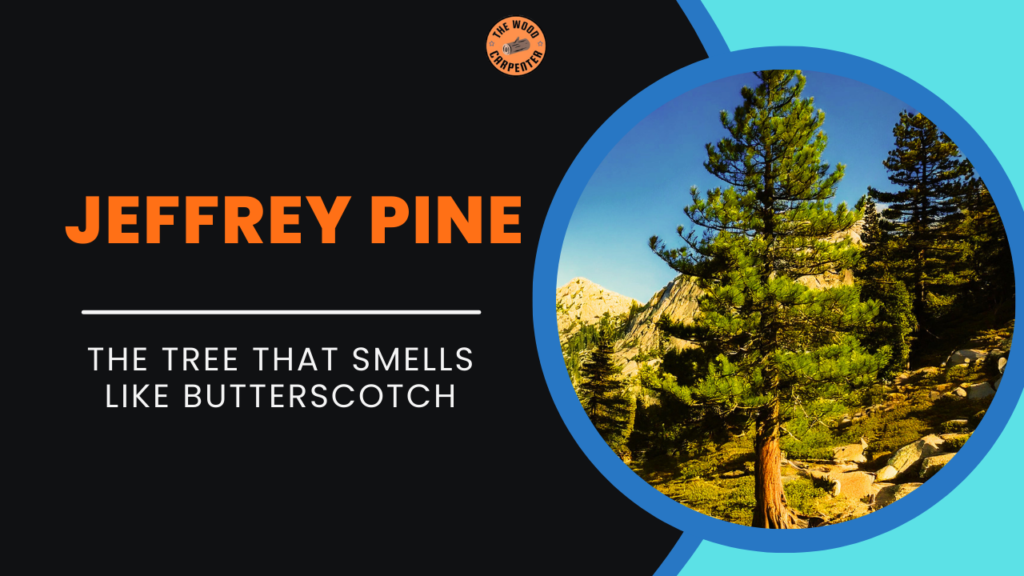
Key Takeaways:
- Grows at 5,000 to 9,000 feet in the Sierra Nevada and surrounding mountain ranges
- Bark smells like butterscotch or vanilla on warm days — caused by a chemical called n-heptane
- Easiest ID trick — pick up a cone. Smooth means Jeffrey. Prickly means ponderosa
- Grows in toxic serpentine soil that kills most other plants
- Lives 400 to 500 years — some much longer
- The n-heptane in its resin helped create the octane rating scale for petrol in the 1920s
You’re Hiking and Something Smells Like a Bakery
You’re walking through the mountains on a warm afternoon. Dry air, quiet trail, nothing unusual.
Then out of nowhere — butterscotch. Maybe vanilla. Possibly something closer to pineapple.
You stop. Look around. No food, no camp nearby. Just trees.
That smell is coming from the bark of a Jeffrey pine. And once you know what it is, you’ll stop every time you smell it for the rest of your life.
What Is a Jeffrey Pine?
It’s a large evergreen pine — scientific name Pinus jeffreyi — that grows in the high mountain ranges of western North America. Named after Scottish botanist John Jeffrey, who first documented it in the 1850s and later disappeared on a plant-collecting expedition, never found.
The tree outlasted him by centuries. Most Jeffrey pines live 400 to 500 years. Some much longer.
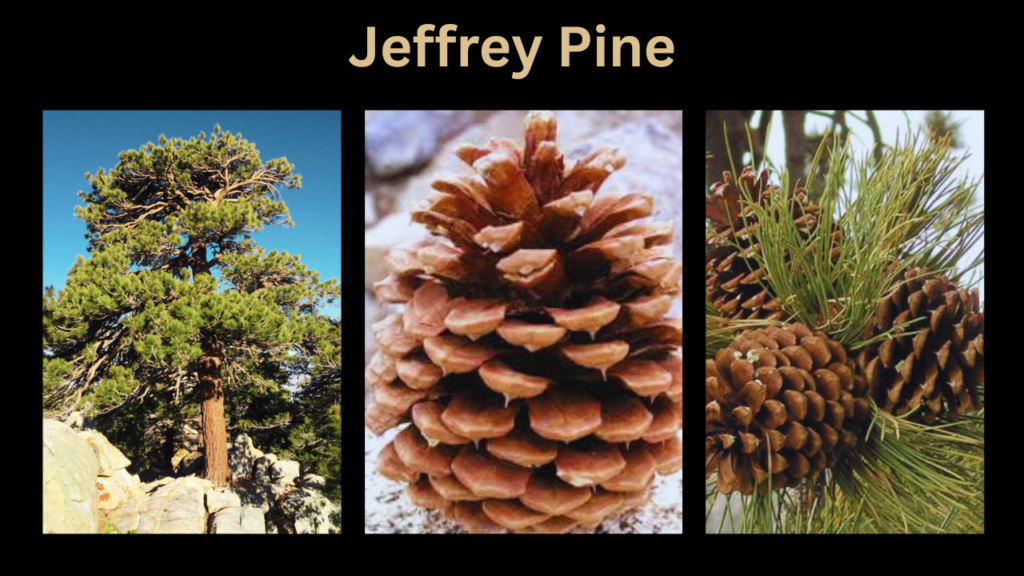
Mature trees reach 80 to 130 feet tall with thick trunks and warm orange-plated bark that breaks apart in irregular puzzle-piece patterns. Young trees have a neat cone shape. Older ones open up at the top and look more sculptural against the sky.
How to Identify One on a Hike
You don’t need any special knowledge. Three things tell you what you’re looking at:
The needles — long, slightly twisted, blue-grey green. Not the sharp bright green of most pines.
The bark — thick orange and reddish-brown plates with dark gaps between them. Warm-toned, almost glowing in sunlight.
The cone — this is the easiest test. Pick one up off the ground and hold it in your bare hand. If it feels smooth and comfortable, that’s a Jeffrey pine. If it pokes you, that’s a ponderosa.
There’s a saying hikers use to remember it:
“Gentle Jeffrey, prickly ponderosa.”
And if you’re still not sure — press your hand against the bark on a sunny day. If you smell anything sweet, you’ve found your tree.
Why Does It Smell Like That?
Most pine trees smell sharp and turpentine-like. Jeffrey pine is different.
Its resin contains an unusually pure concentration of a chemical called n-heptane. That purity is what creates the clean, sweet smell instead of the harsh resinous bite you get from other pines.
Here’s the part nobody expects. That same chemical — n-heptane — was used in the 1920s to create the octane rating scale for petrol. Scientists needed a reference point for the least efficient, most knock-prone fuel. They chose n-heptane. The standard that grades every litre of fuel sold in the world today has its roots in a mountain tree that smells like butterscotch.
The other side of that story — n-heptane is also highly flammable. Early resin harvesters didn’t know how volatile it was and caused serious fires trying to process it. That’s how Jeffrey pine earned its old nickname: the gasoline tree.
Where It Grows
Jeffrey pine is a high-elevation tree. It doesn’t grow in the lower, warmer zones where ponderosa pine dominates.
Find it between 5,000 and 9,000 feet in the Sierra Nevada, the Cascades, the mountains of southern California, parts of Nevada, and northern Baja California in Mexico. Yosemite, Lake Tahoe, Sequoia — these are all Jeffrey pine country.
What makes it ecologically impressive is where it can grow that other trees can’t. Jeffrey pine establishes itself in serpentine soil — ground that’s poor in nutrients, loaded with heavy metals like nickel and chromium, and essentially toxic to most vegetation. Most plants fail in serpentine soil. Jeffrey pine doesn’t just survive there. It thrives, growing in terrain that competition has vacated entirely.
Jeffrey Pine vs Ponderosa Pine
People mix these up constantly. Here’s the comparison that settles it:
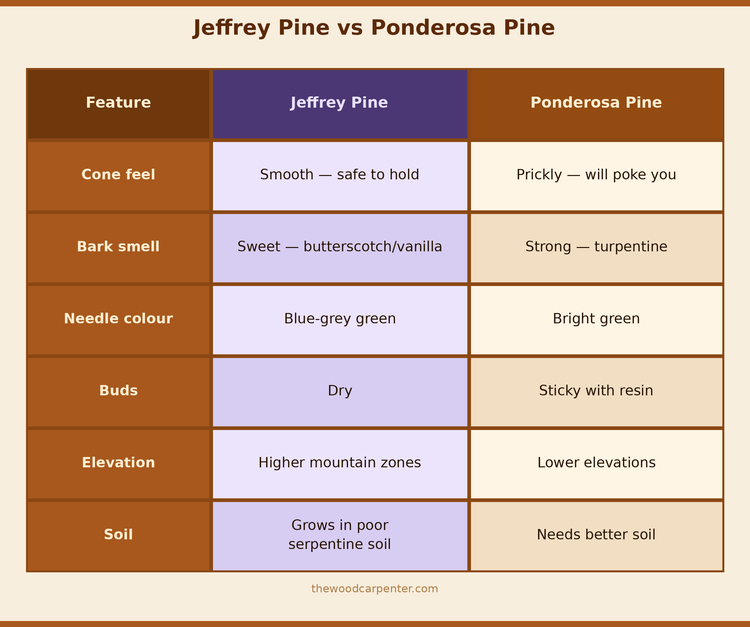
The practical version — if you’re high up in the mountains and smell something sweet, you’re in Jeffrey pine territory. If you’re lower down and it smells sharp, you’re in ponderosa country. Pick up a cone either way and you’ll know for certain.
How It Survives Fire
Mountain forests burn. Jeffrey pine was built for it.
The bark grows thick — several inches on a mature tree. When low-intensity ground fires move through, that thickness insulates the living tissue inside. The fire burns the understorey, clears out competition, and leaves the big Jeffrey pines standing.
This created the open, park-like mountain forests that hikers love — large trees spaced widely apart, sunlight reaching the ground, grasses and wildflowers growing beneath.
The problem now is the same one affecting most western American forests. A century of fire suppression has allowed dense understorey and dead material to build up. When fires ignite in those conditions, they climb into the crowns and burn hot enough to kill even thick-barked trees.
Controlled burns and mechanical thinning are the tools forest managers use to restore what suppression disrupted — but it’s slow, difficult work.
Uses:
Indigenous communities living around the Sierra Nevada used Jeffrey pine in many simple and practical ways. They collected the seeds for food — the seeds are small but nutritious.
People would eat them as they are or grind them into a meal. They also used the sticky resin to make things waterproof, and the bark had everyday uses in their daily life.
However, when European settlers arrived in California they began to harvest the wood for a different purpose. Jeffrey pine is tough and natural wood is in fact, straight, so it was also used to build homes, furniture, and general construction.
At one time its resin was even commercially exploited by humans. However, it came to a halt when it revealed a chemical called n-heptane that is flammable in nature and made the large-scale processing too dangerous.
The wood is still used today, but not to the extent it once was. What Jeffrey pine forests now have, in reality, is the provision for nature. Forest benefits and services provide habitat for wildlife, protect water sources, reduce soil wash on steep slopes and scenery that draws millions of visitors each year.
Wildlife That Depends On It
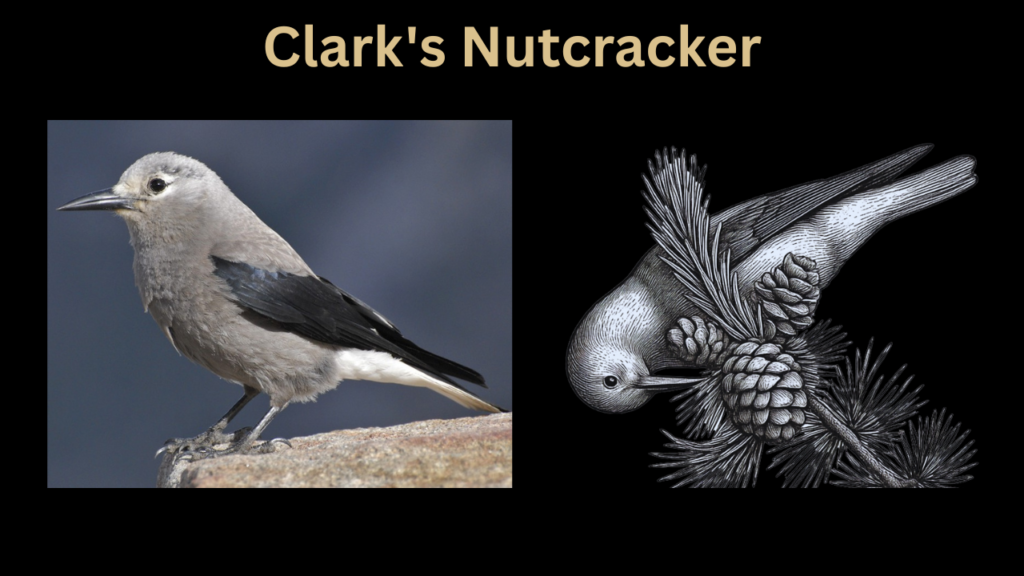
Clark’s nutcracker — a striking black and white mountain bird — is the main reason Jeffrey pine forests keep regenerating. Nutcrackers harvest pine seeds and bury thousands of them in caches to eat through winter. They don’t retrieve all of them. The forgotten ones become trees. Jeffrey pine has essentially built a partnership with a bird for forest expansion.
Squirrels do the same. Deer use the forests for shelter. Bears feed on inner bark in spring. Raptors nest in mature trees and hunt the open areas below. The forest that looks simple from the outside supports a full community of wildlife through every season.
Knotty Pine in Homes: Pros, Cons & Hidden Truths
Eastern White Pine: The White Pine You Need to Know!
Threats It Faces
Jeffrey pine is not an endangered tree, but it is still facing some serious problems.
Bark beetles are one huge culprit. They are insects which attack trees, particularly in high dry weather. A healthy Jeffrey pine can defend itself by oozing sticky resin that expels the beetles. However, in times of drought, the tree cannot produce sufficient resin.
This allows beetles to enter and attack the tree much more efficiently. The numbers of trees that have died following these attacks have gone up in dry years.
Air pollution, particularly ozone, is another issue. Pollution from the big cities — such as Los Angeles — drifts to surrounding mountain regions, including parts of the Sierra Nevada. Ozone is particularly harmful to Jeffrey pine trees.
This damages their needles, limits their ability to photosynthesize, and ultimately causes them to weaken over the years. Among the hardest-hit trees are in the mountains east of Los Angeles.
Climate change is also making things harder. It is changing rainfall patterns, reducing snow levels, and increasing temperatures. Because of this, scientists are still trying to understand where Jeffrey pine will be able to grow well in the future.
Frequently Asked Questions
Why does Jeffrey pine smell sweet? Its resin contains n-heptane — a chemical that produces a clean sweet smell rather than the turpentine scent most pines have. The smell is strongest on warm days when sunlight heats the bark.
How do you tell Jeffrey pine from ponderosa pine? Pick up a cone. Jeffrey cones feel smooth and won’t hurt your hand. Ponderosa cones are sharp enough to poke you. The bark smell works too — Jeffrey is sweet, ponderosa is turpentine.
Can you eat Jeffrey pine seeds? Yes. Small and edible, traditionally gathered and eaten by Indigenous communities. Not commonly sold commercially.
How long do Jeffrey pines live? Most live 400 to 500 years. Some in protected locations live considerably longer.
Where can I see one? The Sierra Nevada is the best place — Yosemite, Lake Tahoe, Sequoia, and the surrounding mountain areas at higher elevations.
Is Jeffrey pine endangered? No. Widespread and stable across its range, though individual populations face pressure from drought, beetles, and air pollution.
The Bottom Line
Jeffrey pine doesn’t try to grab your attention. It simply stands quietly in the mountains, growing for hundreds of years. It carries a soft, sweet smell — often compared to butterscotch — holds together poor and even toxic soil, feeds birds that help spread its seeds, and supports the entire ecosystem in a calm, steady way.
If you walk past one on a warm afternoon without knowing what it is, you might just notice a light, sweet scent in the air and wonder where it came from.
But if you stop, take a moment, and place your hand on its bark, it becomes something you won’t forget.
That’s the beauty of Jeffrey pine — it reveals itself only to those who slow down and pay attention.