
Key Takeaways:
- Macassar ebony comes from Diospyros celebica — a slow-growing tree found mainly on Sulawesi island in Indonesia
- The bold black and brown stripes set it apart from every other ebony — most ebonies are plain black
- Janka hardness of around 3,220 lbf — more than twice as hard as oak and dense enough to sink in water
- Currently classified as Vulnerable due to decades of over-logging and forest loss
- Used in luxury guitars, high-end furniture, knife handles, car interiors, and fine jewellery boxes
- The wood contains natural oils that make gluing tricky — and the dust irritates skin and lungs, so protection matters
Macassar ebony is a rare, extremely hard tropical hardwood from Indonesia with dramatic black and brown stripes that make it one of the most visually striking materials in woodworking — used in luxury instruments, furniture, and fine crafts, but increasingly scarce due to over-harvesting.
The First Time You See It Properly Polished
Most people’s reaction is the same — they assume it’s been painted.
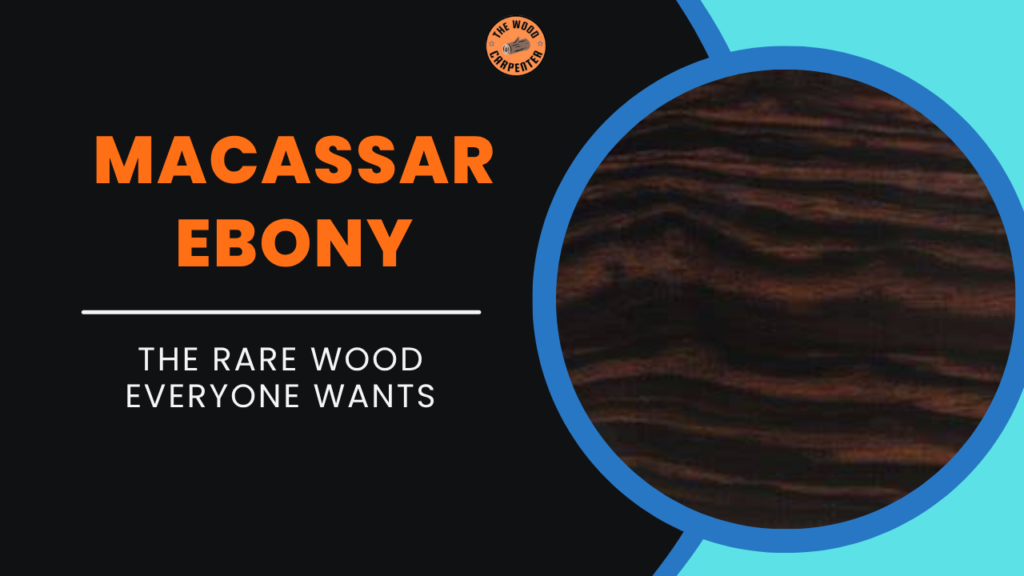
Deep black stripes running through rich brown, chocolate, and gold tones. Some boards have clean parallel lines. Others have wild flowing patterns that look like something between wood grain and abstract art. When it’s polished to a high sheen, the surface reflects light like glass and the contrast between the colours intensifies.
It doesn’t look like wood. It looks like something someone designed deliberately.
That’s Macassar ebony. And once you’ve seen a piece of it properly finished, you understand immediately why craftsmen have been obsessed with it for centuries and why a small amount of it can completely transform a guitar, a cabinet, or a room.
What Is Macassar Ebony ?
Macassar ebony comes from a tree called Diospyros celebica — a member of the ebony family that grows primarily on Sulawesi, an Indonesian island in the eastern archipelago. You’ll also find it in smaller quantities in nearby Maluku and parts of Borneo.
The name Macassar comes from Makassar — the major port city on Sulawesi where this wood was loaded onto ships and exported to Europe and beyond for hundreds of years.
The tree grows up to around 65 feet tall in natural forest. The problem is that large, mature trees are now genuinely rare. These aren’t plantation trees that grow in neat rows.
They’re scattered through dense tropical forest, growing slowly, taking decades to reach a size worth harvesting. Finding them requires effort. Replacing them requires time nobody in the timber trade has historically been willing to wait for.
That combination — exceptional beauty, extreme rarity, and slow replacement — is why a well-figured piece of Macassar ebony costs what it does.
What Makes the Look So Distinctive
Most ebony is simply black. Deep, uniform, almost featureless black — which has its own appeal for applications where consistency matters.
Macassar ebony does something completely different.
The heartwood develops bold stripes — black alternating with brown, golden, reddish-chocolate, and warm tan tones. The pattern varies from board to board. Some pieces have tight, straight stripes that look almost architectural. Others have wavy, flowing patterns that seem to move when the light changes.
Think of it this way. If regular black ebony is a plain black suit — classic, clean, elegant — Macassar ebony is a suit with a pattern so striking that people ask where you got it before they ask anything else.
When polished, the surface becomes glass-smooth and the stripes reflect light differently depending on their angle. The visual effect at that point is genuinely hard to achieve with any other natural material.
This is why designers use even small pieces of it as highlights. A strip of Macassar ebony on an otherwise simple piece changes its character entirely.
How Hard Is It ?
Extremely. The Janka hardness rating for Macassar ebony sits at around 3,220 lbf — more than double the hardness of red oak, which itself is considered a hard wood.
It’s also dense enough to sink in water. Most wood floats. This doesn’t.
That hardness translates to exceptional durability. A piece of Macassar ebony finished and sealed properly can last for generations without significant wear.
But hardness cuts both ways in the workshop. Working with this wood is genuinely demanding. Tools go dull fast — you need sharp, quality blades and you need to resharpen them more frequently than with any common timber.
Cutting takes more effort. The wood is slightly brittle internally, which means it can split or crack if handled carelessly, especially in larger pieces.
This is why most Macassar ebony in finished products appears as veneer — thin slices of the wood applied over a more workable substrate — or in smaller solid pieces like handles, fretboards, pens, and decorative inlay.
You get the full visual impact of the material without fighting large solid blocks of something twice as hard as oak.
Where You Actually See It
Guitars and musical instruments — Macassar ebony fretboards show up on high-end acoustic and electric guitars and bass guitars. The hardness makes it ideal for a surface that gets played thousands of hours. The look makes the instrument visually memorable.
Luxury furniture — as veneer on cabinet doors, tabletops, and drawer fronts. A piece of furniture veneered in well-figured Macassar ebony looks nothing like standard furniture.
Small crafted objects — knife handles, fountain pens, jewellery boxes, billiard cues. These are things people hold and touch regularly, and the weight, smoothness, and visual drama of the material make them feel genuinely premium.
High-end interiors — car dashboards, yacht interiors, bespoke joinery. Anywhere the brief is “make this look extraordinary” and budget isn’t the primary constraint.
Macassar Ebony vs Other Ebonies
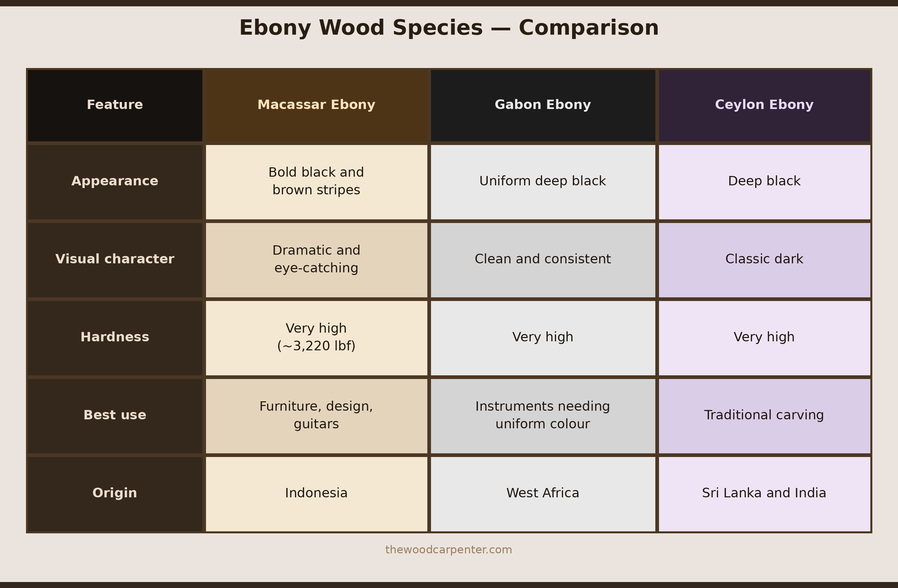
The practical choice between them comes down to what you need. If you want something visually dramatic and don’t mind the variation between pieces — Macassar.
If you need a consistent, uniform black surface without distraction — Gabon or Ceylon ebony. Different woods for different jobs, even within the same family.
Working With It — The Honest Version
Beautiful material. Not easy to work with.
It dries slowly and needs patience. Rush the drying process and it cracks. The natural oils in the wood interfere with adhesives — surfaces need thorough cleaning before gluing or the bond fails.
Sharp tools are mandatory, not optional, and they need maintenance more often than with softer materials.
The dust is a real health concern. Macassar ebony dust irritates skin and respiratory systems. Masks and proper ventilation aren’t suggestions — they’re requirements anyone working with this wood regularly takes seriously.
The brittleness in larger pieces means you can’t force it. Mistakes are expensive — both in the cost of the material and in what gets wasted when a piece cracks under poor handling.
But when it’s done right — when the surface is properly prepared, finished, and polished — the result is the kind of thing people pick up, look at carefully, and ask questions about. That reaction is what justifies the difficulty.
Its History — From Royal Cabinets to Art Deco Masterpieces
Ebony has been prized since ancient times. Egyptian pharaohs had ebony furniture. European royalty used it for cabinets and decorative objects.
The dark, heavy wood carried connotations of wealth and permanence that few other materials matched.
Macassar ebony specifically became prominent during the colonial trade era when Indonesian timber started moving through European ports in significant quantities. Cabinetmakers who encountered it understood immediately that its striped figure was something different from the uniform black ebonies they already knew.
Its defining moment came during the Art Deco period of the 1920s and 1930s. Art Deco was obsessed with bold geometric patterns, dramatic contrasts, and materials that made a visual statement.
Macassar ebony was made for that aesthetic. Furniture from that period featuring it still looks contemporary today — the stripes and the geometry aged better than almost anything else from that era.
That’s the mark of a genuinely exceptional material. The best pieces made from it don’t date.
The Conservation Reality
Macassar ebony is currently listed as Vulnerable on the IUCN Red List. That classification means the population has declined significantly and continues to face pressure.
The reasons are straightforward. The tree grows slowly — you can’t rush it. Natural forests in Sulawesi have faced decades of logging pressure and habitat loss.
Because the trees grow scattered rather than in concentrated stands, sustainable harvesting at scale is genuinely difficult. Demand has historically outpaced the forest’s ability to recover.
This doesn’t mean the wood should be avoided entirely. It means sourcing matters.
Reclaimed Macassar ebony — salvaged from old furniture, demolished buildings, or fallen trees — is the most responsible option. Certified wood from verified legal sources is the next best choice. Asking suppliers about origin before buying is basic due diligence that makes a real difference at scale.
The wood is remarkable. The responsibility that comes with using it is real.
Frequently Asked Questions
What makes Macassar ebony different from regular ebony?
Most ebonies are uniform deep black. Macassar ebony has bold stripes — black mixed with brown, gold, and warm tan tones. That figuring makes it visually dramatic in a way plain black ebony isn’t.
Why is Macassar ebony so expensive?
It is a slow-growing one, and is not readily available. This makes it less ideal in regards to time consuming its time-consuming to cut and shape because this is a very hard wood.
Is Macassar ebony endangered?
While not entirely endangered, it is classed as `Vulnerable. That also means less trees here. Hence, it should be handled with caution.
Where is it used most?
High-end guitars and basses, luxury furniture veneers, knife handles, fountain pens, jewellery boxes, billiard cues, car interiors, and yacht joinery.
Can it be used outdoors?
Not really. It is better for indoor use. With time the Rain and moisture will affect it.
Is it safe to work with?
Yes, but you must be careful. The dust, on the other hand, will damage your skin and lungs. Always use a mask.
How does it compare to rosewood?
Both are premium tonewoods used in instruments. Macassar ebony is significantly harder and denser than most rosewoods, with a more dramatic striped figure. Rosewood tends to be easier to work with and more widely available.
The Bottom Line
Macassar ebony is one of those materials that doesn’t need much explaining once you’ve seen a well-finished piece of it. The stripes speak for themselves.
But what makes it genuinely valuable isn’t just the looks. It’s the combination — that visual drama, the exceptional hardness, the smooth weight of it in your hand, the history attached to it, and the fact that there’s less of it in the world every year.
A piece of furniture or an instrument made from properly sourced Macassar ebony isn’t just an object. It’s something that will outlast most of what surrounds it and look better for the wear.
That’s rare in any material. In wood, it’s almost unique.