
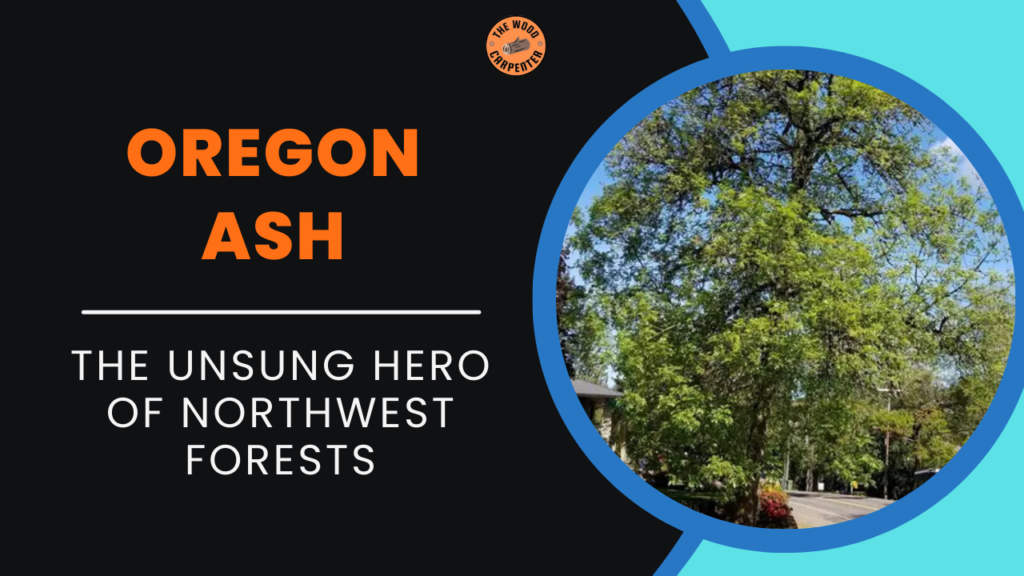
Native to the Pacific Northwest, Oregon ash (Fraxinus latifolia) is a hardwood. Which is fairly common in the Willamette Valley, can frequently be found in wetlands, floodplains and edges of slow-moving streams. Despite being neither as large or well-known as such trees as the Douglas fir or the Coast redwood, Oregon ash is essential in the control of wetland ecological processes.
It is the only native ash species found west of the Rocky Mountains and is an important part of the Pacific Northwest landscape. Now this tree is threatened by a much more — the invasive insect Emerald Ash Borer which is threatening and destroying ash trees in large parts of North America.
This guide summarizes the key information you need about Oregon ash, including how to identify it, where it grows, what its wood is worth, what its value is to wildlife, how to grow it, and the emerald ash borer threat to this native tree.
What Is Oregon Ash?
Fraxinus latifolia is a species with deciduous hardwood belonging to the olive family (Oleaceae). It is also found growing wild from south-west British Columbia through Washington and Oregon and into Northern California, predominantly on the west side of the Cascade Mountains.
With its adaptation to wet conditions, the tree grows best in wet soils. Oregon ash is unique in that many trees tend to suffer in flood-prone locations or heavy clay soil but Oregon ash can withstand and tolerate seasonal flooding in winter and a dry summer season.
This adaptability is why it is one of the most important tree species in wetlands and riparian forests of the Pacific Northwest.
Oregon ash trees grow to between 40 and 80 feet tall in maturity but can reach greater heights where conditions are right.
The trunk is usually straight, and the crown is round-shaped and well spreading, especially in open areas. Certain species of trees have been known to live for over 200 years.
Oregon ash is a typical species in the bottomlands and along riverbanks of the Portland area and western Oregon, where it provides a critical ecological function in wetland landscapes.
How to Identify Oregon Ash
Identification becomes easier once you know what to look for.
Oregon ash has compound leaves, meaning each leaf is made up of several smaller leaflets. Most leaves have 5 to 9 leaflets, sometimes more. The leaflets are oval, broad, and often slightly velvety underneath.
A key feature is opposite branching. The twigs and buds grow directly across from each other — something not many Pacific Northwest trees do. This is a classic ash family trait.
In late summer and fall, female trees produce single winged seeds called samaras. These hang in clusters and spin when they fall.
Mature bark develops a gray, diamond-patterned furrow that looks similar to eastern ash species.
Here’s a simple comparison table to avoid confusion with look-alikes:
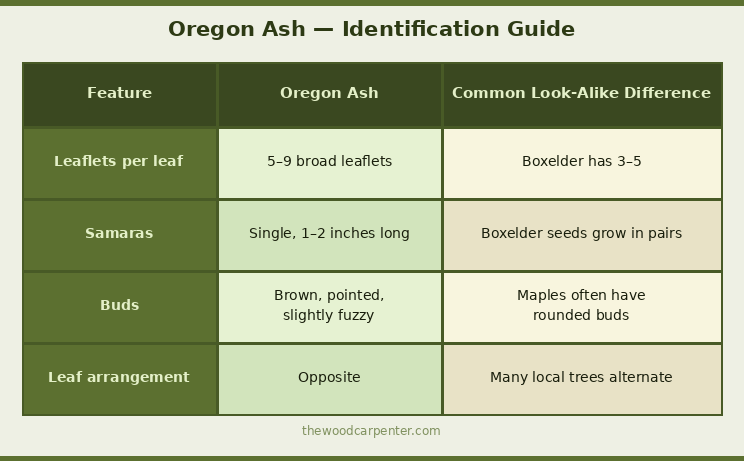
In the Pacific Northwest, it’s the only native ash, so that makes identification simpler.
Where Oregon Ash Grows
Oregon ash prefers low elevations — generally below 3,000 feet.
Its core range includes the Willamette Valley, western Washington, and northern California. It thrives along:
- Riverbanks
- Floodplains
- Wet meadows
- Stream edges
- Poorly drained clay soils
Historically, large portions of the Willamette Valley were covered in Oregon ash woodlands. These areas were too wet for conifers and too dry in summer for other wetland trees.
In modern times, many of these habitats have been converted to agriculture or development, making remaining stands even more important.
If you see a tree standing strong in soggy soil where others struggle, chances are it could be Oregon ash.
Why Oregon Ash Matters Ecologically
Oregon ash is more than just a backdrop! It is the most important factor in maintaining wetland ecosystems.
Its root system holds the stream banks together and stops erosion when the winter rains come. Its canopy shades water, helping keep stream temperatures cool for fish like salmon and steelhead.
When its leaves fall, they break down quickly and add nutrients to streams and soil. This supports insects, which then support birds and fish.
In North America, over 100 species of insect feed on ash trees. And those insects are then consumed by birds, bats, and small mammals.
Especially, wood ducks depend on ash-dominated wetlands for nesting cavities. Other cavity nesters, including flickers and owls, use older ash trees too.
In simple terms, Oregon ash helps hold entire riparian ecosystems together.
Oregon Ash Wood: Strength and Flexibility
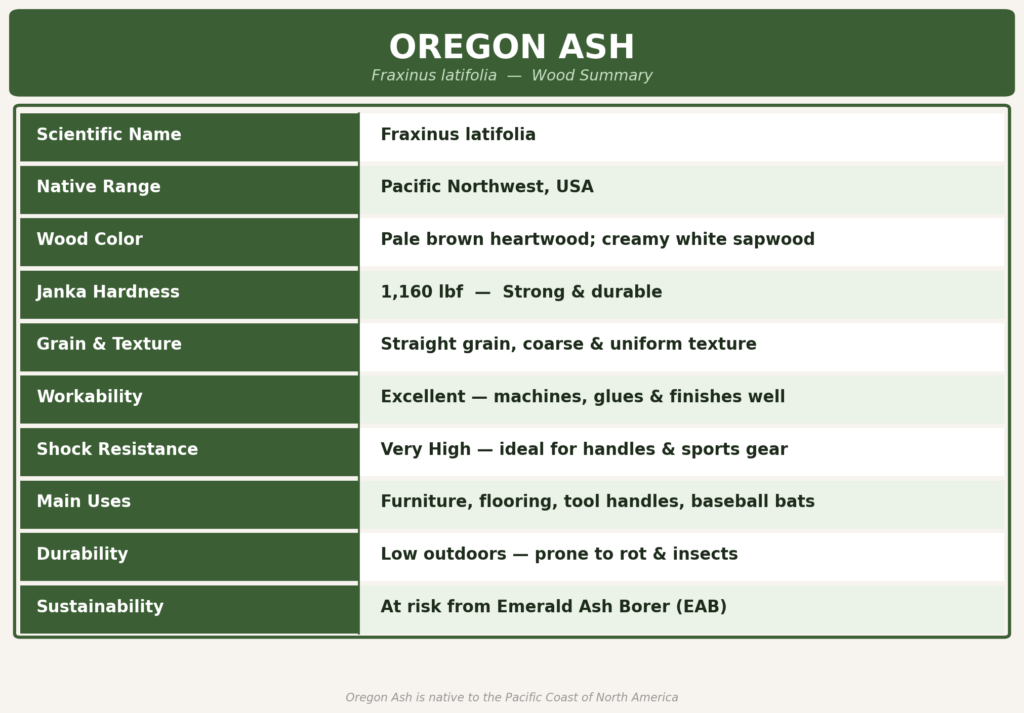
Oregon ash wood is strong, flexible, and dependable.
It is similar to eastern ash species like Fraxinus americana and Fraxinus pennsylvanica, which were traditionally used for tool handles and even baseball bats.
Oregon ash has:
- Straight grain
- Light cream to pale brown color
- Good shock resistance
- Solid strength without brittleness
Because of these properties, it has been used for:
- Furniture
- Cabinets
- Flooring
- Tool handles
- Canoe paddles
- Firewood
Indigenous peoples of the Pacific Northwest used it for digging sticks and paddles because it could absorb repeated impact without cracking.
It is not naturally rot-resistant outdoors, so untreated wood can decay in wet conditions. But indoors or properly treated, it performs very well.
Growing Oregon Ash in Landscapes
Oregon ash is excellent for wet landscapes.
If you have a low spot in your yard that stays soggy, or if you are restoring a stream buffer, it is a strong native choice.
It prefers:
- Full sun to partial shade
- Moist to seasonally flooded soils
- Space to spread (plant at least 20–30 feet apart)
It does not do well in dry, compacted suburban lawns. Planting it in the wrong location often leads to slow growth or stress.
In restoration projects, it is commonly planted with willows, red alder, and black cottonwood.
It grows about 1 to 2 feet per year in good conditions, especially when young.
The Emerald Ash Borer: A Serious Threat
No modern discussion of Oregon ash can avoid this topic.
Emerald ash borer is an invasive beetle from Asia that has killed hundreds of millions of ash trees in North America.
The beetle lays eggs on ash bark. The larvae tunnel beneath the bark, cutting off the tree’s ability to move water and nutrients. Most untreated ash trees die within a few years of infestation.
Eastern ash species have experienced near-total loss in many regions.
The emerald ash borer was first detected in Oregon in 2022 in Forest Grove and later in parts of the Portland area. Experts believe Oregon ash is highly vulnerable.
Signs of infestation include:
| EAB Sign | What It Looks Like |
| Thinning canopy | Dead branches at top |
| D-shaped exit holes | About 1/8 inch wide |
| Bark cracks | Vertical splits |
| S-shaped tunnels | Under peeled bark |
Because Oregon ash is the only native ash in the region, widespread infestation could dramatically change riparian ecosystems.
State agencies are monitoring spread, encouraging people not to move firewood, and researching biological controls.
Common Questions About Oregon Ash
Is Oregon ash the same as white ash?
No. Oregon ash (Fraxinus latifolia) is native to the Pacific Coast. White ash (Fraxinus americana) is native to eastern North America.
How fast does it grow?
About 1–2 feet per year when young in good wet conditions.
Can it grow outside the Pacific Northwest?
It can survive in USDA zones 6–8 if conditions mimic wet valley soils, but it is rarely planted outside its native region.
Is it endangered?
It is not officially listed as endangered, but conservation concern is increasing because of emerald ash borer.
Can I protect my tree from emerald ash borer?
Yes, arborists can apply trunk injections or soil treatments every 2–3 years to protect high-value trees.
Final Thoughts
Oregon ash may not be the most famous tree in the Pacific Northwest, but it is one of the most important.
It protects waterways.
It feeds wildlife.
It stabilizes soils.
It provides strong, flexible wood.
And it quietly supports ecosystems that many other species depend on.
With the emerald ash borer now posing a risk, it’s a tree worth becoming familiar with more than ever! So, by planting them carefully or monitoring old trees or agitating to better protect existing stands, whoever is paying attention to it now may be saving a species that has been one of the cornerstones of Pacific Northwest wetlands for centuries.
Sometimes the most important trees are the ones growing quietly along the water’s edge.