
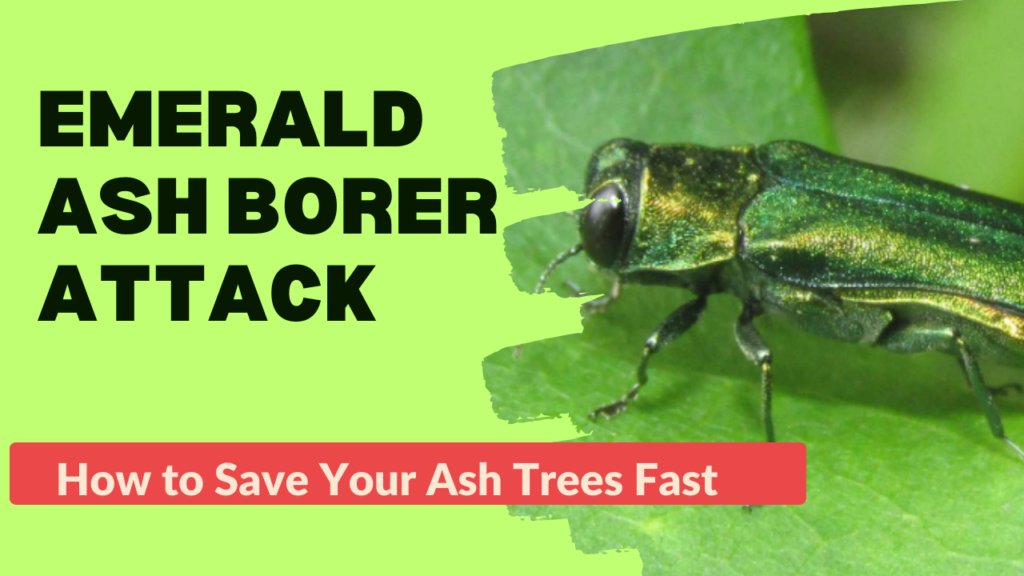
If your yard has an ash tree that appears weak, perhaps dropping leaves or developing odd holes in the bark, there’s a good bet a minuscule bug is the culprit. The insect is the emerald ash borer, which has become one of the most destructive tree pests ever seen in North America.
Since it was first discovered in 2002, this small metallic green beetle has killed tens of millions of ash trees. Entire neighbourhoods and forests have lost mature shade trees that took decades to grow.
However, with proper treatment, many ash trees can be saved but the key is to act early. Each year, many homeowners and property managers are able to successfully protect their trees using tried-and-true treatment products. In this guide, we break down in laymen terms, what the emerald ash borer is, how to identify it, and which treatments actually work.
What Is the Emerald Ash Borer?
The emerald ash borer (Agrilus planipennis) is a tiny beetle native to Asia. The insect itself is only a little short of half an inch long, but the destruction it inflicts can kill a monster-sized tree in just a few years (yes, tree species include monsters, do bear in mind).
The adult beetle is shiny and metallic green. During late spring and early summer, adult beetles emerge from ash trees and begin feeding on leaves. After mating, females lay eggs inside cracks and crevices in the bark.
The worst destruction occurs right after the eggs hatch.
The larvae burrow just under the bark and eat the tree’s inner tissues. These push water and nutrient through the tree. But as the larvae feed, they create winding tunnels that gradually fill in this transportation system. As a result, over a number of years the tree becomes blocked from moving food and water and it gradually perishes.
Emerald ash borers attack perfectly healthy ash trees, unlike many pests, they only infest weak trees.
Without treatment, most infested trees die within two to four years.
All common ash species are vulnerable, including:
- Green ash
- White ash
- Black ash
- Blue ash
Why the Emerald Ash Borer Is So Destructive
Emerald ash borer populations are naturally controlled by predators in their Asian home range. However those natural predators were absent when the pest came to North America.
As a result, the beetles multiplied at an alarming rate. Currently, it is present in dozens of states along with several Canadian provinces, and is still expanding into new territory.
And the damage is not limited to the ecology only When ash trees die, they become more brittle and less safe, and removal of larger trees can cost thousands of dollars. Municipalities in many cities have spent hundreds of millions removing dead trees and replanting new ones.
And that is why early treatment is so important.
How to Tell If Your Ash Tree Is Infested
One of the biggest challenges with emerald ash borer infestations is that the tree often looks normal for a long time. And years later, when the damage starts to show, the creature could have been burrowing inside of the tree for two, three years.
Here are some things homeowners have to keep an eye on.
A common early sign is thinning leaves in the upper canopy. Leaves fall from the top of the tree, while the lower branches appear strong and firm.
Another clue is the appearance of D-shaped exit holes in the bark. These small holes are created when adult beetles emerge from the tree.
You may also notice vertical cracks in the bark. If the bark is peeled back in those areas, you might see the distinctive S-shaped tunnels made by larvae.
An infestation can also be revealed by woodpeckers. It’s well-known these species feed on the larvae and often peck off strips of bark in their search.
Occasionally, when trees are stressed, they attempt to save themselves by developing new shoots from the trunk or lower branches. They are known as epicormic sprouts, and they are commonly a red flag.
A helpful rule used by arborists is based on canopy loss:
| Tree Condition | Chances of Recovery |
| Less than 30% canopy loss | Very good with treatment |
| 30–50% canopy loss | Possible recovery |
| More than 50% canopy loss | Often too late to save |
Because symptoms appear late, experts often recommend starting treatment even before symptoms appear if emerald ash borers are confirmed nearby.
Emerald Ash Borer Treatment Options
Researchers and arborists have tested several treatments over the years. Some methods work much better than others.
The most effective treatments are systemic insecticides. These are absorbed by the tree and carried through its internal system, killing larvae as they feed.
Below is a simple comparison of the most commonly used treatments.
| Insecticide | Application Method | Protection Duration | Best Use | Buying Link |
|---|---|---|---|---|
| Emamectin benzoate (TREE-äge) | Trunk injection by professional | 2–3 years | Most effective for medium and large trees | Check latest Price |
| Imidacloprid | Soil drench or soil injection | About 1 year | Suitable for smaller trees and DIY treatment | Check Latest Price |
| Dinotefuran | Basal bark spray or soil treatment | About 1 year | Fast absorption, preventive treatment | |
| Azadirachtin | Trunk injection | 1–2 years | Plant-derived option that reduces egg laying |
Each treatment has advantages depending on tree size and level of infestation.
Trunk Injection: The Most Effective Treatment
Professional arborists often recommend trunk injections, especially for large trees.
During this process, small ports are drilled into the trunk and insecticide is injected directly into the tree’s vascular system. This allows the chemical to spread quickly through the tree and reach the larvae feeding under the bark.
The product emamectin benzoate is widely considered the most powerful treatment available. Studies have shown it can reduce larval survival by more than 95 percent and protect trees for up to three years.
This method is usually done by licensed arborists because it requires special equipment.
Soil Drench Treatments for Homeowners
For smaller trees, homeowners sometimes use soil drench treatments containing imidacloprid.
The insecticide is mixed with water and poured around the base of the tree. The roots absorb it, and the chemical moves upward through the tree.
This method works best when applied in early spring, before adult beetles emerge.
However, soil treatments can be slower and less consistent than trunk injections, especially in heavy clay soils or dry conditions. That is why professionals often recommend trunk injections for valuable or large trees.
Basal Bark Spray Treatment
Another option is a basal bark spray, commonly using dinotefuran.
Instead of drilling into the tree, the insecticide is sprayed onto the lower portion of the trunk. The chemical penetrates the bark and moves into the tree.
This method is faster and less invasive than trunk injections, but it usually needs to be repeated every year.
Biological Control: Nature’s Long-Term Solution
Scientists have also introduced several species of parasitoid wasps that naturally attack emerald ash borers. These wasps lay eggs inside EAB eggs or larvae, killing them.
Three species are currently used in biological control programs:
These insects do not harm humans, pets, or other wildlife. They specifically target emerald ash borers.
However, biological control works at the ecosystem level, not for protecting a single tree in your yard. It helps reduce overall beetle populations over time but does not replace insecticide treatment for valuable trees.
When Should You Start Treatment?
Timing plays a major role in whether treatment succeeds.
Most experts suggest beginning treatment when emerald ash borers are identified within a distance of approximately 15 miles to your location.
Systemic insecticides work best when they are applied in early spring, just before the adult beetles start to fly and lay their eggs.
However, treatment can still save your tree if it has the majority of its canopy, even if it already shows signs of infestation. Trees with less than 30 percent with canopy loss often recover very well.
The longer you wait, the less likely you are to succeed.
Step-by-Step Approach to Protecting an Ash Tree
Most successful treatments follow a simple process.
First, have a qualified arborist evaluate the tree and make sure it is still healthy enough to save.
Then you are able to select the appropriate method of treatment, according to the size and health of the tree. Trunk injections are typically used for large trees, and soil treatments are generally employed for small trees.
The insecticide is then applied at the correct time of year so that it can be distributed thorough the tree.
After treatment, the tree should be inspected each year. Some treatments need to be repeated annually, while others last several years.
By monitoring frequently, it is assured that the tree remains protected.
When It Is Better to Remove the Tree
Unfortunately, not every ash tree can be saved.
If more than half of the canopy has already died, the tree may not recover even if the insects are killed. Dead ash trees also become brittle and can drop large branches without warning.
When that’s the scenario, it is most often safest to opt for removal.
If an ash tree is so large that removal is necessary, that cost could run anywhere from $1,000 to $3,000 plus (depending on size and location). This is also why treatment is much cheaper than removal, which is why many homeowners opt for treatment.
Good Replacement Trees
If an ash tree must be removed, it is wise to plant a different species so the same pest cannot destroy the new tree.
Some commonly recommended replacements include:
- Honeylocust
- Oak species
- Freeman maple
- American sweetgum
- Kentucky coffeetree
Planting a variety of species also helps make landscapes more resilient against future pests.
Costs of Emerald Ash Borer Treatment
Treatment costs vary depending on the tree size and the product used.
Professional trunk injections typically cost between $100 and $400 per tree, though very large trees may cost more.
DIY soil treatments usually cost $30 to $80 per application.
When compared with the high cost of removing a mature tree and losing decades of shade, treatment is often a worthwhile investment.
Frequently Asked Questions
Can I treat my ash tree myself?
Yes, if the tree is small and still healthy. Soil drenches with imidacloprid are commonly used by homeowners. For large trees, professional treatment is usually better.
How long do treatments last?
It depends on the product. For example, emamectin benzoate trunk injections can protect a tree for two or three years, whereas soil treatments generally require yearly retreatment.
Are these treatments safe for pets and children?
When applied according to instructions, systemic treatments remain inside the tree and generally pose low risk.
Can a damaged ash tree recover?
In trees with under 30 percent canopy loss, response to treatment is often good. Once the tree has more than 50 percent loss, it is rarely recoverable.
Final Thoughts
The Emerald Ash Borer (EAB) has become one of the most destructive invasive insects to affect forests in the last several decades. However, this is one issue where homeowners can still do something meaningful, unlike many other environmental threats.
We know that effective treatments are available, and these work well, but only if we give them at the right time. Acting early is the key.
Don’t wait for signs of damage to appear — if you have an ash that you love for its shade, beauty or environmental value. If there are emerald ash borers in your area, the key to saving your tree could be early checking and treatment, which can be the difference between a tree lost permanently and a tree you can enjoy for many years to come.