
If you’ve ever worked with regular wood then you are familiar with the common issues. It swells in rain. It shrinks in summer heat. Paint peels. Termites attack. Rot slowly sets in.
Accoya wood was developed specifically to overcome these challenges.
They’re simple pine trees, fast growing so they can be replenished quickly and harvested frequently, but with a special treatment, they are among the most durable and stable wood-based products available. Builders, architects and homeowners pick it for projects where they want real wood — but not the usual headaches.
Let’s start with the basics and find out what sets Accoya apart.
What Exactly Is Accoya Wood?
Accoya is modified radiata pine. The wood goes through a scientific process called acetylation, which permanently changes the structure of the wood at a molecular level.
Now don’t worry — this is not about adding toxic chemicals or plastic coatings. The process actually uses a substance closely related to vinegar. It changes how the wood reacts to moisture.
Regular wood absorbs water. It is why it swells, cracks and eventually rots.
Accoya does not absorb water easily. That one change makes a massive difference in durability and performance.
The final result is still real wood. It looks like wood, feels like wood, and can be cut and shaped like wood. But it performs more like a high-tech building material.
The end result however, is still real wood. It appears like wood, it feels like wood and can be cut and shaped like wood. But it behaves more like a high-tech building material.
How Accoya Is Made
Everything starts with sustainable Radiata Pine, sourced from FSC certified forests. They grow quickly, taking about 25–30 years to mature for harvest, and are thus environmentally friendly as compared with slow-growing hardwood trees.
Here’s what happens next:
The wood is dried to a very low moisture level.
It is placed in a special chamber.
It is treated with acetic anhydride, a compound derived from acetic acid (the main part of vinegar).
During this process, natural water-attracting molecules in the wood are replaced with ones that repel water. This is called acetylation.
What does that mean in real life ?
The wood can no longer absorb moisture the way normal wood does. It becomes dimensionally stable and highly resistant to decay.
The treatment goes all the way through the wood, not just on the surface. So if you cut or drill it, the inside is just as protected as the outside.
No heavy metals.
No toxic preservatives.
No harmful leaching.
Just modified wood that lasts longer.
Standout Properties and Durability
Accoya is rated as Class 1 durability, which is the highest category for wood products.
It offers:
50+ years above ground
25+ years in ground or freshwater contact
The biggest advantage is stability. Regular wood expands and shrinks with humidity changes. Accoya reduces swelling and shrinking by up to 75–80%.
That means:
No warping
No twisting
No cupping
No cracked paint from movement
In humid coastal regions or areas with strong monsoons and dry summers, this stability makes a huge difference.
Because it absorbs very little moisture, fungi and rot organisms struggle to survive. Termites also find it less attractive because the modified wood does not provide the moisture and nutrients they prefer.
Paint and coatings last much longer too. While standard pine may need repainting every 1–2 years in harsh climates, Accoya can hold coatings for 8–10 years.
Why Builders and Homeowners Choose Accoya
There are several reasons professionals prefer Accoya.
First, fewer maintenance problems. They have fewer complaints about warped doors, cracked frames or peeling paint.
Second, long-term savings. Though costly to purchase, it saves you from the repairs and replacements.
Third, sustainability. Rather than felling rare tropical hardwoods that grow for 80–100 years, Accoya is made from quick-growing pine that’s responsibly managed.
And finally, appearance. Accoya still looks like natural timber. It can be painted, stained, or left to weather into a soft silver-grey finish.
Common Real-World Applications
Accoya performs extremely well in exterior applications where normal wood usually fails.
Cladding and siding are very popular uses because the boards stay flat and stable even in heavy rain.
Windows and doors benefit from its low movement. Frames stay square and seals remain tight.
Decking remains flatter over time, reducing trip hazards and splinters.
Pergolas, balcony railings, garden furniture, bridges, and even marine projects use Accoya because of its moisture resistance.
In coastal areas or termite-prone zones, it has become a preferred solution for villas and luxury homes where long life matters.
What Are Wood Knots? A Simple Guide for Every Woodworker
How to Dry Wood Right way: Simple Guide for Best Results
Comparing Accoya to Other Wood Options
Here’s a clear comparison:
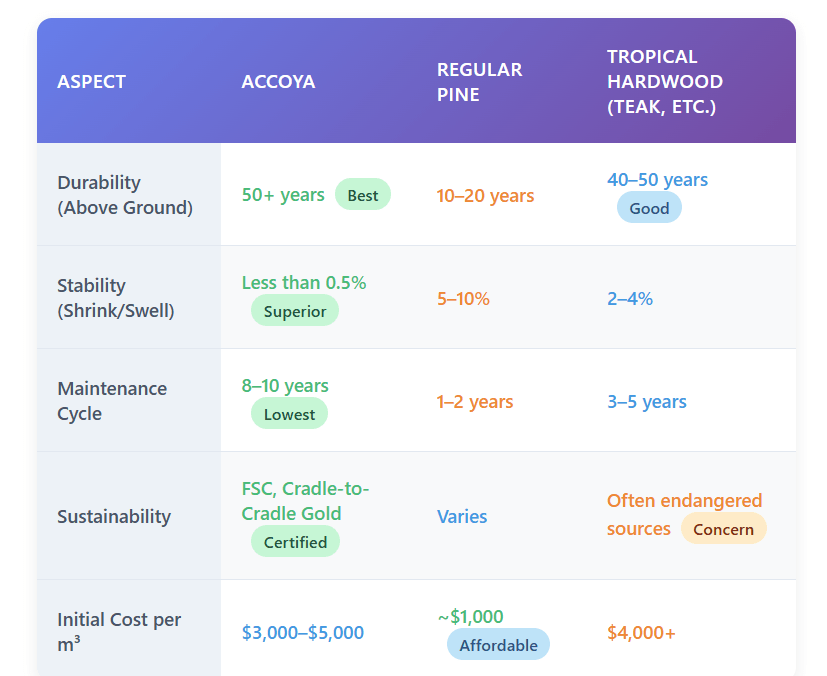
While regular pine is cheaper upfront, it requires frequent maintenance. Tropical hardwoods are durable but expensive and raise sustainability concerns.
Accoya sits in the middle — premium price, but strong long-term value.
Sustainability and Environmental Impact
Accoya has strong environmental credentials.
The pine is from certified sustainable forests.
The acetylation process recycles most chemicals used.
No toxic substances are added.
The wood is biodegradable at end of life.
It is Cradle-to-Cradle Gold certified and approved for the environment.
Because it lasts decades longer than regular wood, fewer replacements are needed. That means less cutting, less shipping, and less waste over time.
In long-term carbon footprint studies, durable materials like Accoya often outperform cheaper alternatives because they do not need frequent replacement.
Installation and Care Tips
Accoya works like normal wood. You can saw, drill, nail, and glue it using standard tools.
For best results:
Pre-drill when working near board edges.
For outdoor projects use stainless steel fasteners.
The finish should be applied soon after installation for best coating performance.
Cleaning is simple. Just wash with a gentle soap and water. Do not use harsh chemicals or abrasive cleaning tools.
Although Accoya does not move much, ventilation behind cladding and a quality installation remain important.
Cost and Long-Term Value
Accoya is not the cheapest wood on the market.
Expect to pay 20–30% more than standard pine for many projects.
But here’s the bigger picture:
- You avoid annual sealing.
- You avoid replacing warped boards.
- You reduce repainting cycles.
- You avoid termite damage repairs.
For many projects, the return on investment appears within 5–7 years due to reduced maintenance costs.
For high-visibility or hard-to-repair installations, the long-term value becomes even stronger.
Frequently Asked Questions
What is Accoya wood exactly?
It is radiata pine that has been modified through acetylation to make it extremely durable and stable.
How long does Accoya last outdoors?
More than 50 years above ground and at least 25 years in ground or freshwater contact.
Is Accoya eco-friendly?
Yes. It uses FSC-certified pine, contains no toxic preservatives, and holds Cradle-to-Cradle Gold certification.
Can I paint or stain Accoya?
Yes. Paint and stain grip extremely well and last years longer than on untreated wood.
Does Accoya warp or crack?
Wood movement is decreased at 75–80%, which means lesser warping and cracking as compared to natural wood.
Is it termite resistant?
Yes. It is highly resistant because the modified wood does not provide the moisture termites need.
Is Accoya worth the higher price?
For long-term, exterior work where a high level of durability is important, the answer for most professionals is yes. Lower maintenance and greater longevity make up for the initial expense.
Final Thoughts
Accoya is not magic. It is science applied to wood in an smart and responsible manner.
It retains the beauty and workability of natural timber while eliminating many of its common weaknesses.
If you want wood that stays straight, lasts decades, resists rot, and requires less maintenance, Accoya is one of the strongest options available today.
It’s not just an upgrade, for the right project it is a long-term investment.