
Last Updated on August 1, 2026 by Sam Wood Worker
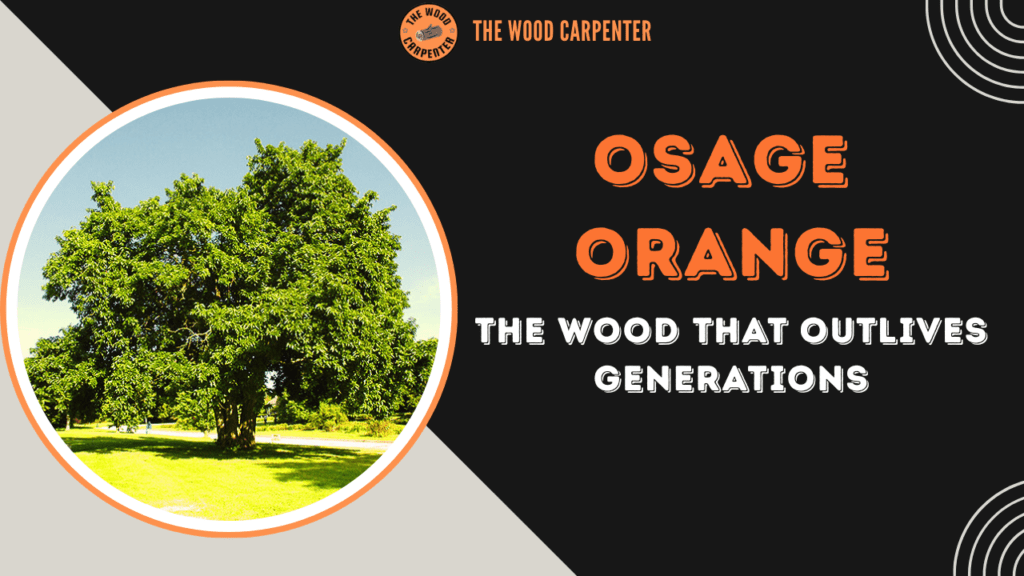
Osage orange wood is one of those materials that quietly outperforms almost everything around it. It boasts high hardness, high durability, good natural resistance to rotting, and it burns hotter than practically all other North American firewood. However, beyond fence builders, bowyers and a few woodworkers, most people can barely tell it exists.
If you have ever come across a board that was almost too yellow to be of natural origin, the likelihood is high that it was Osage orange. And if you’ve ever pulled an ancient, solid post from a fence row, the odds are good that it came from trees like this too.
Let’s look at what makes this tree so special, in simple, practical terms.
What Is Osage Orange?
Osage orange (Maclura pomifera) is a small to medium-sized deciduous tree that is native to the areas of Texas, Oklahoma and Arkansas. It gradually spread across much of the central and eastern United States, and in particular when farmers started to grow it as living fences before barbed wire became common.
Some might call it a hedge apple, others a horse apple, still others a bodark (from the French bois d’arc, meaning “wood of the bow”); and yet others, an Osage apple.
The tree typically reaches heights of 30–50 feet and frequently possesses a thick, somewhat twisted trunk. It bears big, green, wrinkly fruits that can almost resemble little brains. These fruits are not considered edible for humans, though animals sometimes chew on them.
But the most valuable thing that this tree has is not its the fruit. It is the heartwood.
When freshly cut, the heartwood is a bold golden yellow or bright orange. Over time, with exposure to air and light, it slowly turns into a warm brown with golden undertones. That color change is natural and expected.
Quick Property Overview
Here is a clear summary of how Osage orange performs compared to many common hardwoods.
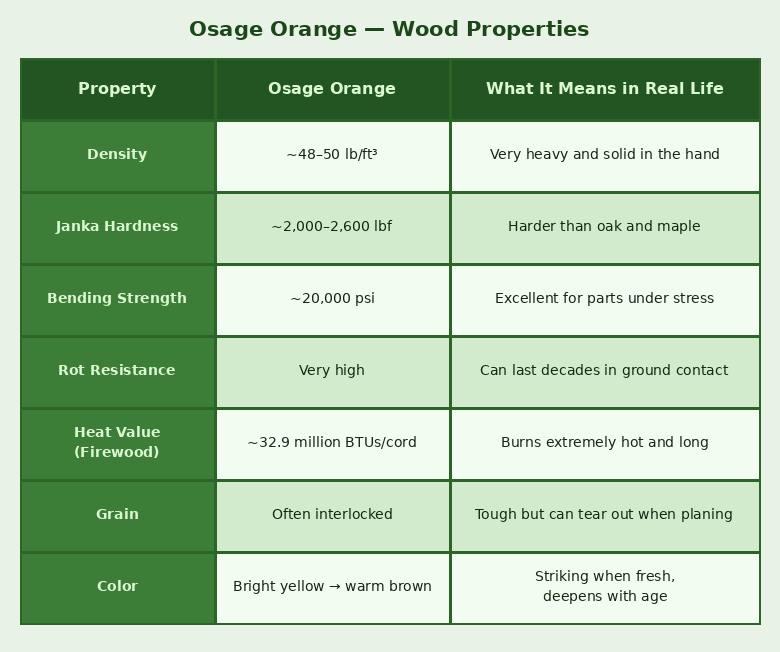
In simple words: it is tough, dense, long-lasting, and strong.
Why It Lasts So Long Outdoors
Osage orange is best-known, perhaps, for its longevity in soil.
Farmers have pulled out fence posts that stood for 40, 50, even 70 years and found them still structurally sound. Not perfect, but far from rotten. That kind of lifespan is rare without chemical treatment.
Natural compounds in the heartwood including the flavonoids pomiferin and related compounds. These assist in defending against fungal decay and insect damage. That is why untreated posts often outlast many pressure-treated alternatives.
A simple real-life example:
Natural compounds in the heartwood including the flavonoids pomiferin and related compounds. These assist in defending against fungal decay and insect injury.
Also read:
Sandalwood: The Untold Story of its true Value
Gopher Wood: The Mystery Wood of Noah’s Ark Explained
The Legendary Bow Wood
Osage orange has a deep history in traditional archery. Indigenous tribes, especially the Osage people, valued it highly for making powerful self bows.
Why?
Because a bow needs two opposite strengths at the same time:
- The back must resist tension.
- The belly must resist compression.
- The limb must bend and return without permanent damage.
Osage orange does all three remarkably well. It bends without taking a permanent set and stores energy efficiently. Even today, many traditional bowyers consider it one of the best single-wood bow materials available.
If someone wants to build a longbow that can last for years of regular shooting, Osage orange is often at the top of the list.
Everyday Practical Uses
This wood shines in applications where strength and durability matter more than easy workability.
Fence posts and farm structures
Its natural decay resistance makes it ideal for vineyard stakes, corner posts, and small outdoor structures.
Tool handles and striking tools
Because it absorbs shock well and resists denting, it works beautifully for mallet heads, wedges, and heavy-duty handles.
Turned objects
On a lathe, it becomes something special. Bowls, pens, bottle stoppers, and small decorative pieces can be polished to a glass-smooth finish. The golden color looks almost artificial when freshly turned.
Knife handles
The density and color give knife scales a bold, durable finish.
Firewood
Osage orange is among the hottest-burning woods in North America. It produces very high heat and long burn times. The downside? It can spark heavily in open fireplaces, so enclosed stoves are safer.
Working With It in the Shop
Here is where things get honest.
Osage orange is not beginner-friendly.
Its hardness dulls tools quickly. Carbide blades are strongly recommended. Hand tools must be razor sharp. Interlocked grain can cause tear-out if you take heavy passes.
Splitting dry logs can feel almost impossible. Many people prefer splitting it while green.
Drying requires patience. The wood can crack if dried too quickly. Sealing the ends and air-drying slowly reduces checking.
However, once properly dried and shaped, it finishes beautifully. Oils and clear finishes highlight its depth and warmth. It polishes to a smooth, almost glowing surface.
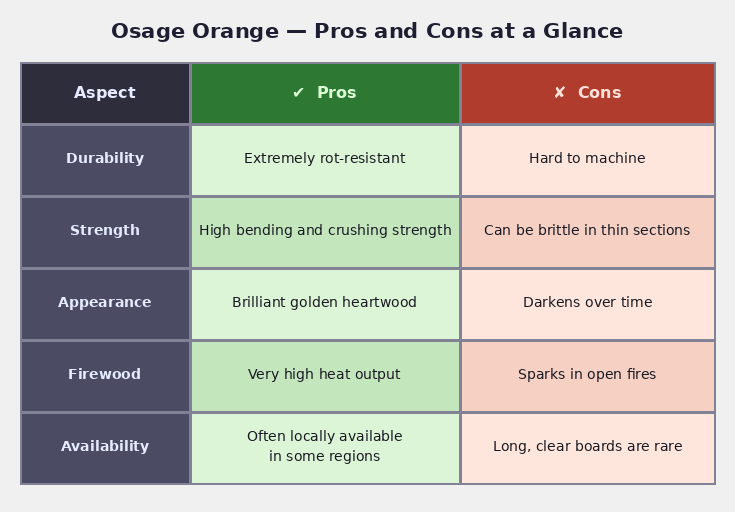
Pros and Cons at a Glance
Is the Fruit Useful?
The large green “hedge apples” are not commonly eaten by humans. They are generally considered inedible, though not highly toxic.
There is a long-standing belief that placing the fruits around a home repels insects. Laboratory extracts show some insect-repelling activity, but whole fruits placed casually in basements do not consistently provide reliable pest control.
So while the folklore exists, it should not replace proven pest management methods.
Sustainability
Osage orange is not endangered. In fact, outside its original native range, it is sometimes considered invasive. Many trees are removed from hedgerows or farmland.
Using locally sourced Osage orange can actually be environmentally responsible. It often comes from trees already being cleared rather than from large commercial logging operations.
Is It Good for Furniture?
Yes — but with limits.
Because trees tend to be short and crooked, wide clear boards are uncommon. That makes large tabletops or cabinets less typical.
However, it performs beautifully in smaller, high-stress furniture parts like chair rungs, legs, and decorative accents. A bench built with Osage orange legs could realistically outlast its owner.
Final Thoughts
Osage orange isn’t a wood that you’ll just find everywhere. It is actually a challenging wood to cut.
It is not the easiest wood to dry.
However when you need strength, durability, and character, you can look very few North American hardwoods can come to par with it.
It is the sort of wood that farmers have trusted for generations, that bowyers still admire, and that woodturners smile at as those first golden shavings fall to the floor.
Sometimes the strongest materials are not the most famous ones. They are simply the ones that refuse to fail.
FAQ’s
1. What is Osage Orange wood?
Osage Orange is a very tough durable hardwood obtained from the wood of Osage Orange tree. This is known for being bright golden color and very strong.
2. Why is Osage Orange wood so popular?
The reason why it is popular is because of its natural resistance against rot, insects, and decay. It lasts for decades, even outside.
3. Is Osage Orange wood good for outdoor use?
Yes. Readily available: It makes for one of the best outdoor woods for projects like fence posts as it does not rot or break down easily.
4. How hard is Osage Orange wood?
One of the most hardest timbers found in North America is Osage Orange. Relative to many other hardwoods, it is extremely dense and durable.
5. Does Osage Orange wood change color?
Yes. It starts as a bright golden yellow and slowly turns into a deeper brown over time when exposed to light.
6. Is Osage Orange wood difficult to work with?
It is extremely hard and dense, so cutting and shaping it can be difficult! Sharp tools are needed.
7. What is Osage Orange wood commonly used for?
Ideal for fence posts, tool handles, archery bows, and small specialty wood projects.
8. Does Osage Orange wood need treatment?
Usually, no. It is frequently untreated with chemicals, because it has natural oils that help to protect it from rot and insects.
9. Is Osage Orange poisonous?
Osage Orange wood itself is not poisonous. It is safe to handle and use for woodworking projects like fence posts, tool handles, and bows.
However, here are a few important points:
- The fruit (often called hedge apples) is not considered toxic to humans, but it is not edible and can cause stomach upset if eaten in large amounts.
- The sap and sawdust may cause mild skin irritation or allergic reactions in some people, especially during cutting or sanding.
- It is generally not recommended for cooking or food-contact items unless properly sealed.
Overall Osage Orange is not toxic, general safety precautions like using a mask and gloves while cutting are always a good idea.