
Last Updated on August 1, 2026 by Sam Wood Worker
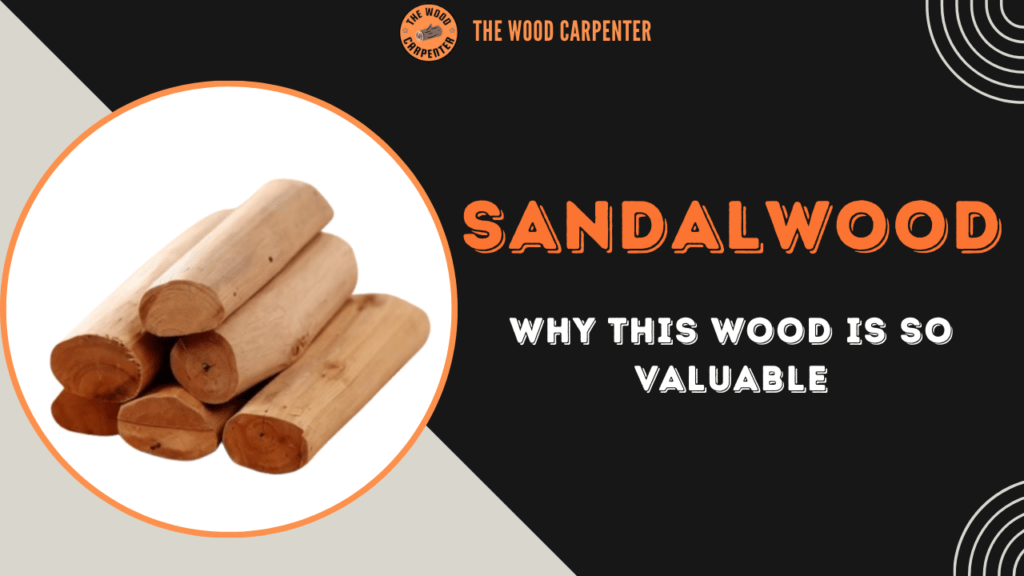
There’s is a reason why sandalwood has been loved for thousands of years. This fragrance is warm, creamy, slightly sweet, and grounding. It doesn’t strike you hard like many modern-day perfumes do. Instead, it settles in slowly. It stays.
Walk into an old temple in South India, a quiet meditation room in London, or even a high-end boutique in New York selling niche fragrances — and you may notice that familiar soft woody note. That’s sandalwood.
However, sandalwood is not just a good smell it is more than that. It is the history, science, medicine, spirituality, craftsmanship, and global trade — all wrapped in one slowly growing tree.
Let’s break it down in a clear, simple way.
What Is Sandalwood ?
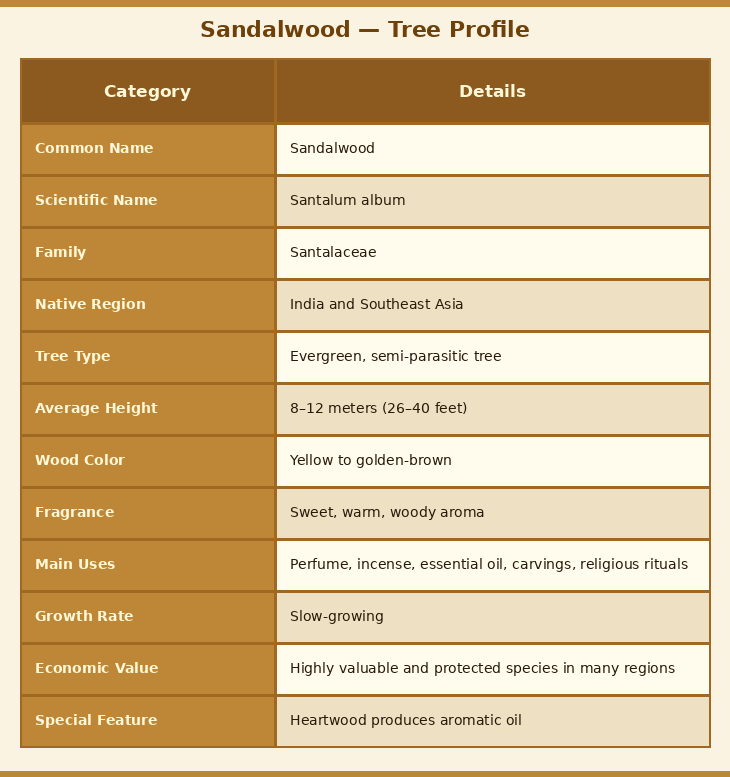
Sandalwood is a type of tree from the family Santalum. Indian sandalwood, Santalum album, is the most popular and commercially valuable.
Unlike most trees, sandalwood is semi-parasitic. That means it can connect its roots into its neighbour trees to suck a little bit of added nutrients.
Because of this unusual biology, it grows slowly and needs careful cultivation.
The magic is in the heartwood — the dense inner core of the tree. That’s where the fragrance lives. And it doesn’t fade quickly. Properly stored sandalwood can hold its scent for decades, even centuries.
It normally takes a tree 15–30 years before it will start producing fine quality heartwood oil. It’s part of why sandalwood is so costly because you have to wait so long.
A History That Spans Continents
Sandalwood has been in the trade for over 4000 years Chandan is the name used in ancient India. For ritual use, for traditional medicine, and royal ceremonies. They made a paste from the wood and put that paste on their forehead when praying. It signified purity and devotion.
In Buddhist temples across Asia, sandalwood incense purified sacred spaces. In parts of the Middle East, it was blended into perfumes. Even ancient Egypt used sandalwood oil in burial rituals.
The European traders soon realised the availability of sandalwood forests in the Indian territories and the demand skyrocketed. The Mysore region (present-day Karnataka in the southern part of India) state-controlled sandalwood by the 1800s for its protection. The Indian government continues to tightly regulate the harvesting and sale of it to this day.
Because of overharvesting, wild Indian sandalwood is now considered vulnerable. That’s where Australia entered the picture.
Western Australia now leads the world in sustainably grown sandalwood. Farmers grow native Australia species and Indian sandalwood in a controlled and sustainable manner. This has stabilised the supply in the global market.
Types of Sandalwood (Simple Comparison)
Here’s a clear look at the main commercial varieties:
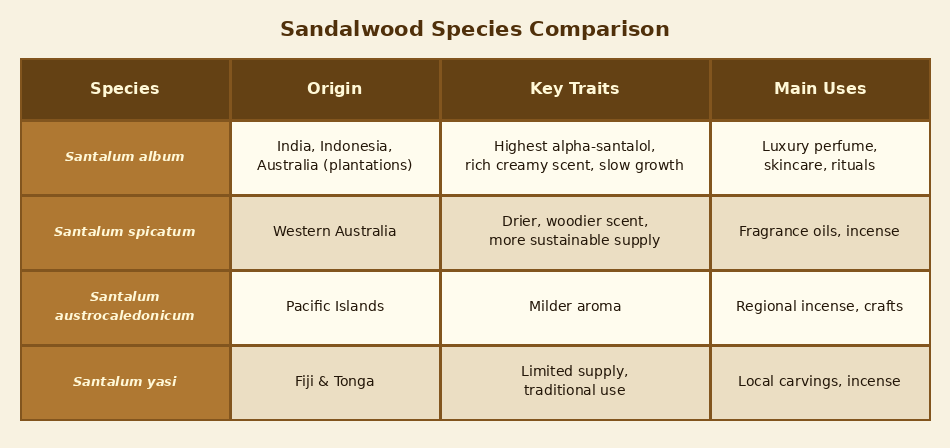
Indian sandalwood is still considered the gold standard for fragrance intensity. However, Australian plantation-grown Indian sandalwood now rivals traditional sources in quality.
Why Is Sandalwood So Expensive?
Several real-world reasons explain the price:
First, it takes time. It takes 20 to 30 years for a sandalwood tree to reach maturity and be ready to be harvested.
That is a long wait compared to many other trees.
Second, there are strict rules. For decades, the government of India has regulated the trade of sandalwood. Because it is so valuable, illegal cutting has also happened, which has pushed prices even higher.
Thirdly, it is not easy to extract oil. That rich oil is found solely in the heartwood (the inner portion of the tree). A small amount of oil requires a massive amount of heartwood. The steam distillation process lasts between 14 and 36 hours of operation.
For context, authentic Indian sandalwood oil can retail for upwards of $100 for 10 ml in countries like the US or the UK. But if you see it being sold for $15, the chances are it is either synthetic or mixed with other oils.
The Science Behind the Scent
The unique scent of sandalwood primarily consists of two natural compounds, namely alpha-santalol and beta-santalol. These are the main ingredients responsible for that soft, creamy warm scent.
In perfumes, sandalwood is often used as a “fixative.” This means it helps other scents last longer on the skin. It works like a strong base that holds the lighter notes in place.
This is why sandalwood is one of the main ingredients in most luxurious perfumes. This thickens the fragrance and also provides longevity.
Today, scientists have created synthetic versions such as Javanol. These are commonly used in modern designer perfumes because they are cheaper and more consistent. Fragrance oils smell like real sandalwood, but rarely have the depth of fragrance of genuine sandalwood oil.
Skin and Health Benefits (What We Actually Know)
Sandalwood is a popular ingredient used in Ayurvedic medicine for over 2000 years. And today research backs up some of those older applications.
For skin, it may help calm inflammation. People with acne or eczema often use diluted sandalwood oil in creams. Some studies suggest alpha-santalol has antimicrobial and antioxidant properties.
In real terms, that means it might soothe any redness and irritation.
Aromatherapy sandalwood is used for relaxation. Inhaled, this has some evidence from smaller studies that shows it can help with anxiety and stress levels.
However, it’s important to be realistic. Sandalwood is not a miracle cure. It’s a supportive ingredient, not a replacement for medical treatment.
Always dilute essential oil to 1–2% in a carrier oil before applying to skin.
Everyday Uses in the USA and UK
In London, sandalwood appears in high-end niche perfumes. In New York and Los Angeles, it’s a favorite in luxury candles. Many natural skincare brands in both countries use sandalwood in moisturizers and facial oils.
It’s also popular in mindfulness spaces. Meditation studios often burn sandalwood incense because the scent feels grounding and steady.
Even barbershops sometimes use sandalwood-based aftershaves — that classic warm masculine scent many people recognize.
Sustainability: The Big Issue
Let’s be honest. Sandalwood has been overharvested in the past.
Wild populations of Indian sandalwood declined due to illegal logging and high demand. That’s why plantation farming in Australia has become so important.
Ethical buyers should look for clear labeling of species and origin. Plantation-grown sandalwood is the responsible choice.
If a brand doesn’t tell you the species or origin, that’s a red flag.
Frequently Asked Questions
Is sandalwood safe for skin?
Yes, when diluted properly. Never apply pure essential oil directly without mixing it in a carrier oil.
How long does the scent last?
Much longer than most woods. Properly stored heartwood can hold fragrance for decades.
What’s the difference between Indian and Australian sandalwood?
Indian sandalwood has a richer, sweeter aroma. Australian sandalwood tends to smell drier and woodier, though plantation-grown Indian sandalwood in Australia is now very high quality.
Can sandalwood help with sleep?
It may promote relaxation when inhaled. Many people use it in bedtime diffuser blends, but it’s not a medical sleep treatment.
Why are cheap sandalwood oils everywhere online?
Many are synthetic blends or diluted oils. Real sandalwood oil is expensive because of slow growth and limited supply.
Gopher Wood: The Mystery Wood of Noah’s Ark Explained
Scots Pine: The Hardy Tree You Should Know
Final Thoughts
Sandalwood is where nature, history, science, and spirituality converge.
It has been burned in temples, blended in royal perfumes, sculpted into sacred idols, examined in laboratories, and bottled in modern skincare products.
There are not that many things in nature that come with a global story like that.
If you choose sandalwood, choose wisely. Look for sustainable sourcing. Understand what species you’re buying. And cherish the patience behind it — every drop of genuine sandalwood essential oil takes decades of growth.
That alone makes it remarkable.