
Last Updated on August 1, 2026 by Sam Wood Worker
Key Takeaways:
- Registers 5,060 lbf on the Janka scale — the hardest wood ever measured, nearly four times harder than oak
- Grows slowly in harsh semi-arid conditions across south-eastern Australia — that difficult environment creates the extreme density
- Dense enough to sink in water — most wood floats, this doesn’t
- Standard steel tools won’t survive contact with it — carbide or diamond-tipped tooling is essential
- The south-eastern red-tailed black cockatoo depends on old buloke trees for nesting — making mature stands ecologically irreplaceable
- Regional populations in Victoria and New South Wales carry endangered status under Australian law.
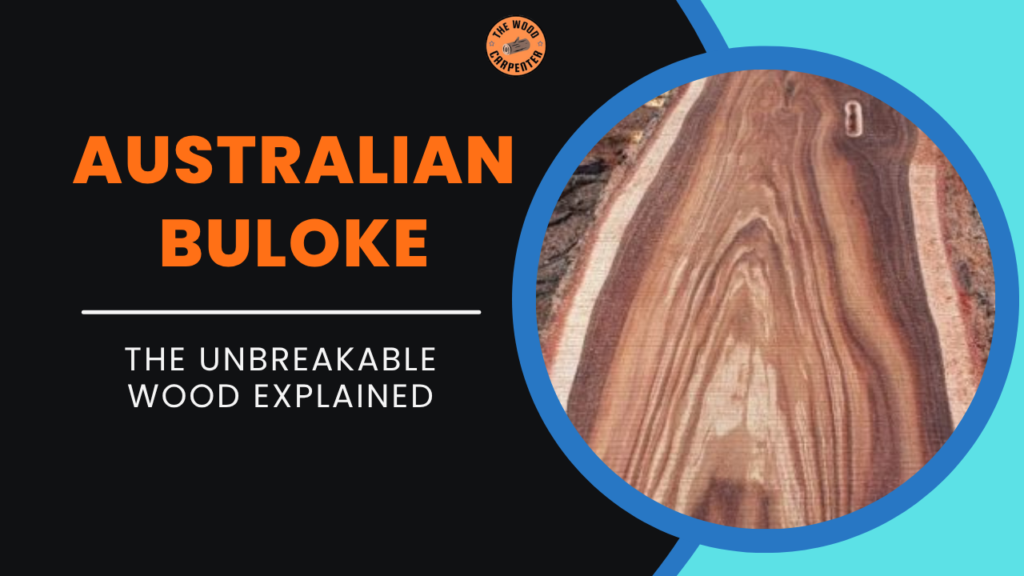
Australian buloke is a slow-growing native tree from south-eastern Australia that produces the hardest timber ever measured — 5,060 lbf on the Janka scale, harder than ebony, harder than lignum vitae, and harder than aluminium — making it one of the most extraordinary natural materials on earth.
When the Wood Wins
A few strokes and the hatchet is blunt. The chainsaw chain breaks. The circular saw loses teeth. One flooring specialist described sanding a buloke floor as the hardest job they’d ever taken on.
That’s Australian buloke. And once you understand what this tree is and where it comes from, none of that surprises you.
What Is Australian Buloke?
Australian buloke — Allocasuarina luehmannii — is a flowering hardwood native to south-eastern mainland Australia. It belongs to the Casuarinaceae family, sometimes called she-oaks or ironwoods, which immediately confuses people expecting a typical hardwood tree.
Instead of broad leaves, buloke grows fine needle-like branchlets — grey-green, upright, up to 400mm long — with leaves reduced to tiny teeth arranged in whorls around each stem. From a distance it looks like a pine. Up close, the rough dark furrowed bark tells you something different is going on.
It’s a dioecious tree — male and female flowers grow on separate trees, wind-pollinated in spring into small woody cone-like structures packed with winged seeds. The tree grows 5 to 15 metres tall with trunks typically 0.3 to 0.6 metres wide, lives over 100 years, and grows slowly throughout.
You’ll hear it called buloke, bull-oak, or the Wiradjuri word Ngany. The Shire of Buloke in Victoria takes its name from this species.
Where It Grows — and Why That Explains Everything
Buloke grows across the semi-arid inland of south-eastern Australia — Victoria, South Australia, New South Wales, and parts of Queensland. Open eucalypt woodlands, heavy clay soils, low rainfall, brutal seasonal temperature swings.
That harsh environment is the direct explanation for what the timber becomes.
Unlike rainforest species that grow quickly in wet, nutrient-rich conditions, buloke grows slowly under stress — year after year of difficult conditions compressing cellular structure in a way that fast growth simply can’t replicate. Every growth ring represents a hard year, and that difficulty locks permanently into the wood.
The problem is that the same flat, productive plains where buloke once grew thickly are exactly what Australian agriculture converted to crops and pasture. In some areas over 90 percent of original woodland has been cleared.
The Janka Hardness — What 5,060 lbf Actually Means
The Janka test measures the force required to press a steel ball halfway into a wood sample. The higher the number, the harder the wood.
| Wood | Janka Hardness (lbf) | Origin |
| Australian Buloke | 5,060 | SE Australia |
| Lignum Vitae | 4,390 | Caribbean |
| Macassar Ebony | 3,220 | Indonesia |
| Hard Maple | 1,450 | North America |
| White Oak | 1,360 | North America |
| Red Oak | 1,290 | North America |
Buloke sits nearly four times harder than oak and 60 percent harder than Macassar ebony — itself considered one of the densest commercially available hardwoods.
The comparison that really puts it in perspective — buloke is harder than aluminium. The wood measures around 22,500 Newtons of hardness. Aluminium measures approximately 15,000 Newtons. A naturally growing tree outperforms a common industrial metal.
Some sources cite 3,760 lbf rather than 5,060 — the variation reflects differences in sample moisture content and test conditions. Either figure still places it dramatically above every other commercial timber species on earth.
Physical Properties
Density runs 1,000 to 1,350 kg per cubic metre for air-dried samples. Above 1,000 kg per cubic metre means the wood sinks in fresh water. That single fact communicates more about this material than almost any other statistic.
The structural numbers back this up — modulus of rupture sits at 120 to 220 MPa, modulus of elasticity runs 15,000 to 20,000 MPa. Real structural strength, not just surface hardness.
The caveat: despite its extreme surface hardness, buloke can be brittle through the heart. It checks and splits as it dries. Most pieces carry a slight twist. The density that makes it impenetrable limits its ability to flex and absorb impact without fracturing — it resists penetration but doesn’t absorb shock the way hickory does.
Finished colour runs toward warm greyish-gold, sometimes with amber tones. The grain is straight and fine — under proper finishing it produces a surface that approaches glass-like smoothness.
Working With It
Standard steel tools don’t survive this wood. That’s not an exaggeration — it’s the consistent experience of every craftsperson who has worked with buloke.
Use carbide-tipped or diamond-tipped tooling at every stage. Pre-drill before every single screw or nail — no exceptions. Work slowly to control heat buildup from friction. Budget significantly longer sanding stages than you’d expect and refresh abrasives regularly.
One account worth knowing: someone who used buloke as firewood reported it burned out a stove within six months of regular use. The heat output is simply too intense for standard equipment.
The reward for patience is real. The tight fine grain produces crisp detail, sharp edges, and a brilliant polish that few materials match. Turned pieces — bowls, pens, bottle stoppers — emerge with a weight and surface quality that immediately signals something different happened here.
What It Gets Used For
Buloke doesn’t appear in large structural applications. Its uses run toward the specialised and decorative.
Knife handles and scales are the natural fit. The hardness resists wear over years of heavy use and the fine grain takes a finish that elevates the tool visually as well as functionally.
Flooring from buloke is extraordinarily durable — a floor installed from this material outlasts virtually everything else available. Installation complexity and cost make it best suited to feature areas rather than whole-house coverage.
Turned objects reward the effort. The density gives finished pieces a heft that makes them feel valuable before they’re even examined closely.
Musical instruments — particularly didgeridoos and hand drums — benefit from the tonal richness the density provides. Aboriginal communities used buloke for boomerangs, clubs, and tool handles requiring impact resistance long before any woodworking catalogue existed.
Outside Australia, buloke occasionally appears as small turning blanks through specialist importers. Prices are high and availability is limited. Craftspeople who manage to source a piece treat it with the seriousness it deserves.
Indigenous Cultural Significance
The Wiradjuri people of New South Wales used buloke timber and resinous sap to make tools and implements for thousands of years. The same properties that attract contemporary craftspeople — extreme density, wear resistance, fine finish — made it the material of choice for implements requiring durability.
The naming of the Shire of Buloke in Victoria after this species reflects how embedded the tree was in the cultural and physical landscape of the region. Place names across south-eastern Australia carry the distribution and significance of this tree encoded in them.
Conservation
Globally, buloke doesn’t appear on the IUCN Red List or in CITES Appendices. That global status obscures what’s happening on the ground.
Specific populations in Victoria and New South Wales carry endangered status under Australian state and federal law. Land clearing has fragmented and reduced buloke woodland dramatically over the past century. Some areas have lost over 90 percent of original cover.
Felling now operates under quota systems restricting harvest to naturally dead or safety-removal trees. Illegal felling continues in some areas regardless.
For anyone buying buloke timber — the question isn’t just whether the species appears on a global list. It’s whether this specific piece was harvested legally. Reclaimed material from demolished buildings, old fencing, or naturally fallen trees is the cleanest option. New-cut material needs clear documentation of legal origin.
Growing It
For anyone in suitable conditions — USDA Zones 8 to 11, full sun, heavy or clay-based soils — buloke rewards long-term thinking.
It tolerates drought once established, handles flooding, and actively improves surrounding soil through nitrogen fixation. Sow seed in autumn — smoke treatment significantly improves germination. Space trees 4 to 6 metres apart.
The growth is slow. The 100-year payoff — mature timber, nesting habitat, soil improvement across the surrounding area — represents a fundamentally different kind of investment than any fast-growing commercial species.
For landowners in the right part of south-eastern Australia, planting buloke is one of the most ecologically valuable things they can do.
Frequently Asked Questions
Is buloke really the world’s hardest wood? Yes — it consistently registers at or near the top of the Janka scale across reputable timber databases. The 5,060 lbf figure is the most widely cited. Either way, the gap between buloke and every other commercial timber species is dramatic.
Where does it grow naturally? Semi-arid open woodlands across south-eastern Australia — Victoria, South Australia, New South Wales, and parts of Queensland. Heavy clay soils, low rainfall zones.
Can you work it with hand tools? Not practically. Power tools with carbide or diamond-tipped tooling are essential. Standard steel blades dull almost immediately. Pre-drill before every fastener without exception.
Is it good for flooring? Extraordinarily durable — but installation requires specialist tooling and costs reflect the difficulty. Best suited to feature areas rather than large-scale coverage.
What animals depend on it? The south-eastern red-tailed black cockatoo has the closest dependency — feeding on seeds and nesting in hollows that only develop in old-growth trees. Superb parrots, diamond firetails, and various small mammals also rely on buloke woodland.
Is it endangered? Not globally. But regional populations in Victoria and New South Wales carry endangered status under Australian law. The ecological situation is more serious than the global listing suggests.
How do I source it responsibly? Prioritise reclaimed or salvaged material. New-cut pieces need verifiable documentation of legal harvest. Outside Australia, availability runs to specialist importers and occasional small turning blanks at premium prices.
Does it have toxic properties? No specific toxicity is documented. Standard respiratory protection applies when machining or sanding — the fine dense dust warrants proper dust management and ventilation.
The Bottom Line
Australian buloke forces you to reassess what wood can actually be.
Nearly four times harder than oak. Harder than aluminium. Dense enough to sink in water. Hot enough to burn out a stove. A tree that blunts hatchets in a few strokes and defeats standard woodworking equipment before you’ve barely started.
But the full picture goes beyond the hardness number. Buloke is an ecologically irreplaceable part of south-eastern Australian woodland.
Threatened birds depend on old-growth trees that take decades to develop. Aboriginal communities built tools and culture around this material for thousands of years.
And in the hands of a patient craftsperson with the right tooling, it produces objects with a weight, finish, and visual quality that almost nothing else achieves.
The number gets you in the door. The tree itself is the actual story.