
Last Updated on May 27, 2026 by Sam Wood Worker
Maple Wood
I remember walking through a furniture store with my father when I was about twelve years old. He stopped in front of a light colored wood cabinet and ran his hand across the surface. He said — feel this. I put my hand on it and it felt like glass. Completely smooth. Almost cold under my fingers. The wood was pale cream with subtle flowing lines running through it. My father said — that is maple. Remember it. I never forgot.
If you want to understand maple wood — what it is, why people love it, what it is used for, and whether it is right for your project — this guide covers everything in plain honest English. No complicated language. Just real information written like one person talking to another.
What Is Maple Wood?
Maple wood comes from maple trees. There are many types of maple trees but the two most important ones for woodworking are:
Hard maple — Also called sugar maple or rock maple. Scientific name is Acer saccharum. This is the most valuable and most used maple for woodworking. When people say maple wood in a woodworking context — they almost always mean hard maple.
Soft maple — Actually several different species including red maple and silver maple. Despite the name soft maple is still harder than many other common woods. It is just softer than hard maple.
Maple trees grow mainly in the northeastern United States and Canada — states and provinces like Vermont, New York, Michigan, Ontario, and Quebec. These are the same trees that produce maple syrup every spring. The same tree that gives you the syrup also gives you one of the finest hardwoods available.
What makes maple wood stand out immediately is its appearance. It is pale. Almost white or cream colored with a very fine even grain. It is the opposite of dark dramatic woods like walnut or wenge. Where walnut says warm and rich — maple says clean and crisp.
Quick Facts About Maple Wood
| Property | Detail |
|---|---|
| Scientific name | Acer saccharum (hard maple) |
| Common names | Hard maple, sugar maple, rock maple |
| Where it grows | Northeastern USA and Canada |
| Color | Pale cream to light golden brown |
| Janka hardness | 1450 (hard maple) |
| Weight | Heavy and dense |
| Cost | $4 – $12 per board foot |
| Best uses | Flooring, furniture, butcher blocks, instruments |
| Special feature | Produces maple syrup |
Why People Love Maple Wood
Maple wood has a very different kind of beauty from dark dramatic woods. It is not loud. It does not immediately grab attention the way walnut or cocobolo does. But it has qualities that make experienced woodworkers and designers reach for it again and again.
The hardness is exceptional. Hard maple at 1450 on the Janka scale is significantly harder than walnut. This makes it extremely resistant to dents and scratches. For floors and work surfaces that take daily punishment — maple is one of the best choices available.
The color is versatile. The pale cream color of maple works with almost any interior style. Light and airy Scandinavian design. Clean modern minimalism. Classic American country style. Maple fits all of them naturally.
The surface is incredibly smooth. Maple has a very tight fine grain that sands and finishes to an almost glass-like smoothness. Running your hand across a well-finished maple surface is a genuinely satisfying experience.
It takes stain well. Because maple is pale and neutral it takes wood stains in any color beautifully. Want dark brown furniture? Stain maple. Want grey tones? Stain maple. Want to match existing dark floors? Stain maple. It is one of the most versatile canvases in woodworking.
It is affordable compared to premium hardwoods. Maple gives you exceptional quality at a price that is accessible to most people. You do not need to spend walnut or teak money to get a genuinely excellent hardwood.
Real life example: A young couple in Vermont were renovating their first home on a tight budget. They wanted hardwood floors that would last and look great for decades. Their contractor suggested maple. They were worried it would look too plain. But after seeing a finished sample they fell in love with the clean warm look. They installed maple floors throughout the main level for significantly less than walnut would have cost. Ten years later those floors still look perfect and have handled two children, two dogs, and countless dinner parties without a single board needing replacement.
What Does Maple Wood Look Like?
Maple is one of the easiest woods to recognize because its appearance is so distinct from most other common hardwoods.
The color is pale cream to light golden tan. Sometimes with a very subtle pinkish tone. Sometimes almost pure white. Unlike walnut or cherry — maple does not have dramatically different colored heartwood and sapwood. The whole board tends to be a similar pale color throughout.
The grain is fine and very consistent. The lines running through the wood are tight and close together giving it a smooth even look. Standard straight-grained maple has a clean uniform appearance that works beautifully in contemporary and modern interiors.
But maple also comes in several spectacular figured varieties that look completely different from standard maple:
Curly maple — Also called tiger maple. The grain waves across the board creating a shimmering three-dimensional effect that appears to change as you move around it. It looks almost like the wood is moving. Absolutely stunning when finished.
Bird’s eye maple — Small circular swirling patterns scattered across the surface — they look like tiny bird’s eyes. This pattern is quite rare and is one of the most sought-after figured wood appearances in all of woodworking.
Quilted maple — The grain creates a puffed or quilted appearance — like a fabric quilt pressed into the wood surface. Very rare and very beautiful.
Blistered maple — Similar to quilted but with more irregular oval patterns. Also rare.
When light hits figured maple — especially curly or bird’s eye — the effect is genuinely breathtaking. The wood seems to have depth and dimension that goes far beyond its surface.
Real life example: A guitar maker in Nashville showed me a curly maple guitar neck he had just finished. He tilted it slowly under the workshop light. The grain shimmered and rippled like water. He said he had been making guitars for 22 years and curly maple still made him stop and stare every single time. That is the effect of figured maple.
Where Does Maple Wood Come From?
Maple is abundant across the northeastern United States and eastern Canada. Unlike exotic woods that require importing from tropical countries — maple grows in the domestic forests of North America.
Vermont and New Hampshire — New England produces some of the finest hard maple. The cold winters and specific soil conditions create especially dense and beautiful wood.
Michigan and Wisconsin — Large quantities of high-quality hard maple come from the Great Lakes region. Much of the maple flooring used in American homes comes from this area.
Ontario and Quebec, Canada — Canadian maple is widely exported across North America and internationally. Very consistent quality.
New York and Pennsylvania — Good sources throughout the Appalachian region.
The maple tree takes about 40 years to reach a good harvesting size. Slower than pine but faster than many tropical hardwoods. The combination of domestic availability, reasonable growth rate, and consistent quality keeps maple prices accessible relative to its hardness and quality.
How Hard Is Maple Wood?
Hard maple has a Janka hardness rating of 1450. This places it among the hardest domestic North American woods.
| Wood | Janka Hardness |
|---|---|
| Pine | 870 |
| Black Walnut | 1010 |
| Teak | 1155 |
| Cherry | 950 |
| Hard Maple | 1450 |
| White Oak | 1360 |
| Wenge | 1630 |
| Ipe | 3680 |
Hard maple is harder than walnut, cherry, oak, and teak. This hardness is one of its most important properties.
For flooring — this hardness means exceptional resistance to dents and scratches from daily life. For butcher blocks and kitchen work surfaces — this hardness means resistance to knife marks and impact. For sports floors — this hardness means the ability to handle years of running, jumping, and heavy equipment without damage.
Soft maple has a Janka rating of around 950 — still perfectly acceptable for furniture and cabinets but noticeably less hard than hard maple.
The Different Types of Maple Wood
Understanding the different types of maple helps you choose the right one for your project.
Hard Maple vs. Soft Maple
Hard maple (sugar maple):
- Janka hardness 1450
- Pale cream to white color
- Very fine tight grain
- Best for flooring, butcher blocks, heavy use surfaces
- More expensive than soft maple
Soft maple (red maple, silver maple):
- Janka hardness around 950
- Slightly more variation in color — sometimes more brown or grey tones
- Similar grain to hard maple
- Good for furniture, cabinets, millwork
- More affordable than hard maple
- Works easier than hard maple
For most furniture projects — soft maple is perfectly adequate and more affordable. For floors and surfaces that take heavy daily use — hard maple is worth the extra cost.
Figured Maple Varieties
Curly maple — The most common figured variety. Wavy shimmering grain. Used extensively in guitar making and premium furniture.
Bird’s eye maple — Small circular patterns. Very rare. Used for premium furniture, veneers, and luxury items.
Quilted maple — Puffy three-dimensional appearance. Rare. Highly sought after for guitar tops and decorative veneers.
Ambrosia maple — Regular maple with grey and brown streaks caused by the ambrosia beetle burrowing through the wood. The beetle introduces a fungus that creates these distinctive color streaks. Many people find this natural character beautiful. Very affordable.
Hard Maple vs. Soft Maple
People often wonder what is the difference between hard and soft maple. Here’s a breakdown:
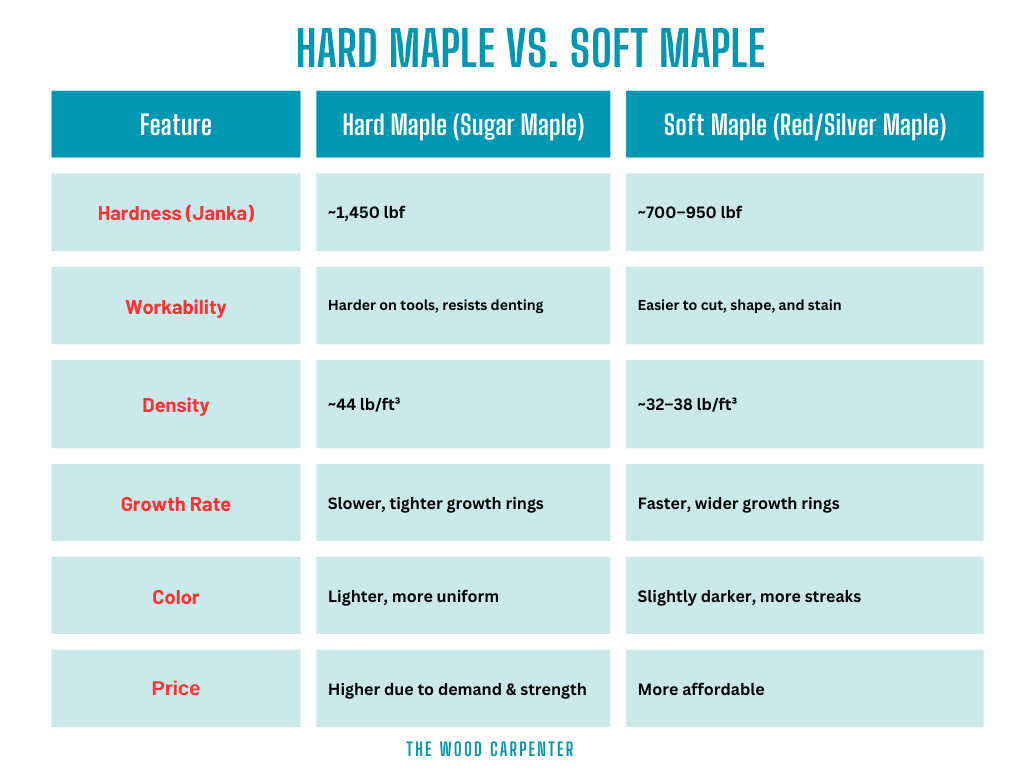
👉 Key takeaway: Hard maple is ideal for high-impact applications where durability is critical, while soft maple is a cost-effective alternative for furniture and cabinetry.
What Is Maple Wood Used For?
Maple is genuinely one of the most widely used hardwoods in North America. It shows up in more places than most people realize.
1. Hardwood Flooring — The Most Common Use
Walk into a basketball arena, a bowling alley, a school gymnasium, or a dance studio — the floors are almost certainly maple. Hard maple is the standard flooring material for any application requiring extreme durability and a very smooth consistent surface.
For residential homes — maple flooring provides the same exceptional durability with a clean contemporary look that many homeowners prefer over darker woods.
Real life example: The NBA has used maple floors in its arenas for decades. The Boston Celtics’ famous parquet floor at TD Garden — one of the most recognized sports floors in the world — is hard maple. Those floors handle 41 home games per season plus concerts, events, and countless other activities. They are sanded and refinished periodically but the maple itself has been performing for decades without structural issues. If maple can handle an NBA season it can certainly handle your living room.
Cost for maple flooring: $4 to $10 per square foot for the material. $8 to $18 per square foot installed.
2. Butcher Blocks and Kitchen Countertops
Maple butcher block countertops are a classic choice for kitchens and one of the applications where maple truly shines.
The extreme hardness resists knife marks far better than softer woods. The tight fine grain makes it naturally hygienic — bacteria have fewer places to hide in the dense surface. The pale color looks fresh and clean in any kitchen.
Maple butcher blocks are found in professional restaurant kitchens around the world. When chefs need a work surface that stands up to daily professional use — they choose maple.
Real life example: A chef who runs a busy restaurant in Chicago has had maple butcher block prep surfaces for 11 years. He says they still look and perform like new with basic maintenance — oiling once a month and sanding down every couple of years. He has tried other materials over the years. He always comes back to maple.
3. Furniture
Maple furniture has a long history in American homes. Shaker-style furniture — the clean simple elegant American furniture tradition from the 18th and 19th centuries — was predominantly made from maple and cherry. Clean lines. Beautiful pale wood. Simple honest construction.
Today maple furniture ranges from traditional to very contemporary. Its pale color and clean grain work beautifully in Scandinavian-influenced modern interiors.
Soft maple is most commonly used for furniture since it is slightly easier to work with than hard maple and the hardness difference does not matter much for chair legs and cabinet doors.
4. Baseball Bats
This is a use of maple that most people outside of baseball do not think about. Maple has become the dominant wood for professional baseball bats in Major League Baseball.
For most of baseball history — ash was the standard wood for bats. But in the 1990s Barry Bonds started using maple bats and his performance with them drew enormous attention. Within a decade maple had largely replaced ash as the preferred bat wood at the professional level.
Why maple for bats? The hardness means greater density in the hitting surface — many players feel they get better contact. The tight grain resists the grain from separating on contact in the way ash sometimes does.
Today approximately 75 to 80 percent of MLB players use maple bats.
5. Musical Instruments
Maple is one of the most important woods in musical instrument making — particularly in stringed instruments.
Guitar necks — The majority of electric guitar necks are made from maple. Fender Stratocasters and Telecasters — arguably the most iconic electric guitars ever built — have maple necks. The hardness resists the tension of guitar strings over decades. The stability means the neck stays straight.
Violin and cello backs — The back, sides, and neck of classical violins and cellos are traditionally made from figured maple. The most prized Stradivarius violins use curly maple for the back plate.
Drum shells — Many of the world’s finest drum kits use maple shells because of the warm balanced tone maple produces. Pearl, DW, and Yamaha all offer maple shell drum kits as their premium lines.
Piano pin blocks — The block that holds the tuning pins in a piano is almost always hard maple. The extreme hardness grips the tuning pins firmly keeping the piano in tune.
6. Bowling Alleys
The lane in a bowling alley is made from hard maple. Walk into any bowling alley and look down — that long polished lane that the bowling ball rolls down is maple.
The hardness resists the impact of bowling balls rolling over it thousands of times per day. The fine smooth grain provides consistent ball roll. Maple has been the standard material for bowling lanes for over a century.
7. Kitchen Cabinets
Maple kitchen cabinets are among the most popular choices in American homes. The pale clean color works in any kitchen style. The hardness means cabinets hold up to daily use for decades. And maple takes paint exceptionally well — so if you want white-painted cabinets that look flawless, maple is the ideal base material.
8. Cutting Boards
Like walnut — maple makes excellent cutting boards. Actually maple has a slight practical edge over walnut for cutting boards because of its greater hardness and tighter grain. Many professional chefs prefer maple cutting boards for their durability and hygienic surface.
The pale color does show stains more than dark walnut — but a simple cleaning with lemon and salt removes most stains from a maple board.
9. Workbenches
Serious woodworkers build their workbenches from hard maple. The extreme hardness means the bench surface resists damage from tools, clamps, and heavy workpieces. A well-made hard maple workbench will last several lifetimes.
How Much Does Maple Wood Cost?
Maple is one of the most affordable quality hardwoods available. Here are realistic prices for 2025:
| Product | Typical Price |
|---|---|
| Hard maple rough lumber per board foot | $4 – $8 |
| Hard maple surfaced lumber per board foot | $6 – $12 |
| Soft maple per board foot | $3 – $6 |
| Curly maple per board foot | $15 – $40+ |
| Bird’s eye maple per board foot | $20 – $60+ |
| Maple flooring per square foot | $4 – $10 |
| Maple butcher block countertop per sq ft | $20 – $45 |
| Maple cutting board finished | $40 – $150 |
| Maple dining table finished | $800 – $4,000 |
| Maple kitchen cabinets per linear foot | $150 – $400 |
Standard hard maple costs significantly less than walnut or cherry while actually being harder than both. This combination of affordability and exceptional hardness makes it outstanding value.
Figured maple — curly, bird’s eye, and quilted — commands a significant premium because of its rarity and extraordinary beauty.
How To Work With Maple Wood
Maple is a pleasure to work with in many ways but it has a few specific characteristics that every woodworker needs to understand.
Cutting Maple
Hard maple is tough on saw blades because of its density. Always use sharp carbide-tipped blades. Dull blades cause burning on maple — brown scorch marks along the cut line that are difficult to sand out.
Take steady consistent cuts. Let the saw do the work — do not force the blade through the wood.
Soft maple cuts more easily and is more forgiving on blades.
Sanding Maple
Maple sands to an exceptionally smooth surface because of its tight fine grain. This is one of the most satisfying things about working with it.
Start with 100-grit for initial smoothing. Work through 120, 150, 180, and finish with 220-grit for a surface that feels almost like polished glass.
One very important point — do not skip grits when sanding maple. Because the wood is so pale any scratches from coarser grits are very visible in the finished surface under a clear finish. Take your time and work through every grit.
Planing Maple
Maple planes beautifully with sharp tools. Hard maple can be difficult with dull hand planes — but a freshly sharpened blade on hard maple produces a surface so smooth it barely needs sanding.
Be aware of grain direction on figured maple. Curly maple in particular can tear out badly if planed in the wrong direction. Take very light passes and work with the grain carefully.
Gluing Maple
Standard PVA wood glue works perfectly on maple. No special preparation needed. Maple glues reliably and the joints are consistently strong.
Make sure surfaces are freshly machined for the best glue bond — do not glue surfaces that have been sitting for several days as they can develop a thin film that reduces bond strength.
Nailing and Screwing Maple
Hard maple requires pre-drilling for screws. The density means screws will not drive in without pilot holes and attempting to do so will split the wood or strip the screw head.
Use sharp drill bits — maple is tough on bits just like it is on saw blades.
The Big Challenge With Maple — Finishing
Here is the honest truth that every beginner woodworker eventually discovers — finishing maple is harder than finishing most other woods.
The main challenge is blotching. When you apply an oil-based stain to maple it does not absorb evenly. Some areas soak up more stain than others creating ugly dark blotches and uneven patches. The result looks terrible.
This catches many people off guard because maple looks so simple and clean that people expect it to be easy to finish. It is not.
Here is how to handle it:
Option 1 — Use a Clear or Lightly Tinted Finish
The simplest solution is to embrace maple’s natural pale color and use a clear finish that lets the wood speak for itself. This avoids the blotching problem entirely because you are not trying to color the wood.
Hard wax oil, clear lacquer, or water-based polyurethane all work beautifully on natural maple. The result is clean, bright, and shows off the fine grain and smooth surface perfectly.
This is what most professional woodworkers recommend for maple — let the natural color shine.
Option 2 — Use a Pre-Conditioner Before Staining
If you want to stain maple a specific color — apply a wood conditioner or pre-stain treatment first. This partially seals the wood surface so the stain absorbs more evenly and reduces blotching significantly.
Apply the conditioner, let it soak in for the recommended time, then apply your stain while the conditioner is still slightly tacky. This gives dramatically better results than staining raw maple directly.
Option 3 — Use Gel Stains
Gel stains are thick stains that sit on top of the wood rather than soaking in. They are much more forgiving on difficult-to-stain woods like maple and pine. They reduce blotching because they do not penetrate as deeply or as unevenly.
Best Clear Finishes for Maple
Water-based polyurethane — Excellent choice for maple. Dries clear without any yellowing so the pale maple color is preserved perfectly. Very durable. Apply 3 to 4 coats with light sanding between coats.
Lacquer — Fast drying and produces a beautiful smooth finish on maple. Popular for kitchen cabinets and furniture. Requires spray application for best results.
Hard wax oil — Penetrating finish that gives a natural low-sheen look. Good protection. Popular for floors and furniture where a more natural appearance is desired.
Oil-based polyurethane — More durable than water-based but adds a slight amber/yellow tint over time. This can actually look beautiful on maple — adding warmth to the otherwise very pale wood.
How To Care For Maple Wood
Daily Care
Wipe with a soft dry cloth to remove dust. For kitchen surfaces and butcher blocks — wipe clean after use and dry immediately. Never leave standing water on maple surfaces.
For butcher blocks used for food preparation — wash with mild soap and water then dry immediately. Never submerge in water or put in a dishwasher.
Regular Maintenance
For oil-finished maple floors and furniture — apply a fresh coat of hard wax oil or furniture oil once or twice per year.
For polyurethane-finished surfaces — wipe clean with a lightly damp cloth. Reapply polyurethane every 5 to 10 years when the finish wears.
For maple butcher blocks — apply food-safe mineral oil or butcher block oil once a month. This prevents drying and cracking. When the surface looks dry and pale it is time to oil. Well-oiled maple butcher block is water resistant and hygienic.
Protect From Heat
Maple is more sensitive to heat than some denser tropical hardwoods. Always use trivets or heat pads under hot pots and pans on maple countertops. Direct heat can leave permanent white marks in the finish.
Fix Minor Damage
Small scratches on polyurethane-finished maple — use a fine scratch repair pen or touch-up marker matched to the color.
Deeper scratches — lightly sand the affected area working up through the grits and reapply finish locally.
Dents on maple — the same damp cloth and warm iron trick that works on walnut works on maple too. The compressed wood cells swell back up with moisture and heat.
Maple Wood vs. Other Popular Woods
| Wood | Color | Hardness | Cost | Best For |
|---|---|---|---|---|
| Hard Maple | Pale cream | 1450 | Low-Medium | Floors, butcher blocks, cabinets |
| Black Walnut | Chocolate brown | 1010 | Medium-High | Furniture, floors, cabinets |
| White Oak | Light brown | 1360 | Medium | Floors, furniture, barrels |
| Cherry | Reddish brown | 950 | Medium | Fine furniture, cabinets |
| Pine | Yellow-white | 870 | Low | Construction, rustic furniture |
| Teak | Golden brown | 1155 | High | Outdoor furniture |
| Ash | Pale brown | 1320 | Medium | Sports equipment, furniture |
Maple wins on hardness among domestic American woods. It is harder than walnut, cherry, and oak while costing less than all three. For applications where hardness matters most — flooring, work surfaces, sports equipment — maple is often the smartest choice.
Is Maple Wood Sustainable?
Yes — maple is one of the most sustainably sourced hardwoods available in North America.
Maple forests across the northeastern United States and Canada are well-managed and abundant. The trees are not endangered. They are not on any restricted lists.
In fact maple forests in the Northeast are actually expanding in area — more maple trees exist today than 50 years ago due to reforestation efforts and the decline of agricultural land.
Look for maple certified by:
- FSC (Forest Stewardship Council) — The most reliable sustainability certification
- NHLA graded — National Hardwood Lumber Association certification
Because maple grows domestically in North America — buying American-grown maple has a much lower transportation carbon footprint than importing tropical hardwoods from South America or Southeast Asia. This is an additional environmental benefit.
Where To Buy Maple Wood
Maple is widely available — more so than most premium hardwoods.
Hardware stores and home improvement stores — Big box stores like Home Depot and Lowe’s carry some maple lumber and maple flooring. Selection is limited but convenient for smaller projects.
Specialty wood dealers — Best selection of grades, figured varieties, and cuts. Staff can advise on specific project needs.
Local sawyers and mills — Particularly in the northeastern United States and Canada — local mills often offer excellent prices on maple directly. Search for local hardwood mills in your area.
Flooring retailers — For maple flooring specifically — flooring retailers carry a wider selection of profiles, widths, and finishes than general lumber suppliers.
Fun Facts About Maple Wood
The sugar maple tree — the source of hard maple lumber — is also the source of maple syrup. The same tree produces one of the finest hardwoods and one of the most beloved food products in the world. A single sugar maple tree can produce maple syrup for over 100 years.
The maple leaf is the national symbol of Canada — featured prominently on the Canadian flag. In the fall the sugar maple produces some of the most spectacular autumn foliage in the world — turning brilliant shades of orange, red, and yellow across the New England and Canadian landscapes.
Bird’s eye maple was extremely fashionable in the early 19th century in America and Europe. The distinctive pattern was considered the height of luxury. Furniture from this era featuring bird’s eye maple veneer is now highly collectible.
The world’s longest maple flooring installation is the Indianapolis Motor Speedway in Indiana — the entire infield area uses maple flooring in the grandstand sections.
Harry Potter’s wand in the famous films is described as being made from holly wood — but many real wands made by collectors and prop makers use maple because of its clean pale appearance and fine grain.
The world record for a single piece of curly maple sold at auction was a spectacular quilted maple slab that sold for over $12,000 for a single board — the buyer was a guitar company who used it for a limited-edition instrument series.
Frequently Asked Questions
Q: What is maple wood?
Maple wood comes from maple trees — primarily hard maple or sugar maple with the scientific name Acer saccharum. It grows mainly in the northeastern United States and Canada. It is a pale cream to light tan colored hardwood with a very fine tight grain. Hard maple has a Janka hardness of 1450 making it one of the hardest domestic North American hardwoods. It is used for flooring, butcher blocks, furniture, musical instruments, sports equipment, and kitchen cabinets.
Q: Is hard maple good for flooring?
Yes — hard maple is one of the best flooring options available. Its Janka hardness of 1450 means exceptional resistance to dents and scratches from daily life. It is harder than oak, walnut, and cherry. It is the standard flooring choice for basketball courts, bowling alleys, gyms, and dance studios — all applications requiring extreme durability. For homes it provides beautiful clean appearance and outstanding longevity.
Q: Why is maple wood difficult to stain?
Maple has a very tight fine grain that does not absorb liquid stain evenly. Some areas soak up more stain than others creating blotchy uneven patches. To stain maple successfully — always apply a wood pre-conditioner before staining or use a gel stain. Better yet embrace maple’s natural pale color and use a clear finish — this avoids the blotching problem entirely and lets the beautiful natural wood show through.
Q: What is bird’s eye maple?
Bird’s eye maple is a rare and highly prized variety of maple that has small circular swirling patterns scattered across the surface — resembling tiny bird’s eyes. This pattern occurs naturally in a small percentage of maple trees and cannot be cultivated deliberately. It creates a stunning three-dimensional effect when finished. Bird’s eye maple costs $20 to $60 or more per board foot and is used for premium furniture, luxury veneers, and high-end decorative items.
Q: What is the difference between hard maple and soft maple?
Hard maple — also called sugar maple — has a Janka hardness of 1450 and is the premier choice for flooring, butcher blocks, and heavy-use surfaces. Soft maple includes several species like red maple and silver maple with a hardness around 950. Soft maple is still harder than many common woods and is excellent for furniture and cabinets. Hard maple costs more and is more difficult to work with. For most furniture projects soft maple is perfectly adequate and more affordable.
Q: How do you care for a maple butcher block?
Apply food-safe mineral oil or butcher block conditioner once a month — more frequently when the wood looks dry. Never put a maple butcher block in a dishwasher or submerge it in water. Clean with mild soap and water then dry immediately after each use. Every year or two lightly sand the surface with 220-grit sandpaper to remove knife marks and stains then re-oil thoroughly. With this basic care a maple butcher block lasts for decades.
Q: Is maple wood expensive?
No — standard maple is one of the most affordable quality hardwoods available. Hard maple rough lumber costs $4 to $8 per board foot. Maple flooring costs $4 to $10 per square foot. This makes maple significantly more affordable than walnut, cherry, teak, or exotic hardwoods. Figured varieties like curly maple and bird’s eye maple are considerably more expensive at $15 to $60 per board foot because of their rarity.
Q: Is maple a sustainable wood choice?
Yes — maple is one of the most sustainably sourced hardwoods in North America. Maple forests in the northeastern United States and Canada are abundant, well-managed, and actually expanding in area. Maple is not endangered and not on any restricted trade lists. Buying domestically grown maple also has a much lower transportation carbon footprint than importing tropical hardwoods. Look for FSC-certified maple for the most responsible sourcing.
Final Word
My father ran his hand across that maple cabinet in the furniture store and told me to feel it. I was twelve years old and I did not really understand what I was feeling. Just a smooth pale piece of wood.
But I understand it now.
What I was feeling was 40 years of slow growth in a cold northeastern forest. What I was feeling was a wood that is harder than walnut and oak and cherry while somehow costing less than all of them. What I was feeling was the same material that is on the floors of NBA arenas and under the hands of chefs in professional kitchens and beneath the fingers of people playing violins made centuries ago.
Maple is not dramatic. It does not stop you in your tracks with wild colors the way walnut or cocobolo does. It earns your respect quietly. Through performance. Through longevity. Through the way it feels under your hand on a cold morning.
The best materials do not always shout. Sometimes they just work — perfectly and consistently — for generation after generation.
That is maple wood.