
Last Updated on August 1, 2026 by Sam Wood Worker
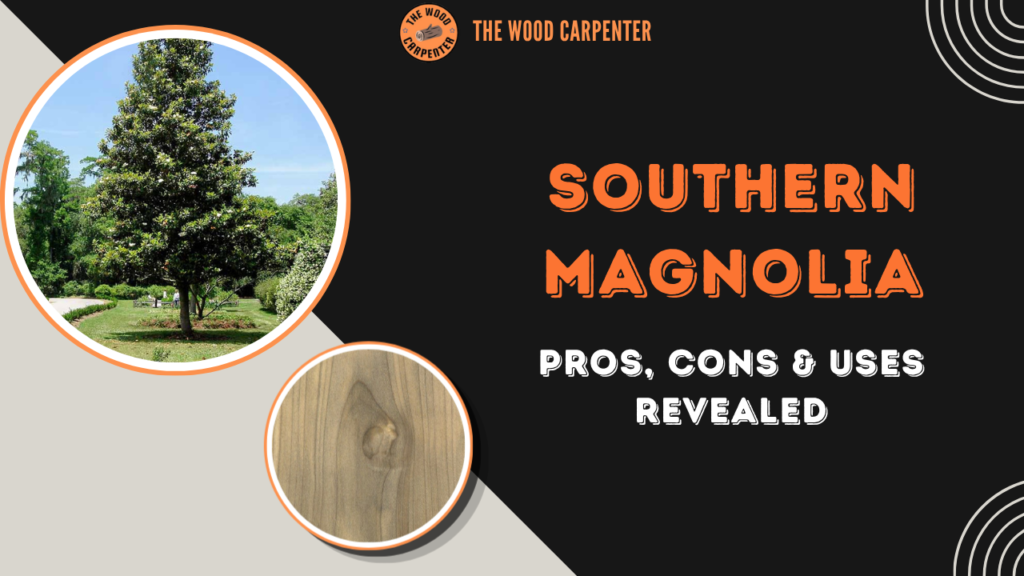
Species: Magnolia grandiflora | Type: Broadleaf Evergreen | Mature Height: 60–80 feet | Native Range: Southeastern United States
Key Takeaways
- Ancient roots, modern usefulness. Southern magnolia (Magnolia grandiflora) is a broadleaf evergreen native to the southeastern US — one of the oldest flowering tree families on earth, and a genuinely underrated timber hiding in plain sight across southern landscapes.
- Mid-range hardness. Janka rating of around 1,020 lbf — right alongside black walnut (1,010 lbf) and well below hard maple (1,450 lbf). That sweet spot makes it a genuinely enjoyable wood to work with.
- Clean, consistent appearance. Creamy white to light tan heartwood with a fine, uniform texture. It finishes beautifully — no blotching, no fuss, happy under paint or a natural finish.
- Interior only. Magnolia has no meaningful rot resistance. It is strictly an indoor wood. Use it outside unprotected and you will regret it quickly.
- Great range of applications. Furniture, painted cabinetry, interior trim and millwork, doors, turned work, and decorative carving — it handles all of these well.
- Not at your typical hardwood dealer. Source it through local arborists, urban wood salvage operations, and regional sawmills in the southeast. The supply is there — you just have to look a little harder.
- Patience pays off during drying. Magnolia checks fast if you rush it. End-seal immediately after cutting and let it air dry slowly. Treat it right and it will reward you.
What Is Southern Magnolia?
Southern magnolia (Magnolia grandiflora) is a broadleaf evergreen native to the coastal plain and piedmont of the southeastern United States. Unlike most of its neighbors in the landscape, it keeps its leaves through winter — thick, leathery, dark green on top with that distinctive rusty-brown fuzz underneath.
It looks the same in January as it does in July, which is part of why it’s so beloved as a landscape tree.
Here’s something worth pausing on: magnolias belong to one of the oldest flowering tree families on earth. They actually predate bees.
These trees evolved to be pollinated by beetles, which is why the flowers are so tough and waxy — built to handle beetle traffic rather than the delicate petals that came later.
When you’re working a piece of magnolia at the bench, you’re working with something that has been doing its thing for tens of millions of years.
Mature trees reach 60 to 80 feet tall with canopy spreads of 30 to 40 feet. They develop a straight, strong trunk and a conical to broadly rounded crown that becomes genuinely majestic in older specimens.
Most trees live 80 to 120 years under typical conditions, with well-sited trees pushing well beyond that.
Identifying Southern Magnolia
Leaves are the most immediately recognizable feature — 5 to 10 inches long, elliptical, leathery, and dark glossy green on top. Flip one over and you’ll see the dense rusty to cinnamon-brown felt underneath.
That two-tone contrast is unmistakable once you’ve seen it. The leaves are stiff enough to crunch underfoot when they fall — they don’t flutter, they thud.
Flowers appear in late spring and continue sporadically into summer. Some reach 8 to 12 inches across — creamy white, intensely fragrant, and genuinely impressive.
Individual flowers only last a day or two, but a mature tree in full bloom keeps pushing out new ones for several weeks straight.
Fruit is a cone-like structure 3 to 5 inches long that opens in fall to reveal bright red seeds dangling on slender threads — striking against dark green foliage and a reliable food source for birds and wildlife throughout the season.
Bark is gray-brown and relatively smooth on young trees, developing shallow interlocking scales as the tree ages.
Form starts narrowly pyramidal in youth and broadens into a full rounded crown over time. Older specimens growing in the open develop wide, layered canopies with lower branches sweeping close to the ground — the kind of tree you just want to sit under.
The Wood: What’s Inside the Bark
Color and Appearance
Fresh-cut southern magnolia has a clean contrast between creamy yellowish-white sapwood and light tan to warm medium brown heartwood — sometimes with subtle greenish tones that mellow out as the wood ages.
It’s not going to hit you over the head with dramatic figure like a crotch-cut walnut slab. What it offers instead is consistency and a quiet, satiny elegance that finishes beautifully without demanding a lot of prep work.
Some pieces show mild wavy grain or a subtle shimmer when the light catches them at the right angle.
But magnolia isn’t generally a figured wood. Its appeal is in its cleanliness, its workability, and its understated warmth — and for a lot of projects, that’s exactly what you want.
Hardness and Density
Southern magnolia sits at around 1,020 lbf on the Janka hardness scale — nearly identical to black walnut at 1,010 lbf. It’s not a soft wood and it’s not punishingly hard. That practical middle ground is part of what makes it so genuinely pleasant to spend time with in the shop.
Density runs 34 to 38 pounds per cubic foot when dry. Manageable weight — you’re not going to be fighting large panels and slabs across the shop floor all day, which matters more than people give it credit for.
Durability
Let’s be straight about this: southern magnolia heartwood is not rated for outdoor use. It has no meaningful natural rot resistance, and if you put it outdoors unprotected, it will let you down within a few seasons. That’s not a flaw so much as just a fact you need to work with.
Its value is entirely in interior applications — furniture, cabinetry, millwork, trim, and decorative work. In those contexts, it performs genuinely well. Just keep it inside where it belongs.
Honey Locust Wood: The Underrated Hardwood Worth Knowing
Spanish Cedar: Properties, Uses, and Working Guide
Working with Southern Magnolia
Machining
Machining is one of magnolia’s strongest qualities. It cuts cleanly, burns less readily than denser hardwoods, and doesn’t punish small technique mistakes. Table saw cuts are clean and predictable.
Jointing and planing go smoothly. Router work is particularly satisfying — the wood holds detail crisply, which makes it excellent for moldings, decorative edges, and casing profiles.
Keep your blades sharp — not because magnolia is especially unforgiving of dull edges, but because the fine texture shows surface quality clearly. The difference between sharp and slightly-dull tooling is more visible on magnolia than on coarser-grained species.
Hand Tool Work
This is where magnolia earns some genuine praise from woodworkers who’ve spent time with it. A sharp bench plane on well-dried magnolia produces a surface that often needs no sanding before finishing — straight to the finish coat. Card scrapers work beautifully for final prep.
Chisel work — mortises, dovetails, box joints — cuts precisely and holds tight. It rewards careful hand tool technique without demanding it at every single step, which makes it a good wood for developing skills as well as for experienced hands.
Drying
This is where you need to be patient, and where most people get into trouble with magnolia. It checks if dried too quickly, and it loses moisture from end grain fast. End-seal logs and fresh-sawn slabs immediately after cutting — within hours if possible — using Anchor Seal or diluted latex paint.
If you let it sit unsealed overnight in dry conditions, you’ll come back to cracks. Air drying at one year per inch of thickness is the sound approach. Once properly dried to 6 to 8 percent moisture content, magnolia is reasonably stable and well-behaved in furniture and cabinetry. The patience is worth it.
Gluing
Magnolia glues well with standard PVA adhesives. For best bond strength, glue within a few hours of freshly machined surfaces — don’t let freshly jointed edges sit overnight before gluing up. Panel glue-ups are straightforward with well-jointed edges and even clamping pressure. Nothing unusual to manage here.
Fastening
Pre-drill near edges and ends. The wood is dense enough that splitting is a real possibility without pilot holes in those locations. Along the grain under normal nailing it holds well and doesn’t split easily — which makes it practical for trim and millwork applications where you’re running a nail gun. Just don’t skip those pilot holes near the ends.
Finishing
Finishing is one of magnolia’s strongest selling points and a big reason experienced woodworkers who’ve found it keep coming back to it. The fine, uniform texture means it accepts stain more evenly than maple or birch — you’re not going to fight blotching under standard preparation.
Oil finishes bring out the warm color and subtle luster beautifully. For painted applications — cabinetry, trim, doors — it’s excellent; the tight grain lies flat under paint without telegraphing texture. Water-based polyurethane and lacquer both work cleanly.
One thing to be aware of: magnolia will amber gently over time under clear finishes with UV exposure. That’s generally attractive, but account for it when you’re trying to match existing millwork that was finished years earlier.
Best Uses for Southern Magnolia Wood
Furniture is a natural fit. Hard enough for daily-use surfaces, machines to tight tolerances, and produces pieces with a clean, warm, slightly formal character that works across traditional and contemporary styles. A well-made magnolia side table or set of chairs is going to hold up and look good for a long time.
Cabinetry — both painted and natural finish — is a strong application. The fine texture under paint is excellent for kitchen and bathroom cabinetry. For natural finish work, the warm light tone brightens interiors in a way that darker species can’t.
Interior trim and millwork — door and window casings, baseboards, crown molding, chair rails, wainscoting — are historically the primary commercial uses of southern magnolia lumber, and it still performs well in all of them. It machines to clean profiles and holds up to normal interior trim demands for decades.
Doors and sash have been traditional applications for over a century. The stability once dried, good machining qualities, and ability to take both paint and clear finishes make it practical for both panel doors and window components.
Turned work — bowls, vases, spindle work — comes out cleanly with sharp tools. The light warm color is attractive in decorative pieces, and it turns without drama.
Carving is genuinely rewarding. The fine texture holds detail well — better than coarser-grained species — and the wood is firm without fatiguing the carver. Relief carving and decorative furniture components are right in its wheelhouse.
What to avoid: Outdoor furniture, decking, exterior structural components, or anything in sustained moisture exposure. The natural decay resistance simply isn’t there, and no amount of finish will substitute for it long-term.
Sourcing Southern Magnolia
Southern magnolia isn’t going to be sitting on the rack at your hardwood dealer next to the red oak and hard maple. But it’s more accessible than most people realize — it just takes a bit of legwork.
Urban tree services and arborists in the southeastern US are your best first call. Southern magnolia is planted so widely as a landscape tree that storm damage, removals, and development clearing produce a fairly regular supply in most southern and mid-Atlantic cities. A friendly relationship with a local arborist can pay off for years.
Local and regional sawmills processing urban timber often have magnolia in rotation. Urban sawmill operations have grown a lot in the past decade as interest in local and salvaged timber has picked up. They’re worth finding in your area.
Urban wood salvage operations in southern cities specifically collect and mill urban tree removals. Old landscape trees grown slowly in good conditions can produce beautiful, tight-grained material that you genuinely won’t find in a commercial hardwood yard.
Landscape Value and Tree Care
Southern magnolia provides year-round evergreen structure, privacy screening, and visual presence that deciduous trees simply can’t match. The red seeds feed songbirds, wild turkeys, and squirrels through fall and winter. As a landscape tree, it earns its place.
Leaf Litter: The Honest Reality
If you’re thinking about planting one, here’s something to know going in: southern magnolia drops leaves continuously year-round — not all at once in autumn like most trees, but steadily, every week of the year.
The large leathery leaves and woody seed cones accumulate and break down slowly. They can smother grass if you let them build up. Plan for the cleanup honestly before you plant, and choose your location accordingly.
Cultivar Selection
For specific situations, cultivar choice matters:
- Little Gem — Compact, 15 to 25 feet, flowers young, good where space is limited
- Bracken’s Brown Beauty — Cold-hardy, dense foliage, reliable flowering, a good choice for the northern edge of the range
- D.D. Blanchard — Upright form, dark glossy foliage, pronounced rusty-brown undersides, widely available
- Edith Bogue — Among the most reliably cold-hardy, successful at the northern limits of the range
- Alta — Columnar and narrow, useful in tight spaces
Choose based on available space, desired form, and your climate. The species at full size is magnificent — but only where it has room to actually grow into what it wants to become.
Planting and Establishment
Full sun for best growth and flowering. Get the root flare at or just above grade — planting too deep is the single most common mistake people make with magnolias, and it’s a slow-motion problem that takes years to show up.
Water consistently and deeply through the first full growing season, potentially two seasons in hot dry climates. Three to four inches of organic mulch out to the drip line, kept back from the trunk.
Pruning
Southern magnolia resents heavy pruning. Avoid it unless there’s a clear structural or health reason — the natural form is genuinely part of the appeal, and large wounds heal slowly on this species. If lower branch removal is needed for clearance, do it gradually over several years rather than all at once. Let the tree grow into its natural shape.
Common Problems
Magnolia scale — one of the largest scale insects in North America — can appear on branches and stems. Horticultural oil applied in late summer during the crawler stage is the standard treatment. Healthy, well-sited trees resist heavy infestations.
Root rot in poorly drained or chronically wet sites. The solution is site selection — avoid planting in low spots or areas where water stands after rain. Once established, root rot is difficult to reverse.
Frost damage at the northern edge of the range. Young shoots and flower buds are vulnerable to late frosts. Cold-hardy cultivars are the practical answer for zone 6 planting rather than hoping for the best.
Leaf scorch in hot dry summers, particularly on young or recently transplanted trees. Consistent watering and mulching during establishment prevents most instances.
Surface root damage from lawn equipment on older trees. Mulching over the root zone both reduces the conflict and protects the roots — a two-for-one.
Frequently Asked Questions
Is southern magnolia wood good for furniture?
Yes — particularly for interior furniture. It machines well, holds joinery reliably, finishes to a beautiful surface, and behaves honestly in the shop. It’s not a flashy wood, but it’s a dependable one.
How does it compare to black walnut for woodworking?
Hardness is nearly identical — both around 1,010 to 1,020 lbf. Walnut has richer, more dramatic color and greater commercial recognition. Magnolia is more uniform, finishes without blotching, and is often easier to source locally in the southeast for no cost at all. For painted work, magnolia has a clear edge. For natural-finish statement pieces where dramatic grain is the goal, walnut wins. They’re different tools for different jobs.
Does southern magnolia stain well?
Better than most people expect. The fine, uniform texture absorbs stain reasonably evenly without the blotching issues that make maple and birch so frustrating to stain. A light pre-conditioner is still good practice, but you won’t be fighting the wood.
Is southern magnolia a messy landscape tree?
Honestly, yes — more than most homeowners expect from an evergreen. The continuous year-round leaf drop, the slow decomposition of large leathery leaves, and the woody seed cones all require consistent cleanup. It’s worth going in with realistic expectations rather than being surprised by it two years later.
What’s the best cultivar for cold climates?
Bracken’s Brown Beauty and Edith Bogue are consistently the most cold-hardy, reliable into zone 6b with some success in protected zone 6a sites.
The Bottom Line
Southern magnolia is the tree most people in the southeast spend twenty years admiring from the outside without ever wondering what’s underneath the bark. What’s there is honest, workable, genuinely attractive wood that machines cleanly, finishes beautifully, and performs reliably in interior applications.
It won’t replace walnut for statement furniture, and it can’t compete with white oak outdoors. But for furniture, painted cabinetry, trim, millwork, and turned work, it earns its place in the shop quietly and without fanfare — and the results are consistently worth the effort.
Dry it carefully. End-seal immediately. Keep your tools sharp. Use it indoors. The tree that’s been growing quietly along streets and in gardens across the south has been hiding something genuinely good inside that bark.