Key Takeaways:
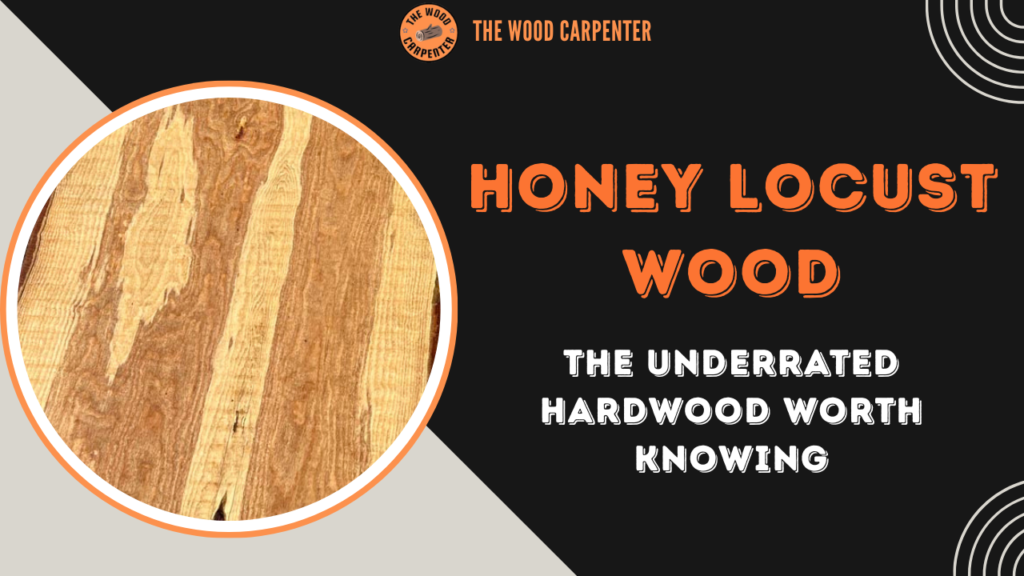
- Heartwood runs golden yellow to reddish-brown, often with striking green streaks
- Janka hardness of 1,580 lbf — harder than white oak, hard maple, and red oak
- Naturally rot-resistant heartwood — holds up 20–30+ years outdoors without chemical treatment
- Best for flooring, outdoor furniture, live-edge slabs, turned bowls, and fence posts
- Sourced through local sawmills and urban salvage — often cheaper than walnut
What Is Honey locust?
Honeylocust (Gleditsia triacanthos) is a native North American hardwood from the pea family — same group as black locust and redbud. That family connection matters: these trees consistently grow wood that’s dense, tough, and rot-resistant.
It grows wild along river valleys and limestone outcroppings through central and eastern North America, reaching 65–100 feet at maturity and living up to 125 years. Fast-growing, but it doesn’t sacrifice quality for speed — which is rare.
Two forms exist: wild thorny honeylocust, which carries brutal thorn clusters directly on the trunk (hard enough to puncture boot soles), and thornless cultivars bred for urban and landscape use. If you’re sourcing from an arborist, always ask which you’re getting before milling.
Wood Properties
Color and Appearance
Fresh-cut honeylocust heartwood is genuinely unusual. It runs from rich golden yellow to deep reddish-brown, often shot through with green streaking that can look almost marbled on certain pieces. It stops people in the workshop — not in a subtle way.
Over time it mellows into warm amber and brown tones. Not a loss, just a different kind of beautiful.
The sapwood is pale creamy white, and the contrast between sapwood and heartwood is sharp. In live-edge slabs, that boundary becomes a design feature worth leaning into. Grain runs straight to slightly interlocked, with a natural luster that reveals itself best under a hand plane.
Hardness and Density
Honeylocust sits at 1,580 lbf on the Janka scale — harder than red oak (1,290), hard maple (1,450), and white oak (1,360). That’s not a marginal difference. It puts honeylocust near the top of what’s available domestically.
Dry density runs 45–48 lbs per cubic foot. Pick up a finished board and the weight registers immediately. You can feel the quality before you’ve done anything to it.
Rot Resistance
The heartwood is rated very durable to highly durable for outdoor use, including ground contact. That’s a short list — black locust sits on it, teak is the imported benchmark. Honeylocust belongs in that company. Old-timers used it for fence posts and railroad ties for exactly this reason. Well-built outdoor pieces can hold up 20–30 years or more with zero chemical treatment.
Working With Honey locust
Machining
Honeylocust isn’t forgiving with dull tools. The hardness that makes it so durable will expose a mediocre edge fast — you’ll get burning, tear-out, and a frustrating surface before you know it. Sharp carbide tooling is the baseline, not an upgrade.
Table saw cuts with a fresh blade are clean. Jointing and planing go smoothly with the grain. Through interlocked sections, lighter passes are the smarter move. Read the grain carefully before committing to a direction — a bad patch of tear-out through those green-streaked boards is genuinely painful to look at.
Hand Tool Work
This is where honeylocust really earns respect. A well-tuned hand plane on properly dried stock produces a surface that machine sanding simply can’t replicate. That natural luster comes alive under a sharp iron in a way that’s hard to describe until you’ve seen it. Cherry and walnut get all the attention, but honeylocust belongs in that conversation.
Chisels need to stay razor sharp — the hardness won’t let a mediocre edge slide. Carving is possible but demanding; better for accent details than deep relief work.
Drying and Stability
Patience is everything here. Rush the drying and you’ll get checking — cracks that can run deep in thick stock. Air dry at roughly one year per inch of thickness. With wood this good, conservative is worth it.
Once properly dried, honeylocust is dimensionally stable. It doesn’t move dramatically with seasonal humidity changes, which makes it reliable for flooring, furniture, and cabinetry. If buying rather than milling, look for 6–8% moisture content for interior work.
Gluing, Fastening, and Finishing
PVA glue works well — clean surfaces and solid clamping pressure. On denser sections, wipe the glue faces with acetone first to clear any surface oils.
Pre-drilling for screws is not optional. Drive a fastener into unsupported honeylocust without a pilot hole and you’re splitting wood or snapping hardware. Drill slightly undersized and it holds like iron.
For finishing, oil finishes — tung oil, Danish oil, penetrating blends — suit it perfectly. They pull out the color depth and luster in a way thick surface coatings tend to bury.
For outdoor work, an exterior penetrating oil or spar varnish gives solid protection while keeping the wood’s character visible. Expect the color to amber gradually under UV exposure. Most people find it attractive; UV-inhibiting finishes slow it down if that matters for your project.
Honey Locust vs Black Locust (Wood Comparison)
| Feature | Honey Locust | Black Locust |
|---|---|---|
| Hardness | 1,580 lbf — moderately hard | 1,700 lbf — very hard, rivals hickory |
| Color | Reddish-brown with cream streaks | Pale yellow to golden-brown, darkens with age |
| Rot Resistance | Moderate — needs treatment outdoors | Excellent — lasts 50–100 years in soil naturally |
| Workability | Easy to machine, glues and finishes well | Hard on tools, prone to tearout, tough to nail |
| Best For | Furniture, flooring, cabinets, interior millwork | Fence posts, decking, boat building, outdoor furniture |
| Price | Mid-range | Premium for outdoor-rated wood |
Bottom Line
| Use Case | Recommended Wood |
|---|---|
| Indoor projects | Honey Locust |
| Outdoor durability | Black Locust |
Best Uses
Flooring — Near the top of domestic hardwoods for durability underfoot, warm color, and dimensional stability after drying.
Outdoor furniture and structures — Benches, tables, pergola components, porch furniture. The decay resistance is real and significant. Heartwood holds up without aggressive treatment.
Fence posts and rails — One of its oldest documented uses. Honeylocust heartwood in ground contact outlasts nearly every untreated domestic alternative.
Turned work — The density and natural luster make for exceptional bowls and decorative pieces. Keep tools sharp and the surface off a well-tuned skew is outstanding.
Live-edge slabs — From older trees, these can genuinely stop you mid-workshop. The heartwood-to-sapwood contrast makes honeylocust slabs competitive with walnut at a fraction of the price.
How to Source It
Honeylocust isn’t commercially stocked, so you need to know where to look.
Local sawmills processing urban and regional timber often carry it. Urban trees removed during development or storm cleanup are frequently old, slow-grown specimens with tight grain and deep color — better material than fast-grown plantation wood.
Urban wood salvage operations mill city trees and sell lumber locally. These programs have grown significantly and offer known provenance.
Arborists and tree services are worth building a relationship with. Let them know you’re interested — many will contact you when a honeylocust comes down.
One practical note: wild thorny specimens can damage bandsaw blades during milling. Mark the thorns, remove what you can, and work around the rest carefully.
Quick FAQs
Is honeylocust good for woodworking? Considerably better than its obscure reputation suggests. Harder than white oak, naturally rot-resistant, and beautiful under a hand plane. Keep your tools sharp, dry it patiently, and it won’t disappoint.
How long does it last outdoors? 20–30 years or more for heartwood in well-constructed pieces — with no chemical treatment.
How much does it cost? Through local mills and urban salvage, often less than walnut or figured maple — while offering comparable or better properties for many applications.
Are all honeylocust trees thornless? No. Wild trees carry serious thorn clusters. Thornless cultivars make up most of what’s planted in landscapes today.
The Bottom Line
Honeylocust is harder than white oak, more rot-resistant than most domestic hardwoods, and genuinely beautiful under a hand plane. It’s available locally across much of North America — often at a price that makes you wonder why more woodworkers aren’t using it.
Find some well-dried stock, put a sharp plane to it, and see what comes up. Most people who work with it once come back for more.