
Last Updated on April 23, 2026 by Sam Wood Worker
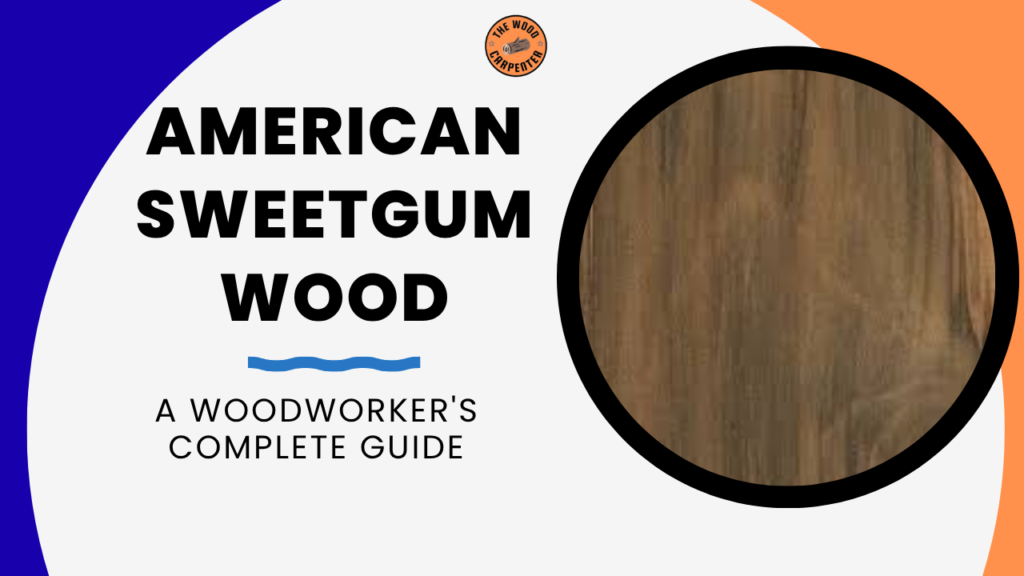
I’ve watched people kick those spiky little seed balls across the yard and mutter something unflattering about the tree they fell from. Sweetgum gets that a lot. It’s one of those trees people know by its annoyances — the gumballs, the aggressive fall color, the way it shows up uninvited on the edge of every field in the Southeast.
What they don’t know is that when you put a sharp blade through the right piece of sweetgum, you sometimes have to stop and just look at it for a second.
That’s happened to me more than once.
American Sweetgum wood (Liquidambar styraciflua) is one of the most common hardwoods in the eastern United States and, without question, one of the most overlooked. It’s cheap. It’s everywhere.
And once you understand its one serious flaw — and how to work around it — it becomes a genuinely capable wood that can hold its own in furniture, millwork, cabinetry, and more.
What You’re Actually Working With
Sweetgum grows fast and tall, commonly reaching 65 to 100 feet across the eastern US, from Connecticut down through the Gulf Coast. Because it colonizes disturbed land so readily, it’s practically considered a weed tree in parts of the Southeast. That abundance is exactly why the timber industry and hobbyist woodworkers alike have historically undervalued it.
Here’s the thing though — crack open a mature sweetgum log and you’re dealing with two completely different woods sharing the same tree.
The outer sapwood, called sapgum, runs from white to pale pinkish tan. Usable, clean, nothing flashy. Fine for painted work or shop furniture where you just need stable, workable material.
The heartwood — redgum — is another story. It’s a warm reddish-brown with darker streaks threading through it, and on a quartersawn piece with interlocked grain, you get this ribbon-stripe figure that honestly looks like it belongs on a piece twice the price.
People have compared it to satin walnut or mahogany, and I don’t think that’s a stretch. It’s genuinely attractive wood when you get a good board of it.
The catch is that only older, mature trees yield much usable redgum. Younger trees are mostly sapwood all the way through, which is partly why well-figured pieces are harder to source than you’d expect given how many sweetgum trees are standing out there.
Sweetgum Wood Properties: What the Numbers Tell You
On the Janka hardness scale, sweetgum sits at around 850 lbf. That puts it solidly in the middle of the domestic hardwood pack — noticeably harder than most pines, softer than oak, quite a bit softer than hard maple. For context: black walnut comes in around 1,010 lbf, hard maple at 1,450 lbf.
What that means practically: sweetgum is solid enough for furniture, cabinetry, and interior trim. It won’t stand up to a busy kitchen floor the way maple or white oak will, but for a bedroom floor, a dining table, or a cabinet face frame, it’s more than adequate. It takes shock reasonably well, which is why it spent much of the 20th century in railroad crossties and industrial packing crates.
The density runs about 34 to 37 lbs per cubic foot — moderate, not exhausting. It’s not a featherweight, but you’re not going to dread flipping a panel over on the bench.
The Drying Problem (And Why It Doesn’t Have to Beat You)
Let’s be honest about this part, because it’s where most people’s relationship with sweetgum ends before it really begins.
Sweetgum warps aggressively during drying. The interlocked grain — the same feature that makes it look so beautiful quartersawn — causes the wood to shrink in unpredictable directions as moisture leaves.
Cup, twist, bow: you can get all three from a stack you thought was drying fine. I’ve seen boards come out of a loosely managed stack looking like they were trying to fold themselves in half.
This is not exaggeration. It is a real problem. But it’s a solvable one.
The key is treating the drying stage with more care than you might give other species. Sticker every 12 inches rather than the standard 16 or 24 — the closer support spacing keeps the boards from sagging between stickers as they soften during moisture loss.
Weight the top of the stack heavily with flat, heavy material. Dry slowly, don’t rush it, and don’t let it over-dry. Once the wood is properly dried, keep your shop humidity consistent, because sweetgum does continue to move with seasonal moisture changes more than something like walnut or cherry.
Here’s the honest version: the drying stage is the battle. The woodworking stage is not. Once you have flat, dry stock, sweetgum is genuinely pleasant to work with.
Is Sweetgum Good for Furniture and Woodworking?
Short answer: yes, with realistic expectations.
It machines cleanly with sharp blades and doesn’t fight you the way dense exotics do. Routing, jointing, drilling — all smooth. Hand planing requires some attention to grain direction because of that interlocked figure; go against it and you’ll raise tearout that takes real sanding to fix. Go with it and take light passes, and the surface comes off the plane looking clean.
Sweetgum glues reliably. One practical habit I’ve picked up: glue within an hour of ripping to final width.
The interlocked grain can cause freshly milled surfaces to shift slightly as they react to air humidity, and a fresh surface bonds better than one that’s had time to move around.
Staining is where sweetgum genuinely shines. It accepts stain evenly and deeply — some figured woods fight you on this, but sweetgum takes color beautifully. A lot of “walnut-stained” interior trim and furniture in older American homes is sweetgum underneath.
That wasn’t a deception; it was a completely sensible use of a wood that stains up to look remarkably close to species costing three times as much.
Clear finishes also lay down well. The fine, even texture means oils, lacquers, and varnishes go on smoothly. On quartersawn redgum, a clear oil finish will make you stop and look at it again.
Sweetgum Wood Uses: Where It Actually Belongs
For interior furniture — tables, chairs, cabinets, shelving — redgum heartwood can stand on its own without stain on a nicer piece. The sapwood is perfectly suited to painted applications or stained work where the wood itself isn’t the visual focus.
Millwork and interior trim is historically one of sweetgum’s primary applications, and for good reason. It machines cleanly into moldings and profiles, accepts stain, and costs considerably less than walnut or cherry for the same job.
Cabinetry is a strong use. Kitchen and bathroom cabinets, especially painted or stained, benefit from sweetgum’s smooth, even texture and its willingness to take finish without fuss.
Here’s one that surprises people: speaker cabinets and acoustic boxes. Sweetgum has been used in speaker cabinet construction for decades. The density and grain structure contribute to sound damping characteristics that actually matter in that application.
Turning is another area where the wood earns its keep. Bowls and spindles from figured redgum look exceptional once finished — the grain patterns that come out on the lathe are worth going out of your way for.
What to Avoid
Outdoor projects are not where sweetgum belongs. The heartwood has only moderate decay resistance; the sapwood has poor resistance in wet conditions. Don’t put it on a deck or in ground contact.
High-traffic flooring is a stretch at 850 lbf Janka. A bedroom? Fine. A main living area with kids and dogs? You’ll see dents. Use oak or hard maple for that.
If you’re building something with extremely tight tolerances that needs to hold its shape perfectly for decades, sweetgum’s seasonal movement is worth factoring in. It’s manageable with good construction practices, but walnut or cherry will give you less to think about.
The Satin Walnut Chapter
There’s a piece of history worth knowing here. In the late 1800s and early 1900s, American redgum was exported to Europe in significant quantities under the commercial name “satin walnut.”
European furniture makers used it extensively as a practical substitute for walnut — not because it was inferior, but because it genuinely performed like a walnut-adjacent hardwood at a lower price point. For a few decades in the early 20th century, sweetgum was one of the more commercially significant hardwoods in America.
Then tastes shifted, other species took over, and sweetgum faded quietly from the mainstream. Nothing about the wood changed. Just the attention paid to it.
FAQ: Common Questions About American Sweetgum Wood
Is sweetgum a hardwood?
Yes. It’s a deciduous broadleaf tree, which classifies it as a hardwood. In terms of actual hardness (Janka 850 lbf), it’s mid-range — harder than most pines, softer than oak, maple, or walnut.
Why does sweetgum warp so badly?
The interlocked grain causes the wood to shrink in multiple directions during drying, not just the standard radial and tangential directions. Proper stickering at close intervals, weighting the stack, and controlled slow drying address this effectively — but you can’t skip those steps.
Can I use sweetgum for a cutting board?
It’s not the best choice. The sapwood has limited durability, and the hardness rating isn’t ideal for cutting surfaces that see daily knife use. Hard maple, walnut, or teak are more appropriate here.
What’s the difference between sapgum and redgum?
Same tree, different part. Sapgum is the lighter outer sapwood — common, inexpensive, plain. Redgum is the reddish-brown heartwood from the core of mature trees — less available, more attractive, worth seeking out for visible work.
Does sweetgum have a smell?
The fresh sap is pleasantly sweet and resinous. The dried, milled lumber itself has almost no distinctive odor, which is actually a practical advantage for indoor furniture and cabinetry.
Final Thought
Sweetgum is not a wood that announces itself. It doesn’t have the cultural cachet of walnut or the name recognition of oak. What it has is availability, low cost, genuine beauty in the right pieces, and a working character that rewards patience — especially through that difficult drying stage.
If you live in the Southeast and have access to a sawmill, sweetgum is one of the better opportunities for getting attractive domestic hardwood at very low cost. The wood is common.
The effort is in the drying and the sourcing of mature timber with real heartwood. But once that’s done, you have something that finishes beautifully, works cleanly, and has a history stretching back to European furniture markets that called it satin walnut for a reason.
Some of the most underrated materials in woodworking are the ones growing in the yard. Sweetgum is a good reminder of that.