
Key Takeaways:
- Grows up to 200 feet tall and lives 300 to 600 years — some past 800
- Bark grows up to four inches thick — natural fire armour that protects the tree from ground fires
- The bark smells like vanilla or butterscotch on warm days — caused by natural oils called terpenes
- One of the most widespread pines in western North America — tens of millions of acres
- Fire suppression has made many ponderosa forests dangerously overcrowded
- Abert’s squirrel depends almost entirely on this one tree for survival
Quick Facts
The Tree That Smells Like a Bakery
You’re hiking somewhere in the American West on a warm afternoon. Tall trees stand widely spaced around you. Sunlight hits the ground in broad patches. Grasses grow between the trunks.
You stop beside a large tree with thick orange-plated bark. On a whim, you lean in and smell it.
Vanilla. Butterscotch. Unmistakably sweet.
That’s ponderosa pine. And once you’ve smelled one, you never forget what you’re looking at.
The scent alone makes this tree memorable. But ponderosa pine is important for far more than fragrance. It’s one of the most ecologically significant trees in western North America — shaping mountain landscapes, supporting wildlife, and providing resources to people for thousands of years.
What Is Ponderosa Pine?
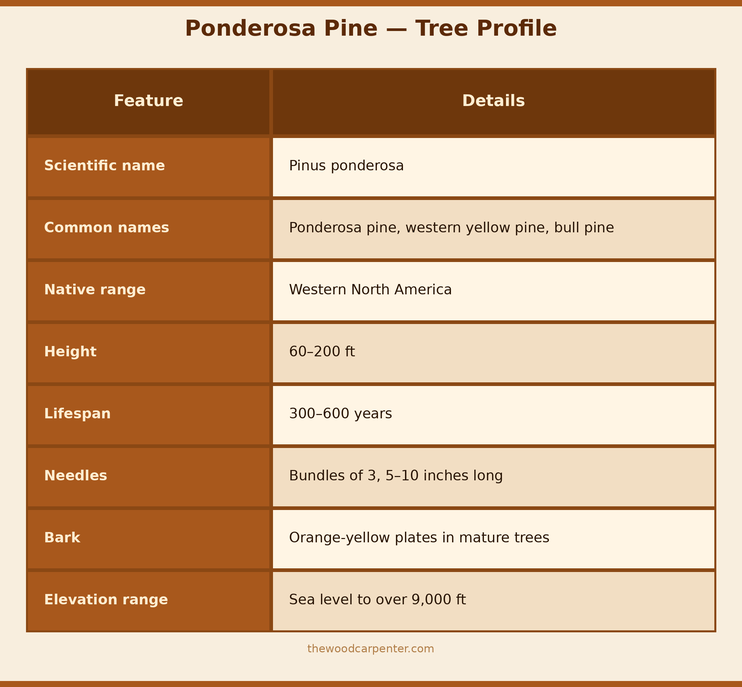
Ponderosa pine — Pinus ponderosa — is a large evergreen conifer native to western North America. Its range runs from southern Canada through the Rocky Mountains, Sierra Nevada, and Cascades down into northern Mexico.
The name ponderosa comes from a Latin word meaning heavy or massive. Walk up to a mature one and the name makes immediate sense. These trees commonly reach 60 to 100 feet. Old-growth individuals push past 200.
Some trunks grow six to eight feet in diameter — wide enough that two people with outstretched arms can barely reach around them.
Most live 300 to 600 years. Some have been recorded past 800.
They form open, park-like forests across tens of millions of acres — one of the defining landscapes of the American West.
How to Identify One
Three things to look for:
The bark on a mature tree breaks into thick orange-yellow plates separated by dark furrows — like irregular puzzle pieces. Young trees have dark, rough bark and look fairly ordinary. Wait 50 years and the tree becomes unmistakable.
On a warm day, those bark plates release terpenes — natural oils that produce the vanilla or butterscotch smell. Press your nose against a sun-warmed ponderosa and you’ll understand why hikers remember their first encounter with this tree.
The needles grow in bundles of three — long, flexible, and dark green, measuring 5 to 10 inches. Most pines have two needles per bundle. Three is a reliable ponderosa identifier.
The cones are 3 to 6 inches long with small outward-pointing prickles on each scale. Handle them carefully — those prickles are sharp enough to draw blood if you grab one carelessly.
Where It Grows
Ponderosa pine is remarkably adaptable. It grows from near sea level all the way up to 9,000 feet. It handles rocky hillsides, dry slopes, and sandy soils where most trees struggle. It does well on 15 to 40 inches of annual precipitation — much of it falling as snow.
Major coverage areas include Oregon, Washington, California, Idaho, Montana, Colorado, Arizona, and New Mexico. British Columbia and northern Mexico hold substantial populations too.
What made historic ponderosa forests visually distinctive was their natural spacing. Trees grew far apart. Sunlight reached the ground easily. Grasses and wildflowers grew beneath them.
That open structure wasn’t random — it was maintained by regular low-intensity fire for thousands of years.
How Ponderosa Pine Survives Wildfire
This is what separates ponderosa pine from most other trees in its range.
The thick orange bark isn’t just beautiful. It’s functional armour. On a mature tree, bark can grow up to four inches thick — acting as insulation that protects the living tissue inside from the heat of a ground fire burning outside.
In natural conditions, low-intensity fires moved through ponderosa forests every 2 to 15 years. These fires cleared dry grass, dead material, and small competing trees.
The big, thick-barked ponderosas came through largely unharmed. Smaller, thinner-barked competitors didn’t survive. Fire was doing the ponderosa’s competitive work for it.
Then came the problem.
Throughout most of the 20th century, forest managers suppressed nearly every wildfire. The intention was good — fire is dangerous. But the ecological consequence was severe.
Without regular fire clearing the understorey, dense thickets of young trees accumulated for decades. Dead material built up on the forest floor. The open park-like forest became a tinderbox.
When fires ignite in these overcrowded forests today, they climb into the tree crowns. Crown fires burn hot enough to kill even mature, thick-barked ponderosas that would have sailed through a natural ground fire easily.
Restoring these forests through controlled burns and mechanical thinning is now a major conservation priority — and an urgent one.
What Lives in a Ponderosa Forest
These forests support more wildlife than their open structure suggests.
Abert’s squirrel is the species most directly tied to ponderosa pine. It eats the seeds, feeds on the inner bark of twigs, and harvests the fungi attached to the tree’s roots. Its entire range maps almost exactly onto the tree’s range — one of the clearest examples anywhere of a species built around a single tree.
Woodpeckers excavate cavities in old ponderosa snags. When they move on, owls, nuthatches, and bluebirds move in. One dead ponderosa can provide nesting habitat for multiple species across decades.
Deer and elk graze in the open areas between trees where the sunlight that reaches the forest floor supports grasses and wildflowers.
Hawks and falcons hunt these forests because the open spacing lets them fly between trunks and pursue prey effectively — something they can’t do in dense closed-canopy forests.
Varieties of Ponderosa Pine
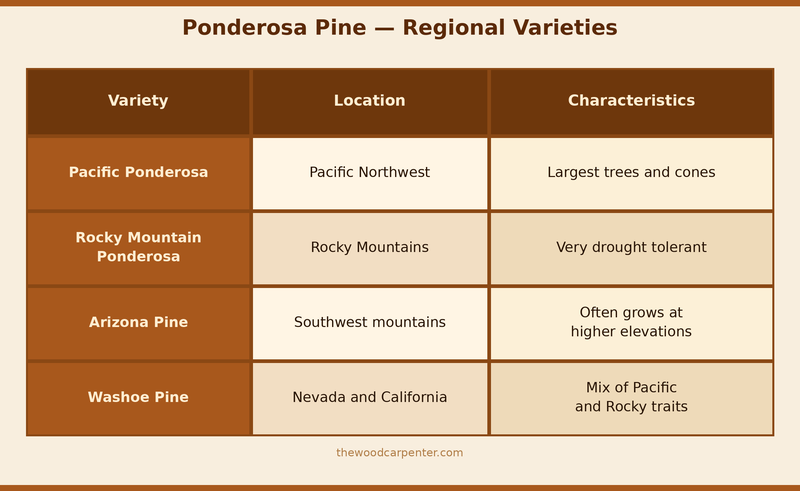
The Pacific variety produces the biggest individual trees. The Rocky Mountain variety trades size for resilience in drier, harsher conditions. Same species — different expressions shaped by thousands of years in different environments.
Ponderosa Pine vs Other Mountain Pines
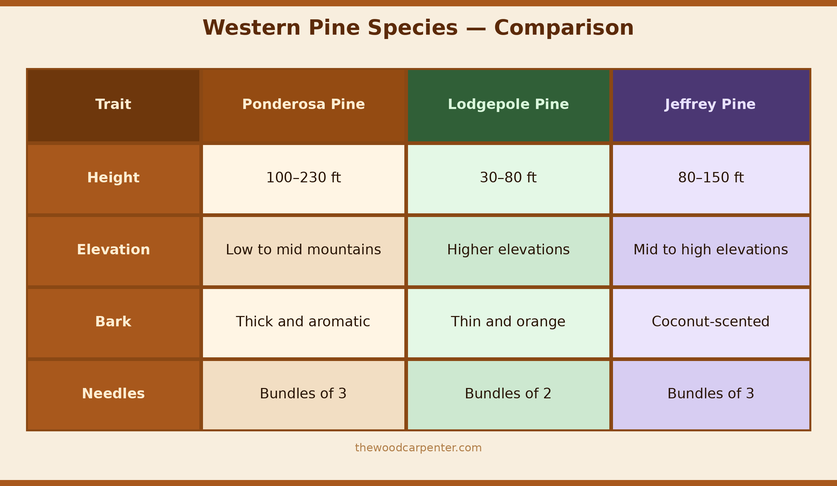
The contrast with lodgepole is worth noting. Ponderosa survives fire through armour. Lodgepole burns easily but releases thousands of seeds immediately after and regenerates the entire forest from scratch. Two completely different evolutionary answers to the same problem — both remarkably effective.
Jeffrey pine is the one people confuse with ponderosa most often. Easy way to tell them apart — grab a cone. Ponderosa prickles point outward and will poke you. Jeffrey prickles curve inward. Jeffrey bark also has a stronger coconut note in the scent. Ponderosa is pure vanilla-butterscotch.
How People Have Used It
Indigenous communities across the West found multiple uses. The inner bark was eaten as emergency food. Pine needle tea provided vitamin C in lean seasons. Resin sealed containers and treated wounds.
When western settlement expanded, ponderosa pine became one of the most commercially important timber species on the continent — straight-grained, moderately strong, easy to work with, and available everywhere construction was happening.
Current uses include building lumber and house framing, fence posts and utility poles, flooring, interior millwork, furniture, and cabinetry.
Many of the historic towns and buildings of the American West were built primarily from this wood. It shaped the forest and the built environment of an entire region simultaneously.
Knotty Pine in Homes: Pros, Cons & Hidden Truths
Eastern White Pine: The White Pine You Need to Know!
Scots Pine: The Hardy Tree You Should Know
Threats It Faces Now
Bark beetles attack stressed, overcrowded trees. A healthy, well-spaced ponderosa can flood beetle entry points with resin and push them out. A drought-stressed tree in an overcrowded stand can’t produce enough resin to defend itself. Large beetle outbreaks have killed significant numbers across the West.
Drought is increasingly severe. Ponderosa is drought-tolerant compared to many species but prolonged multi-year droughts push even resilient trees into the stress that makes beetle attack and fire damage more likely.
Fire suppression legacy remains the most immediate challenge. A century of policy that prevented natural ground fires has left forests that bear almost no resemblance to what they looked like historically — and far more vulnerable to the catastrophic fires that are becoming routine.
Frequently Asked Questions
Why does ponderosa pine smell like vanilla? The thick bark contains natural oils called terpenes. When sunlight warms the bark, these compounds release into the air and produce a vanilla or butterscotch scent. Stronger on hot days and on older trees with well-developed bark plates.
How long do ponderosa pines live? Most live 300 to 600 years. Exceptional individuals have been recorded past 800. The oldest known specimens are in Oregon and California.
Can ponderosa pine survive wildfire? Mature trees survive low-intensity ground fires reliably — that’s the whole point of the thick bark. Crown fires burning at much higher temperatures can kill even mature trees, which is why overcrowded, fuel-laden forests are so dangerous.
How do you tell ponderosa pine and Jeffrey pine apart? Grab a cone carefully. Ponderosa prickles point outward and will poke your hand. Jeffrey prickles curve inward. The bark scent also differs — Jeffrey has a stronger coconut note alongside the vanilla, ponderosa is more purely vanilla-butterscotch.
What animals depend on ponderosa pine? Abert’s squirrel most directly — its range maps almost exactly to the tree’s. Woodpeckers, owls, nuthatches, deer, elk, hawks, and numerous other species all rely on ponderosa forests.
What is ponderosa pine wood used for? Lumber, construction framing, fence posts, utility poles, flooring, interior millwork, cabinets, and furniture. One of the most commercially important timber species in western North America for over a century.
The Bottom Line
Ponderosa pine, is one of those trees that the more you learn about it the more amazing it is.
It grows to gigantic size and lives for hundreds, if not thousands, of years. And it created a strategy for survival around fire for millennia.
It smells like a bakery on a warm afternoon. It supports an entire squirrel species that evolved to depend on almost nothing else.
And right now, understanding what this tree needs — open forests, regular low-intensity fire, relief from the overcrowding that a century of suppression created — matters more than ever.
The next time you find yourself in a western mountain forest, and see the thick orange-plate trunks rising above sun-dappled forest floor, stop and smell the bark.
That vanilla scent is hundreds of years of history drifting up from the wood.
It’s worth a moment.