
Last Updated on July 6, 2026 by Sam Wood Worker
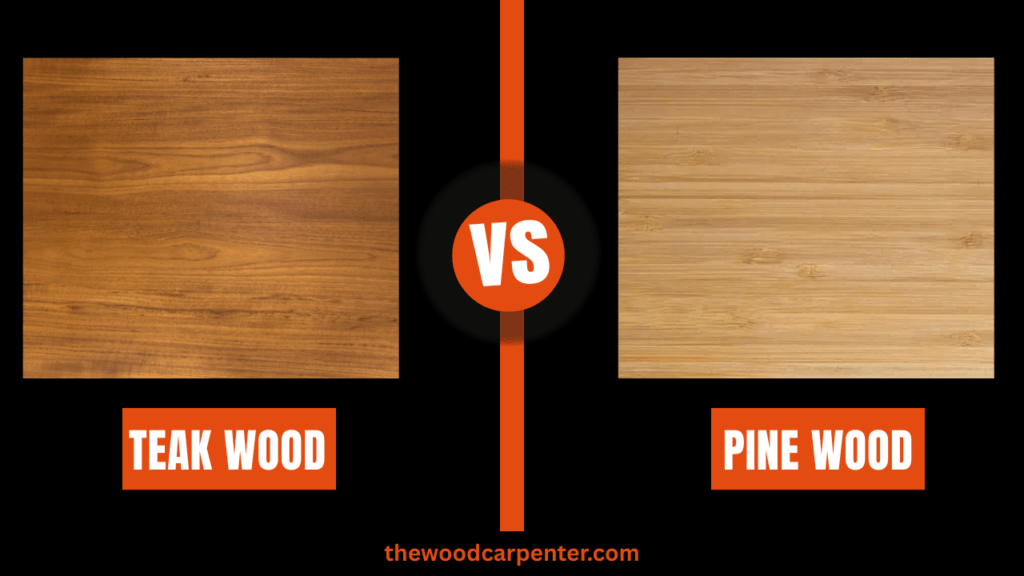
Teak wood vs Pine wood
Teak Wood vs Pine Wood: 9 Differences Buyers Must Know
Quick Answer
Teak and pine are completely different woods. Teak is a dense, oily tropical hardwood that resists water, rot, and insects naturally. Pine is a soft, affordable softwood that needs treatment to survive outdoors. Teak lasts decades with minimal care. Pine needs regular maintenance or it deteriorates fast. For outdoor furniture, teak wins. For indoor projects on a budget, pine is hard to beat.
Key Takeaways
- Teak is a hardwood. Pine is a softwood. They are not in the same category
- Teak contains natural oils that repel water and insects without any treatment
- Pine is 3 to 5 times cheaper than teak depending on grade and source
- Teak scores around 1,070 on the Janka hardness scale. Pine ranges from 380 to 870
- For outdoor furniture, teak is the clear winner — no contest
- For interior shelving, furniture, and budget builds, pine works well with proper finishing
- Teak is harder to work with hand tools due to its density and silica content
- Pine is beginner-friendly — easy to cut, sand, join, and finish
- Teak develops a silver-grey patina outdoors if left untreated — many people love this look
- Pine left outdoors without treatment will rot, warp, and crack within a few seasons
Teak Wood vs Pine Wood at a Glance
| Feature | Teak Wood | Pine Wood |
|---|---|---|
| Wood Type | Hardwood | Softwood |
| Janka Hardness | ~1,070 lbf | 380–870 lbf |
| Natural Oil Content | High | Low |
| Water Resistance | Excellent (natural) | Poor (needs treatment) |
| Rot Resistance | Excellent | Low to moderate |
| Outdoor Use | Highly recommended | Not recommended untreated |
| Cost | High | Low to moderate |
| Workability | Moderate (dulls tools) | Easy |
| Weight | Heavy | Light to moderate |
| Lifespan Outdoors | 25–75+ years | 5–15 years (treated) |
| Finish Required | Optional | Yes |
| Best For | Outdoor furniture, marine, decking | Interior projects, shelving, framing |
What Is Teak Wood?
Teak (Tectona grandis) is a tropical hardwood native to South and Southeast Asia — primarily Myanmar, Thailand, India, and Indonesia. It has been used for centuries in shipbuilding, outdoor furniture, and high-end interior work.
The reason teak is so prized comes down to one thing: its natural oil content. Teak produces its own oils and rubber within the wood grain. Those oils make it naturally water-resistant, rot-resistant, and unattractive to insects — all without any chemical treatment.
It is heavy, dense, and dimensionally stable. That means it does not warp, twist, or crack as the seasons change. A teak garden bench left outside through rain, frost, and summer heat will still be solid decades later.
The color starts as a warm golden-brown. Left outside without oil treatment, teak gradually turns a distinguished silver-grey. Many owners prefer this weathered look — it signals quality and age.
For a full breakdown of teak’s properties, uses, and care tips, see the complete guide on what makes teak wood the gold standard.
What Is Pine Wood?
Pine is one of the most widely used woods in the world. It comes from coniferous trees in the Pinus genus and grows across North America, Europe, and Asia. Because pine trees grow fast, pine lumber is abundant and affordable.
Pine is a softwood — meaning it comes from a conifer, not a deciduous tree. That said, some pine species are harder than others. Heart pine and longleaf pine, for example, can rival some hardwoods in density. But most commercially available pine — like white pine, radiata pine, or SPF lumber — is relatively soft.
Pine has a pale yellow to creamy white color with prominent grain lines and knots. It takes paint and stain well. It is easy to cut, nail, screw, and sand. That makes it a favourite for beginners and high-volume production furniture alike.
The weakness is durability. Pine has very little natural resistance to moisture, rot, or insects. Left outdoors unprotected, it deteriorates quickly.
For deeper reading on individual pine varieties, see the guides on eastern white pine, radiata pine, knotty pine, and why pine wood is everyone’s top pick.
9 Key Differences Between Teak Wood and Pine Wood
1. Hardness and Density
This is the most fundamental difference. Teak is a hardwood with a Janka hardness rating around 1,070 lbf. Most common pine species fall between 380 and 870 lbf — significantly softer.
What does that mean in practice? Teak resists dents, scratches, and surface damage much better than pine. A set of teak outdoor chairs will look good after years of heavy use. A pine chair in the same conditions will show dings, scratches, and wear marks within a season.
For indoor furniture that sees heavy use — dining tables, workbenches, chairs — teak’s hardness is a genuine advantage. For pine to perform in those roles, it needs protection through thick finishes or careful placement.
To understand hardness ratings across wood species, the Janka hardness explained guide is worth reading before making any buying decision.
2. Natural Oil Content and Water Resistance
This is where teak separates itself from almost every other wood, not just pine.
Teak produces natural oils within its grain. Those oils create a barrier that water cannot easily penetrate. Rain, dew, and humidity roll off teak furniture rather than soaking in. That is why teak has been the wood of choice for boat decks, garden furniture, and outdoor structures for centuries.
Pine has almost no natural oil content. Water soaks into pine quickly. Once water gets inside the wood, it causes swelling, warping, and eventually rot. Pine used outdoors must be treated with sealers, stains, or preservatives — and those treatments need regular renewal.
For more on waterproofing wood and which species hold up best outdoors, see the guide on how to waterproof wood.
3. Rot and Insect Resistance
Teak’s natural oils do not just repel water — they also make the wood unappealing to insects and resistant to fungal rot. Termites, carpenter ants, and wood-boring beetles tend to avoid teak. This is why antique teak structures are still standing in tropical climates after a hundred years.
Pine is vulnerable on both fronts. It is susceptible to rot in damp conditions and attractive to insects. Pressure-treated pine adds chemical preservatives to address this — but that treatment adds cost, affects workability, and raises questions about chemical exposure in certain applications.
For context on wood-boring insects and the damage they cause, see the articles on wood-boring beetles, carpenter ants, drywood termites, and termite damage vs wood rot.
4. Outdoor Durability and Lifespan
Teak outdoor furniture regularly lasts 25 to 75 years with minimal maintenance. Some pieces last longer. Quality teak garden furniture from the mid-20th century still sells on the antique market today — still solid, still beautiful.
Pine outdoor furniture has a dramatically shorter lifespan. Untreated pine outdoors might last three to five years before showing serious rot and structural failure. Pressure-treated pine extends that to perhaps 15 to 20 years under ideal conditions — but it requires regular sealing, painting, or staining to maintain that lifespan.
For buyers making a long-term investment in outdoor furniture, teak’s lifespan makes its higher price tag much more reasonable when calculated per year of use.
For guidance on the best woods for outdoor applications, check out the 7 best woods for decks on every budget and best wood for raised garden beds.
5. Cost Difference
Pine is one of the cheapest wood options available. A common pine board from a hardware store costs a fraction of what teak lumber costs per board foot. For large projects — framing, shelving, interior furniture — that price difference is significant.
Teak is expensive. The cost reflects several factors: slow growth rate, limited sustainable supply, high demand globally, and the difficulty of harvesting and milling it. Plantation-grown teak is more affordable than old-growth teak, but still commands a premium compared to pine.
For budget-conscious buyers, pine makes sense for indoor projects where durability against the elements is not a concern. For outdoor investments, paying more for teak upfront saves money over time.
6. Workability
Pine is one of the most beginner-friendly woods to work with. It cuts cleanly with standard blades, accepts screws and nails without splitting (if you pre-drill), sands easily, and takes paint and stain evenly. It is forgiving of mistakes and easy to repair.
Teak is harder to work. Its density means it dulls blades and cutting edges faster. The silica content in teak — a natural compound found in the wood grain — is particularly hard on cutting tools. You will sharpen or replace blades more often when working teak.
Teak also has a naturally oily surface that can interfere with glues and finishes. Surfaces need cleaning with a solvent like acetone or mineral spirits before gluing or finishing. Skipping this step leads to poor adhesion.
For more on wood finishing preparation and surface treatment, see the guide on wet or dry sanding for better results and oil sanding techniques.
7. Finishing Requirements
Pine almost always needs a finish. Left bare, pine absorbs dirt, moisture, and stains easily. Its pale colour shows marks quickly. Most woodworkers apply at least a primer and paint, or a stain followed by a clear topcoat.
Pine staining requires some care — it is prone to blotching, where the stain absorbs unevenly and creates dark patches. A pre-stain wood conditioner helps significantly.
Teak does not need finishing to survive outdoors. It performs well with no treatment at all. Many people apply teak oil periodically to maintain the golden colour and slow the greying process — but this is cosmetic, not structural.
For pine finishing and staining guidance, see the articles on wood staining dos and don’ts, gel stains for wood, how long wood stain takes to dry, and 7 tips for staining pressure-treated wood.
For teak-specific finishing options, read the detailed comparison of teak oil vs tung oil, teak oil vs linseed oil, and the ultimate teak oil hack.
8. Weight and Handling
Teak is heavy. A solid teak dining table is a two-person job to move. That weight is a product of its density — and it contributes to the feeling of quality and permanence that teak furniture delivers.
Pine is noticeably lighter. A pine bookcase or bed frame is easy to move alone. For furniture that gets rearranged, shipped, or moved frequently, pine’s lighter weight is a practical advantage.
For large outdoor structures — garden benches, pergola components, decking — teak’s weight means it stays put in wind and feels planted. Pine structures in the same role need proper anchoring.
9. Appearance and Grain
Teak has a straight, uniform grain with a slightly coarse texture. The colour is a rich golden-brown when fresh. It has a natural lustre and feels slightly waxy to the touch due to its oil content. The appearance is unmistakably premium.
Pine has a more varied appearance. The pale, creamy base colour contrasts with darker grain lines and knots. Knotty pine has a rustic, cabin-style look that many people find charming. Clear pine (fewer knots) looks cleaner and more formal.
Both woods are attractive — but in completely different ways. Teak says quality and longevity. Pine says warmth and accessibility.
Teak vs Pine: Which Is Better for Outdoor Furniture?

Teak wins. It is not close.
The combination of natural oil content, rot resistance, insect resistance, hardness, and dimensional stability makes teak the best wood for outdoor furniture available at a realistic price point. No treatment required. No annual resealing. No rot worries after a wet winter.
Pine outdoors requires significant ongoing maintenance just to survive — and even then, it will not last as long. For anyone buying outdoor furniture as a long-term investment, teak is the better choice even at three to five times the price.
For a detailed comparison of teak against other premium outdoor woods, see acacia vs teak comparison and beech wood vs teak wood.
Teak vs Pine: Which Is Better for Indoor Furniture?
For indoor furniture, the answer depends entirely on budget and use case.
Pine is excellent for bedrooms, living rooms, shelving, and general interior furniture where moisture and insects are not concerns. It is affordable, widely available, easy to work, and looks great painted or stained. Most flat-pack and budget furniture is pine or pine-derived for good reason.
Teak indoors is a luxury choice. Teak dining tables, coffee tables, and cabinets look stunning and last a lifetime. But you are paying a significant premium for durability and appearance that indoor conditions do not fully test.
For most homeowners, pine for interior projects makes financial sense. Save teak for outdoor applications where its unique properties genuinely earn the price.
For guidance on choosing woods for specific indoor applications, see the guides on best wood for kitchen cabinets, top 10 wood choices for table tops, best woods for furniture, and the full guide to furniture wood types.
Sam’s Take: Real Workshop Experience

Sam has worked with both woods extensively — and the differences are immediately obvious the moment you pick them up.
The first time Sam lifted a solid teak plank, the weight was surprising. Dense, heavy, with that slightly oily feel on the surface. Running a hand plane across teak for the first time, the blade dulled faster than expected. The silica in the grain is real — you feel it.
Pine, by contrast, feels almost effortless. Light, easy to cut, forgiving with tools. A beginner’s first project in pine teaches good habits without punishing every small mistake.
The most memorable teak experience was restoring a set of old teak garden chairs. They had been left outside, unprotected, for about fifteen years. The surface had gone completely silver-grey. The joints were loose. But the wood itself — the core — was still solid. No rot. No structural failure. Just surface weathering.
A light sanding, some teak oil, and those chairs looked twenty years younger. Pine in the same situation would have been firewood.
That is the teak difference in real terms: it just keeps going.
Frequently Asked Questions
Is teak wood better than pine?
For outdoor use, teak is significantly better. It resists water, rot, and insects naturally without any treatment. Pine outdoors needs regular maintenance and still will not last as long. For indoor budget projects, pine is the practical choice. Better depends entirely on application — teak wins outdoors, pine wins on price.
How long does teak outdoor furniture last?
Quality teak outdoor furniture typically lasts 25 to 75 years or more. The natural oil content protects the wood from within, preventing rot and insect damage even in harsh climates. With occasional oiling and cleaning, teak furniture can last a lifetime and be passed down generations.
Can pine wood be used outdoors?
Pine can be used outdoors but requires significant preparation and maintenance. It must be sealed, painted, or pressure-treated to resist moisture and rot. Even treated pine needs regular resealing every one to three years. Untreated pine outdoors will show serious deterioration within a few seasons.
Why is teak so expensive compared to pine?
Teak grows slowly — a teak tree takes 40 to 80 years to reach harvestable size. Pine trees reach harvestable size in 15 to 25 years, and many are managed in fast-rotation plantations. The slow growth, limited sustainable supply, and high global demand for teak all drive its premium price.
Does teak need oiling?
Teak does not need oiling to survive outdoors — its natural oils handle that internally. Oiling is a cosmetic choice that slows the natural greying process and maintains the golden-brown colour. If you prefer the silver-grey weathered look, no oiling is needed. If you want to maintain the original colour, oil once or twice a year.
Is pine strong enough for furniture?
Pine is strong enough for most indoor furniture — beds, tables, shelving, chairs, and cabinets. It is not the hardest wood, but with proper joinery and finishing it performs well in typical home use. For heavy-use furniture or outdoor applications, harder and more durable woods are a better choice.
Which is easier to work with — teak or pine?
Pine is significantly easier. It cuts, sands, and joins easily with standard tools. Teak is denser, dulls blades faster due to its silica content, and requires surface cleaning before gluing because of its natural oils. For beginners or production work, pine is far more forgiving and efficient to work with.
What wood is closest to teak in quality but cheaper?
Several woods offer some of teak’s outdoor performance at lower prices. Ipe is extremely durable but even harder to work. Accoya is modified softwood with impressive durability. Acacia offers similar aesthetics at lower cost. Cedar is affordable and naturally rot-resistant. Each has trade-offs — see the full comparisons in the acacia vs teak guide and the article on is acacia wood waterproof.
Which Should You Buy?
Choose teak if:
- You are buying outdoor furniture, decking, or garden structures
- You want a long-term investment that requires minimal maintenance
- Appearance and premium feel matter to you
- You are working on marine or boat-related projects
- You can absorb the higher upfront cost
Choose pine if:
- Your project is indoors and away from moisture
- Budget is the primary concern
- You are a beginner learning woodworking
- You want a wood that is easy to paint or stain in custom colours
- You are building framing, shelving, or high-volume interior furniture
For more wood comparisons and buying guides, explore the articles on teak wood vs pine wood, red oak vs white oak, maple vs cherry wood, OSB vs plywood, pressure-treated wood pros and cons, and the complete ultimate guide to woodworking types of wood.