
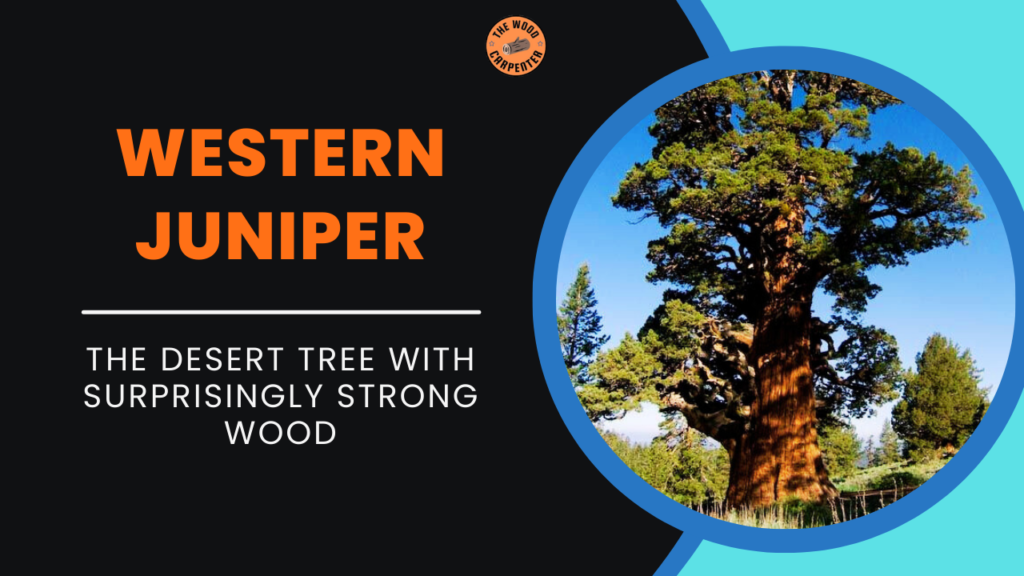
In many dry and rocky areas of the western United States, there is a tree that easily catches people’s attention. This one is called Western Juniper (Juniperus occidentalis). Since it grows in very harsh environments, it often measures twisted, coarse and ragged.
The tree does not seem like a special tree at first. Most become stunted and twisted, as the soil is poor and the weather is harsh. However, when people go to cut and laminate the wood, they learn something else. Solid, rot resistant natural wood that requires no chemical treatment.
Due to these characteristics, the use of western juniper wood in fences, furniture and small wooden works is increasing.
At the same time, ecologists, ranchers, and land managers often discuss how this tree affects the land where it grows. Some say the opposite that it causes problems in other segments of the environment while others say it is advantageous for the environment.
To really understand this tree, it helps to look at where it grows, how it survives in such tough places, and how people use it today.
What Western Juniper Is
Western juniper is a slow-growing evergreen tree that belongs to the cypress family. It is native to the dry regions of the western United States.
You can usually find it growing in places like:
- Oregon
- Nevada
- Northern California
- Idaho
- Parts of Washington
These trees often grow in sagebrush deserts, rocky hillsides, and dry mountain slopes.
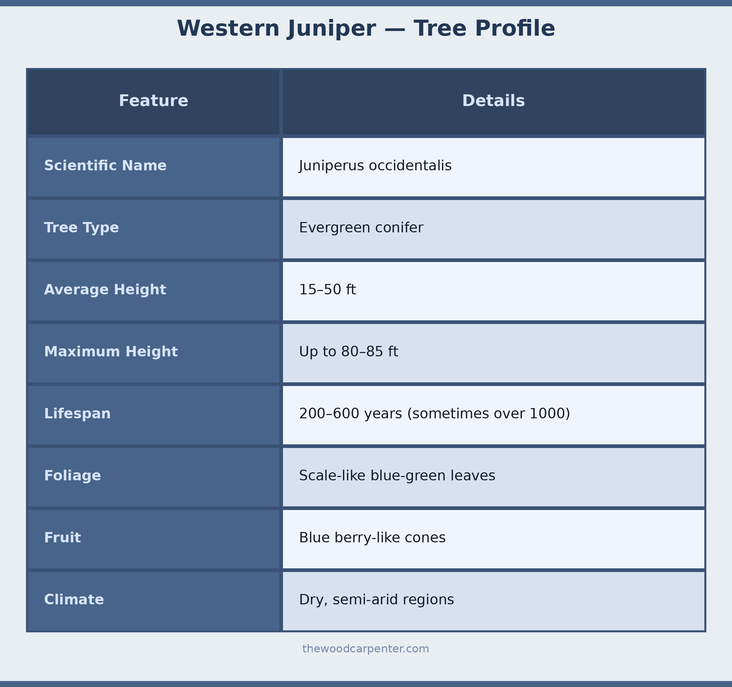
Unlike fast-growing forest trees, western juniper grows extremely slowly. In many areas it may grow only about an inch per year. Because of that slow growth, even a small-looking tree might already be several hundred years old.
Some of the oldest trees are believed to be over 1,000 years old.
Most trees grow between 30 and 50 feet tall, although older ones can sometimes reach around 80 feet.
Wind, drought, and poor soil shape the tree’s form. That is why western junipers often look twisted or gnarled, especially in open desert areas.
Quick Facts About Western Juniper
How to Identify a Western Juniper Tree
Once you know the key signs, western juniper is fairly easy to recognize.
Leaves
The leaves are very small and scale-like. They stay green all year and often have a blue-green or gray-green color.
If you crush them between your fingers, they release a strong, sharp, cedar-like smell.
Bark
The bark is thin and fibrous. It usually looks reddish-brown or gray and peels in long strips.
On very old trees the bark becomes thicker and deeply grooved.
Berries
Western juniper produces small round berries. Technically they are cones, but they look like berries.
They start green and later turn blue-black with a white waxy coating.
Birds and animals rely on these berries as a food source during winter.
Tree Shape
The tree often looks irregular or twisted. In windy or rocky places the branches grow in strange directions, giving the tree a very rugged appearance.
That unusual shape is actually part of what makes the wood interesting for furniture.
Where Western Juniper Grows
Western juniper thrives in areas where many other trees would struggle.
It can grow in places that receive as little as 10–14 inches of rain per year.
The tree survives because of its root system. It develops:
- A deep taproot that reaches underground moisture
- Wide surface roots that absorb rainfall quickly
This allows the tree to survive long dry periods.
You will usually see it growing with plants such as:
- Sagebrush
- Bitterbrush
- Native bunchgrasses
These plants form the classic sagebrush steppe ecosystem found across the Great Basin.
Why Western Juniper Is Expanding
In the past, western juniper mainly grew on rocky hills and ridges.
But today the tree has spread across millions of acres of land. Some areas now have three to four times more juniper than they did 150 years ago.
There are a few main reasons for this change.
Fire Suppression
Historically, small natural fires burned through grasslands regularly. These fires killed young juniper trees before they could grow large.
When humans began suppressing fires, those young trees survived and spread.
Livestock Grazing
Heavy grazing reduced the native grasses that once fueled natural fires. With fewer fires, juniper seedlings had a better chance of surviving.
Climate Changes
Certain wet periods in the late 1800s helped juniper seedlings grow in new areas.
Because of these changes, juniper forests now cover millions of acres that were once grassland.
The Ecological Role of Western Juniper
Even though the expansion of juniper can create problems, the tree still plays an important role in nature.
Many animals rely on juniper woodlands.
Birds
Several bird species depend heavily on juniper trees, including:
- Juniper titmouse
- Western bluebird
- Townsend’s solitaire
These birds feed on juniper berries or nest in the trees.
Mammals
Many mammals also use the trees for food or shelter, including:
- Coyotes
- Foxes
- Mule deer
- Small rodents
During winter storms, deer often shelter under juniper trees because the dense branches block wind and snow.
Western Juniper Wood Properties
The wood itself is one of the most interesting parts of the tree.
It has several qualities that make it useful for building and woodworking.
The heartwood ranges from pinkish orange to deep reddish brown, while the sapwood is pale cream. This color contrast creates beautiful patterns in furniture.
The wood also contains natural oils that give it a strong scent and protect it from insects and decay.
Wood Strength Properties
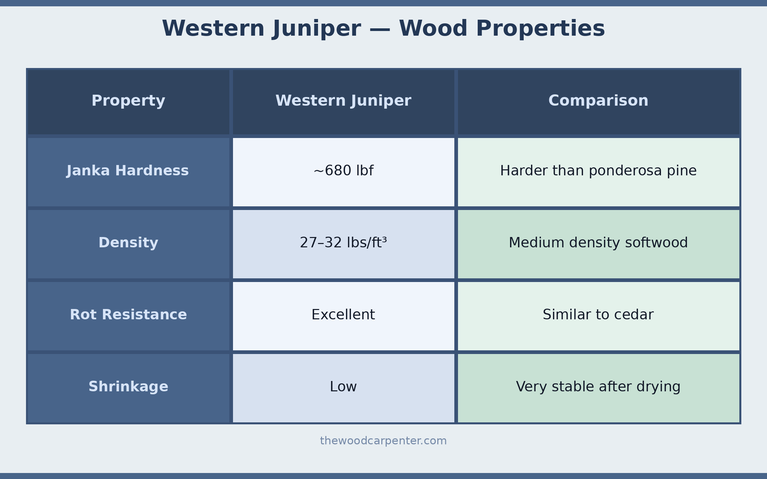
Because of these properties, western juniper wood can last a long time even outdoors.
Common Uses of Western Juniper
For many years the tree was considered a nuisance on rangeland. But today more people are finding useful ways to use it.
Fence Posts
This is one of the most common uses.
Juniper fence posts can last 20 to 30 years or more without chemical treatment. Ranchers often prefer them because they are durable and natural.
Furniture
Woodworkers like juniper because of its dramatic grain patterns.
For example, a craftsman might turn a twisted juniper slab into a rustic coffee table where the natural shapes of the wood become part of the design.
Interior Woodwork
The aromatic smell makes it popular for:
- Closets
- Drawers
- Small cabinets
The scent helps repel insects like moths.
Firewood
Western juniper burns very hot. A full cord can produce around 26–28 million BTUs of heat.
However, it should be well dried before burning because fresh wood can spark.
Landscaping and Mulch
Wood chips from juniper are sometimes used as mulch. They break down slowly and add a pleasant scent to gardens.
Working With Western Juniper Wood
Many woodworkers enjoy using juniper, but there are a few things to know.
The wood machines fairly well with sharp tools. However, the twisted grain can sometimes cause tear-out.
A typical finishing process might look like this:
- Sand the wood to about 150–220 grit
- Wipe away dust with mineral spirits
- Apply a penetrating oil finish such as tung oil or linseed oil
- Add a protective topcoat if needed
This brings out the rich colors and swirling grain patterns.
Eastern White Pine: The White Pine You Need to Know!
Thinking of Using Red Gum Wood? Read This First
Cultural and Historical Uses
Western juniper served Indigenous peoples thousands of years across the Great Basin.
Different parts of the tree had different uses.
Juniper berries were sometimes eaten or used in traditional medicines. They used the bark fibers to make ropes, mats, or baskets.
The wood was also used for shelter poles and tools.
The smoke that came from the juniper when it was burned – a very aromatic smoke – was used in ceremonial activities and for purification practices.
Managing Western Juniper Today
Because the tree has spread into many grassland areas, land managers sometimes remove it.
Common management methods include:
- Cutting individual trees
- Mechanical removal using machines
- Prescribed fires
These methods help restore grasslands that are important for wildlife such as sage grouse.
However, complete removal is rarely the goal. Instead, managers usually try to keep a balanced ecosystem with both grasslands and scattered juniper trees.
Cost and Market Value
The growing interest in sustainable wood products has increased demand for juniper.
Typical prices in western states today may look like this:
| Product | Size | Average Price |
| Lumber | 1×6×8 ft board | $20–$40 |
| Fence Posts | 4×4×8 ft | $15–$25 |
| Firewood | Half cord | $200+ |
Prices vary depending on location and availability.
Simple Juniper Project Example
A beginner woodworking project with juniper might be a small wall shelf.
First, choose a dry juniper board about 12 inches wide. Cut it to about 36 inches long. Sand the edges and round them slightly with a router.
Sand and oil the wood, and screw floating brackets to the back.
But in a matter of hours you end up with a rustic shelf that smells amazing and showcases the grains of juniper beautifully.
When Western Juniper Is a Good Choice
Western Juniper is suitable and works best for specific conditions.
This makes for a perfect wood for outdoor posts, rustic furniture, and more decorative woodwork. It handles dry outdoor conditions great due to its natural durability.
But if it is for heavy structural construction or too humid, other woods such as oak or redwood are more appropriate and be better choices.
Final Thoughts
Western juniper is a fascinating tree. The tree takes its time to grow and it can survive in very adverse conditions. Some of these trees where you can enjoy/have been alive for hundreds of years.
In some places, the tree has invaded grasslands, posing a management problem for the land managers. But at the same time, it even benefits wildlife sheltering animals and homes. The wood from western juniper is also useful for people.
Earlier, people considered it merely a crooked tree growing in dry regions. Today, more people are slowly starting to realize its potential. It is strong, durable, and attractive wood.
With good land management practices and careful harvesting, western juniper can serve as a natural resource to support nature and provide wood for useful products for many generations.