
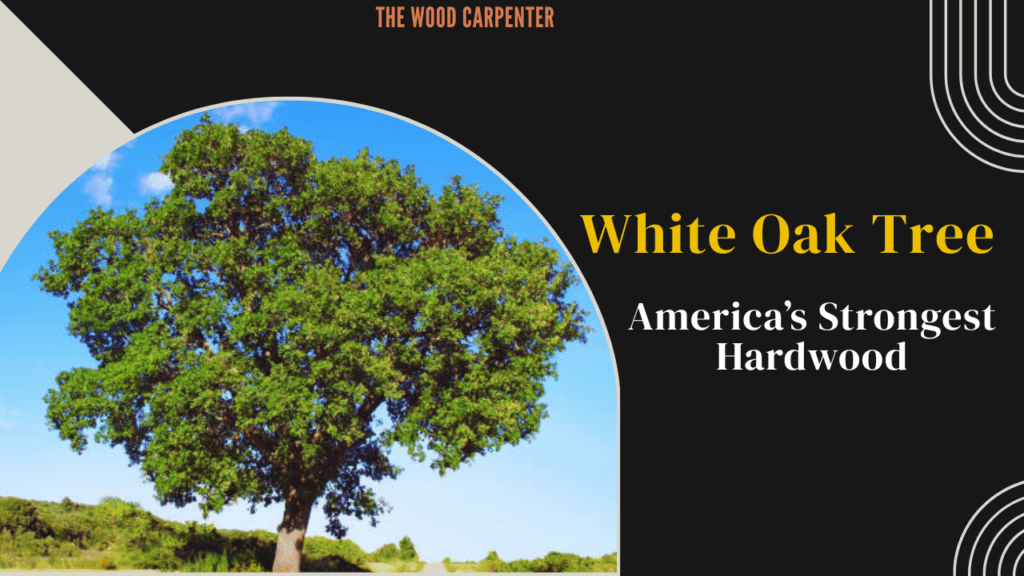
When you walk through an old forest in the eastern United States, you may see a tree that stands out from the rest. Its trunk is thick and strong. The bark is light gray and feels a little rough. The branches spread wide and look powerful. In the fall, its leaves turn a deep red or wine color, making the forest look beautiful.
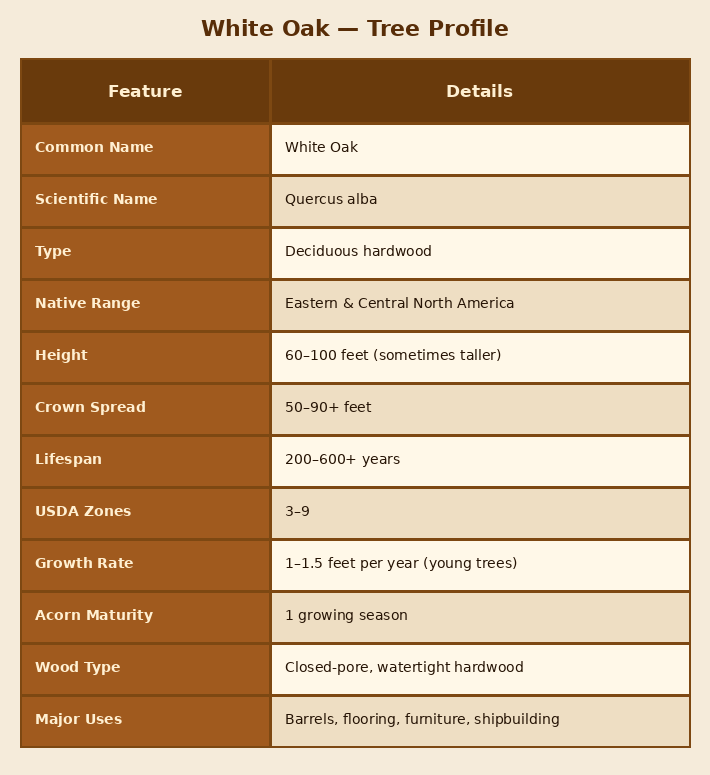
This tree is called the white oak. Its scientific name is Quercus alba.
The white oak is no ordinary tree. It span thousands of years into American forests. It provides food and shelter for animal life. For centuries, people have used its timber for ship and home building, as well as to construct barrels for traditional aging whiskey.
Slow-growing white oak may live for centuries. It will gain both strength and value it time goes on. And it matters not only for the nature, but it matters for people too.
This guide explains everything you need to know about the white oak in a simple and clear way.
White Oak Wood Overview (Summary Table)
What Exactly Is a White Oak?
The white oak is a large native hardwood common over much of eastern North America. Its distribution ranges from southern Canada down to northern Florida and west into Texas and the Midwest. And that big range says something important: this tree is highly adaptable.
By the way, the “white” doesn’t refer to the leaves or acorns. The name derives from the pale grey, sometimes silvery bark and the light-colored wood inside.
White oak is part of the “white oak group”, and contrasts with red oaks by very important features. Its acorns take one year to mature, rather than two. These are less bitter, higher in fat, and thus a more profitable food for wildlife. The most important characteristic for humans when it comes to white oak wood is its closed pores, which are filled with structures called tyloses. This characteristic makes the wood watertight by default.
It was that one characteristic that transformed American history.
How to Identify a White Oak
Once you know what to look for, identification becomes easy.
The leaves are the best clue. They are 5 to 9 inches long with rounded lobes — never pointed. That rounded shape separates white oak from red oaks immediately.
In spring, new leaves often appear slightly pink or silvery before turning green. In fall, they shift to deep red, burgundy, or russet brown.
The bark on mature trees is light gray and broken into thin, flaky plates. On upper branches, it can look almost pale or whitish.
The acorns are oval and about ½ to ¾ inch long. Their caps cover about one-quarter of the nut. Unlike red oak acorns, which take two years to ripen, white oak acorns mature in the same year they form.
In open fields, white oaks develop broad, rounded crowns. In forests, they grow taller and straighter as they compete for light.
How Long Do White Oaks Live?
White oaks are long-term trees. Under good conditions, they regularly live 200 to 600 years.
One famous example was the Wye Oak, which stood in Maryland for about 460 years before falling in 2002. At its peak, it was nearly 100 feet tall with an enormous crown spread.
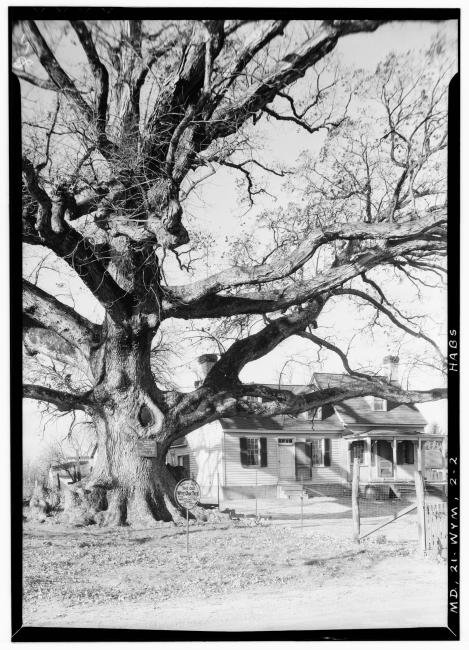
When you plant a white oak, you are planting something that may outlast multiple generations of your family.
The Ecological Powerhouse of the Forest
White oak is considered a keystone species. That means many other organisms depend on it.
Already, researchers have documented over 500 species of caterpillars and moths that feed on oak trees as hosts. Those caterpillars provide critical food for nesting birds. Two chickadees raising chicks may need thousands of caterpillars in one season. And that food chain gets weaker without oaks.
The acorns feed deer, black bears, wild turkeys, squirrels, wood ducks, blue jays, and many other animals. Because white oak acorns are less bitter than red oak acorns, animals often choose them first.
Older white oaks often develop hollow spaces in trunks or branches. These cavities provide nesting spots for owls, woodpeckers, squirrels, and other wildlife.
In simple terms, a mature white oak provides a greater diversity and abundance of life than just about any other single tree in the eastern United States.
Why White Oak Wood Is So Valuable
White oak wood is one of the most important hardwoods in North America.
The closed pores in its wood make it watertight. That is why white oak is used for whiskey and wine barrels. American bourbon must legally be aged in new charred white oak barrels. Without white oak, the bourbon industry as we know it would not exist.
White oak was also heavily used in shipbuilding. Even the famous warship USS Constitution used white oak timber in parts of its structure.
Today, white oak is widely used for flooring, cabinetry, furniture, and interior design. Quarter-sawn white oak is especially valued for its striking ray fleck patterns.
If you’ve seen a beautiful modern hardwood floor in a higher-end home, there’s a good chance that it was white oak.
Growing White Oak: What to Expect
White oak is not for impatient gardeners.
It grows around 1 to 1.5 feet a year while it is young. It may take 15 or 20 years to be of any size as a shade tree. But in a half-century, it becomes a feature of the land.
White oak grows best in soil that drains well. It likes soil that is slightly acidic, but it can grow in many different types of soil. However, it does not do well in places where water sits for a long time. Too much standing water can damage the roots.
White oak prefers full sun. The sunlight encourages the tree to grow sturdy and spread wide and healthy. Young trees can grow in a little shade but will be much more successful in the open where they receive full sun.
Space is very important when planting a white oak. Once fully grown, it can reach its impressive width — often 50 feet or wider across in every direction. This is why it must be sited well away from homes, walls, driveways, and any underground pipes or wires.
Smaller trees grown in containers, especially those under three feet tall, are often easier to transplant. This is because white oak grows a deep main root (called a taproot) very early in its life. Larger trees can be harder to move without damaging this root.
The Truth About Solid Oak Flooring
Fumed Oak Explained: Know How Oak Turns Dark and Timeless
Maintenance in Real Life
In the first few years, water regularly during dry periods.
After establishment, white oaks are fairly drought tolerant.
Prune during late fall or winter to reduce the risk of oak wilt. Though white oaks are somewhat less susceptible than red oaks, caution is still wise.
Avoid compacting the soil around the roots with heavy equipment or constant lawn traffic. Mature trees suffer more from construction damage than from insects.
Fertilizer is rarely needed unless soil is extremely poor.
Common Problems and Solutions
wilt can affect white oaks, though they tend to resist it better than red oaks. Avoid pruning during spring when beetles that spread the fungus are most active.
Anthracnose may cause leaf spots during wet springs but rarely harms mature trees.
Occasional caterpillar feeding may make leaves look ragged, but healthy trees usually recover without intervention.
Chlorosis can occur in alkaline soils, causing leaves to yellow. Soil treatment with iron may help in those cases.
Most healthy white oaks handle problems surprisingly well.
Red Oak vs. White Oak: What’s the Difference and Which Is Better?
White Oak vs Live Oak (Quick Comparison)
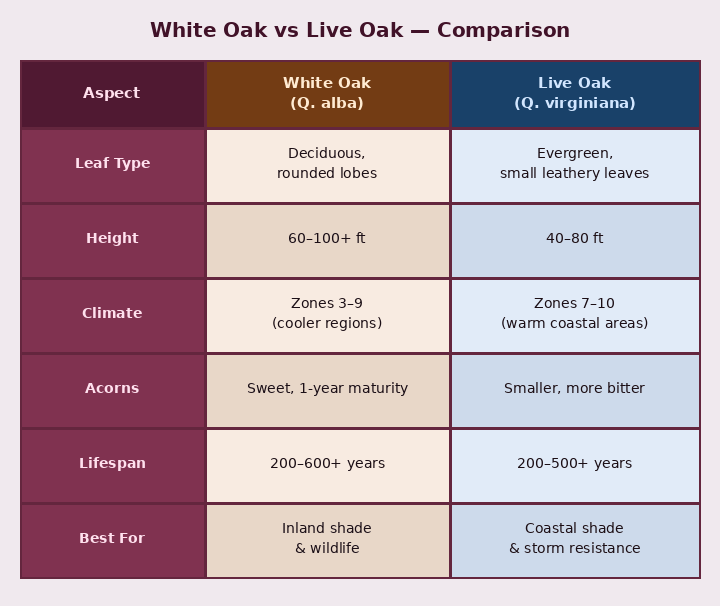
White oak dominates inland forests. Live oak rules the coastal South.
Frequently Asked Questions
How fast does a white oak grow?
About 1 to 1.5 feet per year when young. Growth slows as it matures.
Are white oak acorns edible?
Yes. They are among the least bitter acorns in North America. Indigenous communities traditionally leached and ground them into flour.
How big can a white oak get?
Open-grown trees commonly reach 60 to 100 feet tall with very wide crowns. Exceptional specimens exceed that.
When do white oaks start producing acorns?
Usually around 20 years of age, with heavier production after 50 years.
Can I plant one near my house?
Yes, but give it serious space. At least 20 feet away is a minimum. Many experts recommend 40–50 feet for long-term safety.
Final Thoughts
Planting a white oak is not about quick results. It is about legacy.
Within a few years, wildlife will use it. Within decades, it will shade your property. Within a century, it may become a landmark.
Few trees offer the combination of strength, beauty, ecological value, and economic importance that white oak provides.
If you have the space and patience, planting a white oak may be one of the most meaningful long-term investments you can make in your land.