
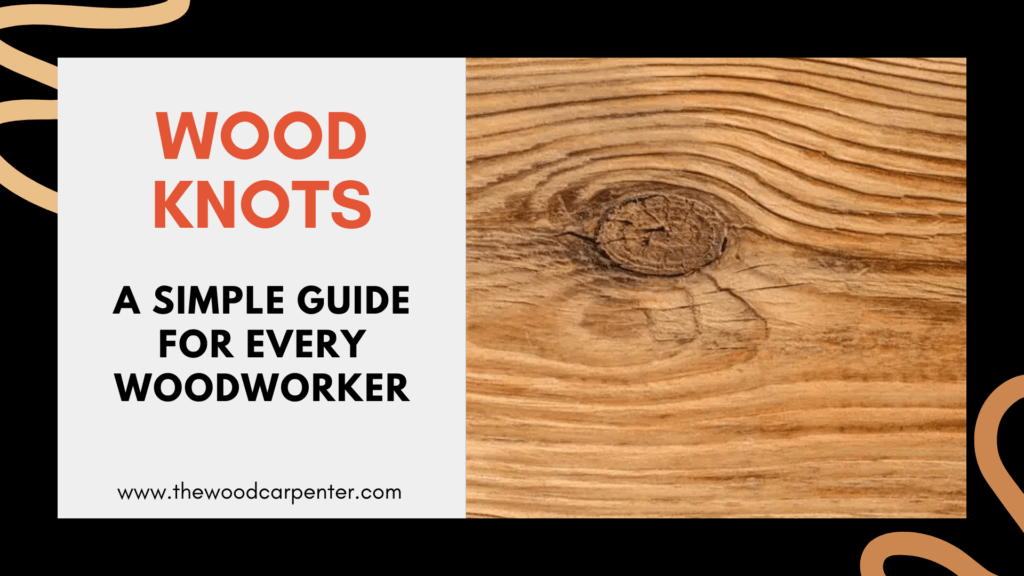
If you examine a board closely, you might see some round or oval, dark spots in the grain. These are called wood knots. They are not random flaws. Each knot narrates a small tale of how the tree grew, where its branches once lived and what nature did to form the wood well before it came under the saw.
Understanding how knots form and what they do allows you to make informed choices about which type of wood would work best for furniture, construction or décor. This guide demystifies wood knots in simple ways that anyone can relate to.
What Are Wood Knots ?
Wood knots are formed where branches once grew out from a tree’s trunk. As a tree grows taller and wider, it adds new layers of wood around itself every year. When a branch is part of the trunk, the tree grows around the base of that branch.
It will eventually either die off, break away or in some cases, it remains alive but its base is set within the trunk. When cut into boards, that embedded branch becomes a knot.
You can think of a knot as a natural “scar” that became part of the wood’s structure.
How Wood Knots Form Naturally
Trees grow from the inside out, adding rings each year. When a branch grows from the trunk, its wood fibers connect directly with the trunk’s fibers.
If the branch stays alive while the trunk grows, the knot becomes tight and strong. The wood fibers stay connected and grow together.
If the branch dies early because of shade, damage, or lack of sunlight, the trunk still grows around it. Since the branch is no longer alive, the fibers do not fully bond. This creates a loose or dead knot.
Fast-growing trees like pine and spruce usually develop more knots because they grow many branches quickly. Slower-growing trees like oak and maple often have fewer knots, but they are usually deeper and tighter.
Every knot you see is a frozen moment from the tree’s life.
Main Types of Wood Knots
Not all knots behave the same way. Some are strong and stable, while others are weak and may fall out over time.
The table below explains the most common knot types in simple terms:
| Knot Type | What It Means | How It Affects Wood |
| Live (Tight) Knot | Formed from a living branch | Strong, stable, rarely falls out |
| Dead (Loose) Knot | Formed from a dead branch | May crack or fall out |
| Sound Knot | Solid with no decay | Safe for most uses |
| Unsound Knot | Decayed or crumbly | Weakens the wood |
| Pin Knot | Very small knot | Mostly cosmetic |
| Spike Knot | Long knot across grain | Reduces strength |
| Black Knot | Fully dried dead knot | Decorative but weak |
Tight and sound knots are usually safe in non-structural projects. Loose and unsound knots need extra care.
How Knots Affect Wood Strength
Knots change the way wood fibers run through a board. Instead of flowing straight, the grain curves around the knot. This creates weak points, especially when pressure or weight is applied.
Large knots can reduce strength by up to 20 percent or more in some cases. Knots near the edge of a board are more dangerous than those in the center. Angled or elongated knots weaken boards even further.
That said, small, solid knots usually cause no problems in furniture, paneling, or decorative work.
This is why building-grade lumber has strict limits on knot size and placement.
Wood Knots and Lumber Grading
Lumber grades are largely based on knots.
Higher grades allow very few, very small knots. These boards are used for structural framing or fine furniture.
Lower grades allow more knots, larger knots, and clusters. These are cheaper and perfect for rustic furniture, flooring, sheds, or wall panels.
Understanding grading helps you avoid overspending. Clear wood is not always necessary, especially if the wood will be hidden or painted.
Working With Knotty Wood
Knots are harder than surrounding wood and can be tough on tools. Sharp blades and slower cutting speeds make a big difference.
When sanding, knots may stay slightly raised because they are denser. Take your time and check the surface often.
Resin inside knots can bleed through paint or stain. Sealing knots with shellac before finishing prevents this problem and gives a clean final look.
Loose knots can be removed carefully and filled using epoxy or wood filler. Epoxy works best for larger holes because it adds strength and durability.
Why Many Woodworkers Love Knots
Knots are no longer seen only as defects. Many people actively choose knotty wood for its natural beauty.
This is why rustic tables, farm-style furniture, ceiling beams and wall paneling often showcase these knots as decorative elements. Wood floors with knots are particularly in demand in contemporary homes.
Knots provide each piece of wood with character. No two boards look the same, and that type of character can not be duplicated by man made materials.
Knots in Different Wood Species
Knots are more common in softwoods, such as pine, spruce and cedar. Pine knots tend to be big, resin-rich and are well suited for rustic or outdoor applications.
Hardwoods such as oak, walnut, and maple usually have fewer knots. Oak conceals knots deeply, walnut specifies them for visual contrast, and maple is often selected without knots for high-precision work.
Choosing the right species helps match knots to your project’s needs.
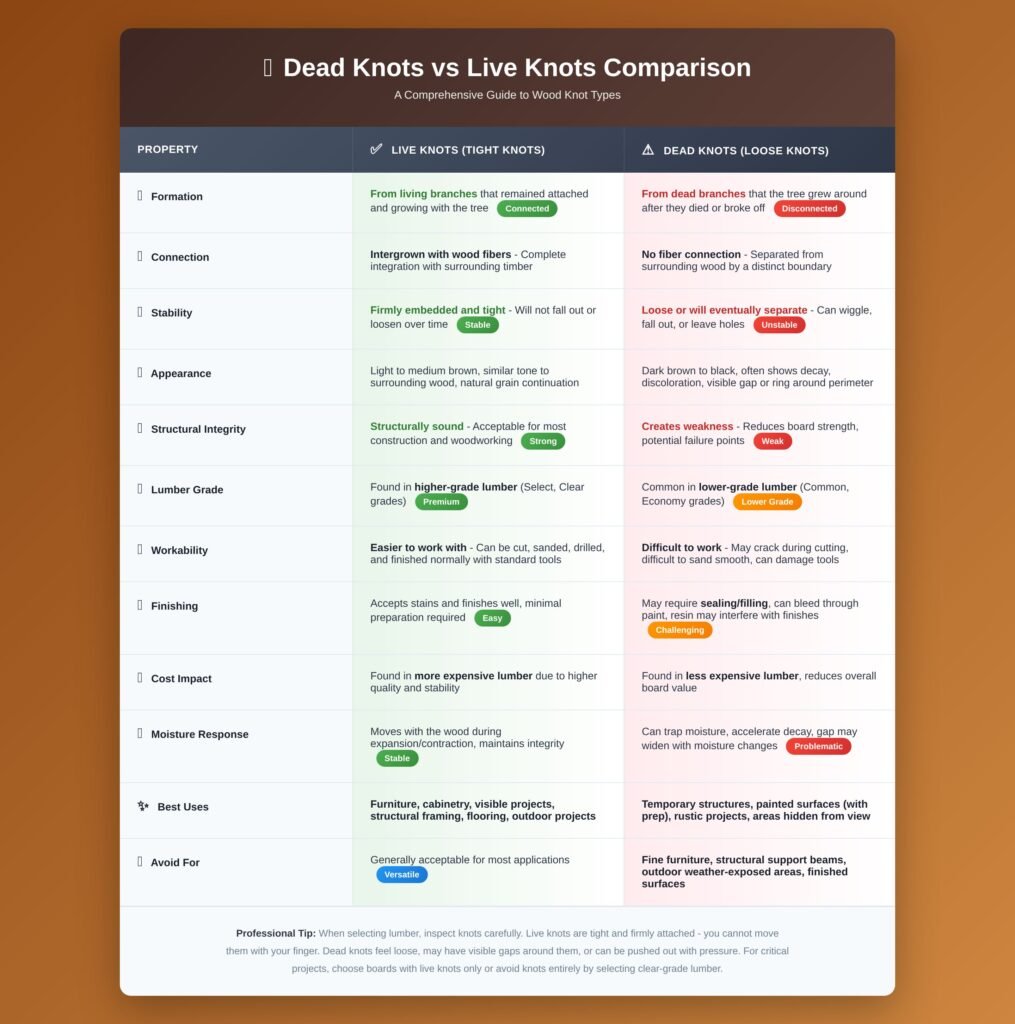
Dead Knots vs Live Knots
A Brief History of Knotted Wood
Humans have used knotty wood for thousands of years. Early tools, shelters, and ships were built using whatever wood was available, knots included.
Knots were a traditional natural decoration in antique furniture. Now, reclaimed barn wood and old beams carry on that tradition, combining history with sustainability.
Frequently Asked Questions
What causes wood knots?
Knots form when tree trunks grow around branches and embed them inside the wood.
Are all knots bad?
No. Tight and sound knots are usually safe. Large or dead knots weaken wood.
Can knots be filled?
Yes. Epoxy works for large holes, and wood filler works for small ones.
Which trees have the most knots?
Fast-growing trees like pine and spruce.
Do knots affect lumber grades?
Yes. Size, number, and condition of knots heavily influence grading.
Final Thoughts
Knots are one of the things that make wood real. They’re a reminder that every board once was part of a living tree, shaped by weather, sunlight and time.
Once you know the knots, you stop seeing a problem, and start seeing choices. And sometimes you avoid them for strength. At other times, you take them on for beauty.
Either way, understanding how knots happen allows you to make decisions about how wood can be used without fear and with respect for its natural story.
 Sam Wood Worker