
Last Updated on April 23, 2026 by Sam Wood Worker
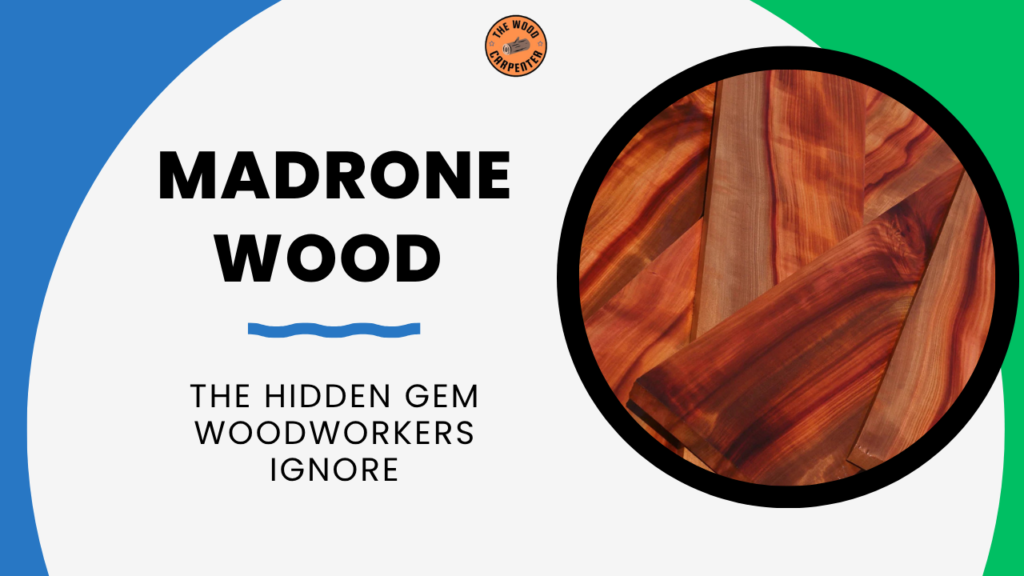
The first time someone handed me a piece of madrone, I turned it over in my hands and asked them straight up — “Did you stain this?”
They laughed. Of course they did.
Nobody stained it. That’s just how madrone comes out of the tree. That warm pinkish-cream bleeding into deep reddish-brown, sometimes with these patches that look almost like dried blood — that’s all natural. No dye, no toner, no chemical treatment. Just a tree doing its thing on the California coast.
I’ve been working wood for a long time, and madrone still catches me off guard sometimes. It’s one of the most visually impressive hardwoods that grows right here in North America, and yet most woodworkers east of the Rockies have never touched a piece of it. Some have never even heard of it.
That’s not because it isn’t worth knowing about. It absolutely is. It’s because getting your hands on good, properly dried madrone is genuinely difficult — and if nobody warns you about the drying part, you can lose a lot of expensive material fast.
So let’s talk about all of it. The good, the frustrating, and the stuff that makes it worth every bit of the trouble.
What Is Madrone Wood, Exactly?
The full name is Pacific madrone — Arbutus menziesii — and it grows along the western edge of North America. We’re talking the coastal strip from southwestern British Columbia down through Washington, Oregon, and into California. You might also see it called “madrona” (with an A at the end) or just “arbutus” depending on which part of the coast you’re in. Same tree, different regional nicknames.
If you’ve ever driven the coastal highway in Oregon or Northern California and seen trees with this striking peeling orange-red bark — that’s madrone. The bark sheds every year in papery curls, exposing smooth greenish-silver wood underneath.
It’s one of the most distinctive-looking trees in North America, honestly. People stop and photograph it all the time thinking it must be some exotic imported species. Nope. Born and raised right here.
The trees get to about 50 to 80 feet tall, but here’s the thing — they don’t grow in nice straight columns the way Douglas fir does. Madrone twists. The trunk spirals, the branches reach out at awkward angles, and the whole tree has this gnarled, sculptural quality.
Beautiful to look at in the forest. Challenging to mill into clean, straight lumber. That tension — stunning raw material that fights you at every step — is kind of the whole madrone experience.
What Does the Wood Actually Look Like?
No two boards are the same. I’m not saying that in the vague marketing way people sometimes do about wood. I mean it literally — madrone has enough color variation and pattern variation that you genuinely need to hand-select boards for a matched project.
The sapwood is creamy white with a soft pink tint — almost the color of the inside of a peach. The heartwood shifts into pinkish-tan and then deeper reddish-brown as you move toward the center of the log. Really old, dense wood from the lower trunk can go almost burgundy in places.
Some pieces have this warm salmon tone. Others lean more mocha. The color deepens and richens slowly with age and light exposure, which means a madrone piece looks even better five years after you built it than the day you finished it.
The grain is fine and even — much finer than oak or ash. Madrone is a diffuse-porous wood, which basically means the pores are tiny and evenly distributed rather than concentrated in big growth rings.
If you look at a surface under good light, the grain is subtle and refined. Sand it up through the grits and it polishes almost like you’ve already applied a finish.
The Burl — That’s Where Things Get Really Interesting
Here’s what madrone is genuinely famous for among people who work with it: the burls.
Burls form at the base of the tree and sometimes higher up on the trunk. They’re these swollen, lumpy growths, and inside them the grain goes completely haywire — dense clusters of knots, bird’s-eye formations, wild swirling patterns packed together so tightly it almost looks like an abstract painting.
Madrone burl veneer is genuinely among the most prized decorative veneers in the world. When you see those breathtaking, complex swirling panels on high-end furniture or custom cabinetry and you think “what on earth is that?” — there’s a real chance you’re looking at madrone burl.
One thing worth knowing if you’re ever processing your own madrone burl: sometimes these burls grow around rocks. Completely encase them. I’ve heard stories — and I believe them — of chainsaws hitting stone mid-cut because the tree had grown around it over decades. If you’re working with burl sections, take a minute and probe the surface first. Your blades will thank you.
Madrone Wood Properties — The Numbers That Matter
Hardness: The Janka hardness sits at 1,460 lbf. That puts it right alongside hard maple, which most woodworkers know as a benchmark for “genuinely hard domestic wood.” It resists denting, handles wear well, and doesn’t scratch easily under normal use.
Weight: About 45 pounds per cubic foot at standard moisture content. Pick up a board and it’s got real heft to it. Not exotic-tropical-hardwood heavy, but noticeably denser than something like cherry or walnut.
Strength: High bending and crushing strength. It handles impact well, which makes it good for joinery that takes stress.
Rot Resistance: Low. And I want to be clear about this — madrone is an indoor wood. It does not hold up to outdoor conditions, moisture exposure, or ground contact. Don’t use it for anything that’s going to live outside. It’ll deteriorate on you.
Stability: Once it’s properly dried — and that’s a big “once” that we’re about to spend some time on — madrone is actually quite stable in service.
It holds its shape, doesn’t move dramatically with seasonal humidity changes, and behaves itself. The challenge is entirely in getting it from a freshly-cut log to a properly dried board. That process is where most of the difficulty lives.
The Part Nobody Warns You About: Drying Madrone
I want to spend some real time here because this is where people get into trouble.
Madrone comes off the tree absolutely soaking wet. We’re talking moisture content somewhere between 68 and 93 percent in fresh-cut logs. Just ridiculous amounts of water locked in the cells.
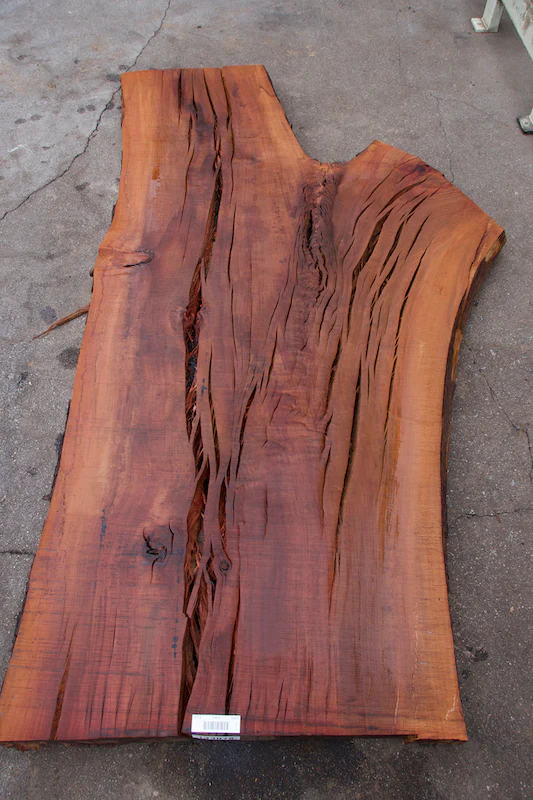
And as that water leaves, the wood shrinks significantly — the tangential shrinkage (think: across the width of the ring) is nearly 12 percent, while radial shrinkage is roughly half that. That imbalance is what creates the problem. When the wood shrinks at different rates in different directions, it wants to warp, twist, cup, bow, and check. Badly.
If you dry it too fast, it checks and cracks — sometimes down the center of the board, sometimes in dozens of small surface checks, sometimes in ways that look fine on the outside but have internal honeycomb damage you won’t discover until you start machining.
If you’re not careful and patient with the drying, you can lose a significant percentage of your material. That’s partly why prices are high and supply is limited.
So what actually works?
Quartersawn cuts are your friend. If you’re having madrone milled from a log, request quartersawn. The cut angle reduces that shrinkage imbalance significantly and produces boards that are much less likely to warp and distort. You lose some yield, but you save your sanity.
Air drying before the kiln. Don’t rush green madrone into a kiln. It needs to come down slowly first. Let it air dry for a meaningful period before any forced drying. Rushing it is how you end up with a pile of cracked, checked boards that you paid good money for.
Seal the end grain immediately. The moment a log or slab is cut, those exposed end grains start releasing moisture fast. Too fast. Coat them right away with an end-grain sealer or even just thick paint. This slows things down and keeps the rate of moisture loss more even across the board.
The boiling trick for turners. This one sounds strange but it’s real and it works. If you’re turning madrone — especially green bowls — rough-turn the piece first, then boil it in water for a couple of hours, then let it dry slowly wrapped in paper bags.
Something about the boiling releases internal stress in the wood and it dries with dramatically less cracking than green wood dried the conventional way. Turners who work with madrone regularly swear by this method.
Get through the drying successfully and the hard part is done. The rest of working with madrone is genuinely rewarding.
Working With Madrone Day-to-Day
Once you have properly dried madrone in the shop, the experience shifts considerably. It machines cleanly, compares well to hard maple in most operations, and rewards good technique with beautiful results.
On the lathe: This is honestly where madrone is at its best. It cuts cleanly and smoothly — turners describe it as almost buttery when your tools are sharp. The fine texture means a well-tuned tool leaves a surface that barely needs sanding. And the burl pieces in particular are extraordinary on the lathe.
The swirling figure reveals itself as you cut through the blank in a way that feels genuinely exciting — you don’t always know exactly what pattern you’re going to uncover until you’re into the piece.
Sanding: The fine grain works in your favor here. Madrone sands to a very smooth surface. Work through your grits methodically and the result feels almost polished before you’ve applied anything.
Finishing: Oil finishes are what I reach for first with madrone. Danish oil, hard wax oil, tung oil — they all bring out the warm reddish tones beautifully and let the color do what it does. If you want a film finish, water-based products are the better choice if you’re trying to preserve the lighter, creamier tones.
Oil-based film finishes will darken the wood noticeably. Both can look great — it depends on the look you’re after. Either way, the fine grain accepts finish evenly and the results are usually excellent without a lot of fuss.
Gluing: One thing to know — if you’re doing glue-ups, wait until the joints are fully dry before you machine further. Madrone can show slightly sunken glue lines if you go back to the planer or sander too soon, because the wood continues its final settling as it reaches full equilibrium with your shop’s humidity.
Hardware and fasteners: Pre-drill everything. Always. The hardness level means nails will split the wood and screws won’t drive cleanly without pilot holes. This isn’t optional with madrone — it’s just part of working with a 1,460 lbf Janka wood.
What Is Madrone Used For ?
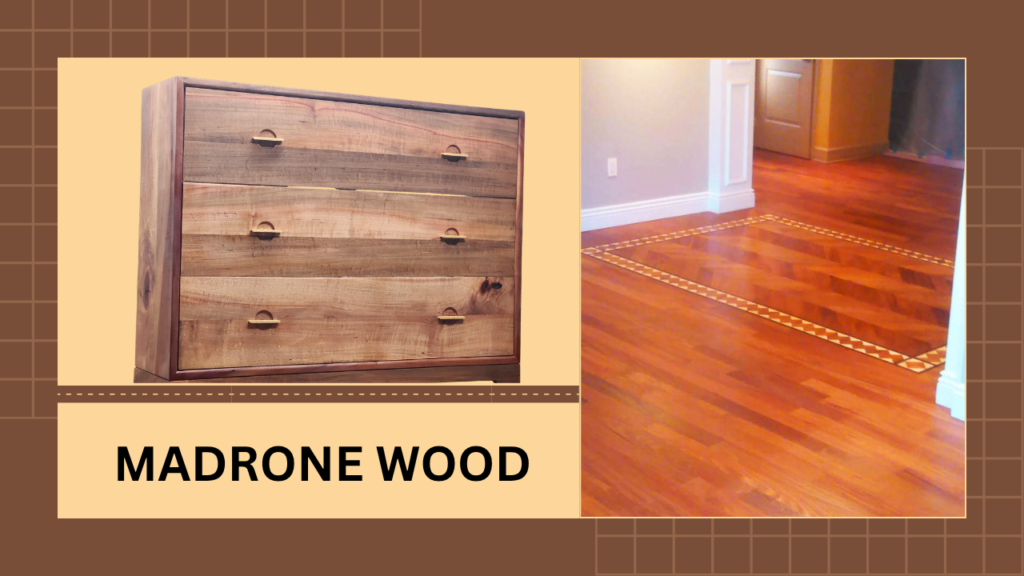
Furniture and cabinetry — tables, cabinet doors, drawer fronts, case pieces. The combination of fine grain, excellent polish-ability, and distinctive color range makes it exceptional for furniture where surface quality and visual interest both matter.
Flooring — the hardness makes it genuinely durable enough for residential floors, and the color range — cream, salmon, pinkish-brown, deep red — produces floors that look unlike anything else available in North American domestic hardwoods. The drying challenges mean it isn’t widely manufactured as flooring, but it exists and it performs well when you can find it.
Turned objects — bowls, vessels, hollow forms, handles, decorative pieces. Possibly the single best application for this wood, especially figured and burl material. Turners who discover madrone tend to seek it out repeatedly.
Burl veneer — this is actually the most commercially significant use. Madrone burl veneer appears on high-end furniture panels, premium cabinetry, and architectural millwork around the world. It’s one of the most recognized and sought-after decorative veneers in the industry.
Musical instrument parts — small components, accessories, and in some cases tonewoods for stringed instruments. The density, fine grain, and tonal properties suit it to this work.
Firewood — not a woodworking use, but genuinely worth knowing. Madrone burns extremely hot and long, producing some of the highest BTU output of any West Coast species. In its native range, it’s considered premium firewood. If you end up with offcuts and shavings you can’t use otherwise, don’t throw them out.
What Does Madrone Cost?
Madrone is expensive for a domestic hardwood — more than cherry or walnut in most markets. The prices reflect the difficulty of successfully drying the wood, the limited commercial production, and the real scarcity of high-quality figured material.
Standard boards will run you roughly $6 to $10 per board foot from West Coast specialty dealers. Curly or heavily figured pieces jump to $18 or $20 per board foot. Burl lumber is often sold by the pound rather than board foot — somewhere around $5 per pound is a rough benchmark, though exceptional figure can push that higher. Burl veneer runs about $3 to $4 per square foot.
If you’re on the East Coast, expect to pay more and have fewer options. Shipping costs add up, and East Coast dealers who stock it are fewer.
Where Do You Actually Find Madrone?
Outside Washington, Oregon, and California, it’s just not common at local hardwood dealers. Here’s where to look:
Specialty hardwood dealers along the Pacific Coast are your most reliable source. Portland, Seattle, the Bay Area — there are dealers in those markets who carry madrone regularly in solid lumber and veneer form. Gilmer Wood Company in Portland is one example of a Pacific Northwest dealer that stocks it.
Burl veneer is actually the most accessible form nationally. Veneer suppliers across the country carry it, and it’s your best option if you’re not near a West Coast source and don’t want to pay heavy freight on solid lumber.
Local arborists in coastal California, Oregon, and Washington are worth asking. When madrone trees come down for whatever reason, the wood often just gets chipped or left. An arborist willing to set logs aside for you is a real resource if you have the patience and setup to process and dry your own material.
Quick Answers
Is madrone hard?
Yes — 1,460 lbf on the Janka scale, which is the same as hard maple. It’s a legitimately hard, durable wood that resists denting and surface wear well.
Is madrone okay for outdoor projects?
No. Low natural rot resistance means it breaks down with consistent moisture exposure. This is strictly an interior wood.
Is madrone good for turning?
It’s excellent. Clean cuts, fine detail, minimal sanding needed, and the burl figure is stunning in three-dimensional forms. Turners love it.
Why is madrone so expensive?
The drying process is genuinely difficult and has a high failure rate if not managed carefully. Boards check, warp, and sometimes develop internal damage that isn’t visible until you start machining. That difficulty limits commercial supply and pushes prices up.
What’s the deal with madrone burl?
Burl is the heavily figured growth that forms on the trunk, usually near the base. Inside, the grain swirls and clusters into patterns — bird’s-eye formations, dense knots, abstract-looking figures — that are among the most prized in decorative woodworking. Madrone burl veneer is used on premium cabinetry and furniture worldwide.
Is madrone the same as arbutus?
Same tree. Americans say madrone or madrona. Canadians tend to say arbutus. Either way, you’re talking about Arbutus menziesii.
The Bottom Line on Madrone
Madrone is not a beginner-friendly material. Not because it’s impossible to work, but because the front end of working with it — sourcing it, drying it correctly, managing it through that process without losing half your material — demands knowledge and patience that takes time to develop.
But here’s the thing: once you’ve got properly dried madrone in your hands and you’re running it through the shop, it rewards that patience. It cuts cleanly. It sands beautifully. It takes finish like a dream. And the color — that warm reddish-cream shifting through to deep burgundy in places — doesn’t look like anything else growing in North America.
The first bowl you turn from a good madrone burl blank, or the first tabletop you build where the figure catches light at the right angle — you’ll understand why people on the West Coast talk about this wood the way they do. And you’ll be a little annoyed that it took you this long to find it.
If you’re outside the Pacific Coast states, it takes more effort to source. That effort is worth it.
Find some. Work with it. You won’t regret it.