
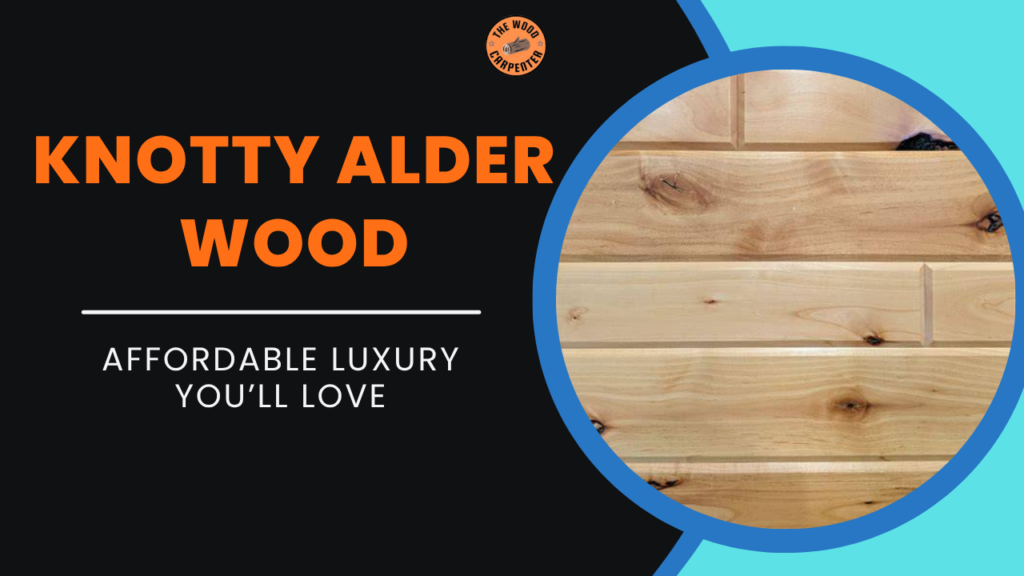
Key Takeaways:
- Comes from red alder (Alnus rubra) — the most abundant commercial hardwood in the Pacific Northwest
- Janka hardness of 590 — easier to work with than oak, cherry, or maple but durable enough for everyday use
- Knots, mineral streaks, and grain variation are the whole point — not defects to apologise for
- Stains beautifully and mimics cherry or walnut at a fraction of the cost
- Used in cabinetry, doors, furniture, guitar bodies, beams, and mantels
- Often half the price of cherry — making whole-room real wood projects genuinely achievable
What Twenty Years of Building Knotty Alder Cabinets Actually Taught Me
By a production cabinetmaker based in the Pacific Northwest interior, with over two decades of residential millwork.
Quick answer if you’re researching knotty alder cabinets: They’re warm, workable, and genuinely affordable — but they dent easier than most clients expect, they demand a pre-stain conditioner without exception, and they move with humidity in dry climates if you don’t account for it. Everything else is detail.
A contractor in Bend, Oregon handed me a set of plans in 2004 and said the clients wanted “that rustic wood — the one with the knots.” I’d worked with alder before, mostly clear grades for paint-grade millwork. Knotty alder cabinets were a different conversation, and I didn’t fully understand that yet.
I was about to learn, expensively.
Pulled the lumber from a local yard — kiln-dried 4/4 red alder, decent grade, looked fine in the stack. Ran the doors, assembled the boxes, sanded everything to 180. Client wanted a medium walnut tone. Grabbed my Minwax Wood Finish in Early American and went straight to staining without conditioning first.
By the third door I knew something was wrong. Dark splotches, light patches, uneven absorption where the grain shifted near the knots. Looked like I’d applied stain with a dirty sponge. Finished the run anyway, hoping it would even out. It didn’t.
Spent two days stripping and resanding. Used Minwax Pre-Stain Wood Conditioner on the second attempt — waited the full fifteen minutes, wiped the excess carefully.
Different wood. Same species, completely different result. That job cost me fourteen hours I hadn’t priced for and a conversation with a contractor who has never let me forget it.
Skip the conditioner on alder and you will have that same conversation with someone.
What Knotty Alder Actually Is (The Short Version)
Red alder — Alnus rubra — grows fast along the Pacific coast, from Alaska down to central California, mostly on riverbanks and wet valley floors. Fast growth means straight, fine-grained wood with almost no colour difference between outer sapwood and inner heartwood.
That uniformity is genuinely useful when staining a full run of knotty alder cabinets — forty door panels that need to read consistently across a kitchen.
Janka hardness: 590. Poplar is 540. Cherry is 950. White oak is 1,360. That number tells you where to use it and where not to.
“Knotty” is a grade, not a species. The same tree produces clear alder — what distinguishes knotty alder is the deliberate decision to keep the tight knots, open knots, mineral streaks, and wormholes rather than culling them out. That variation is the product, not a compromise.
The Controversial Take (Comments Will Disagree)
Knotty alder cabinets don’t belong in a kitchen with young children. Not because the wood fails — it won’t — but because it dents and scratches at a rate families with a seven-year-old and a labrador are not prepared for. Chair corners, dog nails, cabinet doors taking hits three hundred times a year.
I’ve had two callbacks specifically because families were unhappy with how the wood looked after eighteen months. Both times the cabinets were performing exactly as the material should. The expectation was wrong, and I hadn’t corrected it early enough.
For a retired couple, a weekend cabin, a home office — knotty alder is excellent. For a household that is genuinely hard on things, I steer toward oak and have that conversation before anyone falls in love with a showroom sample.
The “Great Pretender” Claim: True But Oversold
Every article about this wood repeats the idea that stained alder mimics cherry at a fraction of the cost. It’s true, but oversold. Stained alder gets you close. Side by side with aged cherry, the grain is finer, the figure is different, the depth isn’t quite the same.
Close enough for most clients and most budgets — not the same thing. If a client asks directly whether their knotty alder cabinets will look like cherry, I tell them they’ll look like well-finished alder, which is a handsome thing to be.
Finishing: Products That Actually Work
For topcoats on knotty alder cabinets in kitchens, I’ve moved almost entirely to Sherwin-Williams Kem-Aqua Plus conversion varnish. Moisture resistance near the sink and dishwasher is in a different category from standard polyurethane.
Oil-based poly works in furniture applications. In kitchens, the conversion varnish pays for the extra setup cost inside the first two years.
Pre-stain step stays Minwax Pre-Stain regardless of topcoat. Apply it, give it the full recommended time, wipe the excess, stain immediately after. That sequence doesn’t change.
Humidity Movement in Dry Climates
Nobody covers this adequately. Alder moves with seasonal humidity shifts — not dramatically, but enough to matter in wide panels and solid doors in dry climates. Working in the high desert of the Pacific Northwest interior, summers are dry and winters are drier because of heating.
Doors framed in summer need room to contract in January. Leave too tight a reveal and you’ll have a door that binds in February.
Size your reveals at three-sixteenths in dry climates, not the eighth-inch you might default to with a more stable species. Not a complicated problem. One that comes back if you ignore it.
Understanding the Grades Before You Order
Rustic Knotty keeps everything — open dead knots, large knots with no size limit, dramatic colour variation, mineral streaks. Maximum character, maximum variation. Most affordable.
Premium Knotty is sorted for closed knots, more colour uniformity, fewer dramatic marks. For a large kitchen where you need panels to read as a coherent set rather than a collection of individuals, Premium Knotty is worth requesting specifically. Rustic Knotty across a large run can read as chaotic if the client isn’t prepared for that energy.
Knotty Alder vs Knotty Pine vs Cherry
| Feature | Knotty Alder | Knotty Pine | Cherry |
| Classification | Hardwood | Softwood | Hardwood |
| Janka hardness | 590 lbf | 380–870 lbf | 950 lbf |
| Base colour | Honey to reddish-brown | Yellow-cream to pale amber | Reddish-brown |
| Staining | Excellent with conditioner | Can blotch; yellows over time | Can blotch without prep |
| Price | Affordable | Usually cheaper | Premium |
| Best style fit | Rustic, transitional, Craftsman | Country, cabin | Classic, traditional |
Alder holds stain more evenly than pine, machines with less tear-out, and produces a more refined result at comparable price points. Stained alder can come very close to the look of cherry for significantly less money — the main difference is hardness and durability under heavy use.
Frequently Asked Questions
Are knotty alder cabinets durable enough for a kitchen? Yes for most households. Janka hardness of 590 handles normal residential use without problems. High-traffic family kitchens with young children or pets will show wear faster than oak or maple. Set that expectation clearly before installation.
Do knotty alder cabinets need special finishing? Always use a pre-stain wood conditioner before staining — Minwax Pre-Stain Wood Conditioner is reliable. Skip it and you’ll get blotchy, uneven colour. For topcoat in kitchen environments, catalysed lacquer or conversion varnish outperforms standard polyurethane significantly.
Will knotty alder cabinets darken over time? Yes. The change over five to ten years is noticeable and generally positive — light honey tones deepen into warm reddish-brown. This is the same aging phenomenon people pay a premium for in cherry.
What’s the difference between open and closed knots in alder? Closed knots are fully integrated — surface is continuous across the knot. Open knots have a small hole where the knot pulled away from surrounding wood. Both are character, not defect. Premium Knotty grades limit open knots. Leave open knots unfilled in most applications — clear epoxy only when a smooth surface is structurally required.
How do knotty alder cabinets compare to oak? Oak is harder (1,360 Janka vs 590), more resistant to denting, and costs more. Alder machines more easily, weighs less, and stains more evenly once conditioned. For durability-first applications or hard-use households, oak is the stronger choice. For warmth, character, and budget — alder wins.
Is knotty alder a sustainable wood choice? Red alder is fast-growing, self-repopulating, and harvested domestically in the Pacific Northwest. Among North American hardwoods, it carries one of the better environmental profiles.
Stock your Minwax Pre-Stain before any alder job. Buy more than you think you need. Run your conditioner test on scrap from the actual batch, not from memory. Set your reveals at three-sixteenths in dry climates. And if your clients have a labrador — talk about oak first.