
Last Updated on July 7, 2026 by Sam Wood Worker
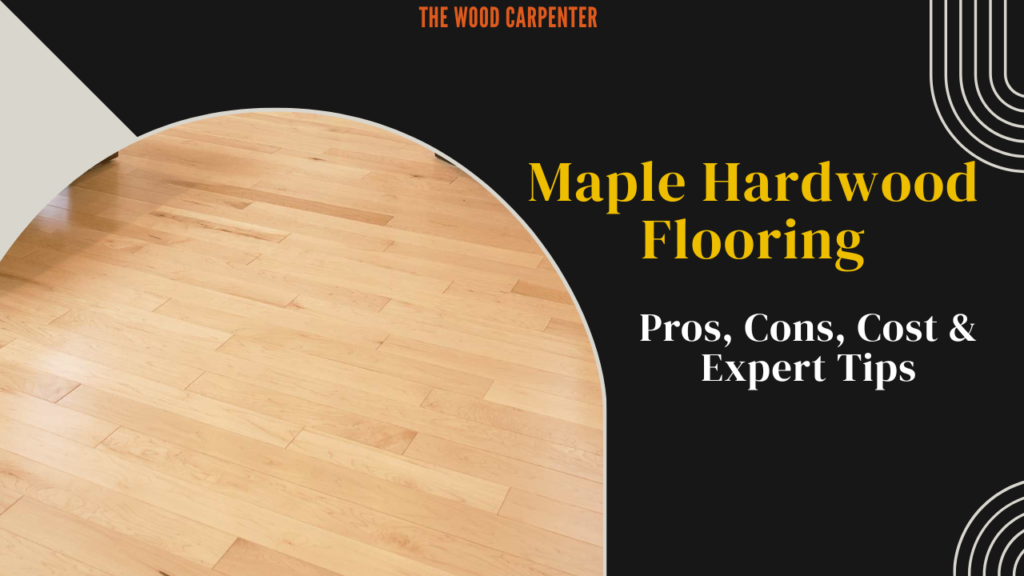
I still remember the first maple floor I ever installed.
Young couple in Portland. Open layout, big windows, minimal furniture. They wanted the space to feel bright and airy. I walked through their home, looked at the light coming in, and said — maple. No hesitation.
Three years later they emailed me a photo. The floor looked exactly like the day I left.
That’s what maple does when you get it right.
But here’s what I also know after two decades on my knees installing floors: maple is not right for every home. And the people who find that out after they’ve already spent thousands of dollars — that’s a painful lesson. I’ve seen it happen more times than I care to count.
So let me save you from that. Let me walk you through everything — the good, the tricky, the cost, the climate stuff, all of it — so you can decide with your eyes wide open.
What Is Maple Hardwood Flooring ?
Maple flooring comes from the sugar maple tree — Acer saccharum — one of the hardest domestic hardwood species you can put in a home.
Most people think of oak first. Oak is everywhere. But maple has been quietly installed in homes, gyms, basketball courts, and bowling alleys for over a century. There’s a reason NBA courts are maple. It takes abuse and keeps going.
The wood itself is pale — creamy white with a fine, smooth grain. It doesn’t shout at you. It doesn’t have the dramatic swirl of oak or the rich darkness of walnut. What it has is a clean, understated elegance that modern and contemporary spaces absolutely love.
If you want a floor that makes a room feel bigger, brighter, and more open — maple does that better than almost anything else.
Is Maple Good for Flooring ?
Yes. Genuinely yes — with one big condition.
Maple scores 1,450 on the Janka hardness scale. That’s the industry test for how well wood resists denting and surface damage. For reference, red oak sits at 1,290. White oak at 1,360. Maple beats them both.
In practical terms: maple holds up under kids, pets, furniture, and high foot traffic better than most hardwoods you’ll find at a showroom.
The condition? Maple is more sensitive to humidity changes than oak. If your home’s indoor humidity swings wildly between seasons and you’re not managing it, maple will let you know — through gaps in winter and slight cupping in summer.
Control the humidity. Everything else takes care of itself.
Maple Flooring Pros and Cons
The Pros
It is genuinely, seriously hard. That 1,450 Janka rating is not marketing. I’ve installed maple in homes with two large dogs, three kids, and a husband who wears work boots indoors. Five years later the floor barely shows it. If durability is what you’re after, maple belongs at the top of your list.
It opens up a space. Maple’s natural pale tone reflects light in a way that makes rooms feel larger. I’ve used it in smaller apartments, basement conversions, and narrow hallways specifically because it fights the feeling of being closed in. It works every time.
It looks modern without trying. The tight grain and light color suit minimalist, Scandinavian, and contemporary interiors perfectly. It doesn’t compete with your furniture. It lets everything else breathe.
It’s a local, sustainable wood. Sugar maple grows abundantly across eastern North America. If you’re in the US or Canada, the maple floor you buy likely didn’t travel across an ocean to get to you. For environmentally conscious buyers, that’s a genuine plus.
Under a clear finish, it’s stunning. Natural maple with a water-based clear coat is one of my favorite floors to deliver. There’s a sophistication to it that costs a fraction of what exotic hardwoods run.
It’s ideal for active households. Home gyms, playrooms, mudrooms — maple thrives in high-activity spaces. The hardness that protects a basketball court will easily handle whatever your household throws at it.
The Cons
Staining maple is genuinely difficult. This is the thing I warn every single client about before we start talking price. Maple has a dense, closed grain. It doesn’t absorb liquid stain evenly. You apply stain directly to raw maple without proper prep, and you can end up with a blotchy, streaky mess that looks nothing like that showroom sample.
One mistake I see constantly is homeowners picking a dark stained maple sample under flattering store lighting, signing the contract, and then calling me confused when the installed floor looks uneven in morning sunlight. It happens. The fix is an experienced finisher who uses a pre-conditioner before staining — someone who has finished maple before, not someone figuring it out on your floor.
It moves with moisture more than oak does. This is not a dealbreaker. It’s a management issue. But if you’re in a climate with big humidity swings and you’re not willing to manage indoor humidity, maple will cause you grief. White oak handles those swings more gracefully.
High-gloss finishes show wear fast. Under a gloss finish, heavy-traffic paths on maple become visible over time. This is easily solved — a satin or matte finish hides daily wear beautifully. But if you’ve got your heart set on a shiny floor, maple will frustrate you faster than other species.
It’s hard to redirect later. Maple’s light palette is its strength. It’s also a design commitment. If you ever want to re-stain the floor to a dramatically darker or warmer color down the road, maple makes that difficult. You’re not locked in forever, but you’re somewhat committed to the lighter end of the spectrum.
Maple Hardwood Flooring Cost: Real Numbers
Let me skip the vague ranges and give you what I actually see in the market.
Solid maple flooring (material only): $4–$10 per square foot. Select grade — the clear, consistent stuff — sits at the higher end. Character grade with natural knots and mineral streaks runs cheaper and has a charm of its own that some people actively prefer.
Engineered maple (material only): $4–$9 per square foot. Visually comparable to solid in most cases, and significantly more dimensionally stable.
Professional installation: $3–$6 per square foot. Nail-down on a wood subfloor is on the lower end. Glue-down over concrete runs higher.
Finishing (for unfinished wood): $2–$5 per square foot for professional sanding, optional staining, and finish coats.
Total installed, mid-range: Roughly $8–$18 per square foot all in.
Compared to white oak, maple typically costs slightly less on material — which surprises people because it’s actually harder. Where you spend more with maple is if you go the custom staining route. That requires a more experienced finisher and more prep work, so factor that in.
Maple Flooring Durability: The Honest Picture
In a stable, climate-controlled home, maple is as durable as any domestic hardwood you can name.
I’ve walked into homes with 30-year-old maple floors — original finish completely worn, boards slightly faded from years of sunlight. Structurally? Perfect. A sand and refinish brought them back completely. The homeowners couldn’t believe it.
That’s what you’re buying with maple — a floor that can outlast you if you treat it right.
The honest caveat is humidity. Maple expands in high humidity and contracts when the air gets dry. In a poorly managed home, this shows up as visible gaps in winter and slight cupping in humid summer months. That’s not structural damage — but it’s unsettling if you weren’t expecting it.
Keep your indoor humidity between 35% and 55% year-round. That’s the single most important thing you can do to protect a maple floor. Everything else — proper installation, good finish, regular cleaning — matters, but humidity control is the foundation.
Maple vs. Oak Flooring: Which One Is Right for You?
I answer this question probably ten times a week. Here’s how I actually explain it to clients.
Pick maple if you want the hardest domestic hardwood available, you love the bright and airy look, your design direction is modern or minimalist, and you’re confident your home’s humidity is stable year-round. Maple is also the better call for home gyms, playrooms, and any high-impact activity space.
Pick oak if you want more flexibility with stain colors, better tolerance for humidity fluctuations, a warmer or more traditional aesthetic, and less worry about humidity management. White oak in particular accepts stain far more predictably than maple and handles moisture shifts more gracefully.
On pure hardness, maple wins. On versatility and forgiveness, oak wins.
The question I always ask clients before recommending one over the other: what does your light look like, and do you see your design direction changing in the next ten years? If they’re committed to bright, modern, and consistent — maple is a beautiful long-term choice. If they think they might want warmer tones or more flexibility down the road — oak will serve them better and stress them less.
Engineered vs. Solid Maple Flooring
This decision is really about where the floor is going and what conditions it will live in day to day.
Solid maple is a single piece of wood, typically ¾ inch thick. You can sand and refinish it many times over its lifespan. It has the authentic feel that a lot of homeowners are paying for. But it moves significantly with humidity changes — more than solid oak — which makes it a risky choice over concrete slabs or in below-grade spaces.
Engineered maple has a real maple veneer on top bonded to layers of plywood running in opposing directions. Those cross-directional layers fight the natural tendency to expand and contract, making it significantly more stable than solid.
I’ve installed engineered maple over radiant heat systems and directly over concrete, delivering results that solid maple simply could not have handled without problems.
When you’re shopping engineered maple, the number that matters most is the wear layer thickness — that’s the real maple on top. Anything under 2mm means you’re looking at one refinish at best, probably none. Look for 3mm or thicker. That’s your real longevity.
My honest guidance: traditional wood subfloor in a climate-controlled home with stable humidity — solid maple is a worthy investment. Over concrete, over radiant heat, in climates with significant humidity swings — go engineered every time.
Best Finish for Maple Floors
Finishing maple well is an art. It matters more with this species than almost any other because the wrong choice shows immediately — and keeps showing.
Water-based polyurethane is what I recommend most and use most often on maple. It dries completely clear, which preserves that naturally pale, bright tone maple is known for.
It’s low in fumes, dries relatively quickly between coats, and modern formulas are genuinely tough. If you want maple to look like maple — clean, light, natural — this is your finish.
Oil-based polyurethane adds amber warmth that deepens over time. On oak, that warmth is often gorgeous. On maple, it can push the color into a yellow-orange direction that catches people off guard a few years after installation.
I’ve had clients call me asking why their maple floor looks “yellowy.” Nine times out of ten, it’s the oil-based finish doing exactly what oil-based finishes do. If you want warmth, it works. If you want to preserve that clean, cool maple look — avoid it.
Hardwax oil finishes like Rubio Monocoat work beautifully on maple when you want a natural, low-sheen feel. The floor looks and feels like actual wood rather than wood sealed under plastic.
The tradeoff is more frequent maintenance — you’ll need to recoat every few years in high-traffic areas. But the look and feel are exceptional, and spot repairs are easier than with polyurethane.
Pre-conditioner before any stain — this is non-negotiable. Without it, stain hits maple unevenly and the result is blotchy. A good pre-conditioner or washcoat opens the grain and allows even absorption. Any experienced maple finisher knows this step exists. If yours doesn’t — find a different finisher.
Sheen level matters more than people think. Matte and satin finishes hide footprints, everyday scratches, and minor wear far better than gloss. I tell every maple client the same thing: gloss looks beautiful in the showroom and drives you crazy at home. Go satin. Thank me later.
Climate Guide: How Maple Performs Across Regions
Where you live matters enormously when it comes to maple. Here’s what I tell clients based on their region.
Humid coastal environments — Southeast US, Gulf Coast, Florida: Maple is not my first recommendation here. The sensitivity to moisture means it can cup or gap if the home isn’t well climate-controlled.
If a client absolutely wants maple in a coastal home, I always insist on engineered over solid, a proper moisture barrier under the installation, and a well-sized HVAC with dehumidification capability. Managed correctly, it works. But it requires more vigilance than white oak would in the same situation.
Dry inland climates — Colorado, Arizona, Nevada: Dry climates are actually where maple tends to behave well — but you have to add humidity, not remove it. When indoor humidity drops below 30% in winter, maple planks develop visible gaps.
A whole-home humidifier is not optional in these climates — it’s the price of admission for maple. Get it installed before the floor goes down, not after you start seeing gaps appear in January.
Cold northern climates — Minnesota, Wisconsin, New England: Maple is native to these regions and generally performs well here. The challenge is the heating season, which creates very dry indoor air that needs active management.
Acclimatize the wood in the actual room — not the garage, not the hallway — for at least a week before installation. Maintain indoor humidity through the heating season. Maple installed carefully in these climates, in homes where the humidity is managed, can genuinely last 100 years.
Moderate stable climates — Pacific Northwest, mid-Atlantic, parts of the Midwest: This is maple’s sweet spot. Stable humidity, mild temperatures, manageable seasonal swings — maple performs beautifully here with minimal intervention. If you’re in one of these regions and you like the look of maple, it’s a very safe and very rewarding choice.
Expert Installation Tips for Maple
After 20 years of installing maple specifically, here’s what separates a great install from one that causes headaches later.
Acclimatize the wood properly. Bring the flooring into the actual room — the room it will live in — at least five to seven days before installation. Maple moves more than oak during acclimatization. Don’t rush this step.
Wood that hasn’t adjusted to the room’s ambient humidity before installation will move after you nail it down, and that’s a problem you don’t want.
Inspect your subfloor before anything else. Maple is unforgiving over an imperfect subfloor. Flex, high spots, low spots — all of it telegraphs through the finished floor over time. I need the subfloor flat within ⅛ inch over 6 feet before I start any maple install. Anything beyond that gets corrected first. Full stop.
Use a moisture barrier on or near-grade installs. Even if the subfloor feels dry, a 6-mil poly vapor barrier is cheap insurance. Maple responds to moisture coming from below just as readily as from above.
Nail it down firmly. Solid maple is dense. Use cleats or staples every 6–8 inches in the field and at every joist along the perimeter rows. Under-fastening maple leads to movement and squeaks that are nearly impossible to fix after the floor is fully installed.
Rack the floor before you fasten anything. Lay out five or six rows and step back. Look at the overall pattern. Distribute grain variations and any mineral streaks intentionally. The extra fifteen minutes here makes the finished floor look considered rather than random.
Hire a finisher who has done maple before. Seriously. Ask them directly: have you finished maple? What’s your process for preventing blotching? How do you prep before staining? The answers will tell you immediately whether they know this species or are learning on your floor.
Frequently Asked Questions
Q: Is maple hardwood flooring good for high-traffic areas?
Honestly? It’s one of the best you can get. Maple sits at 1,450 on the Janka hardness scale, which puts it above most domestic wood species. That hardness isn’t just a number — you actually feel it underfoot, and more importantly, you see it in how the floor holds up over years of punishment. Dents, scratches, daily wear — maple shrugs most of it off.
There’s a reason gyms, bowling alleys, and basketball courts have been using maple for decades. It’s not tradition. It’s performance. If you’ve got kids running around, a dog that hasn’t quite figured out its claws, or a house where the front door never really stops opening — maple can take it.
Q: How long does maple hardwood flooring last?
A long time. A genuinely long time. Solid maple, properly installed and looked after, can go 50 to 100 years without needing replacement. I’ve personally refinished maple floors in homes from the 1950s that were structurally completely sound — the wood just needed a fresh coat of finish to come back to life. That’s it. The bones were perfect.
Engineered maple is a different story, but not a bad one. As long as you’re buying something with a wear layer of 3mm or thicker, you’re looking at 30 to 50 years of solid residential use. The two things that matter most for longevity? Stable humidity in your home and regular maintenance. Get those right and maple will outlast most of the people who walk on it.
Q: Why is maple flooring so hard to stain?
This one trips people up — and it trips up inexperienced finishers too, which is where the real problems start.
Maple has a very dense, tight grain. When you apply liquid stain directly to raw maple, it doesn’t absorb evenly. Some spots soak it up, others barely take any — and you end up with a blotchy, patchy mess that’s painful to look at. It’s not a defect in the wood. It’s just how maple behaves, and if you know that going in, it’s completely manageable.
The fix is a pre-conditioner — sometimes called a washcoat — applied before any stain touches the wood. It opens the grain evenly and gives the stain somewhere consistent to go. Any finisher worth hiring knows this. If you’re talking to someone about staining maple and they don’t mention pre-conditioning, that’s a red flag.
Q: Can maple hardwood flooring go in a kitchen?
Yes — but you have to be realistic about what a kitchen is. Moisture is the issue. Not just big spills, but the slow stuff — steam from cooking, splashes near the sink, humidity from the dishwasher running twice a day. Maple’s hardness is great for a kitchen floor. The moisture tolerance is where you need to stay on top of things.
Wipe up spills the moment they happen. Never wet-mop maple — ever. Under a quality water-based or hardwax oil finish, maple in a kitchen is genuinely fine. I’d put a good mat in front of the sink and dishwasher regardless of the floor type, but especially here. A little prevention goes a long way.
Q: How does maple compare to oak for flooring?
This is probably the question I get most often, and the honest answer is: both are excellent, and the right choice depends on your home specifically.
Maple is harder than red oak and white oak both, so it wins on dent resistance. But white oak is more forgiving when humidity fluctuates — and that matters more than people realize, especially in older homes or climates that swing between dry winters and humid summers. Oak also stains far more predictably. You want a rich walnut brown or a cool grey? Oak gets you there cleanly. Maple fights you on dark stains.
So if your home has stable humidity year-round and you’re after a lighter, more natural look — maple is hard to beat. If you want more design flexibility or you’re in a climate that’s harder on wood — white oak is probably going to give you fewer headaches. Both species, done right, make beautiful floors. It really does come down to your home and your priorities.
Q: What’s the best finish for maple hardwood floors?
Water-based polyurethane. That’s the answer for most situations.
It dries completely clear, which is exactly what you want with maple — the whole point of the species is that clean, pale, almost luminous look. Modern water-based formulas are far tougher than they used to be, and they hold up well. Avoid oil-based polyurethane if you’re after that bright, cool result. Oil-based adds amber tones over time, and on maple specifically, that can start looking orange within a few years. Not everyone hates it, but most people installing maple don’t want it.
If you prefer a more natural, low-sheen finish, hardwax oils like Rubio Monocoat are excellent. They feel different underfoot — less plasticky — and they’re easier to spot-repair down the line. One firm rule regardless of finish: if you’re staining maple, always use a pre-conditioner first. No exceptions.
Q: Is maple flooring more expensive than oak?
On material cost alone, not really. Maple usually runs slightly cheaper than white oak, which is enormously popular right now and priced to match. Red oak and maple tend to sit in a similar range per square foot.
Where maple can get more expensive is labor — specifically the finishing. Getting a good stain result on maple takes more prep time, more product, and more experience than oak. A good finisher will charge accordingly, and you should expect that. Total installed cost — materials plus labor — usually lands in a pretty comparable range to oak. It’s not a dramatic difference either way.
Final Thoughts: Is Maple the Right Floor for You?
After twenty years of installing and refinishing floors, here’s what I’d tell you straight.
Maple is a genuinely exceptional floor. It’s hard, it’s durable, it’s beautiful — and in the right house, with the right finish and some basic humidity awareness, it can last longer than anything else you’d put in that space. There’s a cleanliness to maple that you don’t get from other species. It makes rooms feel brighter and bigger. When it’s done well, it’s really done well.
But maple doesn’t tolerate shortcuts. Skipping the acclimatization before installation, using the wrong finish, putting an inexperienced finisher on the job, ignoring humidity control — any one of those things will catch up with you. Not right away. But give it a few years and you’ll know.
If maple’s look is calling to you and your home has stable humidity through the seasons, go for it. You won’t regret it. If you’re somewhere with real climate swings, or you know you want design flexibility with darker stains and richer tones down the road — be honest with yourself and look hard at white oak. It’ll stress you out considerably less.
Neither choice is the wrong one, as long as it’s the right one for your actual home and how you actually live in it.
And here’s the thing I always tell people when they’re standing in a room trying to make the call — pay attention to the light. How does it come in the morning? What does it do in the afternoon? The floor you want is the one that works with that light, in that specific room. Everything else flows from there.