
Last Updated on July 7, 2026 by Sam Wood Worker
Let me be straight with you. I’ve installed floors in beach cottages, Chicago condos, and Vermont farmhouses built before your grandparents were born. I’ve worked with every species, every finish, every price point the market offers.
And when clients ask what I’d put in my own home? White oak. Every single time.
Here’s why — and everything you need to know before you spend a dollar.
What Is White Oak Wood Flooring?
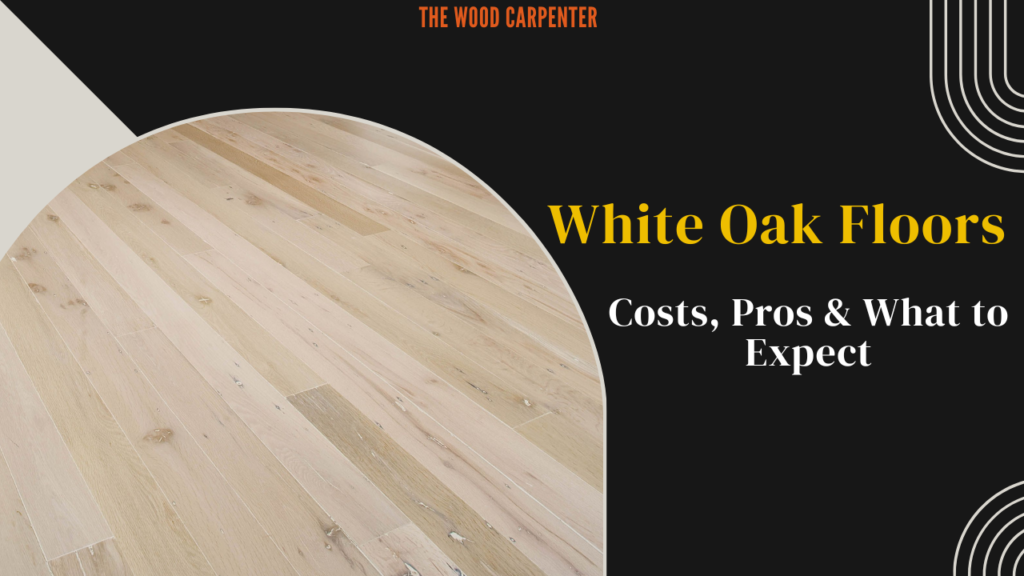
White oak flooring is milled from Quercus alba, a dense hardwood native to eastern North America. What makes it special isn’t any one thing — it’s the combination.
You get a warm, neutral tone. A tight, subtly wavy grain. And those signature silvery ray flecks that catch morning light in a way that makes people stop mid-conversation just to stare at the floor. Yes, that’s happened on my job sites. More than once.
Unlike red oak, which announces itself loudly, white oak has a quiet confidence. It doesn’t fight your furniture or your walls. It just works — and that kind of versatility is genuinely rare in a building material.
Is White Oak Actually Good for Flooring?
Short answer: it’s one of the best species you can choose.
White oak scores 1,360 on the Janka hardness scale — the industry standard for measuring how well wood resists denting and wear. That’s harder than red oak (1,290), American cherry, and significantly harder than pine. In plain terms: it handles daily foot traffic, pets, kids, and furniture without giving up easily.
But hardness only tells part of the story. What really sets white oak apart is its closed-pore structure. The wood’s pores are naturally filled with a compound called tyloses, which acts like a built-in moisture barrier. It’s literally why white oak has been used to build wine barrels and ships for centuries.
For your floors, that means better moisture resistance than almost any other hardwood, excellent stain absorption, and a surface that ages gracefully instead of slowly deteriorating.
White Oak vs. Red Oak: What’s the Real Difference?
This is the question I field most often. Here’s the honest breakdown.
Color is the first thing people notice. Red oak has pinkish-red undertones that warm up a space but can clash with cooler, more modern palettes.
White oak leans toward warm beige, tan, and grey — a tone that works with almost any interior direction. If you’re designing a Scandinavian, neutral, or contemporary space, white oak plays nicely. Red oak can fight it.
Grain is the second difference. Red oak has a more open, pronounced grain. White oak is tighter and finer, with those distinctive ray flecks. It reads as more refined, less traditional.
Hardness goes to white oak, but only by 70 Janka points. In a real home, both are durable enough for everyday life.
Water resistance is where white oak wins decisively. That tyloses-filled pore structure makes a meaningful difference in humid climates, near kitchens, and anywhere humidity swings between seasons.
Cost-wise, white oak runs about 10–20% more than red oak. Not a dramatic gap — but worth knowing upfront.
One pattern I see constantly: homeowners choose red oak to save a bit of money, then regret it three years later when their interior design shifts toward cooler tones. White oak ages with design trends. Red oak tends to fight them.
The Real Pros and Cons of White Oak Flooring
What white oak gets right:
It lasts generations. I’ve walked into homes with 40-year-old white oak floors that needed nothing more than a light sand and refinish. These are floors that outlive the people who installed them.
It handles moisture better than most hardwoods. I’ve installed it in coastal Georgia homes where humidity swings wildly between seasons. With proper acclimatization, it performs remarkably well.
It takes stain beautifully. White oak absorbs stain evenly — light natural oils, dark espresso, cool grey tones, all of it works without blotching. Red oak tends to go orange or uneven under the same stains. White oak just drinks it in.
It’s genuinely timeless. Interior designers have been reaching for white oak for two decades and they’re still reaching for it. It’s the navy suit of flooring — it never looks wrong.
You can refinish it 5–8 times over its life. That’s multiple fresh starts without replacing a single board.
Where white oak falls short:
It’s not cheap. Quality white oak is an investment. But consider this: flooring is one of the only things in your home you interact with every single day.
It can still move with moisture. In very dry climates like Arizona or Colorado, planks can develop small gaps in winter if indoor humidity drops too low. A whole-home humidifier solves this almost completely.
It’s dense and will remind you of that if you’re doing a DIY install. It dulls saw blades faster than softer woods. Use carbide-tipped blades and don’t rush.
Wide planks can be hard to source. The trend toward 5-inch and wider planks is real, and supply can be inconsistent depending on your region and the season.
White Oak Flooring Cost: Real Numbers
Here’s what you’re actually looking at, not vague ballpark figures.
Solid white oak material runs $6–$14 per square foot depending on grade, width, and whether it’s pre-finished or unfinished. Engineered white oak is similar at $5–$12 per square foot.
Add $3–$7 per square foot for professional installation. Nail-down on a wood subfloor is on the lower end. Glue-down over concrete or tricky floating installs push it higher.
If you’re buying unfinished wood, add another $2–$5 per square foot for professional sanding, staining, and finishing. Don’t cut corners here — this is where the floor’s character comes from.
All-in, expect $10–$20 per square foot for a quality white oak floor, professionally installed and finished.
The difference between a $10 job and a $20 job isn’t just the wood. It’s the thickness of the wear layer, the precision of the milling, the quality of finishing materials, and the skill of the person installing it. You feel that difference the moment you walk on it.
How Durable Is White Oak, Really?
Very — but let me give you the honest picture.
The 1,360 Janka rating means everyday scratching from normal use is minimal. Pet claws, high heels, dragged chair legs — white oak handles all of it better than softer hardwoods.
What actually damages white oak isn’t foot traffic. It’s water left standing. A puddle from a leaking dishwasher left overnight can warp planks. Repeated wet mopping will eventually raise the grain and dull the finish.
I’ve installed this flooring in homes with three large dogs and two toddlers. Five years later, those floors still looked fantastic. The formula was simple: a quality finish, felt pads under furniture, and a doormat at every entry point.
Engineered vs. Solid White Oak: Which One Do You Actually Need?
There’s no universal right answer. It depends entirely on where the floor is going.
Solid white oak is exactly what it sounds like — a plank milled from a single piece of wood, typically ¾-inch thick.
It’s the traditional choice. You can sand and refinish it many times. It nails down beautifully to wood subfloors.
The downside is that solid wood moves — it expands in humidity and contracts in dry conditions. Over concrete slabs or in very humid climates, that movement becomes a real problem.
Engineered white oak has a real white oak veneer on top bonded to multiple layers of plywood beneath. Those cross-directional layers dramatically reduce the expansion and contraction that plagues solid wood.
It’s not fake — it’s engineered for stability. When you’re shopping for it, check the wear layer thickness closely. Two millimeters or more gives you at least one refinish. Four millimeters or more gives you two or three.
My rule of thumb: if you’re going over concrete, over radiant heat, or in a coastal or very humid environment, choose engineered.
If you have a traditional wood subfloor in a climate-controlled home, solid white oak is a beautiful investment that will outlast you.
What’s the Best Finish for White Oak Floors?
The finish makes or breaks how the floor actually looks and feels day-to-day. Don’t rush this decision.
Oil-based polyurethane is the classic workhorse. It’s durable, widely available, and gives white oak a warm, slightly amber glow that deepens the natural color beautifully.
The tradeoffs: longer drying time (24–48 hours between coats) and that amber tint means it won’t work if you’re after a bright, minimal Scandinavian look.
Water-based polyurethane dries faster, produces less fumes, and stays clear. If you want white oak to look raw and natural, this is the finish. Modern formulas have closed the durability gap with oil-based significantly.
Hardwax oil finishes — like Rubio Monocoat or Osmo — are what I recommend most often now, and what I use in my own home. They penetrate the wood rather than sitting on top, so the floor looks and feels like actual wood, not wood under plastic.
When it wears, it wears gracefully, and you can spot-repair small areas without sanding the whole floor. The tradeoff: recoating every 2–5 years depending on traffic.
Wire-brushed and UV oil finishes are ideal if you love a rustic, distressed look. The brushed texture hides everyday scratches beautifully because variation is already built into the surface.
One strong piece of advice: avoid high-gloss finishes on white oak. Gloss shows every footprint, every scratch, every smudge from a dog nose. Matte or satin finishes are dramatically more forgiving and look far more natural.
Where White Oak Performs Best: A Climate Guide
Flooring doesn’t exist in a vacuum. Where you live matters enormously.
In humid coastal areas like the Carolinas, Florida, and the Gulf Coast, white oak performs well compared to most hardwoods — but engineered is the smarter call. The closed-pore structure resists moisture, and the engineered construction handles seasonal humidity swings without warping.
In dry inland climates like Colorado, Arizona, and Nevada, solid white oak works, but you need to maintain indoor humidity between 35–55% year-round. A whole-home humidifier is worth every penny. Skip it, and you’ll see visible gaps between planks every winter.
In cold northern climates like Minnesota, Wisconsin, and New England, white oak handles temperature extremes well. The critical step is proper acclimatization — let the wood sit in the actual room it will live in for at least a week before installation.
In moderate climates like the Pacific Northwest and mid-Atlantic, this is where white oak truly thrives. Stable humidity, mild temperatures, minimal maintenance required. The ideal scenario.
Installation Tips That Make the Real Difference
After 20+ years, a few things consistently separate a good install from a great one.
Acclimatize the wood. Bring the flooring into the room at least 5–7 days before installation. Don’t leave it in boxes in the garage if it’s going into the living room. The wood needs to adjust to the actual humidity and temperature of the space it will live in.
Check your subfloor — and actually check it. I’ve lost count of how many times a homeowner insisted the subfloor was “fine,” and I found flex, high spots, or moisture issues hiding under old carpet.
Subfloor flatness needs to be within ⅛ inch over 6 feet. Anything more than that must be corrected before you lay a single plank.
Use enough fasteners. For solid white oak, use cleats or staples at every joist for the first and last rows, and on 6–8 inch spacing across the rest of the floor.
White oak is dense — it needs more fasteners than softer species to stay locked in place.
Rack the floor before you nail anything down. Lay out 5–6 rows, step back, and look at the overall pattern.
Move boards around to distribute grain variation and knots naturally. The floor you install is only as good as the thought you put in before the first nail goes in.
Leave expansion gaps. A ¾-inch gap along all walls, covered by baseboard or quarter round. White oak moves with humidity changes, and it needs room to breathe.
Frequently Asked Questions
Is it actually worth the higher price?
If you’re staying put for more than 5 years, yes. You’re not paying more — you’re paying once. White oak can be sanded and refinished repeatedly, meaning the same floor can last 75 to 100 years. LVP and laminate look decent on day one, but when they’re done, they’re done. No second chances, no refinishing, no added resale value.
How long will it last?
Solid white oak? Potentially a century. I’ve walked into homes built in the 1920s with the original floors still going strong — they just needed a fresh refinish. Even engineered white oak with a thick wear layer holds up 25 to 50 years under normal use.
Can it go in a kitchen?
Yes. White oak has a tight grain that handles moisture better than most wood species. Wipe up spills quickly, never use a steam mop, and you’ll be fine. Bathrooms are a different story — that constant shower humidity is relentless, even for white oak. Stick to tile or vinyl in there.
What stain color works best?
White oak takes stain better than almost anything else on the market. Light natural oils let the grain show through beautifully. Grey tones give it a modern, clean look. Dark espresso is elegant but shows dust like crazy — just know what you’re signing up for. My personal go-to is a light fumed or UV-oiled finish. It deepens the natural color without covering up what makes the wood special.
Does white oak hold value better than red oak?
In today’s market, yes. Designers and real estate agents call it out by name now. Its neutral tone works with almost any interior style, which makes it a genuine selling point. That said — if you have well-kept red oak floors already, don’t tear them out. They’re still beautiful and valuable.
How do I take care of it?
Keep it simple. Sweep or dust-mop daily — grit is what scratches floors, not foot traffic. Damp-mop weekly with a hardwood cleaner, never plain water. Every 3 to 5 years in a busy home, get a light recoat done. No steam mops. No rubber-backed rugs sitting on it long-term.
What does refinishing cost?
A full refinish — sanding, staining, new coats — runs about $3 to $5 per square foot. A 500-square-foot room lands around $1,500 to $2,500. If the floor just looks dull but isn’t damaged, a simple recoat is $1 to $2 per square foot and makes a dramatic difference.
Still not sure? Go stand in a room with white oak floors. Watch how the morning light hits it. Feel how solid it is underfoot. Notice how it doesn’t compete with anything in the room — it just quietly makes everything around it look better.
That usually does it.