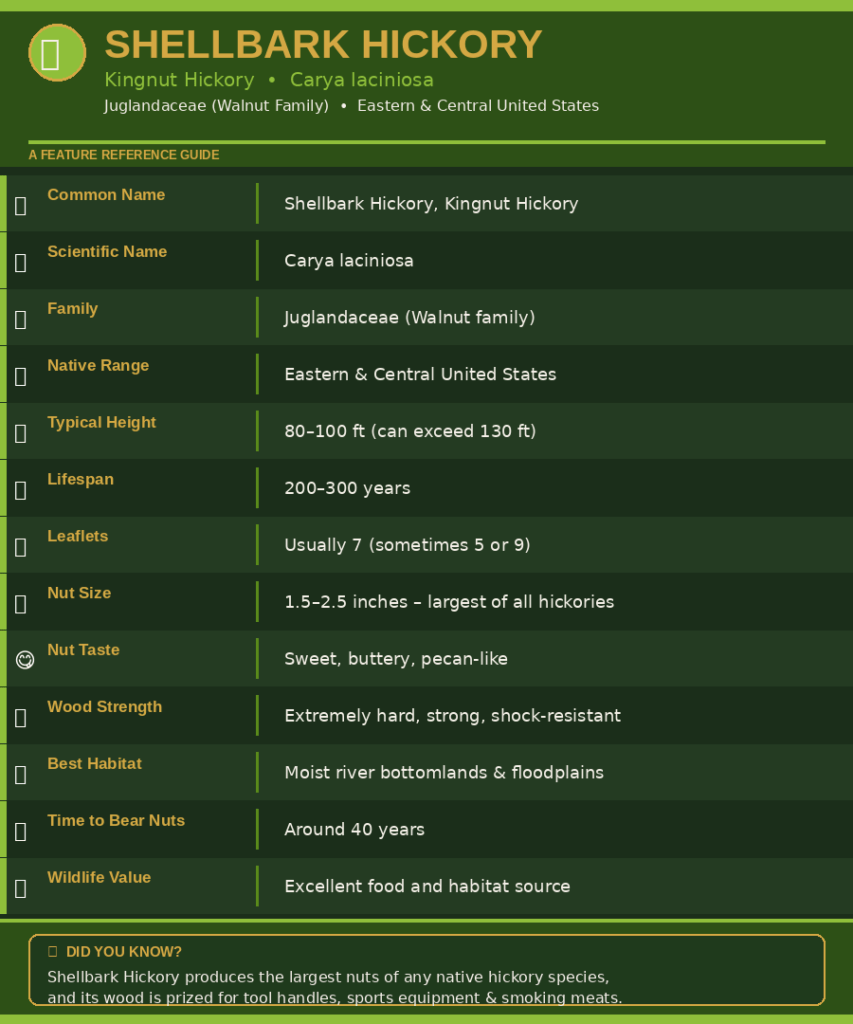
Quick Summary Table
If you have ever seen a giant hickory nut almost the size of a small lime, chances are you found a shellbark hickory. The kingnut hickory, named so because it produces the largest hickory nuts, But itis not only about size.
Not only is it an excellent source of nutrition for wildlife, Shellbark is also one of the most beautiful and strongest hickory species, with its shaggy bark. This makes it one of the most majestic native hardwood trees in North America.
In this comprehensive guide, you will learn how to recognize it, where it grows, the taste of its nuts, how its wood is used, and how it compares to its close relative, the shagbark hickory. All this is explained in a simple way.
What Is Shellbark Hickory?
Shellbark Hickory (Carya laciniosa) — a large native hardwood tree, ranging throughout much of the eastern and central U.S. It is a member of the walnut family (Juglandaceae), which includes pecans and walnuts.
This tree grows tall — commonly 80 to 100 feet — with a thick trunk and a wide crown. It can grow taller, under the best of conditions.
Shellbark hickory is a slow-growing and long-lived tree. Lifespan of 200–300 years. However, it takes patience. It takes about 40 years for the tree to start nut production.
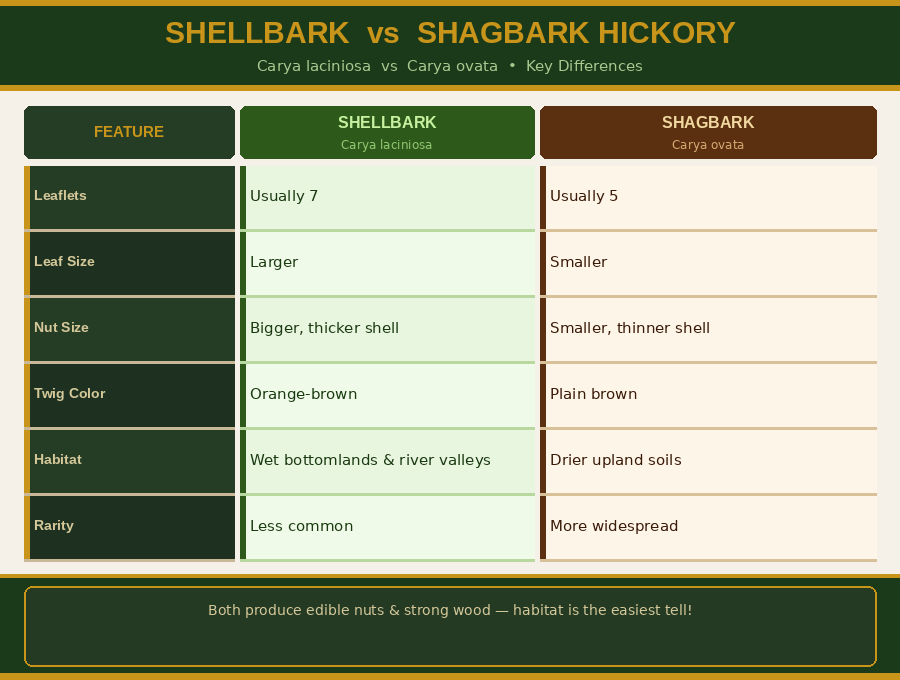
It grows mostly in rich river bottomlands and floodplains. Unlike some other hickories, it prefers moist, fertile soil and does not do as well on dry hillsides.
Shellbark Hickory Identification: How to Recognize It
Once you know what to look for, identifying shellbark hickory is easy.
Bark
One of the most distinguishable qualities is its bark. Bark of mature trees becomes gray and peels in long, wide plates. These plates curve outward at the ends, giving the trunk a rough, shaggy look.
The bark is shaggy like shagbark hickory, but shellbark bark tends to form broader and flatter plates rather than very long strips.
Young trees start with smoother bark, and the peeling plates develop as the tree ages.
Leaves
The leaves are compound and large, usually 12 to 24 inches long.
Each leaf usually has seven leaflets along a central stem. Sometimes five or nine, but seven is the standard.
The leaflets are dark green above and paler below. And then they go bright yellow-gold color in fall.
Counting leaflets is an easy trick for identification. Shellbark usually has seven. It also sets it apart from other closely related species.
Twigs and Buds
The twigs are thick and orange-brown in color. This orange tone is a useful feature, especially in winter.
The buds are large and covered with overlapping brown scales. These are easy to see when the tree has no leaves.
Nuts
The nuts are the biggest clue.
Among all the hickories, the biggest nuts are made by shellbark hickory. They are approximately 1.5 to 2.5 inches in size.
It has a hard outer husk that divides into four sections when it ripens. The inside has a extremely tough shell hiding a large sweet kernel.
Between September and November nuts ripen.
Shellbark Hickory vs Shagbark Hickory
Shellbark Hickory Habitat and Range
Shellbark hickory grows naturally in the eastern and central United States.
Its range stretches from western New York through Michigan and Iowa, south to Oklahoma and Tennessee, and back east toward Pennsylvania.
However, it is not common everywhere within this range. It mainly grows in:
- River floodplains
- Bottomland forests
- Moist, fertile valleys
- Areas with seasonal flooding
It tolerates short periods of flooding but does not survive in permanently wet soil.
The tree grows best in neutral to slightly alkaline soil and deep, rich ground.
Because of farming and land clearing, many bottomland forests were removed, which reduced shellbark populations.
Shellbark Hickory Nuts: Large, Sweet, and Nutritious
The nuts are what make this tree famous.
They are large, heavy, and packed with a sweet, buttery flavor similar to pecans. Many foragers believe shellbark nuts taste even better than other hickory nuts.
The kernels are high in healthy fats, protein, magnesium, and iron.
They can be:
- Eaten raw
- Roasted
- Used in pies and baked goods
- Ground into flour
- Added to trail mixes
Cracking them can be challenging because the shell is very thick. A small hammer works better than a regular nutcracker.
After collecting, let the nuts dry for a few weeks. This improves flavor and makes cracking slightly easier.
Wildlife also loves these nuts. Squirrels, deer, turkeys, and other animals rely on them as an important fall food source.
Shellbark Hickory Wood: Extremely Strong and Durable
Shellbark hickory wood is one of the hardest and strongest hardwoods in North America.
It is known for:
- High shock resistance
- Strength and flexibility
- Dense grain
Because of these qualities, it is commonly used for:
- Tool handles
- Ladder rungs
- Sporting goods
- Furniture
- Flooring
- Cabinetry
The wood is also excellent firewood. It burns hot and produces strong heat. Hickory smoke is also famous for flavoring barbecue.
The wood can be difficult to work with because it is so hard, but the finished product is very durable.
Growing Shellbark Hickory
Growing shellbark hickory requires patience.
It grows slowly and may take decades before producing nuts.
Important Growing Conditions
- Full sun is best
- Deep, moist, well-drained soil
- Plenty of space (at least 40–60 feet)
- Neutral to slightly alkaline soil
The biggest challenge is its deep taproot. The tree develops a strong taproot early, making transplanting difficult.
Starting from seed in its permanent location works best.
The nuts need cold stratification (90–120 days of cold) before they will germinate. In nature, this happens during winter.
Caring for Shellbark Hickory Trees
Once established, shellbark hickory is relatively low maintenance.
Ensure that young trees are watered regularly until the roots grow strong.
Use of mulch helps protect the roots, and keep moisture in the soil.
While generally disease resistant, the tree is susceptible to minor fungal problems and insects.
The bark of this tree is dry and shaggy, making it easy for fire to damage the tree.
Regular pruning is usually not necessary except to remove damaged branches.
Wildlife and Ecological Importance
Shellbark hickory plays an important role in forest ecosystems.
The large nuts provide food for:
- Squirrels
- Deer
- Turkeys
- Ducks
- Small mammals
The shaggy bark creates shelter for insects and even certain bat species.
The tree also supports moth and caterpillar species, which in turn feed birds.
It helps maintain healthy forest soil through partnerships with beneficial fungi in its root system.
Frequently Asked Questions
How do you identify shellbark hickory?
Look for shaggy gray bark with broad plates, large compound leaves with seven leaflets, orange-brown twigs, and very large nuts.
Are shellbark hickory nuts edible?
Yes. They are sweet, buttery, and considered one of the best-tasting hickory nuts.
How long does shellbark hickory live?
It can live 200 to 300 years.
When does it start producing nuts?
Usually around 40 years of age, with peak production much later.
Can you transplant shellbark hickory?
It is difficult due to the deep taproot. Planting from seed in the final location is the best method.
Final Thoughts
The shellbark hickory is one of the best native trees in all of North America. It provides huge sweet nuts, very strong wood, gorgeous golden autumn color, and valuable wildlife habitat.
Despite its slow growth and need for patience, in the right setting it is a living legacy that can endure for hundreds of years.
Regardless of if you are a forager, woodworker, wildlife enthusiast, or just someone who enjoys the wonders of old growth trees, shellbark hickory is a species that should be on your radar and one we must protect.