
Last Updated on April 24, 2026 by Sam Wood Worker
It’s Saturday morning. You’re in the garage. Music’s playing.
You turn a rough piece of oak into something beautiful. A friend sees it and says, “I’d pay good money for that.”
That’s how most woodworking businesses start.
You don’t need a massive workshop. You don’t need a business degree. You don’t need to quit your job. You just need a plan — and this is it.
Quick Start Summary
Decide what you’ll make and who will buy it. Set up a safe, organized workspace — a garage or shed works fine. Start with essential tools only and upgrade as you earn. Register your business and get a sales tax permit. Price your work correctly from day one. Sell on Etsy and Facebook Marketplace first. Use social media to show your work and attract customers.
Step 1: Choose What to Make and Sell
This decision matters more than most beginners realize.
A woodworking business that tries to make everything ends up mastering nothing — and struggling to market itself.
Popular home woodworking business ideas:
- Custom furniture — dining tables, bed frames, bookshelves
- Home décor — wall signs, frames, trays, candle holders
- Kitchen items — cutting boards, serving boards, spice racks
- Kids’ items — toy boxes, name puzzles, small stools
- Outdoor items — planters, garden benches, Adirondack chairs
- Pet furniture — dog beds, cat shelves, feeding stations
Start small if you’re a beginner. Cutting boards and home décor are fast to make, easy to ship, need fewer tools, and sell consistently well online. Expand into larger, higher-ticket pieces as your skills and income grow.
Step 2: Set Up Your Home Woodworking Shop
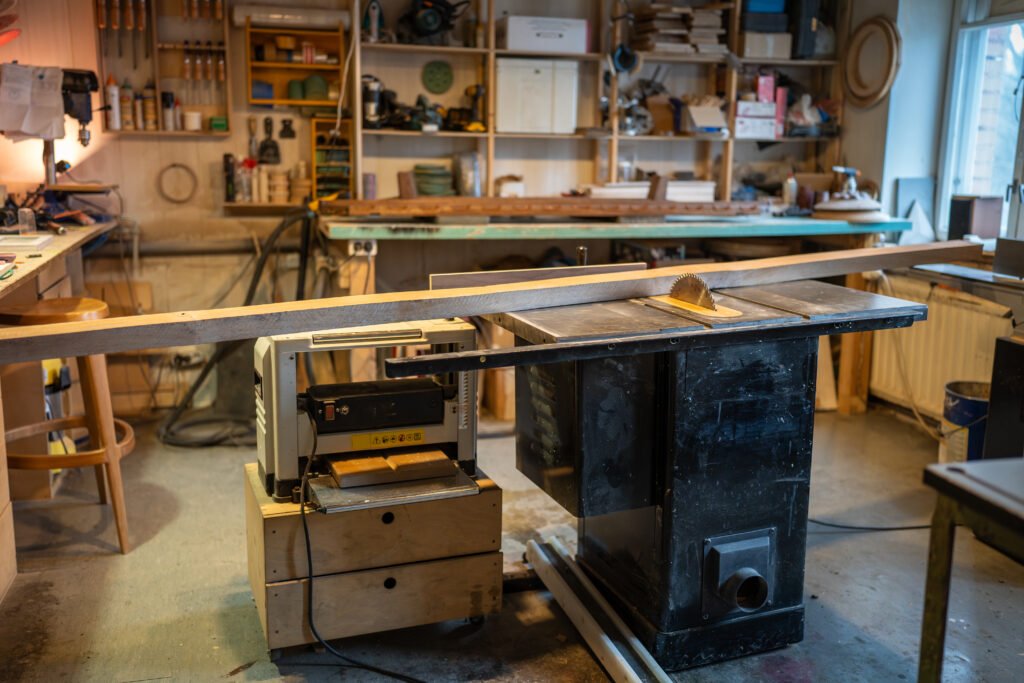
Yes, you can start from home. Thousands of woodworking businesses run from garages, backyard sheds, and spare rooms. You don’t need a commercial space. You need an organized, safe workspace that fits the products you’re making.
Choosing your space:
Garage — The most popular option. Good ceiling height, concrete floor, fits most starter tools comfortably.
Backyard shed — Great for smaller operations. Build or buy one designed as a workshop. Prioritize ventilation if you’re applying finishes.
Spare room — Works for small items like cutting boards or décor. Focus on dust and noise control.
Rented maker space — No home space available? Some shared workshops rent by the hour or month. Low commitment, great way to start.
Basic workshop safety — do this first:
- Install proper lighting. Shadows cause accidents.
- Use dust collection. A shop vac is the bare minimum.
- Keep a fire extinguisher accessible. Wood finishes are flammable.
- Store solvents in a fireproof cabinet.
- Wear safety glasses and hearing protection every time you use power tools.
- Keep the workspace organized. Clutter causes falls.
Step 3: The Tools You Actually Need
You don’t need expensive tools to start. Many successful woodworkers started with a handful of basics and upgraded as they earned.
| Tool | Purpose | Budget Range |
| Circular saw or miter saw | Cutting lumber to size | $80–$200 |
| Random orbital sander | Smoothing surfaces | $40–$80 |
| Drill/driver | Joinery and assembly | $50–$120 |
| Tape measure + square | Accurate measurements | $15–$30 |
| Clamps (6–10 assorted) | Holding pieces while glue dries | $30–$80 |
| Router (optional) | Edges and decorative details | $80–$150 |
| Table saw | Ripping boards, precise cuts | $200–$500 |
| Workbench | Stable work surface | $100–$300 (or build your own) |
| Safety gear | Eyes, ears, lungs | $30–$60 |
Total starter toolkit: roughly $600–$1,500 depending on what you already own and whether you buy new or used.
Pro tip: Buy used tools on Facebook Marketplace, Craigslist, or at estate sales. A used table saw in good condition can cost half the price of a new one and work just as well.
Band Saw vs Table Saw: Which Power Tool Fits Your Workshop?
Oil Sanding: How Pros Achieve Buttery-Smooth Wood
Step 4: Know Your Startup Costs
How much does it actually cost to start?
A basic setup costs $1,000–$3,000 if you already own some tools. A more equipped setup with quality tools and materials runs $3,000–$8,000. You don’t need to spend it all upfront. Start lean and reinvest your earnings.
| Expense | Low Budget | Mid Budget | Higher Budget |
| Tools | $600 | $1,500 | $3,000+ |
| Workbench/shop setup | $100 | $300 | $600 |
| Initial materials | $150 | $400 | $800 |
| Safety equipment | $50 | $100 | $150 |
| Business registration | $50 | $100 | $200 |
| Website/online store | $0 (Etsy) | $100 | $300 |
| Finishing supplies | $80 | $200 | $400 |
| Total | ~$1,000 | ~$2,700 | ~$5,500 |
The rule: don’t buy what you don’t need yet. Start with the tools your first products actually require. Buy more as orders demand it.
Step 5: Handle the Legal Basics
This doesn’t need to be complicated. Here’s what most home woodworking businesses need:
Register your business. Starting as a sole proprietor using your own name requires no formal registration in most states. Want a business name like “Oak & Anchor Woodworks”? File a DBA (Doing Business As) with your county or state. An LLC gives you personal liability protection and is worth setting up once your income grows.
Get a sales tax permit. Selling physical products? Most states require you to collect sales tax. A seller’s permit is usually free and takes about 15 minutes to apply for online through your state’s revenue department.
Check local zoning. Before scaling up your home shop, verify that your residential zone allows home-based business activity. Some neighborhoods restrict noise and customer traffic.
Open a business bank account. Keep your business income and personal money separate. It makes taxes far simpler and keeps your finances clean from day one.
For a full state-by-state breakdown, check the woodworking business license requirements guide in this series. (internal linking)
Step 6: Price Your Products Correctly
Underpricing is the single most common mistake new woodworking business owners make.
Charging too little doesn’t just hurt your wallet — it devalues your work and makes your business unsustainable.
Use this formula:
Price = Materials + Labor + Overhead + Profit Margin
- Materials — wood, hardware, finishes, packaging
- Labor — your hourly rate × hours to complete (don’t go below $20/hr — aim for $30–$50)
- Overhead — a portion of tool costs, electricity, shop supplies
- Profit margin — add 20–30% on top
Real example: A custom cutting board costs $15 in materials. It takes 1.5 hours at $25/hr ($37.50 labor). Add $5 overhead. That’s $57.50 before profit. Add 25% profit margin = $72 retail price.
That might feel high. But yours is handmade, local, and custom — not mass-produced. Customers who value that will pay for it. Those are the customers you want.
Step 7: Where to Sell Your Work
Online:
Etsy — The go-to marketplace for handmade goods. Easy to set up, large built-in audience, ideal for décor and smaller items.
Facebook Marketplace — Great for local sales of larger items like furniture. No shipping required.
Instagram and Pinterest — Build a visual following and drive traffic to your Etsy or website.
Your own website — More setup work, but you keep 100% of sales. Shopify or Squarespace both work well.
Local:
- Farmers markets and craft fairs
- Local furniture stores or home décor boutiques (wholesale or consignment)
- Word of mouth from neighbors, friends, and family
- Local Facebook groups and community boards
- Custom orders from people in your area
Start with Etsy and Facebook Marketplace. They’re free, have existing traffic, and will get you your first sales while you build a broader presence.
Step 8: Market Your Business Without a Budget
You don’t need a marketing degree. You need to show people what you make.
Use social media — it’s free:
- Post progress photos and finished pieces on Instagram and Facebook
- Show before-and-after transformations — people love the process
- Share short phone videos of you working — simple content gets strong engagement
- Use hashtags like #woodworking, #handmade, #customfurniture, #woodworkingbusiness
Build trust through reviews: Ask every satisfied customer to leave a review on Etsy or Google. One five-star review is worth more than a paid ad.
Take good photos: You don’t need a professional camera. A smartphone with natural daylight produces excellent product photos. Use a clean background, shoot from multiple angles, and keep it simple.
Offer custom orders: Custom work builds loyalty and commands higher prices. Mention it in your Etsy bio, on social media, and in person.
Mistakes That Kill Home Woodworking Businesses
Underpricing your work. Calculate your true costs and charge accordingly. You are not competing with IKEA. You’re offering something better.
Buying too many tools too early. Tool collecting feels productive. It isn’t. Buy what you need for your current products and expand from there.
Ignoring safety. Rushing through safety steps to save time is how people get seriously hurt. Invest in dust collection, lighting, and safety gear from day one.
Skipping the legal basics. No sales tax permit or business registration feels fine at first. It creates real problems at tax time.
Trying to make everything. A focused business is easier to market, easier to run, and easier to scale. Pick a niche and get great at it.
Poor product photos. Online selling lives and dies by photos. Blurry, dark, cluttered images kill sales — no matter how good the actual product is.
Beginner Checklist: Before Your First Sale
☐ Decided on your product niche
☐ Identified and set up your workspace
☐ Basic safety equipment in place
☐ Purchased essential starter tools
☐ Made 3–5 sample pieces to photograph and sell
☐ Checked local zoning rules
☐ Registered your business name (DBA or LLC)
☐ Applied for a sales tax/seller’s permit
☐ Opened a separate business bank account
☐ Set up an Etsy shop or Facebook Marketplace profile
☐ Taken quality product photos
☐ Posted your first products for sale
☐ Shared your business on social media ☐ Calculated pricing using the full formula
FAQ
Can I run a woodworking business in a small space?
Yes. A single-car garage or a shed is enough. Choose products that fit your space. Cutting boards, décor, and small shelves work well in tight quarters with just a handful of tools.
Do I need expensive tools to start?
No. A circular saw, sander, drill, clamps, and measuring tools cover most beginner projects. That’s $600–$1,000 all in. Buy used where possible and upgrade as your business earns.
How long before I make a profit?
Most home woodworking businesses turn profitable within 3–6 months when they start lean and price correctly. Your first sales may just cover materials. By month 3–6, with growing reviews and a small product catalog, real income follows.
What sells best in woodworking?
Cutting boards and serving boards are consistent bestsellers — low material cost, fast to make, high demand. Custom furniture commands the highest prices but takes longer. Personalized items like name signs perform very well on Etsy because they’re unique and gift-ready.
Is woodworking a profitable side hustle?
Yes. Skilled woodworkers regularly earn the equivalent of $30–$60/hr when they price correctly. Some home businesses grow into full-time, six-figure operations. It takes time — but the income potential is real.
Do I need a website to start?
No. Etsy and Facebook Marketplace let you start selling for free with zero technical skills. A website becomes valuable once you have consistent sales and want full control over your brand. It’s not a day-one requirement.
What if I have no woodworking experience?
Start by learning. YouTube has incredible free content for beginners. Take a local class. Practice making simple items. Start selling when you can consistently make something you’re proud of — not before.
Conclusion
Starting a woodworking business from home is one of those rare opportunities where a hobby you love becomes income you actually earn.
You don’t need a perfect workshop. You don’t need the best tools. You don’t need thousands of dollars on day one.
You need a decision to start. A commitment to price your work fairly. And the patience to build something real.
Every successful home woodworking business started the same way — one person, one project, one sale.
Your garage is enough. Your shed is enough. That spare corner of the basement is enough.
Pick your product. Set up your space. Make something. Sell it.
Then do it again — a little better each time.