
Last Updated on April 27, 2026 by Sam Wood Worker
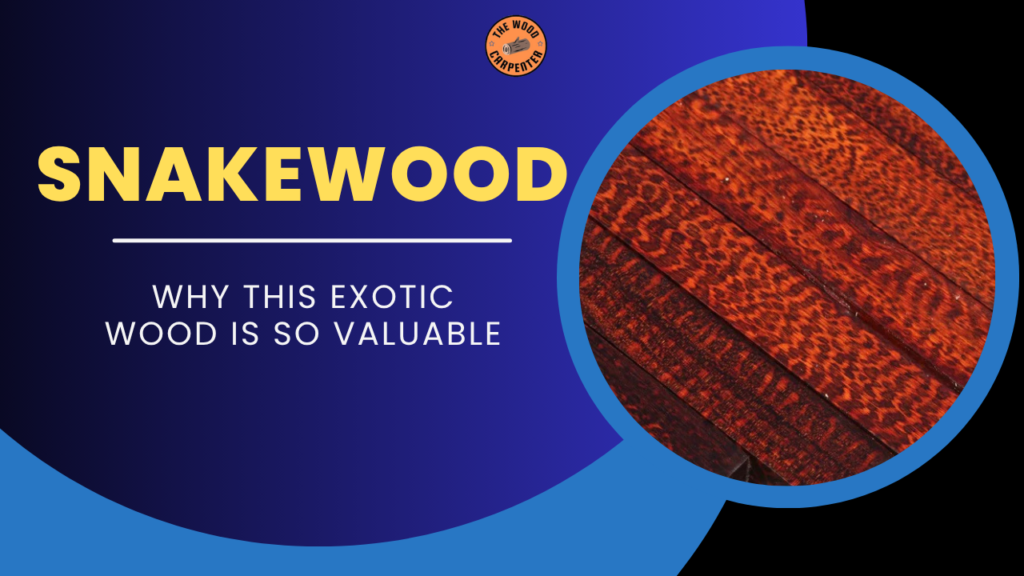
I still remember the first time I held a piece of snakewood. I turned it over in my hands a few times and genuinely couldn’t believe it was real. It looked like someone had painted a snakeskin pattern onto a piece of reddish-brown wood. Not a rough approximation — an actual, convincing snakeskin. Dark brown and black splotches scattered across a warm reddish base, sharp-edged and dramatic.
Nobody painted it. That’s just how it grows.
Snakewood is in a category of its own. It’s the most expensive exotic lumber in the world by board foot. It’s harder than almost anything else you can buy. And it comes from a tree so small and so particular about what parts of it are actually usable that working with it feels like a privilege every single time.
Here’s everything you need to know.
What Is Snakewood?
Snakewood comes from Brosimum guianense, a tree that grows along the coastal forests of northeastern South America — mainly Suriname, Guyana, and Brazil. It’s a relative of bloodwood, which explains a lot about how it behaves in the shop.
The tree itself is not impressive to look at. It’s slender, rarely growing more than 6 to 12 inches in diameter and around 65 to 80 feet tall. That’s small for a hardwood tree. And here’s the catch that makes snakewood so expensive and so frustrating to source: only a small portion of each log actually shows the distinctive snakeskin figure.
The rest of the tree — the sapwood, and large sections of the heartwood — either has light figure, no figure at all, or defects like pith checks and cracks. You can buy an entire log and end up with maybe a third of it being genuinely figured, usable material. The rest gets sold off cheaply under the name “amourette,” or discarded entirely.
That’s why snakewood costs what it does. You’re not just paying for the wood. You’re paying for everything the supplier had to cut through to find it.
What It Looks Like
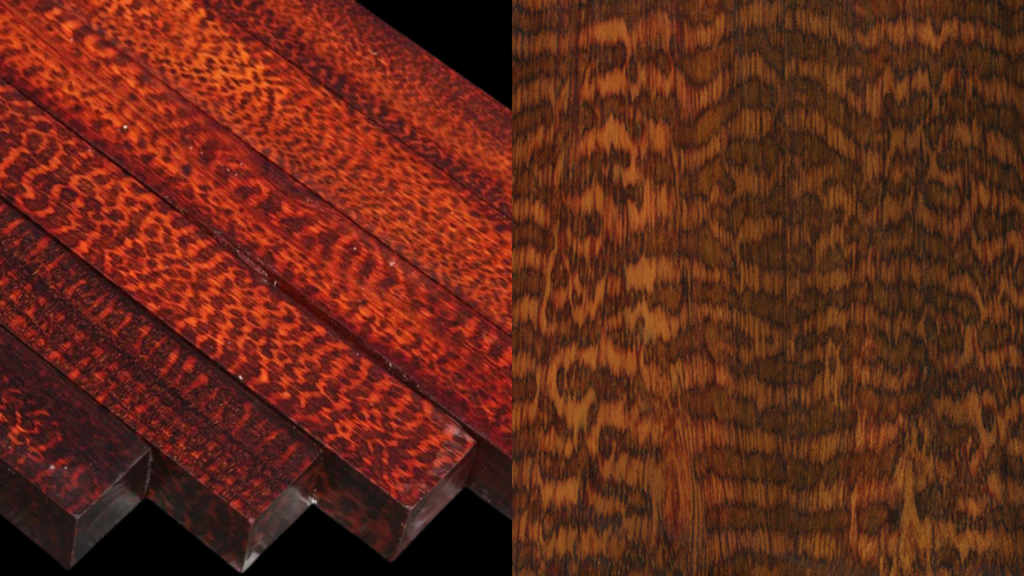
The base color is a rich reddish-brown, sometimes leaning toward orange-red or a deeper mahogany tone depending on the piece. Running through that base are dark brown to near-black splotches and patches — irregular, clustered, spread across the surface in a pattern that genuinely resembles snake scales or, as some people call it, a scattering of hieroglyphics. That’s actually the wood’s other name: letterwood.
No two pieces look the same. Some are dense with patterning, almost chaotic. Others have a more open, spaced-out figure that looks almost calm. Either way, the moment you put a finish on it and the color pops, it’s one of the most striking things you’ll ever see come off your workbench.
One thing to know: the color does shift over time. Fresh snakewood is vivid and high-contrast. With age and light exposure, the colors tend to deepen and blend a little.
The snakeskin pattern doesn’t disappear, but the contrast between the base and the splotches softens. If keeping the original look matters to you, store it away from direct light and use a UV-blocking finish.
How Hard Is It, Really?
Very. Snakewood has a Janka hardness of around 3,800 lbf. To put that in context:
- White oak: 1,360 lbf
- Hard maple: 1,450 lbf
- Marblewood: ~2,300 lbf
- Snakewood: 3,800 lbf
It’s one of the hardest woods on earth. It’s also one of the densest — around 76 lbs per cubic foot, which means it actually sinks in water. Pick up a small piece of snakewood and it feels almost impossibly heavy for its size.
That density gives it extraordinary strength. The bending strength, compression resistance, and stiffness numbers are all off the charts for a natural wood.
This is why it became the traditional choice for violin bows — it’s stiff enough to hold tension, resilient enough to flex without breaking, and heavy enough to give the bow presence and responsiveness in the hand.
Working With It: What to Expect
This is where snakewood humbles people who aren’t ready for it.
It’s brittle. For all its hardness, snakewood can shatter or splinter suddenly, especially when you’re resawing or working across the grain. Thin pieces snap without much warning. You need to treat it with a kind of careful respect — not forcing cuts, not making aggressive moves. The wood will tell you when you’re pushing too hard, usually by cracking something you didn’t want cracked.
It destroys blades. The density creates a serious blunting effect on cutting edges. Carbide-tipped tools are a must. Sharpen right before you start, not the day before. If a blade feels even slightly dull, it will show immediately — rough cuts, more splintering risk, and a worse final surface.
Planing is tricky. The grain is generally straight, which helps. But the density means you take very light passes. Aggressive cuts invite tear-out or worse, a split. Go slow, go shallow, and let sharp tools do the work.
It turns beautifully. This is where snakewood surprises people. On the lathe, it behaves better than you’d expect. It cuts cleanly with sharp tools, it polishes off the tool to a high natural gloss almost without extra effort, and the figure reveals itself in gorgeous ways as you turn. Pen blanks, bowl blanks, handles — the lathe is where a lot of woodworkers fall in love with this wood.
Finishing is a reward. Snakewood polishes to a glass-like surface. Oil finishes bring out the depth of the figure beautifully. The wood has a natural luster that even a light finish amplifies dramatically. Shellac, hard wax oil, or a thin wiping varnish all work well. The figure almost glows under a good finish.
One health note: snakewood dust has been associated with thirst, excess salivation, respiratory irritation, and nausea in some people. Work with good ventilation and a proper dust mask. It’s not the most hazardous wood dust out there, but it’s worth taking seriously.
What People Actually Make With It –
Snakewood Uses
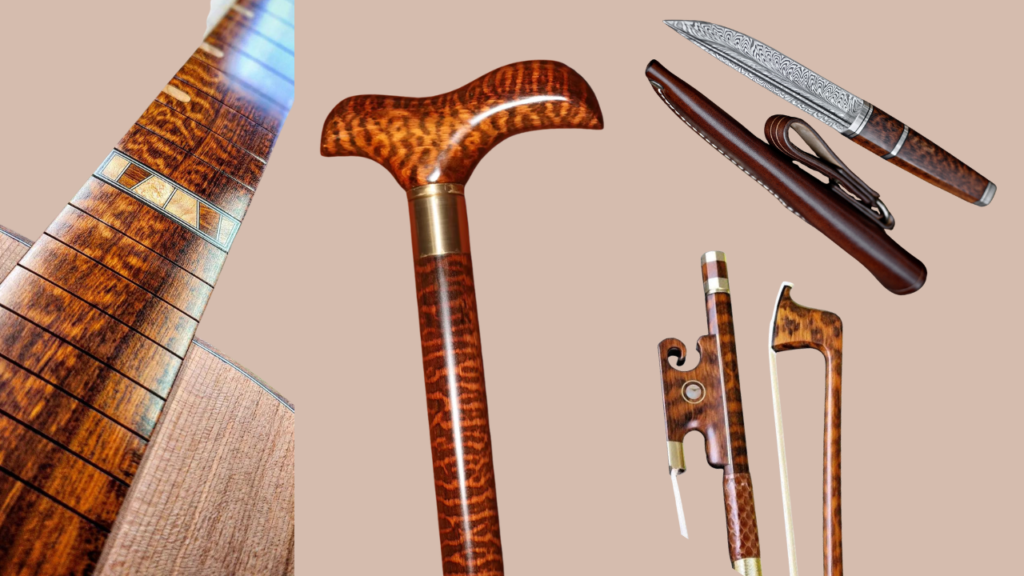
Given the size of the trees and the scarcity of figured material, snakewood is almost never used for large projects. You won’t see snakewood dining tables or cabinets — the boards simply don’t exist at that scale, and the cost would be staggering. It lives in the world of small, precise, high-value work.
Violin bows — this is snakewood’s most famous application and has been for centuries. Baroque violin bows were traditionally made from snakewood, and it’s still used for quality bow-making today. The stiffness, density, and natural flex make it acoustically ideal. A real snakewood bow has a distinctly different feel and response compared to carbon fiber or brazilwood.
Knife and tool handles — the hardness and density make it perfect. It doesn’t absorb moisture easily, it doesn’t dent or scratch in normal use, and it looks extraordinary. A snakewood-handled knife is genuinely a showpiece.
Pen blanks and small turned objects — this is where most hobbyists first encounter the wood. A snakewood pen blank is not cheap, but the finished pen is the kind of thing people pick up and don’t want to put down.
Inlay and veneer — when you’re paying this much for figured wood, using it as inlay or veneer makes a lot of sense. A small amount goes a long way, and the visual impact is massive.
Walking canes and decorative handles — historically, snakewood was popular for cane handles and umbrella handles precisely because of its looks and its hardness.
Guitar fretboards — some luthiers use snakewood for fretboards on high-end instruments. The hardness handles fret wear extremely well.
The Cost Problem
Let’s be direct about money. Snakewood is widely listed as the most expensive exotic lumber in the world on a per-board-foot basis. Good figured snakewood regularly runs $300 to $500 per board foot or more. Exceptional pieces cost even more than that.
And remember — that’s for the figured heartwood. Less figured sections sold as “amourette” are cheaper, sometimes significantly so, but they lack the dramatic patterning that makes snakewood snakewood.
If you’re buying a small pen blank or a turning blank for a small project, the cost is manageable. If you’re hoping to use it for anything larger, the budget conversation gets serious fast.
The practical approach most woodworkers take: start with a pen blank or a small turning blank. Understand the wood before you commit more money to it. It’s a learning experience in itself.
Snakewood vs Other Exotics
vs Bloodwood — they’re closely related, and bloodwood has similar density and hardness. But bloodwood has a uniform deep red color without the snakeskin patterning. Bloodwood is significantly cheaper and easier to find. If you want the figure, there’s no substitute. If you just want a hard, striking exotic, bloodwood is an easier and more affordable starting point.
vs Ebony — both are extremely hard and fine-textured, both finish to a glassy surface, and both are expensive. Ebony is jet black and dramatic in its own way. Snakewood is visually busier, warmer in color, and lighter in weight than ebony. In terms of acoustic properties, some players and luthiers consider snakewood to have a livelier, more resonant response than ebony.
vs Marblewood — both are exotic hardwoods with dramatic figure that stops people cold. Marblewood is somewhat more available and significantly cheaper. Snakewood is harder, denser, more brittle, and more expensive. For flat work and furniture, Marblewood is the more practical choice. For small precision work and turnings, snakewood is in its own world.
Sustainability
Snakewood is not listed on the CITES appendices, and the IUCN currently rates it as a species of least concern. So it doesn’t carry the same regulatory red flags as, say, some rosewood species.
That said, it grows in tropical forests that face real deforestation pressure, the trees are small and slow-growing, and usable figured material represents a small fraction of each tree.
None of that adds up to “harvest freely without thought.” If you’re sourcing it, look for suppliers who can speak to responsible sourcing practices. And using it as veneer or inlay instead of solid lumber is always the more resource-conscious choice when the project allows for it.
Is It Right for You?
Be honest with yourself here.
If you’re a hobbyist who wants to try something truly special and you’re comfortable with the cost of a pen blank or small turning — yes, absolutely. The experience of working with snakewood and the finished result are both memorable. It’s one of those materials that reminds you why woodworking is worth doing.
If you’re an intermediate woodworker looking to push into more demanding exotics, snakewood is a genuine challenge. The brittleness will catch you off guard at least once. But it teaches you to slow down, use sharp tools, and pay attention — all things that make you better at this regardless of what wood you’re working with.
If you’re a beginner, hold off on flat work with snakewood. Start with something that forgives mistakes. Come back to this one when you’re ready.
If you’re a luthier or bow maker — you probably already know everything in this article. You’ve known about snakewood for years.
Quick Answers
How much does snakewood cost?
Figured heartwood typically runs $300 to $500+ per board foot. Less figured material sold as “amourette” is considerably cheaper. Small pen and turning blanks are the most affordable entry point.
Why is snakewood so expensive?
Two reasons. The trees are small and rare, meaning there’s limited material to begin with. And only a portion of each log displays the figured snakeskin pattern — the rest is sold off cheaply or discarded. You’re essentially paying for a lot of log to get a little truly figured wood.
Is snakewood good for beginners?
For small lathe work like pen blanks, yes — it’s actually a great introduction to hard exotic woods. For flat work like furniture or panels, no. The brittleness and expense make it unforgiving for beginners.
Does snakewood sink in water? Yes. Its density is higher than water, so it sinks. That’s actually a quick way to spot fake snakewood — real figured snakewood goes straight to the bottom.
What’s the difference between snakewood and amourette?
They’re from the same tree. Amourette is the name given to less figured sections — lighter in figure, sometimes almost plain, and sold at a much lower price. Snakewood specifically refers to the highly figured heartwood sections with the dramatic snakeskin pattern.
Snakewood is one of those rare materials that earns its reputation completely. It’s genuinely difficult to work with. It’s genuinely expensive. It’s genuinely beautiful in a way that very little else in the natural world can match.
When you hold a finished piece — a pen, a knife handle, a bow — and see that figure under a good finish, you understand immediately why people have been seeking this wood out for centuries. Some things are worth the trouble.
This is one of them.