
Last Updated on April 1, 2026 by Sam Wood Worker
Scientific Name: Quercus macrocarpa | Family: Fagaceae | Lifespan: 200–400 years | USDA Zones: 3–8
Key Takeaways:
- Bur oak lives 200–400 years — one of the longest-lived native oaks on the continent
- Handles drought, road salt, compacted soil, cold winters, and periodic fire better than almost any comparable tree
- Produces large, low-tannin acorns eaten by deer, turkeys, squirrels, wood ducks, and dozens of other species
- Grows slowly for the first 3–4 years while building a deep taproot — then accelerates to 12–20 inches per year
- Needs full sun and space — mature spread reaches 60–80 feet
- Best suited for large properties, parks, farms, and restoration plantings
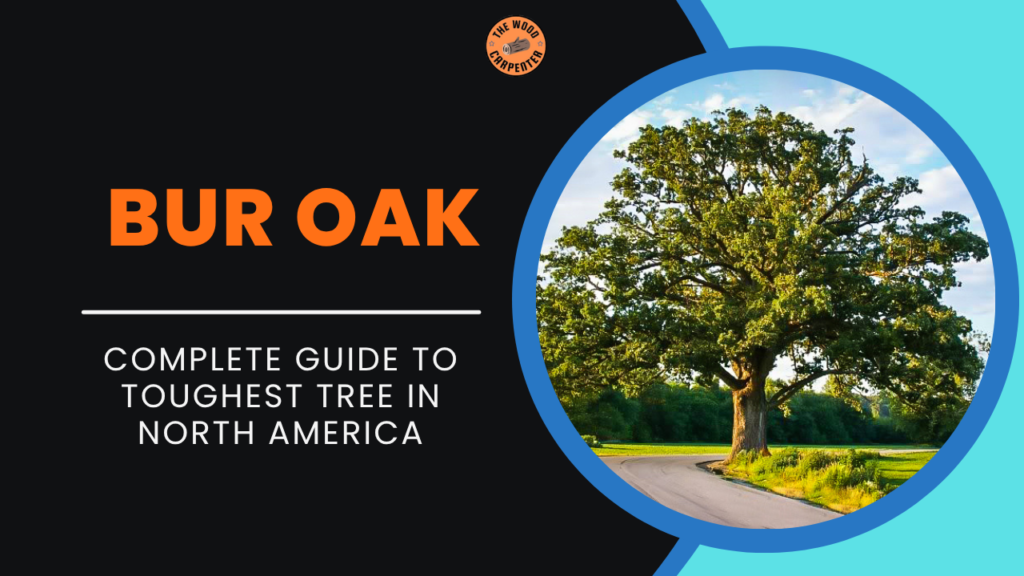
Bur oak is a massive, long-lived North American native tree that tolerates drought, cold, poor soils, and urban stress better than most shade trees — while producing exceptional wildlife value and a centuries-long landscape presence that few other species can match.
What Is Bur Oak ?
Bur oak (Quercus macrocarpa) is a deciduous native oak that has shaped North American landscapes — particularly the tallgrass prairie and oak savanna — for thousands of years. The name macrocarpa means “large fruit” in Latin, a direct nod to its oversized acorns. The nickname mossycup oak comes from the deeply fringed acorn cap that makes it instantly recognisable.
It belongs to the white oak group, which means acorns mature in a single growing season and carry lower tannin levels than red oak acorns. That detail matters — lower tannins make the acorns far more attractive to wildlife and, historically, to people as well.
Mature trees live 200 to 400 years. Some documented specimens in remnant savannas exceed that. When you plant a bur oak, you’re not planting for yourself. You’re planting for the next three or four generations of people who will use that land after you.
How to Identify Bur Oak
Once you know the key features, bur oak is one of the easier native oaks to identify with confidence.
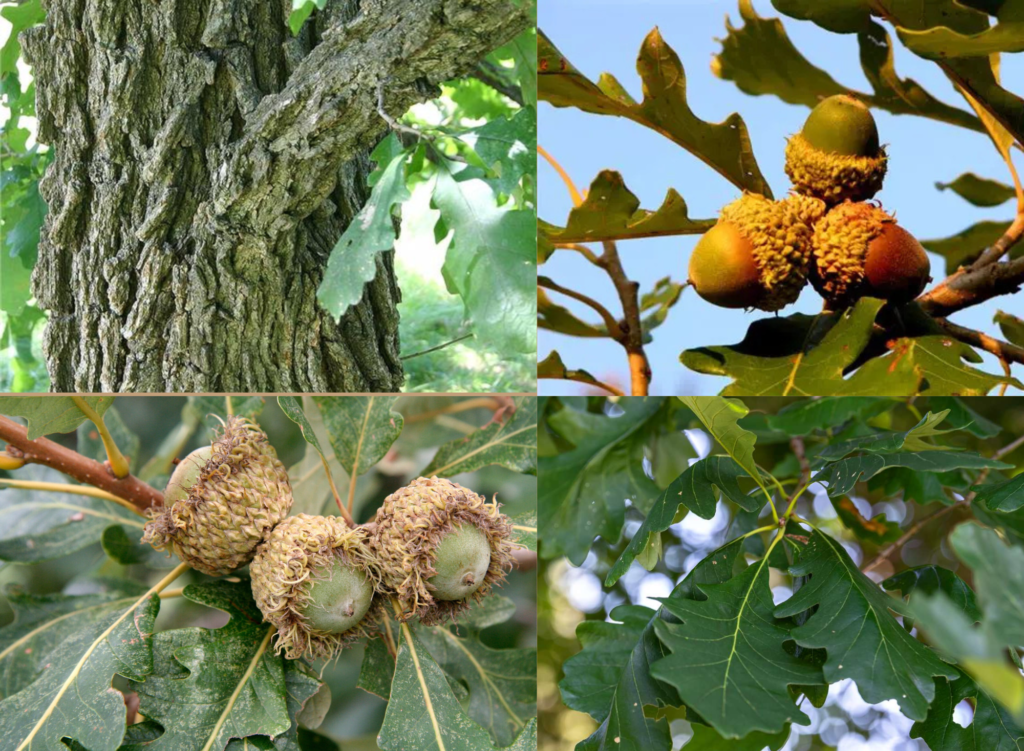
Leaves — Large, alternate, and deeply lobed. The lower half narrows toward the stem while the upper half fans out broadly — a distinctive fiddle or club shape. Thick and leathery, dark green on top, noticeably paler underneath. Often 6 to 12 inches long.
Bark — Gray to gray-brown, deeply furrowed with thick blocky ridges. On mature trees it becomes almost plated in appearance. Young branches develop a distinctive corky, ridged texture along the sides — a feature no other eastern oak replicates as clearly.
Acorns — Among the largest of any North American oak. The cap is deep and covered in long shaggy scales that curl outward at the rim — the signature mossycup look. The nut itself is rounded, often larger than a marble, and typically half to three-quarters enclosed by the cap.
Twigs — Stout with corky wing-like ridges running lengthwise. Useful for winter identification even without leaves.
Crown — Wide, spreading, often asymmetrical on open-grown trees. Massive horizontal lower limbs give mature specimens a broad silhouette completely different from the taller, narrower profiles of pin oak or red oak.
Fall colour — Muted yellow-brown to tan. Not a standout autumn tree. The value is in structure and longevity, not seasonal colour.
A reliable field identification: find a large shaggy-capped acorn on the ground and check nearby branches for that corky ridged bark. Those two features together — you’ve found your bur oak.
Where Bur Oak Grows Best
This tree has an unusually wide tolerance for different site conditions — one of its most practical strengths.
It grows well in dry sandy or rocky soils, moderate loamy slopes, thin alkaline soils over limestone, prairie edges, and even occasional floodplain margins. It handles soil pH from roughly 4.7 to 8.0 — covering everything from moderately acidic sandy soils to calcium-rich limestone.
The one non-negotiable requirement is light. Bur oak needs full sun. It does not regenerate or compete effectively in shade. In dense forest it gets outpaced by more shade-tolerant species. Its dominance in oak savannas historically depended on periodic fire that kept the understory open and gave bur oak the light it needs.
In any managed landscape — plant it in full sun with at least six hours of direct light daily and no overhead obstructions.
Growth Rate: What to Actually Expect
Bur oak’s reputation as a slow grower needs honest context.
Young trees invest heavily in building a deep, extensive root system before putting energy into upward growth. In the first two to four years, above-ground progress can look almost stagnant — sometimes just a few inches per season. This is not failure. This is the tree doing exactly what it should.
Once established — typically years three to five — growth accelerates substantially. In good conditions, a bur oak adds up to 20 inches of height annually. A well-sited tree at 20 years may reach 60 feet with a spreading canopy already providing real shade.
The long game is where it becomes extraordinary. Century-old trees in open settings develop trunk diameters of three to four feet and canopy spreads exceeding 80 feet. These aren’t just large trees — they’re landmarks that define a property for generations.
Think in decades. The first ten years feel slow. By year twenty you have a substantial specimen. By year fifty, something genuinely impressive. By year one hundred, something irreplaceable.
Why Bur Oak Is Exceptionally Tough
In three decades of tree work, I’ve rarely seen a species with this combination of stress tolerances.
Fire resistance — The bark on mature bur oaks is among the thickest of any eastern North American tree. Living cambium survives low and moderate ground fires that kill neighbouring species outright. This trait evolved alongside periodic fire as the defining force shaping savanna landscapes. Bur oak survived while everything around it burned back — which is precisely why it came to dominate those habitats.
Drought tolerance — The taproot begins penetrating deep into the soil almost immediately after germination. Established trees access moisture reserves well below where most other trees are drawing water. I’ve watched bur oaks push through summer dry periods that left silver maples and ashes visibly stressed and wilting.
Cold hardiness — Rated through USDA zones 3 to 8, covering the coldest parts of the northern plains. Bur oak’s natural range includes southern Canada and the northern Great Plains, where hard winters are the baseline.
Soil adaptability — Thin, rocky, alkaline, compacted, or otherwise difficult sites that defeat more demanding species are manageable for established bur oaks. That makes it genuinely useful for restoration work where other trees simply won’t take hold.
Wildlife Value: A Tree That Keeps Giving
Few native trees in North America support as many species as bur oak across as many seasons.
White oak acorns — including bur oak — are lower in tannins than red oak acorns, making them actively preferred by wildlife when both are available. In a productive mast year a single large tree drops thousands of acorns — a significant caloric contribution to local wildlife before winter sets in.
Species that feed directly on bur oak acorns include white-tailed deer, wild turkey, eastern gray squirrel, fox squirrel, blue jay, wood duck, mallard, ruffed grouse, black bear, raccoon, and red-headed woodpecker. For anyone managing land with wildlife goals, a single bur oak serves multiple target species simultaneously.
Beyond acorns, oaks as a genus support more caterpillar species than virtually any other plant group in North America. Since caterpillars are the primary food source for most nesting songbirds, planting an oak has cascading ecological effects up the food chain that persist for the life of the tree.
As bur oak ages and develops structural complexity — cavities, deep bark furrows, massive horizontal limbs — it provides nesting sites for wood ducks, screech-owls, and red-bellied woodpeckers, plus roost sites and winter cover for mammals.
Few trees deliver this range of wildlife benefit across so many seasons and so many species.
Timber and Human Uses
Bur oak wood is classified as true white oak — strong, dense, and resistant to splitting. It was commercially important throughout the 19th and early 20th centuries for construction, wagon wheels, fence posts, furniture, and barrel cooperage across the Midwest. As a timber species it compares well to other white oaks in strength and durability.
As a shade tree it excels in large settings: farmsteads, parks, school campuses, rural estates, and golf courses. Wide canopy, very low long-term maintenance once established, and a lifespan that outlasts everyone involved in planting it — that combination is hard to argue against anywhere space isn’t a limiting factor.
In ecological restoration it’s a first-choice species for oak savanna reconstruction, prairie-edge planting, riparian buffer establishment, and erosion control on vulnerable slopes. The deep root system stabilises soil while the leaf litter and structural complexity it builds gradually restore ecological function over decades.
Water Oak Tree: Pros, Cons & Care Tips
White Oak Tree: America’s Strongest Hardwood
Live Oak Tree Secrets You Didn’t Know 🌳
Planting and Care
Get establishment right and you have a tree that essentially manages itself for the next century.
Site selection — Full sun, no overhead obstructions — not power lines, building eaves, or overhanging mature trees. Think about the footprint at 50 years. Allow a 30-foot radius of clearance around the planting site as a reasonable minimum.
Planting depth — The root flare must sit at or very slightly above the surrounding soil grade. Planting too deep is the most common and damaging error with oaks. It restricts gas exchange at the root collar and causes slow, hard-to-diagnose decline over years.
Watering — Deep, infrequent soaking rather than light frequent sprinkling. In hot dry summers, thorough watering every 10 to 14 days without meaningful rainfall covers the first two to three seasons. Once the tree shows consistent vigorous new growth, reduce supplemental water and let the roots find moisture independently.
Mulching — Three inches of organic mulch — wood chips or shredded bark — in a ring out to the drip line. Keep mulch a few inches back from direct trunk contact. Conserves moisture, moderates root zone temperature, and suppresses competing grass during the critical establishment window.
Pruning — Dormant season only — late fall through early spring. The pathogen responsible for oak wilt is spread by sap beetles attracted to fresh wounds during the growing season, particularly April through July. Remove dead, damaged, or crossing branches in dormancy. Avoid heavy pruning of healthy mature wood without a structural reason.
Common Problems
Bur oak is tough, but a few threats are worth knowing.
Oak wilt — The most serious concern. This vascular disease spreads through root grafts between neighbouring trees and via beetles attracted to fresh wounds. Symptoms include rapid wilting and bronzing of leaves progressing inward from branch tips. Bur oak is less susceptible than red oaks but not immune. Prune only in dormancy and consult a certified arborist if symptoms appear.
Anthracnose — Irregular brown spots and early leaf drop during cool wet springs. Rarely fatal to established trees. Raking and disposing of fallen leaves reduces spore load the following season.
Gall-forming insects — Cynipid wasps produce various galls on leaves, twigs, and acorns. Almost entirely cosmetic. No treatment is warranted.
Invasive shrubs — Buckthorn, shrub honeysuckle, and multiflora rose can shade and suppress young bur oaks before they establish fully. Managing competing vegetation during the first several years matters particularly in restoration settings.
Frequently Asked Questions
Is bur oak a good shade tree for a large yard?
One of the best native shade trees available for large properties. The canopy spreads 60 to 80 feet or more at maturity, providing deep shade across a wide area. Low-maintenance once established and centuries-long lived. The key limitation is space — it’s a poor fit for small suburban lots where expanding roots and canopy will eventually conflict with structures.
How fast does bur oak grow per year?
Slow for the first two to four years — sometimes just a few inches — while building its root system. Once established, 12 to 20 inches annually in good conditions. A 20-year-old tree in optimal conditions may approach 60 feet.
Can bur oak survive drought?
Yes — this is one of its defining strengths. The taproot reaches deep into the soil profile quickly, accessing moisture unavailable to shallow-rooted species. Established trees routinely outlast summer dry periods that stress other common shade trees. Young trees need supplemental watering for the first few seasons; after that the investment produces a genuinely drought-resilient tree.
Is bur oak good for wildlife?
Exceptionally so. Large nutritious acorns eaten by deer, turkeys, squirrels, wood ducks, blue jays, and many others. Structural complexity supporting cavity-nesting birds and roosting mammals. A significant diversity of caterpillar species hosted on the foliage — the primary food source for most nesting songbirds. Few trees offer this range of wildlife benefit across so many seasons.
How long does bur oak live?
200 to 300 years under typical conditions; over 400 years on good sites. A bur oak planted today in the right location could still be standing and thriving long after everyone alive right now is gone. Very few landscape decisions carry that kind of significance.
What makes bur oak different from other oaks?
The fringed deep acorn cap, the corky ridged twig bark, the wide leathery fiddle-shaped leaves, and exceptionally thick bark on mature trunks. Beyond appearance — a combination of drought tolerance, fire resistance, cold hardiness, and a lifespan of up to 400 years that few other North American oaks approach.
The Bottom Line
Bur oak needs space, full sun, and a few years of patient establishment. That’s the honest ask.
What it gives back — centuries of low-maintenance growth, an enormous canopy, exceptional wildlife value, rot-resistant timber, and a lifespan that outlasts nearly everything else we plant — puts it in a category almost nothing else can occupy.
I’ve planted a lot of trees over thirty-plus years. When someone asks me what single tree they should put in the ground if they have room for one great native hardwood, the answer comes quickly.
Bur oak. Every time.
Plant it somewhere it can grow without restriction. Give it good establishment. Then step back and let it become what it was built to be — one of the genuinely great trees of the North American continent.