
Last Updated on July 7, 2026 by Sam Wood Worker
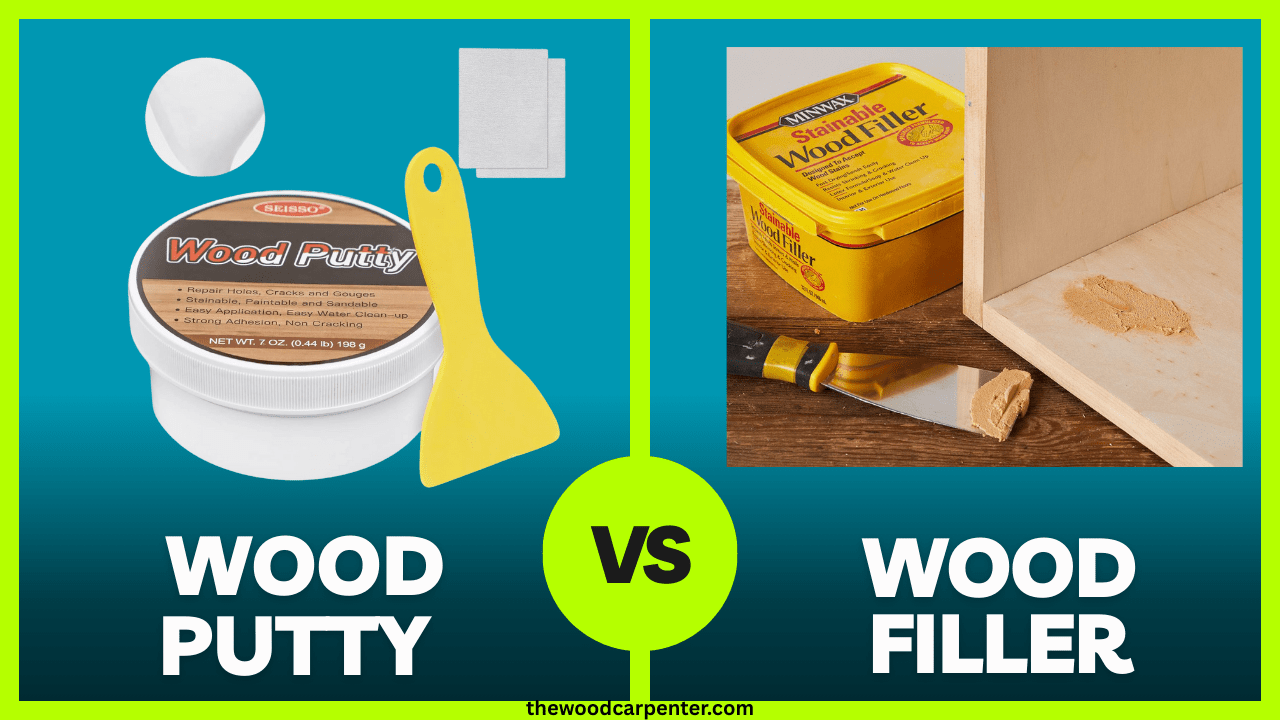
Wood Putty vs Wood Filler: Which One Should You Use?
When fixing wood, very often the question for homeowners and DIYers is not “Am I going to use a wood putty or wood filler?” At a superficial level, these two products are very similar looking and feeling. Both are paste-like substances meant to fill in wood imperfections. “But they have different purposes. Choosing the right one can make the difference between a seamless repair and a patch that stands out for all the wrong reasons.
In this comprehensive guide, we’ll explain everything you need to know about wood putty vs. wood filler—how they’re are made, when you should use them, and the pros and cons of each — including their outdoor performance and expert tips. In the end, you’ll have a clear idea of which is best suited to your next project.
What Is Wood Filler ?
Wood filler is a compound made from wood fibers, resin, and a hardening agent. Once applied, it cures into a rigid, solid surface that can be sanded, painted, or stained. Filler frequently accepts stain better than putty since it actually has wood fibers in it, allowing the filler to take the color more naturally to the unfinished wood.
Wood filler is best used before applying any finish. That could be raw furniture, new floors, its trim work, cabinetry or any wood project that still has yet to be sealed, varnished or painted.
Key Features of Wood Filler
- Hardens after curing
- Sandable and stainable
- Perfect for filling gaps, holes and gouges
- Best for unfinished wood
- May shrink or crack if not applied properly
My Experience with Wood Filler
My most-used wood filler scenario is nail holes in new trim and door casings before painting. I’ll apply it slightly overfilled, let it cure for 30 minutes, sand it flush with 120-grit, and by the time the primer goes on you genuinely cannot tell anything was ever there. I once filled a fairly deep gouge in a pine workbench top — about 6mm deep — and made the mistake of packing it in one thick application. It cracked as it dried. Lesson learned: build up deep repairs in thin layers, letting each one cure before adding the next. Never rush wood filler.
What Is Wood Putty ?
Wood putty, sometimes called plastic wood, is a pliable material made from synthetic resins, oils, and pigments. It doesn’t dry completely, unlike wood filler. Rather, it exhibits some flexibility after curing which allows the sealant to stretch and compress while in use, such as surfaces that are prone to expand/contract due to humidity or temperature changes.
Wood putty is for finished wood surfaces: furniture, floors and trim that already have stain, varnish or paint. Because it doesn’t take stain well, it typically comes in a variety of colors that can be color-matched to the existing finish.
Key Features of Wood Putty
- Remains flexible after curing
- Comes pre-stained in several wood colors
- Not sandable or stainable
- Best for finished wood
- Covers minor nicks, scuffs, and small holes
My Experience with Wood Putty
I keep a set of color-matched putty sticks in my apron pocket on almost every job. They’re the fastest repair tool I own. A client once called me back to a kitchen I’d fitted six months earlier — one of the cabinet doors had taken a knock and had a small dent on the face.
Two minutes with a matching putty stick, a light wipe, and it was invisible. No sanding, no re-finishing, no disruption to their kitchen. That’s what putty does best: quick, invisible touch-ups on surfaces that are already done. Where I’ve seen people go wrong is trying to use it on bare wood before staining — the putty sits on top, won’t take the stain, and you end up with a pale blotch that’s impossible to hide.
Wood Putty vs Wood Filler: Side-by-Side Comparison
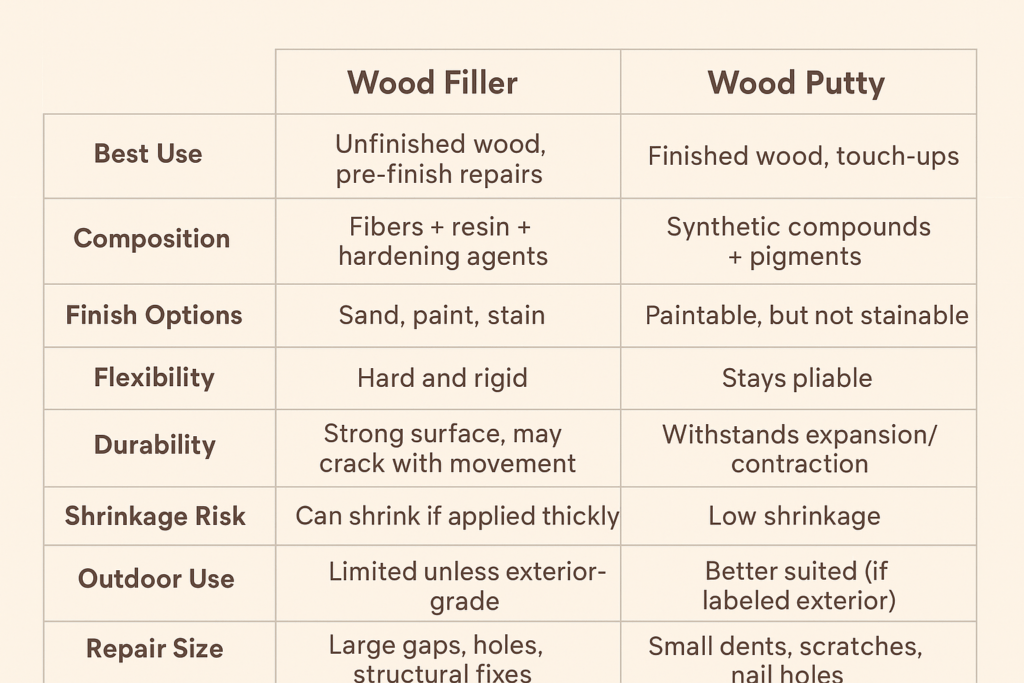
Wood Putty vs Wood Filler — Quick Comparison
Before anything else, here’s the table that answers the question most people actually have:
| Feature | Wood Putty | Wood Filler |
|---|---|---|
| Can you sand it smooth | No — stays slightly flexible | Yes — sands to a flush, hard surface |
| Can you paint over it | Yes — most brands are paintable | Yes — takes paint and stain well |
| Works on stained wood | Yes — designed for finished surfaces | No — bonds poorly to sealed or finished wood |
| Drying time | 2–8 hours (stays slightly pliable) | 15 minutes–2 hours (hardens fully) |
| Interior or exterior use | Both — flexible, handles wood movement | Interior mainly; exterior-grade versions available |
| Price range | ~$5–$15 per tube or tub | ~$6–$18 per tub |
| Best application scenario | Small scratches, dings on finished furniture | Holes, gouges, cracks on bare unfinished wood |
Clear Winner by Situation: If your wood is already finished — stained, painted, or sealed — reach for wood putty every time. If the wood is bare and unfinished and you’re about to stain or paint it, wood filler is the only one that will give you a result you can be proud of.
Also read:
Oil-Based Stains: A Guide for Long-Lasting Wood Finishes
Butcher Block Oil: A Complete Guide for Lasting Wood Care
When to Use Wood Putty
You should use wood putty if:
- The surface has already been finished (stained, sealed, or painted).
- You are fixing up some small dings, scratches or gaps.
- You need a product that remains flexible with wood movement.
- You want a quick fix without re-finishing the whole surface.
Example: Your dining table gets a small scratch after years of use. A color-matched putty stick can fill it in so it disappears without stripping or re-staining the entire tabletop.
Pros and Cons of Wood Filler
Pros
- Hardens to a durable, sandable surface
- Can be stained or painted to match raw wood
- Excellent for unfinished carpentry projects
- Quick-drying formulas available
Cons
- Not suitable for finished surfaces.
- May crack or shrink over time.
- Poor outdoor durability unless formulated for exterior use.
- Needs sanding and finishing afterward.

Pros and Cons of Wood Putty
Pros
- Flexible, resists cracking from wood movement
- Great for already finished surfaces
- Available in a wide variety of colors
- Simple application—no sanding required in many cases
Cons
- Not stainable (color options must be matched)
- Can damage raw, unfinished wood
- Longer curing time than filler
- Less rigid, not for large repairs
Common Mistakes to Avoid
- Applying wood filler to finished wood – It will not bond well, and will stand out against the finish.
- Attempting to stain wood putty — Putty doesn’t take stain, so the repair will appear in a different color.
- Filling huge gaps with putty — Putty is for tiny flaws, not structural repairs.
- Not sanding the filler – Wood filler needs to be sanded level prior to finishing.
- Using indoor filler for outdoor spaces — Always read labels for weather-resistant or exterior-grade versions.
Outdoor Applications: Which Works Better?
If your project is outdoors — deck boards, exterior trim, siding, or garden furniture — standard versions of both products have limitations.
Wood filler in its standard form is not water-resistant. However, exterior-grade wood fillers exist and work well outdoors as long as the repair is properly sealed and painted afterward. Without a topcoat, even exterior filler will eventually break down in rain and sun.
Wood putty is more flexible and handles the expansion and contraction that outdoor temperature swings cause better than filler. Most putties are also more water-resistant than basic filler. That said, neither product is truly waterproof — always check the label for exterior or weather-resistant ratings, and always seal the repair.
Pro Tips for Best Results
Match colors carefully: Use the closest pre-tinted color, with putty. For the filler apply test stains on scrap wood and check that color matches.
Overfill slightly: Filler has a tendency to shrink, and putting on too much here will give you a flush surface after sanding.
Use wood dust: For a invisible repair, mix fine sawdust from your project with filler to match exactly the color and grain.
Seal repairs: Never forget to finish with paint, varnish or sealant in line with longevity.
Check compatibility: While most fillers and putties adhere to all finishes, some may not stick to certain woods or finishes; you should always test them first.
Which One Should You Choose?
It is really all about one simple thing: The wood is finished or the wood is unfinished?
Unfinished wood → Use wood filler.
Finished wood → Use wood putty.
For outdoor projects, make sure the product is rated for exterior use, and always seal afterward for protection.
Final Thoughts
Between the two, if I had to keep only one in the workshop, I’d keep wood filler — because most of my repairs happen during a build, before any finish goes on. But in practice, both sit on my shelf within arm’s reach.
A quality set of color-matched putty sticks has saved me on more client call-backs than I can count, and a good exterior-grade filler has bailed me out on more than a few deck repair jobs. Learn when each one belongs, and you’ll never have a repair that draws the eye for the wrong reasons.
Frequently Asked Questions (FAQs)
1. Is wood filler the same as wood putty?
No. Wood filler is designed for unfinished wood and hardens after curing, while wood putty is for finished wood and stays slightly flexible.
2. Can wood filler be used on finished wood?
No, Wood filler does not adhere well to finished surfaces. It’s intended to be used before staining, painting or sealing.
3. Can wood putty be sanded or stained?
Wood putty cannot be sanded or stained. It comes pre-colored to match finishes and is usually paintable.
4. Which is stronger, wood filler or wood putty?
Wood filler is more resistant and produces a tough, solid surface. Putty is a bit more flexible, but it’s not as firm or rigid, so it works better for very small touch-ups.
5. Can I use wood filler outdoors?
Yes, but only if it’s labeled exterior-grade and has been sealed the right way. Traditional wood filler is not water resistant.
6. Is wood putty waterproof?
The majority of those wood putties are water-resistant, but not completely waterproof. Never use anything that isn’t rated for outdoor use.
7. What’s better for nail holes—wood filler or wood putty?
For nail holes in unfinished wood, use wood filler; for those in finished wood, opt for wood putty.
8. Does wood filler shrink?
Yes, wood filler can shrink or crack as it dries, particularly when used in large gaps. Always overfill slightly and sand smooth.
9. Can you paint over wood putty?
Yes. Most wood putties are paintable, although you can’t get them to soak up a stain. Pick a color that is closest to your finish for optimal success.