
Last Updated on July 7, 2026 by Sam Wood Worker
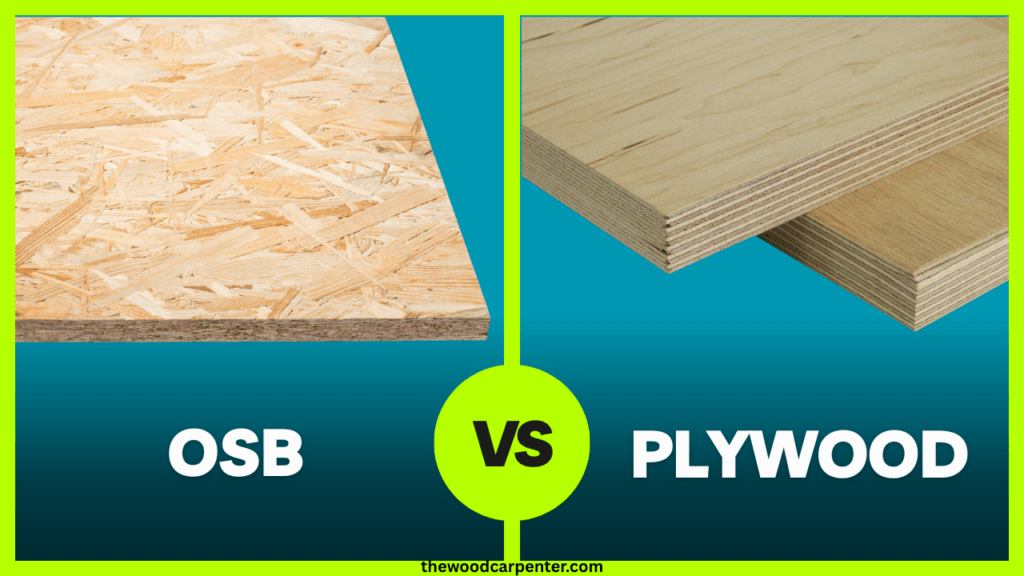
OSB vs Plywood
When framing a house, sheathing a roof, or building a piece of furniture, the debate almost always comes down to two engineered wood products: OSB and plywood. Both are widely used, both are available at every lumber yard, but they perform very differently depending on where and how you use them.
I’ve worked with both materials across dozens of projects — from subflooring a full home build to crafting workshop shelving and furniture. My honest take: neither one is universally better. The right choice depends entirely on your project’s demands. Let me break it all down so you can decide with confidence.
OSB vs Plywood — Quick Comparison
Here’s a side-by-side overview before we dig into the details:
| Feature | OSB | Plywood |
|---|---|---|
| Average cost (4×8 sheet) | ~$15–$22 | ~$22–$45 |
| Strength under load | High shear strength; uniform throughout | Stiffer; holds fasteners better |
| Moisture resistance | Absorbs water; edges swell and are slow to dry | Resists swelling better; dries faster |
| Weight per sheet (7/16″) | ~47–50 lbs | ~40–45 lbs |
| Edge quality and finishing | Rough, ragged edges; hard to finish cleanly | Smooth edges; sands and finishes well |
| Best use case | Wall sheathing, roof decking, subflooring | Furniture, cabinetry, floors, humid environments |
| Overall recommendation | Budget structural work | Visible surfaces, wet areas, long-term performance |
What Is OSB?
OSB (Oriented Strand Board) is an engineered panel made from rectangular wood strands or flakes that are layered and compressed with resin under high heat. The strands are deliberately oriented — outer layers run lengthwise, inner layers run crosswise — which gives the panel consistent, uniform strength across the entire sheet.
Because OSB uses smaller, faster-growing trees rather than large old-growth logs, it’s considered more eco-efficient than traditional plywood.
Common uses:
- Roof decking
- Wall sheathing
- Subflooring
- Industrial crating and packaging
My experience: I’ve used OSB as wall sheathing on three residential builds, and it always performed exactly as expected — solid, uniform, and easy to work with in large panels. Where I’ve been burned is leaving cut sheets exposed to rain during a build. The edges swelled noticeably and never fully recovered, which caused some minor fastener issues along the perimeter. Seal those edges. Every time.
What Is Plywood?
Plywood is made by peeling thin veneers from logs and bonding them in alternating grain directions under heat and pressure. This cross-lamination is what gives plywood its dimensional stability — it resists warping, holds its shape well, and doesn’t expand uniformly in any single direction.
Plywood comes in a wide range of grades: softwood plywood for structural construction, hardwood plywood for furniture and cabinetry, and specialty grades like marine plywood for wet environments.
Common uses:
- Furniture and cabinetry
- Flooring and underlayment
- Roofing and wall sheathing
- Decorative and visible panels
My experience: My go-to for any project where the wood will be seen is always plywood, usually a B/C or better grade. I once built a set of shop shelves from OSB to save money. They looked fine for about six months — until the workshop humidity got to them. The surfaces started to roughen and the edges began to fray. I rebuilt them in 3/4″ birch plywood and haven’t had a problem since.

OSB vs Plywood: Pros and Cons
OSB
Pros:
- Significantly cheaper — typically 15–30% less than plywood of the same thickness
- No voids, soft spots, or core gaps; strength is consistent throughout
- More eco-friendly due to use of fast-growing, smaller trees
- Available in large panel sizes ideal for construction
Cons:
- Heavier than comparable plywood panels
- Edges absorb water and swell; can take much longer to dry and may not fully recover
- Doesn’t hold nails and screws as securely as plywood
- Rough surface and appearance makes it unsuitable for any decorative or visible application
Plywood
Pros:
- Stiffer and holds fasteners (nails, screws) more securely
- Resists swelling and warping better, especially in humid conditions
- Smooth surface that sands, paints, and finishes cleanly
- Available in many grades: softwood, hardwood, marine, fire-retardant, and more
Cons:
- More expensive than OSB across all comparable thicknesses
- Prone to delamination if exposed to prolonged or repeated moisture
- Lower grades can contain knots, voids, or uneven core quality
Which Should You Choose?
For structural applications (roofing, wall sheathing, subflooring): OSB is a solid and affordable choice — as long as edges are properly sealed and moisture exposure stays limited. It’s the reason OSB now accounts for roughly 70% of all floor, wall, and roof sheathing used in North American construction.
For furniture, cabinetry, or any visible surface: Plywood is the clear winner. Its smooth face, clean edges, and ability to hold screws tightly make it far superior for anything people will see or touch.
For humid or damp environments: Choose plywood. It doesn’t swell as much, dries faster, and holds its shape better over time.
For tight-budget projects: OSB runs 15–30% cheaper than plywood. On a 2,400-square-foot home, that price difference can save you roughly $700 in materials alone.
OSB vs Plywood by Application
Roofing
OSB is the dominant choice for roof decking because of its low cost and consistent panel quality. That said, in a climate with frequent rain or high humidity, plywood is the safer long-term investment — it dries faster and resists the edge swelling that can cause problems with OSB over time.
Wall Sheathing
Both work well for walls. OSB’s large, uniform panels make installation faster, and its shear strength is actually slightly higher than plywood’s — which is why many structural engineers specify it for shear walls. For damp climates, plywood holds a modest edge.
Subfloors and Flooring
For subfloors under tile or hardwood, I recommend plywood every time. It’s stiffer, holds fasteners more reliably, and is far less likely to bounce, squeak, or swell at the seams. OSB is still used widely in budget subfloor applications, but keep it dry during installation.
Shelving and Furniture
No contest — plywood wins. OSB’s rough surface is difficult to finish cleanly, and its edge quality makes it impractical for any project where appearance matters. Use plywood here, full stop.
OSB vs Plywood: Strength
Both materials are strong enough for structural use, but they’re strong in different ways. OSB has slightly higher shear strength along panel edges, which makes it excellent for load-bearing wall applications. Plywood is stiffer overall — research has found that quality plywood panels can be up to 1.8 times stiffer than comparable OSB panels. For floors and roofs where rigidity matters, plywood performs better under repeated loading.
OSB vs Plywood: Water and Moisture Resistance
This is where the gap between the two materials is most pronounced. OSB absorbs water more readily than plywood, and — more importantly — its edges swell significantly and are slow to return to their original dimensions. In some cases, they never fully recover.
Plywood resists moisture better, dries faster, and maintains its structural integrity longer in wet conditions. If your project will face any exposure to rain, humidity, or condensation, plywood is the safer material. For very wet environments, marine-grade or exterior-grade plywood is specifically engineered for the task.
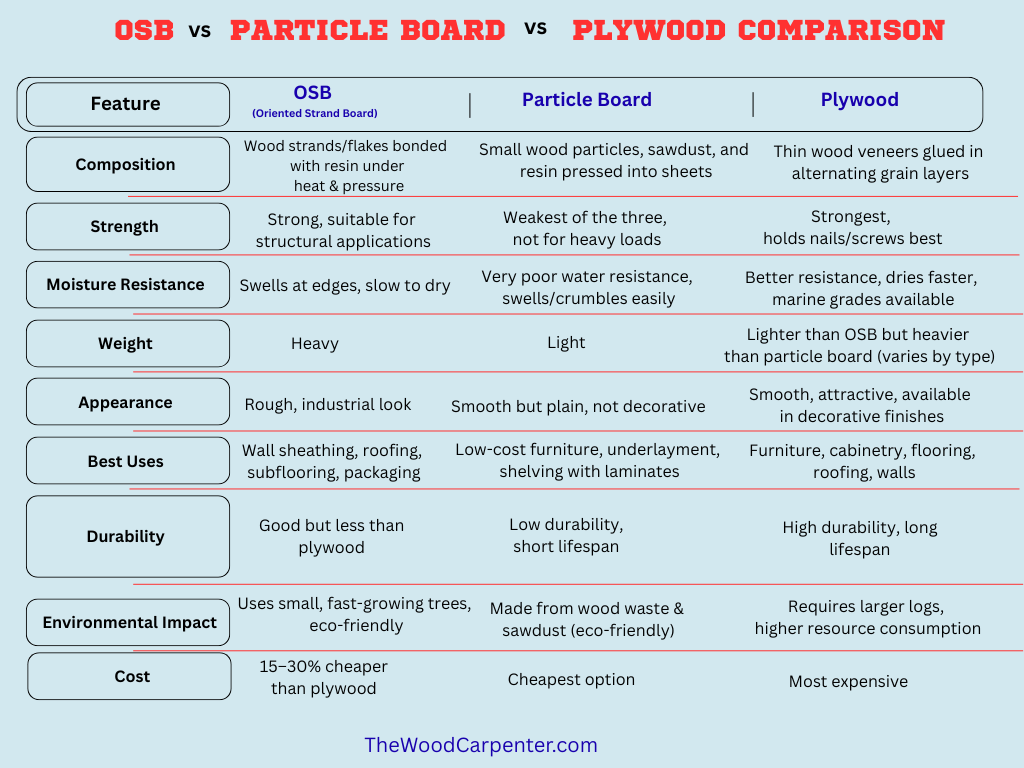
Frequently Asked Questions
1. Is OSB stronger than plywood?
OSB has higher shear strength, making it excellent for structural applications like wall sheathing. However, plywood is generally stiffer, holds fasteners better, and performs more reliably under repeated load.
2. Can OSB be used outdoors?
Yes, but only with sealed edges and protection from prolonged moisture. For outdoor use, exterior-grade or marine plywood is the more durable and reliable option.
3. Which is cheaper: OSB or plywood?
OSB is typically 15–30% less expensive than plywood of the same thickness, making it the better choice when budget is the primary concern.
4. Does OSB or plywood last longer?
Plywood generally lasts longer, especially in humid or wet environments, because it resists swelling and dries faster when it does get wet.
5. Which is better for furniture?
Plywood — always. It has a smoother surface, cleaner edges, better screw-holding ability, and a much more presentable appearance.
6. What is the weight difference between OSB and plywood?
OSB is slightly heavier than plywood at comparable thicknesses. A standard 7/16″ OSB panel weighs roughly 47–50 lbs, while a similar plywood sheet runs closer to 40–45 lbs. Over a large project, that weight adds up during handling and installation.
Final Verdict
There’s no single right answer in the OSB vs plywood debate — but the decision is simpler than most people think once you know what each material is actually good at.
Choose OSB if you’re doing structural work on a budget, working on wall sheathing, roof decking, or subfloors in a dry environment, and you can keep the edges sealed and protected.
Choose plywood if appearance matters, if the material will be exposed to moisture, if you need a surface that holds fasteners under long-term stress, or if you’re building furniture or cabinetry.
I’ve used both materials throughout my career, and I keep both on hand in my shop. OSB saves money where savings make sense. Plywood earns its price where quality actually shows. Know which category your project falls into, and you’ll always make the right call.