
Last Updated on July 7, 2026 by Sam Wood Worker
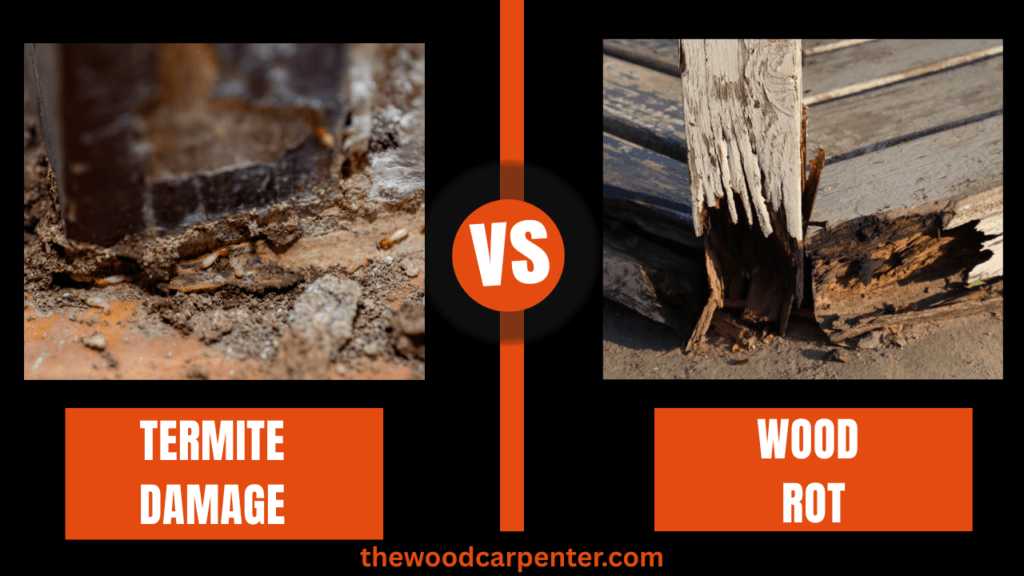
Quick Answer: Termites are sneakier. They eat wood from the inside without showing any signs outside. Wood rot is easier to spot early. But both can badly damage your home if you ignore them. This article will help you tell them apart and know what to do next.
COMPARISON TABLE
| Feature | Termite Damage | Wood Rot |
|---|---|---|
| Visual Appearance | Looks normal outside but hollow inside. You may see maze-like tunnels or mud tubes | Wood looks dark, soft, or crumbly. You may see fungus or warped boards |
| Texture | Hollow when you tap it. Feels like a thin shell with nothing inside | Feels soft and spongy (wet rot) or dry and crumbly like old bread (dry rot) |
| Odour | Mild musty smell, like old damp clothes | Strong musty smell, like a wet basement or old mushrooms |
| Typical Locations | Floor joists, wall studs, door frames, baseboards, anywhere near soil or moisture | Window sills, door frames, decks, roof edges, crawl spaces |
| Spread Speed | Slow at first, then very fast once the colony grows big | Dry rot spreads fast. Wet rot stays in one area near the water source |
| Cause | Termite colonies eating the cellulose inside wood | Fungus that grows on wood when it stays wet for too long |
| Treatment / Repair | Call a pest control professional. Then replace the damaged wood | Fix the water leak first. Then repair or replace the rotted wood |
Why I Wrote This Article
I have been working with wood for a long time. I have seen both problems up close. And I can tell you — most homeowners only find out about these problems when it is already expensive to fix.
One of my neighbours spent close to $18,000 fixing termite damage in his floor joists. From the outside, the floor just felt a little soft. He thought it was just an old house. It was not. A termite colony had been living under his crawl space for three years.
I had my own problem with wood rot. I was working on my deck one weekend. I pulled off a board and it basically fell apart in my hands. The outside looked fine. The inside was black and soft and completely useless. One clogged gutter had been dripping water onto that board for two whole rainy seasons.
So yes — both of these problems are real. And both of them can hurt your wallet badly.
What Is Termite Damage?
Termites are small insects. They live underground in large groups called colonies. They travel up into your home through the soil or through small mud tubes they build on your foundation walls.
They eat wood from the inside. They do not eat randomly. They eat along the grain of the wood, making long hollow tunnels inside. The outside of the wood still looks normal. That is what makes termites so dangerous. You cannot see the damage until it is already very bad.
There are different types of termites that can invade your home. Drywood termites live inside the wood itself without needing soil contact at all. Subterranean termites travel up from underground. Both are destructive in their own ways.
One thing that helps with early detection is knowing exactly what termite droppings look like. They are tiny, six-sided pellets that often collect below infested wood. Finding them is one of the earliest signs you have a problem.
A mature colony of around 60,000 termites can eat through one foot of a pine 2×4 board in about six months. And those termites work every single hour of every single day without stopping. Termites cause around $5 billion in damage every year in the United States alone. By the time most people notice something is wrong, the termite damage repair cost is already around $3,300 or more.
What Is Wood Rot?
Wood rot is not caused by insects. It is caused by fungus. When wood stays wet for a long time — with a moisture level above around 20% — fungus starts to grow on it and break it down.
This is why a good moisture meter for wood is one of the most useful tools you can own as a homeowner. If you can check moisture levels in suspicious areas regularly, you can catch rot problems very early. Much cheaper than finding out later.
There are two types of wood rot. It helps to know the difference.
Wet rot is the more common type. It needs a constant water source, like a leaking gutter, a dripping pipe, or poor drainage near your home. The wood turns dark and soft. It smells strongly of damp and mould. The good news is that wet rot usually stays in one area. Fix the water source and you can stop it.
Dry rot is more dangerous. It still needs moisture to get started, but once it begins it can actually spread on its own to other parts of the wood — even to drier areas. Dry rot makes wood shrink, crack into small cube-shaped pieces, and eventually turn to powder. If you see wood crumbling like that, dry rot is almost certainly the cause.
Keeping wood properly sealed and finished is one of the best defences against rot. Whether you are protecting exterior siding, a deck, or structural timber, knowing how to waterproof wood properly makes a big difference over the long term.

How to Tell the Difference: 5 Simple Tests
You do not need special tools for this. You just need your hands, a screwdriver, and your nose.
Test 1 — Knock on the Wood
Use your knuckle and knock firmly on the wood. Solid wood makes a dense sound. Termite-damaged wood makes a hollow sound — like knocking on a cardboard box. Rotted wood sounds dull but not hollow.
Test 2 — Poke It With a Screwdriver
Press the tip of a flathead screwdriver firmly into the wood. Termite-damaged wood suddenly gives way — the thin outside shell collapses and there is nothing behind it. Rotted wood gives way more slowly and feels soft or crumbly.
Test 3 — Look at the Pattern
Look closely at the surface. Termite damage shows tunnels running with the grain of the wood. These tunnels are often filled with dark mud and tiny pellets of frass. Wood rot shows discolouration — grey, brown, or black patches. There are no tunnels, just decay.
Test 4 — Look for Clues Nearby
Look around the area you are inspecting. If you find mud tubes on concrete or masonry, that is a definite sign of termites. If you find tiny translucent wings scattered near a windowsill, termites have been swarming nearby. If you see white or orange fuzzy growth on the wood, that is fungal mycelium — a sign of dry rot.
It is also worth knowing the difference between termites and other wood-destroying insects. Carpenter ants also chew through wood and leave behind similar looking damage. The key difference is that carpenter ants do not eat the wood — they only hollow it out to nest. You can read more in this comparison of carpenter ants vs termites to understand which one you are dealing with. And if you see small black ants rather than the larger reddish-brown carpenter ants, this guide on black ants vs carpenter ants will help you identify them correctly.
Test 5 — Smell the Area
Get close and smell. Termite damage has only a mild earthy smell. Wood rot has a sharp, strong, musty smell — especially in closed spaces like crawl spaces or behind walls. If you open a crawl space and the smell hits you right away, you almost certainly have a moisture and rot problem.
Which One Spreads Faster?
This is what most people really want to know.
Termites start slowly. A new colony takes time to grow. In the first year or two, a small colony may not cause much damage you would notice. But once the colony matures, the feeding never stops. And because all of this happens inside the wood with nothing visible outside, you can have years of serious damage before you ever see a single sign.
Dry rot can spread faster than most people expect. Unlike wet rot, which stays near its water source, dry rot fungus sends out threads through walls, across gaps, and into wood in other areas. It does not need to stay close to moisture once it is established.
My honest answer: termites are the sneakier destroyer. You will not notice them until real damage is done. Dry rot moves faster through a structure once it gets going, but you usually see signs of rot earlier than you see signs of termites.
Either one left alone for five or more years can mean replacing entire sections of your home’s structure.
Other Insects That Can Cause Similar Damage
While you are inspecting, it is worth knowing about a few other wood-destroying pests that can look similar to both termite damage and wood rot.
Powderpost beetles leave tiny round exit holes in wood and a fine flour-like powder underneath. The wood looks solid from outside but is riddled with tunnels inside — similar to termite damage. Wood-boring beetles cause similar damage and are often found in older homes with hardwood floors and beams. And if you notice small round holes in hardwood furniture or flooring, it is worth reading about wood-destroying pests more broadly before assuming termites.
Real Examples From My Own Experience
Example 1 — The Soft Floor That Nobody Questioned
A homeowner asked me to look at some flooring work. One section near an exterior wall had a soft spot. He assumed it was just an old joist that had shifted a little. I went into the crawl space and found termite mud tubes running up the foundation wall and into the floor joists. Three joists had been hollowed out almost completely. The floor felt slightly soft because there was literally nothing solid underneath it anymore. No smell. No visible damage from above. Nothing at all to see until you were underneath the house.
Example 2 — The Deck Board That Fell Apart
My own back deck looked perfectly fine from the top. Clean boards, no obvious problems. But the ledger board — the piece that connects the deck to the house — had been sitting behind a gap in the flashing for years. Every time it rained, water ran behind it and soaked into the wood. When I finally checked it, the whole board had wet rot from one end to the other. Choosing the right wood species for outdoor use matters a lot here. Some woods are much more rot-resistant than others. If I had used one of the best woods for decks from the start, the outcome may have been very different.
Example 3 — When Both Problems Show Up Together
This is more common than people think. Damp and rotting wood is exactly what termites love. I have seen homes where a moisture problem in the crawl space had been going on for years — the rot had already weakened the wood — and then termites found it and moved in. By the time the homeowner noticed the sagging floor, both problems were present. The repair cost was double what it would have been if only one problem existed.
How to Fix Each Problem
Fixing Termite Damage
Step one is always getting rid of the termites. A pest control professional will inspect the home and recommend the right approach. Before you call anyone, it helps to understand how much termite treatment costs and what a termite inspection involves so you are not caught off guard by the bill. You must eliminate the termites before you repair anything. If you repair the wood first and leave the termites, they will just eat the new wood too.
After the termites are gone, a contractor will assess the structural damage. Minor damage can sometimes be repaired by adding new lumber alongside the damaged piece. More serious damage means full replacement. If load-bearing beams are affected, a structural assessment is important before any repair work starts.
Fixing Wood Rot
Step one here is always fixing the water source. Find the leak, fix the flashing, clear the gutters, improve the ventilation — whatever is causing the moisture problem. If you replace rotted wood without fixing the water source, the new wood will rot too.
For small areas of rot, a wood hardener soaked into the damaged area can stabilise what remains. Then an epoxy wood filler restores the shape, and primer and paint seal it. For larger or structural damage, full replacement is the only real fix. Dry rot repair can cost anywhere from $500 to $3,000 depending on how far it has spread.
Once repairs are done, protecting the new wood immediately is critical. A good outdoor wood stain creates a proper moisture barrier on exterior surfaces. And if you are repairing deck boards or any structure that gets direct weather exposure, knowing how to paint a deck properly will help the repair last much longer.
How to Prevent Both Problems
To prevent termites:
- Keep wood away from direct soil contact wherever possible
- Fix all moisture problems in and around your home right away
- Grade the soil so water flows away from your foundation
- Keep firewood stored away from the house
- Get a professional termite inspection once a year if you live in a high-risk area
- Consider a termite bond — a yearly monitoring agreement with a pest control company
To prevent wood rot:
- Keep all exterior wood painted or sealed — paint is a moisture barrier, not just decoration
- Fix roof leaks, pipe drips, and HVAC condensation issues promptly
- Keep gutters clear so water does not overflow onto wood
- Use pressure-treated lumber for any wood near the ground or in wet areas — it is treated to resist both rot and insect damage
- Add a vapour barrier and proper ventilation to your crawl space
- When building anything outdoors, choose naturally rot-resistant species. Woods like cedar, teak, and ipe hold up far better in wet conditions than pine or poplar
FAQ
Can termite damage and wood rot happen in the same place at the same time?
Yes. Rotting wood is wet and soft — exactly what termites like. If you find rot in a crawl space or near a foundation, get a termite inspection at the same time. Having both problems together makes repairs much more complicated and expensive.
Does home insurance cover termite damage or wood rot?
Usually no. Most policies do not cover termite damage because it is considered a preventable pest problem. Rot from a sudden pipe burst may be covered, but rot from long-term moisture usually is not. Always read your own policy carefully.
Can I fix termite-damaged structural wood myself?
For very minor surface damage, maybe. For floor joists, wall studs, or beams — no. These are structural members. Get a professional assessment before you touch them. For small surface repairs, an epoxy wood filler can help restore shape once the pest problem is resolved.
How do I know if I have dry rot or wet rot?
Wet rot is dark, soft, and stays near the water source. Dry rot is lighter in colour, crumbles into small cube-like pieces, and may have fuzzy white or grey threads spreading outward. Dry rot is the more serious of the two.
What does termite damage smell like?
A faint musty or earthy smell. Most people do not notice the smell first — they notice the structural signs first. The smell is mild compared to wood rot.
Which is more expensive to repair — termite damage or wood rot?
It depends on how long the problem was ignored. Termite damage caught early is manageable. Termite damage discovered after several years of hidden feeding can cost $15,000 or more. You can get a clearer picture by reading this full breakdown of termite damage repair costs.
Are there other insects I should watch for besides termites?
Yes. Carpenter ants, powderpost beetles, and wood-boring beetles all cause structural wood damage. Knowing which pest you have changes the treatment completely.