
Last Updated on June 23, 2026 by Sam Wood Worker
Quick Answer
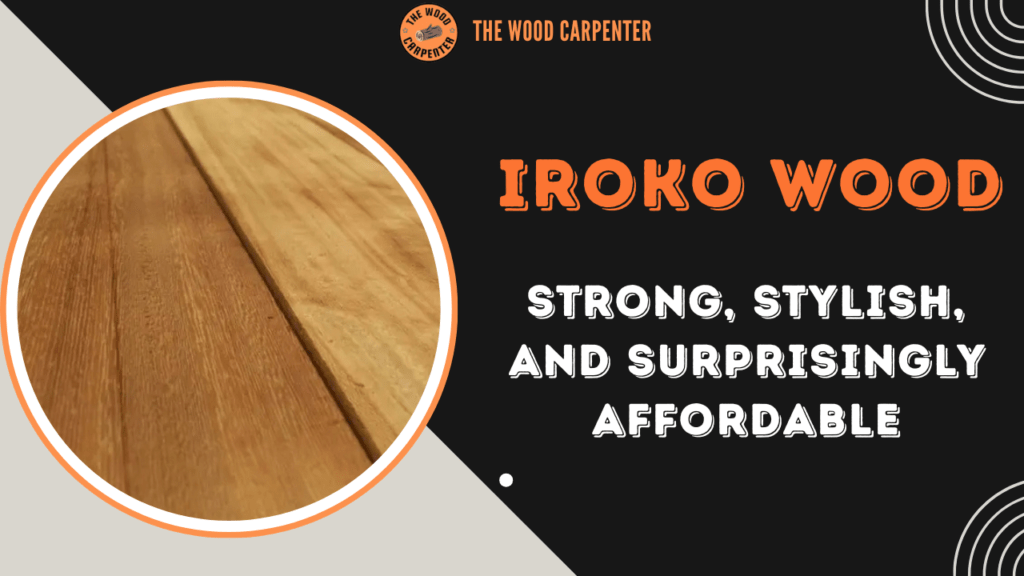
Iroko is a tough African hardwood with a golden-brown color that gets darker and richer over time. It resists rot, insects, and moisture without needing any chemical treatment. People call it “African teak” because it performs so similarly to real teak — but costs a lot less. The catch: it can irritate your skin and lungs when you cut it, and the interlocked grain means tearout is a real risk.
Key Takeaways
- Iroko has a Janka hardness of 1,260 lbf — harder than oak and maple
- It is naturally rot resistant, insect resistant, and highly weather durable
- Often used as a cheaper alternative to teak for decking and outdoor furniture
- The grain is interlocked, which can cause tearout when planing
- It contains calcium carbonate deposits that dull blades faster than most hardwoods
- Can cause skin, eye, and respiratory irritation — always wear a dust mask
- Listed as vulnerable on the IUCN Red List, so always buy from a sustainable source
What Is Iroko Wood?
I first came across iroko at a timber yard when I was looking for something to use on a small outdoor deck. The supplier laid out two boards side by side — one teak, one iroko — and asked me to tell them apart.
I could not. Not right away.
The color was nearly the same. The texture looked the same. Even the weight felt similar. Then he told me the price difference.
That was the moment I started paying serious attention to iroko.
Iroko is a hardwood tree native to the west coast of tropical Africa. These large trees typically grow between 30 and 40 meters tall and can live for up to 500 years.
Iroko wood can be categorised into two species — Milicia excelsa and M. regia. While Milicia excelsa can be found in most regions of tropical Africa, M. regia is limited to the West African regions of Gambia and Ghana.
In some parts of the world, people call it African teak. In others, they call it loko, logo, or odum. Whatever name you use, it is the same wood — dense, golden, and built to last.
What Does Iroko Wood Look Like?
Iroko has a warm, golden-yellow color when it is freshly cut. Over time, it deepens into a medium to dark brown. That aging process is actually beautiful — the color gets richer and warmer with every passing year.
The heartwood is generally yellow to medium brown and becomes darker with age. The freshly sawn iroko has a golden-yellow hue. The sapwood is pale yellow. The wood has an even, medium to coarse texture and an interlocked grain.
The grain pattern is one of iroko’s most interesting features. Like many tropical hardwoods, iroko has large, open pores that contribute to an interesting, characterful grain pattern. On a wide board, especially a flat-sawn piece, you can see light stripes running through the heartwood that catch the light in an appealing way.
It is not as dramatically figured as some exotic woods. But it has a clean, confident look that suits both modern and traditional styles.
Iroko Wood Properties at a Glance
| Property | Detail |
| Weight | 41 lbs/ft³ (660 kg/m³) |
| Janka Hardness | 1,260 lbf — very hard |
| Color | Golden yellow, darkens to warm brown |
| Grain | Interlocked, medium to coarse |
| Rot Resistance | Very high — rated Class 1-2 |
| Insect Resistance | Durable — resists termites and borers |
| Water Resistance | High — naturally oily |
| Stability | Good — low shrinkage and warping |
| Workability | Moderate — tearout risk with interlocked grain |
| Tool Blunting | Yes — calcium carbonate dulls blades |
| Allergen Risk | Yes — dust and fresh cuts can irritate skin and lungs |
My Personal Observations
I used iroko for the decking project and also had it in my workshop for a few weeks while I was cutting, planing, and sanding boards.
Here is what I noticed:
The weight surprised me. It is heavier than it looks. Picking up a long iroko board by yourself — especially in hot weather — reminds you quickly that this is a dense, serious piece of timber. Iroko is a dense and strong hardwood with a Janka hardness of 1,260 lbf and a density of approximately 660 kg/m³, making it highly resistant to damage from impact, scratches, and wear.
The color improved over time. The boards I used started out a pale yellow-gold. About six months after installation, they had shifted to a deeper, warmer brown. It looks better now than it did the day I put it down.
The interlocked grain caught me off guard. I made the mistake of planing against the grain on one board without thinking. The tearout was bad. I had to go back with a card scraper and fix it carefully. After that I always checked grain direction first. Sharp tools and slow, careful passes made a big difference.
The dust caused irritation. This was the part that bothered me most. I wore a regular dust mask the first day. By the afternoon, my forearms had a mild rash and my nose was running. I switched to a proper respirator and gloves for the rest of the job. Iroko wood has been reported as a sensitizer, and woodworkers may experience common eye and skin irritation when working with it. This is a real issue. Do not skip the mask.
The finished deck held up beautifully. No rot, no movement, no problems even through wet winters. I did oil it once a season. That was all it needed.
Is Iroko the Same as Teak?
No, but people confuse them all the time — including me when I first saw the two boards side by side.
Both are African hardwoods with a medium golden-brownish hue that becomes darker with age. Both woods are durable, but teak is much more durable and dense than iroko and many other options. Both teak and iroko are naturally resistant to decay and insect attack and require no treatment prior to use.
The big practical difference is price. Teak is expensive and increasingly hard to source responsibly. Iroko is significantly cheaper and more commercially available. This is why builders and woodworkers have used it as a teak substitute for generations.
If you are comparing woods for outdoor projects, you might also want to look at our guide on teak wood to see exactly how the two compare side by side.
Iroko is slightly less water-resistant than teak, so it may require additional sealant or treatment for extended exposure to moisture. But for most outdoor uses — decking, garden furniture, cladding — the difference is small enough that iroko is a perfectly sensible choice.
Iroko vs. Teak: How Do They Compare?
Teak may have long been considered the benchmark of outdoor hardwoods, but Iroko holds its own in many respects:
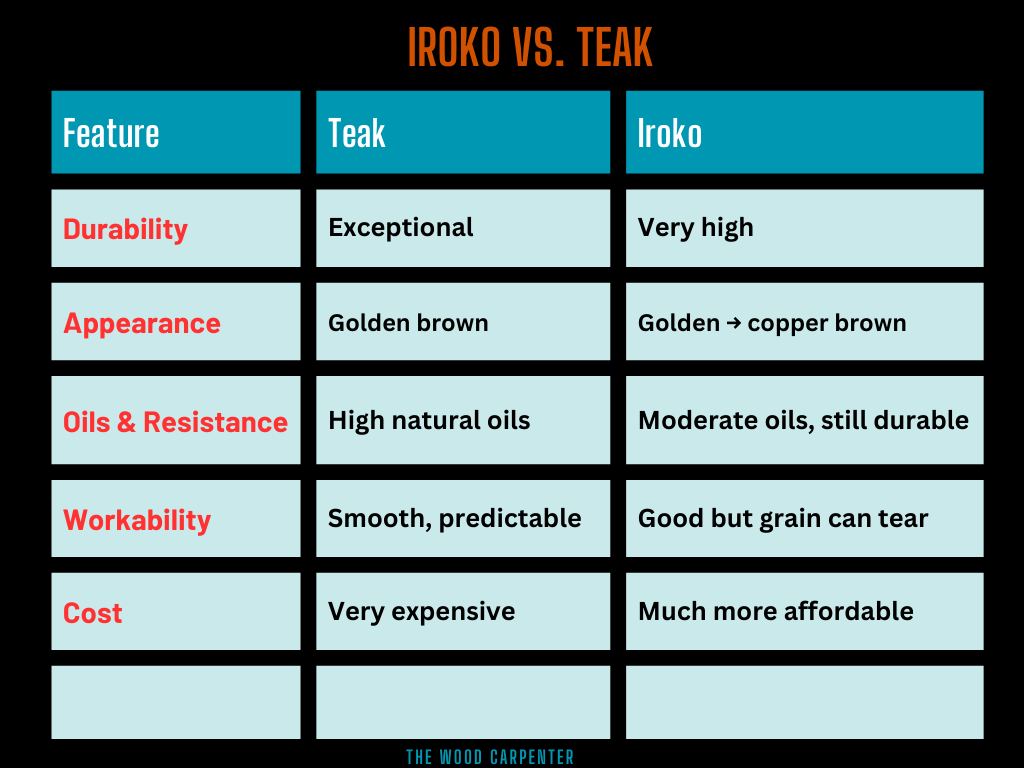
In short, if teak is out of your budget, iroko is a smart, reliable substitute.
What Is Iroko Wood Used For?
Outdoor Decking
This is where iroko really earns its reputation. Iroko wood is primarily used for outdoor decking because it is naturally resistant to decay and moisture and does not require any preservative treatment. Iroko decks can last about 50 years or more with low maintenance.
That kind of longevity is remarkable. If you are building a deck and want it to last decades without constant maintenance, iroko is one of the best choices at this price point. For more on choosing the right wood for decking, see our breakdown of the 7 best woods for decks on every budget.
Furniture
Iroko has a beautiful golden-brown color and straight grain pattern that lend it an aesthetic appeal. The natural oils in iroko protect it from insects and fungus stains. It moderates heat, ensuring comfort during both hot summers and cold winters.
For outdoor garden furniture especially, iroko is an excellent material. It handles rain and sun without warping or cracking, and it looks beautiful without needing constant treatment.
Kitchen Countertops
This is one use I did not expect. Iroko contains natural silica and oils within the wood structure itself, providing a baseline level of moisture resistance before any finish is applied. In practice, this means iroko is more forgiving of finish degradation around wet zones — the finish can wear thin before moisture damage begins to accumulate.
That self-protecting quality makes it ideal for kitchen surfaces. Iroko has been used in pub and bar countertops, restaurant pass surfaces, and commercial kitchen prep areas for generations.
Flooring
Durable and stable iroko is a popular choice for hardwood floors. It not only gives your home a natural look but also withstands everyday wear and tear. Due to its high hardness, it is less prone to scratches and dents than other woods.
It is a strong competitor against some of the hardwoods listed in our guide to furniture wood types — and holds its own well in flooring applications. You might also compare it directly to some of the best woods for furniture before making a decision.
Boatbuilding
Iroko wood is generally known as one of the best boatbuilding materials. It is a dense, hard, and strong wood containing natural chemicals that prevent rotting.
The combination of natural oil content, water resistance, and hardness makes it well-suited to marine use. It is not as legendary as teak in boat-building circles, but it performs very well and at a lower cost.
Cabinets and Interior Joinery
Iroko works beautifully as a cabinet wood too. Its wide boards and stable behavior after drying make it millwork-friendly. The warm golden color brings life to interior spaces in a way that lighter domestic hardwoods sometimes cannot. If you are thinking about what wood to use for kitchen cabinets, check our detailed guide on the best wood for kitchen cabinets.
Practical Scenario: Building a Garden Bench

Let’s say you want to build a solid outdoor bench that will sit in the garden year-round. You want something that looks good, lasts a long time, and does not need to be brought inside every winter.
Iroko is one of the best choices for this project. Here is why:
- The natural rot resistance means it does not need chemical preservatives
- The hardness means it holds screws and joints firmly without splitting
- The color deepens naturally to a rich brown over time — beautiful with zero effort
- One oiling per season keeps it looking sharp without a major time commitment
The one thing to watch: if you want to maintain the golden color, apply a UV-protective oil finish. If you appreciate its golden hue, make sure it stays rich with UV-protective oil or finish to preserve its richness. Otherwise, exposure to sunlight can eventually turn it silver-grey over time.
If you let it go silver-grey naturally, that is fine too. Some people prefer that weathered look.
Practical Scenario: Choosing Between Iroko and Oak for Flooring

You are laying new hardwood floors in a living room that gets heavy foot traffic and has a dog running around in it every day.
Oak at around 1,290 lbf on the Janka scale is a popular choice for exactly this reason. Iroko at 1,260 lbf is in the same class — slightly softer than oak, but close enough that in real-world use the difference is not meaningful. Both will handle a dog’s claws and regular foot traffic without problems.
The color story is the real deciding factor. Oak tends to stay lighter or warm amber depending on the finish. Iroko starts golden and deepens to a rich dark brown over time. If you want a floor that gets better looking as it ages without staining it, iroko is actually the more interesting choice.
For a detailed look at oak, we covered red oak wood properties and uses and white oak flooring costs and pros if you want to make a direct comparison.
The Things That Catch People Off Guard
Tearout on the Grain
This is the most common frustration beginners have with iroko.
Iroko’s interlocked grain — where the grain direction alternates between adjacent growth layers — makes it harder to machine cleanly than straight-grained species. Tearout during milling, planing, or routing is more likely, particularly on end-grain cuts and complex edge profiles.
The fix is simple: always work in the correct direction relative to the grain, keep tools razor sharp, and take light passes rather than heavy cuts. Once you get used to checking the grain direction before every pass, it becomes second nature.
Blade Dulling
Iroko does have a tendency to blunt tools because of the presence of hard calcium carbonate.
This is not as severe as working with silica-heavy tropical hardwoods like ipe, but it is noticeable. Carbide-tipped blades last longer than standard steel. Sharpen often, and check the blade edge frequently during long cuts.
Allergic Reaction Risk
This deserves its own paragraph because it catches a lot of people by surprise the first time.
Iroko dust and freshly cut surfaces can cause skin and respiratory irritation in some people. This is a well-documented characteristic of the species. Iroko should be worked with a dust mask and good ventilation.
Wear a proper dust mask — not a paper one. Wear long sleeves and gloves if your skin tends to react to things. Have good airflow in your workshop. This is not a reason to avoid iroko, but it is a reason to be prepared.
Sustainability Concerns
Due to the continuous harvesting of M. regia, its population has decreased by about 20% in the last three generations. The Iroko species is listed on the IUCN Red List.
Always buy iroko from a supplier who can confirm it comes from a sustainably managed forest. Look for FSC certification where possible. The wood is worth using — just make sure it is sourced responsibly.
How to Finish Iroko Wood
Iroko is an oily wood, which is part of why it performs so well outdoors. But that natural oil also means you need to prepare the surface carefully before applying any finish.
Because iroko is naturally oily, finishing often starts with wiping the surface using methylated spirits or similar cleaners to remove surface oils and improve adhesion of oils, varnishes, or film-forming coatings.
For outdoor use: A UV-protective exterior oil works well. Apply it once or twice a year to maintain the golden color. If you skip it, the wood will silver-grey gracefully — but the color change is permanent unless you sand it back and re-oil.
For interior use: You have more options. A hard wax oil gives a natural, low-sheen finish that enhances the grain beautifully. Polyurethane gives a tougher, glossier result. Both work well as long as you wipe the surface clean of oils before application. For help choosing between finishing options, our oil-based stain vs water-based stain guide and tung oil vs Danish oil comparison are good starting points.
For sanding: Use good orbital sanding technique and work through the grits progressively. Our guide on wet or dry sanding explains when each approach makes sense for dense hardwoods like this.
Iroko vs. Other Woods
| Wood | Janka Hardness | Best For | Outdoor Durability |
| Iroko | 1,260 lbf | Decking, furniture, flooring, boats | Excellent |
| Teak | ~1,070 lbf | Same uses, premium price | Outstanding |
| White Oak | ~1,360 lbf | Flooring, furniture, barrels | Good |
| Sapele | ~1,410 lbf | Furniture, veneers, cabinets | Good |
| Mahogany | ~800 lbf | Indoor furniture, cabinets | Moderate |
| Pine | ~870 lbf | Construction, budget furniture | Poor untreated |
Iroko sits in a strong position — harder than teak in Janka terms, naturally weather resistant, and priced below both teak and many other exotic hardwoods.
If you are comparing it to African relatives, our sapele wood overview is worth reading. For different types of mahogany, we also have a complete guide to mahogany species.
FAQ
What is iroko wood?
Iroko is a tropical hardwood from West and Central Africa. It is dense, durable, and naturally resistant to rot and insects. It is often called African teak because of how similar it looks and performs.
Is iroko wood good for outdoor use?
Yes, very good. It naturally resists rot, insects, and moisture without needing chemical treatment. It works well for decking, garden furniture, cladding, and boatbuilding.
Is iroko the same as teak?
No, but they are very similar in appearance and properties. Teak is slightly denser and more water-resistant. Iroko is cheaper and more commercially available. For most outdoor projects, iroko is an excellent substitute.
How hard is iroko wood?
It has a Janka hardness of 1,260 lbf, which is harder than red oak (1,290 lbf is close), ash, and mahogany. It is a genuinely hard wood that resists dents and scratches well.
Does iroko wood darken over time?
Yes. It starts as a golden yellow and gradually deepens to a warm medium or dark brown. Many people find the aged color more attractive than the fresh-cut look.
Is iroko wood easy to work with?
Mostly yes, but the interlocked grain creates tearout risk when planing. Always check grain direction and keep tools sharp. The calcium carbonate in the wood dulls blades faster than softer hardwoods.
Is iroko wood toxic?
It is not toxic, but it is a documented sensitizer. The dust and freshly cut surfaces can cause skin, eye, and respiratory irritation in some people. Always work with a proper dust mask and good ventilation.
Is iroko wood sustainable?
It is listed as vulnerable on the IUCN Red List due to overharvesting in some regions. Always buy from suppliers who can confirm FSC certification or sustainable forest management.
How do I finish iroko wood?
Wipe the surface with methylated spirits first to remove natural oils, then apply your chosen finish. For outdoors, a UV-protective exterior oil applied once or twice a year works best.
Final Recommendation
Iroko is one of those woods that earns your respect the more you work with it. It is tough, attractive, long-lasting, and versatile across a huge range of projects.
For outdoor decking, garden furniture, countertops, and flooring — iroko is hard to beat at its price point. The combination of natural durability, beautiful aging color, and genuine hardness makes it a practical and rewarding choice.
Just go in knowing the three things that catch people off guard: protect yourself from the dust with a proper mask, take care with the interlocked grain to avoid tearout, and keep your blades sharp and freshened up regularly.
Buy it from a responsible source, finish it properly, and iroko will reward you with decades of solid, beautiful performance.
The supplier at the timber yard was right. It really is like teak — just more honest about its price.